Friday, January 7, 2011

Variety Friday: A Tale of 3 Fukubukuro


Those who have been reading this blog for awhile may recall that "fukubukuro" are bags full of surprise items (in most cases) that are sold in Japan around the New Year. The total value of the items in the bag are supposed to be exceed what you paid for them. The translation of "fukubukuro" is "lucky bag" or "happy bag". In past years, I've purchased these from Mr. Donut and Starbucks.

This year, we weren't sure where we were going to get our fukubukuro, but we decided to investigate some places further afield on January 1 in order to find something new. Unfortunately, we found that it was a dry run through Shinjuku for the most part. Electronics shops (Bic Camera and Yodobashi) were open and loudly selling fukubukuro, but they didn't offer much of appeal. Most of theirs were accessories for digital cameras, video cameras, iPods, and iPads. The contents were surprises but fit a theme.


It turned out that January 3rd was the best day for finding fukubukuro as shops had opened that had been closed, and our local options were pretty good. In fact, they were so good that we ended up with three of them. The first was from Baskin Robbins ice cream. The two young women pictured above were trekking up and down the local shopping street carrying a basket full of them. Each was 1000 yen ($12.20) and quite small. The girls were almost peculiarly delighted when we bought one. I wonder if they were sent out into the cold and told to sell the whole basket or die trying.


We didn't expect actual ice cream, but we did expect coupons to purchase ice cream.As you can see from the picture above (click any picture to see a bigger version), we got a couple of 500-yen coupons so we get back the entire value of the "lucky bag" in ice cream. We also got a snoopy mug, a couple of ice cream magnets, and an ice cream cone cell phone strap. The other items are a list of shops and brochures for Baskin Robbins products. All in all, this is a decent investment in a Fukubukuro provided that you were going to buy some ice cream anyway. The little bag is cloth and can be reused as a tote.


The second bag that we bought was from a supermarket called Peacock. It's part of a chain of shops, but it's not especially common. This one cost 2000 yen ($24.40). If you bought all of these items separately in the shop, undoubtedly they would cost more than 2000 yen.

The items it contained (from left) are: reduced salt soy sauce, roasted seaweed, shrimp snacks, squid- and sweet-sake-flavored rice crackers, Chinese soup mix, green tea, hot pepper and garlic paste (for cooking), tea bags, drip coffee with paper filter system, ground coffee, animal crackers, seaweed rice crackers, and chocolate cookies.

Mainly, the shrimp and squid snacks, and roasted seaweed are not very good for either of us since we're not fans of seafood flavors. The coffee, tea, and cookies are all of use, and I expect we can use the garlic/hot pepper paste, soy sauce, and Chinese soup mixes (though we've never tried them before). I'm going to be giving away the extra items to someone who I know likes them.


The final bag from the snack shop was probably the smallest gamble as it was from Okashi no Machioka snack shop. Even stuff which I might not normally buy would be blogging fodder from this bag. However, a lot of this is stuff I wouldn't buy of my own volition. I guess that either makes it good or bad as it'll push me to try new snacks, or make me sample food I wouldn't really want to eat. All I know is that it's going to take a very, very long time to eat all of this. I'm actually grateful that many of these are very small packages of a half ounce (14 grams, or less). This one also cost 1000 yen ($12.20) and also probably represented the smallest overall value. Certainly all of these items would cost more than 1000 yen if purchased separately, but not that much more. A lot of the items in the front are kid's snacks which would cost between 20-40 yen each.

The contents are (from left):
back "row": Mayonnaise and cheese Pringles, Toppo pretzels filled with chestnut cream, maple pie cookies, Shrimp rice crackers, Toy Story 3 chocolate-covered crunchy snacks
2nd "row": Heart chocolate-covered peanuts, "cheese fondue" Cratz pretzels with almonds, Milky petit (salty milk?) candies
3rd "row": vacuum-packed chestnuts, "fried potato" snack (more like a weird chip), fluffy brown sugar "stick" called "fu-bo-san taro", Chip Chop crispy chocolate snacks with chocolate filling
front "row": cabbage Taro salted snacks, "Big Katsu" fried snack, "new mochi" Taro snack, and "corn Taro".

I've already reviewed some of these things, but most are new to me.

I reviewed the Big Katsu here:
http://japanesesnackreviews.blogspot.com/2010/09/suguru-big-katsu.html

I reviewed the corn taro (as part of a big pack) here:
http://japanesesnackreviews.blogspot.com/2009/12/variety-friday-japanese-christmas-packs.html

And I talked about the cabbage taro and fu-bo san taro here (as part of another big pack):
http://myso-calledjapaneselife.blogspot.com/2007/12/christmas-pack-2.html

In terms of "value", the supermarket bag easily represents the best value overall, but it is still a gamble. For snackers, I'd definitely say grab the Okashi no Machioka bag next year if you can. There's enough in it to make the value worthwhile and unless you've very picky, you'll get your money's worth out of the bag.

Thursday, January 6, 2011

Hagoromo (canned) Yakitori


A variety of food review bloggers, including the Onion's AV Club, have reviewed canned hamburgers. The point that this has in common with I'm about to review is that both yakitori and hamburgers are foods that should never be sold in a canned version. If you've had the real thing, you know that it can be a tasty and almost sublime experience that can only be realized in a freshly prepared presentation.

I found this abomination at Lawson 100 and bought it on impulse because I'd never seen canned yakitori on sale anywhere else. Hagoromo is more familiar to me as a maker of crappy canned tuna rather than crappy canned chicken.


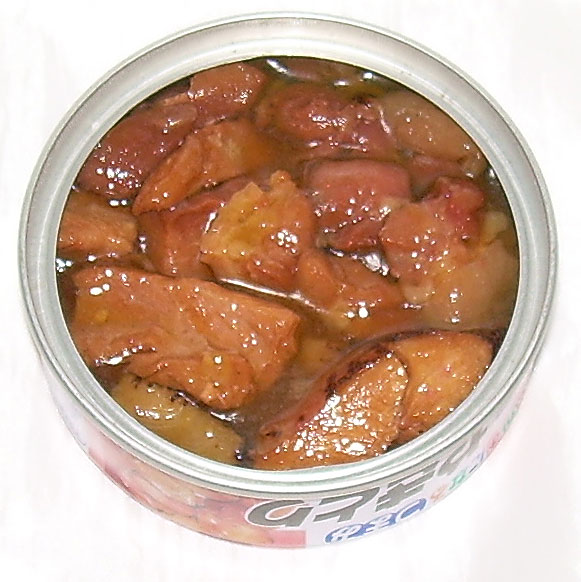
 There are plenty of little bits of chicken skin, and precious little actual chicken. The can is 55 grams and offers 139 calories, but the web side says that that includes everything (sauce, skin, chicken), not just the edible chicken parts. That makes sense because I couldn't imagine such a high calorie count for what little is there. In fact, I'd guess this would be the equivalent of one stick of actual yakitori if you were to get the real deal. I think this stuff is designed mainly as earthquake survival food. You can keep it in your emergency bag for up to 3 years, or you can serve it as a side dish to people that you don't like very much.


Before I popped the top, I expected that this would smell like that usual canned food smell. You know, a sort of eau de dog food? Yeah, it smelled like that and just a bit like chicken. Inside were some chicken tidbits suspended in some sort of gelatinous substance. I figured that it might be more palatable if I warmed it up and allowed the goo to liquefy.

Despite the unappealing look and smell, I wasn't too grossed out by the idea of eating this. I've had bad canned food before, after all. The texture of the chicken was horribly dry and stringy. It needs to be chewed quite a bit unless you prefer to swallow it whole. It has that canned food taste which I always guessed was due to pressure cooking mass amounts of the food as well as whatever preservatives are used. There is also a hint of a smoky, char-cooked flavor and, of course, low quality chicken. The sauce is slightly sweet and salty. It's not bad, but it's far from good.

This was bad, but not in a way that renders it awful. It's just overcooked, processed canned food that fails entirely to be more than one expects, even when one expects very little. If you need something for your earthquake survival kit, this wouldn't be the worst possible choice if you can't find anything else. Otherwise, give it a pass.

Wednesday, January 5, 2011

Random Picture 45


The Ryoma Sakamoto (a political revolutionary in the mid-1800's) theming of foods has not disappeared yet, despite having been around for most of the previous year. I saw this display of regional Japanese sweets and cookies at a local supermarket. One of the great benefits of using the image of someone long-dead with no family to claim rights to his image is that you can splatter his face anywhere and everywhere without offering a slice of the profit pie to anyone else.

I think that we're bound to see this fad finally run out of steam in 2011 as the documentary on Japanese T.V. that inspired it is certain to be fading in memory and I'm sure people feel less inspired to buy snacks by his stern-looking face than they once did.

Tuesday, January 4, 2011

Uchi Cafe Sweets Mochi Puyo


One of the great things about doing this blog while actually living in Japan (as opposed to buying imports) is that Japanese people will recommend or give things to you that you may  not bother to sample for yourself. I learned about this pastry secondhand via my husband, who was given one as part of a little "party" at the end of the year that his last student of 2010 "threw" for him. Of course, I don't know if you can call a small bottle of some champagne-like substance and a couple of mochi ball sweets a real party, but it was the thought that counted.

My husband is not the greatest fan of Japanese sweets, so when he tells me he has tried something like this and likes it enough to buy it again, there's a good chance it's going to be pretty darn dandy. The "Uchi Cafe" line of sweets can only be purchased at Lawson's. There are three types of Lawson's convenience stores in Japan: Lawson 100, Natrual Lawson's, and just plain old Lawson's. We found this for 150 yen at the last type and I don't know if you can get them at any of the others, but I doubt it.

Note that, though this is a Lawson's brand, it is made by Yamazaki Pan. I've done a few reviews of Yamazaki Pan sweets and had an indifferent response to those treats, but the truth is that they make some of the best pastries in Japan, particularly when you're looking at anything which is made with cream or custard. If you ever see a Yamazaki Pan package which contains two disks of chocolate cake with whipped cream between them, buy it and enjoy the goodness. It's one of my favorites, but it's also a calorie bomb that you can't indulge in often if you want to look good in your Speedos.


Each little pastry is about 6.5 cm/255 in. in diameter and 155 calories. The top ingredient is "milk flour paste, followed by shortening then eggs, and flour. Though "mochi" is pounded rice cake, rice is nowhere to be found in this. This isn't really mochi so much as a dough which bakes up with the chewy properties of mochi. I also find it odd that no sweetening agent is in the top ingredients yet these aren't low calorie and are sweet. I think the calories are coming from the heavy carbohydrate load and the sweetness from some sort of lactose configuration (but I can't know for certain).

When you open the package, the cakes smell like vanilla custard. For the cutaway picture, it was hard to cut through with a knife because it is as tough as real mochi. The outside is slightly chewy and the custard inside is slightly thin, smooth and creamy. The two textures make for an interesting contrast. The outer mochi-like cake doesn't have a strong flavor, but it does have a baked good sense and even tastes a little like rice. A Japanese person who reviewed this said they thought the outer shell was salty, but I didn't pick that up at all. The white custard has a nice rice eggy flavor along with solid sweetness levels.

I really liked this and would definitely buy it again. It's one of those all too rare treats which balances a very Japanese element (mochi) with a very European one (custard) that makes it unique and delicious. Unless you aren't a fan of chewy bread products, you will want to try this.

Monday, January 3, 2011

Meiji MeltyKiss Whips


Looking at the illustration on the front of the Meltykiss Whips box, I imagined a fluffy interior that would melt in my mouth like a Samba Kisses Better. Now, I realize that that is an obscure reference to many of my readers, and that is all the sadder for you. I'm not reviewing Samba Kisses Better because it is a product produced in Denmark, but it's dome of whipped egg whites, sugar, and chocolate on a super thin wafer base. It's light as air and melts in your mouth like the fluffiest marshmallow ever. If you can, go buy one now. I'll wait here for you to come back and thank me. Go on.

Getting back to the matter at hand, the Meltykiss Whips, I'm sorry to say that they do not live up to the image or to a Samba Kisses Better in terms of their texture. Though they are very light and smooth when melted on the tongue, the initial impression is almost one of chalkiness, but not in any sense which could be considered negative. It's chocolate that has been aerated while warm and then has solidified into extremely fine catacombs of chocolate that are so tiny that you can't detect.

The texture is decent but it's the taste that really stands out. The flavor has depth and complexity depending on how you eat it. The initial notes are bittersweet then it becomes milky and sweeter. It tastes a lot like a chocolate truffle, albeit a relatively low-rent one. Because they are covered in a fine dust of cocoa powder, I'm guessing that is part of where the bittersweet element comes from initially.


I bought these for 168 yen (about $2) at Okashi no Machioka discount snack shop, but they are currently available in convenience stores and supermarkets for a somewhat higher price. I may have miscounted because I ate a few before writing the review, but I believe there are thirteen tiny pieces in the box. Each is about the size of your thumbnail and super light. At 23 calories each, they are a delight without a big caloric impact.

I would definitely recommend trying these if you are a chocolate fan. Since I have never sampled the regular "Meltykiss" releases so I can't compare the "whips" to the normal version, but these are very good quality consumer chocolates. They'd make a great gift for someone who is squeamish about more Japanese sweets.