Monday, December 28, 2009

Milk Coffee KitKat


I think this particular KitKat has definitively signaled the fact that Nestle Japan is running out of ideas. You'd think the hundred or so variations on strawberry that have been released would have helped me reach such a determination quite awhile back, but, no, I have given them the benefit of the doubt (and maybe I'm just a little dumb). Back in April, I reviewed an Espresso Coffee KitKat which looked, smelled, and tasted suspiciously similar to this one. The important point to keep in mind is that this KitKat isn't about adding a novel flavor to the ever-increasing roster of flavors. No, it's about marketing.


This KitKat contains the "support students" mark (the pink flower which says "kitto sakura sakuyo") that appeared on the KitKat Mail. This KitKat is timed to coincide with students taking exams. There's a little message box on the back of the box which says "Dear (big blank space for name and message" and "From (smaller blank space for name)." I wonder if the flavor selection is also related to students with the idea that coffee is often drunk to keep one awake during long study sessions. The PR on Nestle Japan's site says this is good for breaks when you're working hard.


This KitKat was released on December 21 and you can pick it up at various convenience stores. My husband found this one at the venerable New Days for 120 yen ($1.31) and deposited it on my desk for review purposes.

I like milk in my coffee and I enjoyed the Espresso KitKat so I thought it looked pretty promising. The bar smells like white chocolate sweetness and there's no coffee scent. The interior has brown cream between the wafers, but I think coffee flavoring is in the coating as well. The flavor is very much like instant coffee with milk. There's a slight bitterness to it which takes the edge off of the white chocolate sweetness. The wafer flavor seemed more prominent in this as well, which I rather liked. It could be that this was just really fresh and you can detect the baked flavor of the wafers more when they're new off the manufacturing line.

This was good. I could see buying it again, but I'd caution people who are interested in it that they really have to like instant coffee and the level of bitterness of weak coffee in general. Since I'm a coffee sissy and can't take it black, the way in which the strong flavors were muted was appealing to me. All the being said, I liked the Espresso KitKat better because of the salty hit it had and this bar was on the edge of getting an "indifferent" rating and a "happy" one. I'd never turn this down if I got it for free and I enjoyed it, but it's not a slam dunk as a repeat purchase.

Friday, December 25, 2009

Variety Friday: Japanese Christmas Packs

A Christmas goods display at Queen's Isetan market. It includes Christmas boots full of snacks for kids, marshmallows, fondue kits, imported plastic canes full of candy kisses and cookies.

If you're a kid in Japan, you're not likely to be getting very worked up about Christmas. You're far more likely to get excited about the new year's holidays when you get a prolonged vacation from school and can look forward to gift money from all of the relatives. While kids generally get a little something for Christmas, it's nothing like the rain of gifts kids may get in the U.S. or other largely Christian countries.


I have asked students what they were given as children and they have mentioned the style of "stocking" or boot that you see above which is sold for 1050 yen ($11.78). These boots are full of regular snacks like Baby Star Ramen, (plain) popped popcorn, and "bo" (stick) snacks. Yaokin sticks are particularly common.


There are also some big bags of powdered drink mixes and cookies which are offered with Christmas-themed wrapping, but they're also nothing special. The cookies pictured above with a Santa lion motif are just plain and chocolate animal crackers that are around all year being re-purposed.

I have actually purchased and detailed the contents of such Christmas packs before, but not in this blog. I did them several years ago in my former personal blog. I've seen exactly the same packs show up year after year at the local 99 yen shop, so I'm not going to buy a new one and review it again. I will, however, paste the review of one of those packs here for you to read. This was from December 2006, but it is just as valid today:
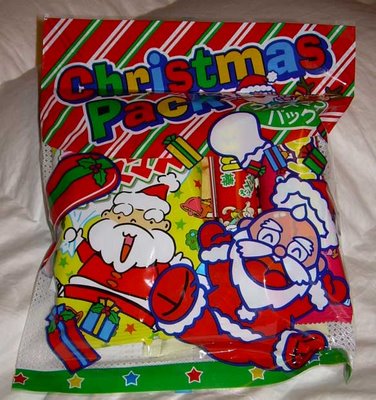
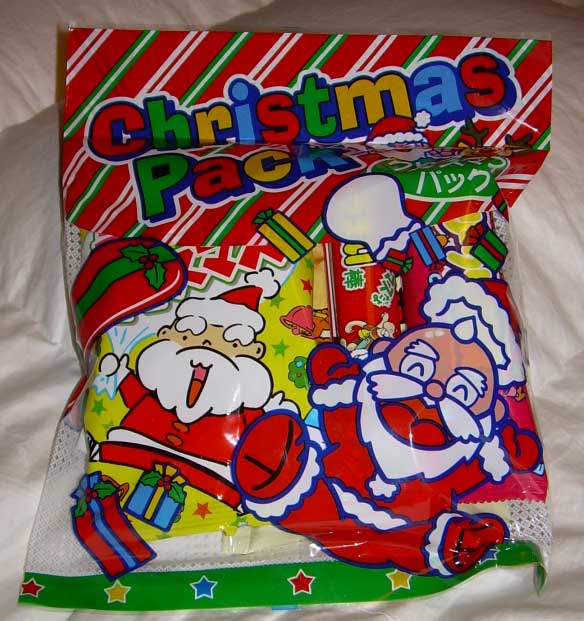
Santa is almost perversely overjoyed.

One thing my husband and I used to do when we first arrived in Japan was buy some random packaged item and find out what was inside. We stopped doing that a long time ago. I rather forgot why. It struck me that it might be interesting to give that a try again. After sampling the contents of the happy package above, I believe the reason we stopped is for the same reason that you touch a hot stove once and then never do it again. Curiosity may not kill the cat but it can sure turn off his taste buds and offer up a belly-ache.

The Christmas Pack pictured above is meant for children and only cost 99 yen at a convenience store. I didn't have great expectations of gourmet contents and I thought that it may be more interesting because it would show what sort of items are supposed to appeal to children. Unsurprisingly, the items in the bag are the kind of things you see in the candy and snack aisles which are geared toward kids in markets.


This bar resembles a cake when you see a smallish picture of it but if you click and see a larger picture, you can see it is far from a cake. It is called "Merry Christmas wheat gluten (fu) snack". I'm sure many children this year will be writing Santa and asking for special treats made of wheat gluten. The package, as best I can read, seems to be saying that it is a nutritionally-balanced snack. Among the main ingredients are brown sugar, sugar, glutinous flour, and all-purpose flour. It smells like a mixture of burnt sugar and bouillon cubes. The description says something about minerals being in it. The outside is incredibly sweet and the inside is a tasteless quasi-puffed corn snack texture. It was perfectly vile when I forced myself to taste it.


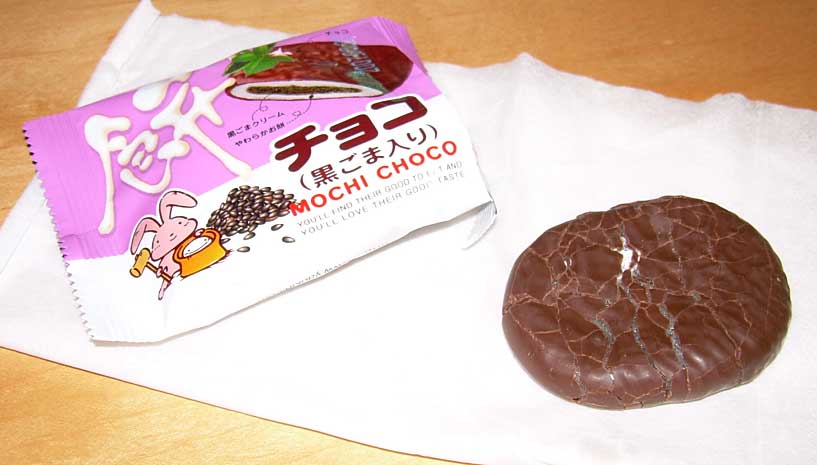
This is a "black sesame mochi choco". I tried to pull this apart so you could see the center but it was too tough to separate. The chocolate just broke up. I did take a small bite of this and it out-did the wheat gluten bar in disgustingness. It was absolutely horrible. I'd try to describe it but I'm trying to allow the brain cells that retain that information to atrophy and die. Among the ingredients for this one are "chocolate" (no ingredients for the chocolate are given), corn syrup, sugar, cornstarch, sesame seed paste, mochi (like rice "taffy", though it's usually called rice "cake"), powdered milk, and soy beans. I liked how the package actually used correct English but confused "they're" and "their" (click the picture to see a larger one to clearly see the slogan). Of course, American young people who have grown up on the internet probably couldn't tell the difference between the two anyway.


This is "morokoshi wa taro" or, essentially, "corn and corm rings". Among the ingredients are corn, taro (a Japanese corm), vegetable oil, and spices. They don't smell like much of anything and taste like an airier, relatively flavorless Chee-to. I'd call these rather inoffensive to mildly pleasant because of the texture.
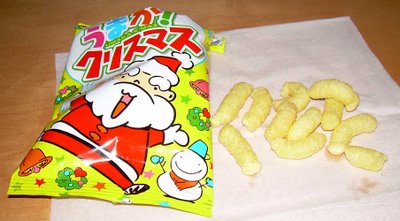

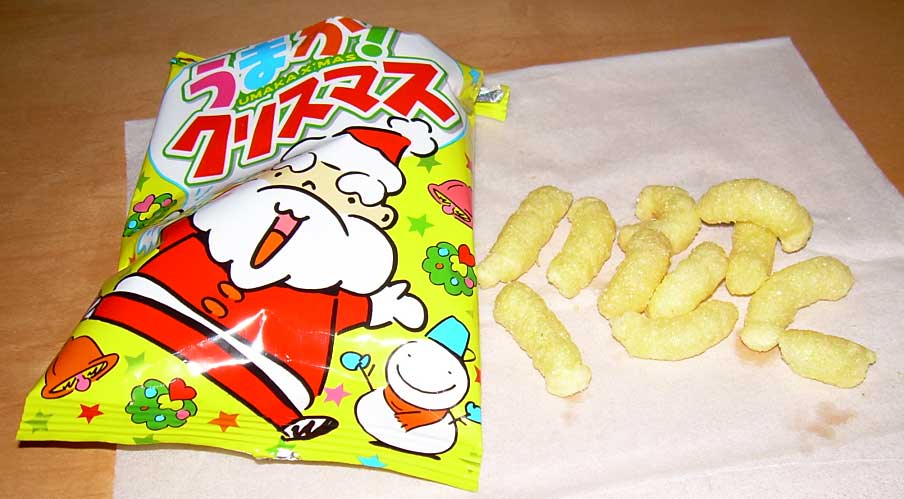
This one is called "Umaka Christmas" which as best I can work out means "sweet Christmas". My research indicated that "umaka" is another way of saying "umai" in a particular dialect but this may be an incorrect translation. Among the ingredients are corn grits, vegetable oil, sugar, pork extract, salt, onion powder, chicken consomme, Japanese rice (uruchi rice) and fructose. This was the only item in the package which I thought was relatively pleasant tasting. The onion powder and consomme were noticeable and the texture was fine.
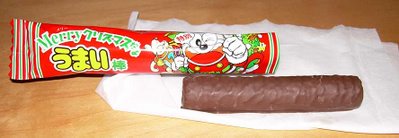

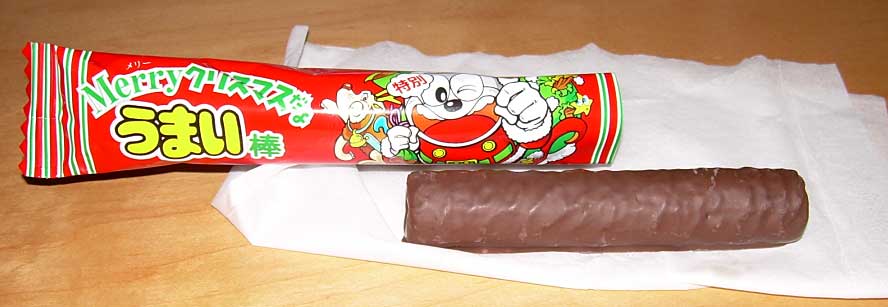
This is "Merry Christmas Umai (Sweet) stick". This actually wasn't bad. The chocolate on the outside tasted okay and the inside was a hollow log which tasted like and had a similar texture to Kix cereal only it was puffier and airier. Among the ingredients are sugar, vegetable oil, corn, powdered milk, chocolate mousse, cocoa, flour, non-fat powdered milk, soybean milk and flavoring.

If nothing else, this exercise pushed my husband and I to do some translating. It also explains why Japan imports so much corn. I think a good portion of it must be processed into these sorts of snacks.

To me, this was a classic example of something you see a fair amount of in Japan. That is, it's something which looks far better on the outside than it actually is on the inside. Maybe kids go nuts for this stuff but I bought this bag over a week ago and the QQ branch I bought it from looked to have just as many in stock as when I purchased mine.

Thursday, December 24, 2009

Japanese Christmas Cake


Earlier this week, I was remarking to my husband that we have lived in Japan for 20 years, and never once purchased a Christmas cake. For those who are not aware of what it is, the Japanese have carved out their own unique way of celebrating the holiday in a secular manner which involves the purchasing of a birthday-cake-style cake and eating it on Christmas Eve or Day. The history of this cake is not clearly known, but the idea seems to have come from a combination of buche de noel cakes from France with their whipped cream decorations and sponge cake and the British Christmas cake shape and style.

Of course, the cakes also have been modified to suit Japanese people's tastes. In general, that includes the use of whipped cream frosting and fresh strawberries. There are some beautiful pictures of the most common type of Christmas cake on the Shibuya 246 site. There are a vast number of cake types though, and you can get nearly any type you like.

Getting back to my Christmas cake, my husband said that he'd like to, "just once", go the KFC chicken route for Christmas (fried chicken is the other half of the traditional Japanese Christmas custom) and I said we should try a cake as well. Fortunately for me, my little wish came true without my having to ponder whether I'd reached an alarming degree of cultural assimilation by diving in and buying a Christmas cake. One of my students gave me a beautiful chocolate cake last night as a gift.


The cake is quite small (but perfect for 4 satisfying, but not diet-killing, servings) and I'm sure cost an insane amount of money. It's got 6 layers. From top to bottom, it is: bittersweet chocolate syrup, chocolate mousse, dark chocolate sponge cake, whipped cream, crunchy chocolate ganache (possibly mixed with corn flakes?), light chocolate sponge cake. This was fantastic. Most of the cake you get in Japan is fatty, but not sweet enough to enhance the chocolate flavor (or uses too little chocolate). This one had high quality ingredients and great flavor. It was also very light. The mix of textures and flavors was impressive.

Wherever you are, I hope you're having a great holiday and enjoying whatever Christmas goodies your culture has to offer. Thank you for reading!

Lotte Yukimi Daifuku Mini


Ice cream is not a winter food, but that doesn't mean that it can't be marketed as such. "Yukimi daifuku" means "snow viewing rice cake filled with sweets". The web site for this product mentions that you should sit under the kotatsu. A kotatsu is a table with a heating element stuck under it so you can sit on your ass and stay warm in winter. The table has a blanket to hold the heat in, but you're screwed if you have to get up for any reason so many people sit under them for hours and hours when it's cold. I guess it serves the dual purpose of increasing your chances of storing winter fat.

The back of the box shows school kids stuffing themselves with some daifuku. Why? I don't know.

Word is that "yukimi", or snow viewing, is supposed to be a traditional seasonal activity like watching the cherry blossoms. I'm guessing this works pretty well in the northern part of Japan, but in Tokyo (and southern parts of Japan) where we see snow in very small amounts about once or twice a year tops, I wouldn't be holding my breath waiting for a nice snowy day.


Lotte's yukimi daifuku mini is a small ball of vanilla ice milk wrapped in a soft mochi (glutinous rice pounded until it is uniform and stretchy in texture). Word is that the predecessor to this confection, released in 1980, was a ball of ice cream wrapped in marshmallow. There are 9 balls in a plastic tray with a little plastic fork to help you pick them up and eat them. Each is about 5 cm (about 2 in.) in diameter and 50 calories.


Though this is promoted as "ice cream", it's actually ice milk, but it's very creamy ice milk. The texture is silky and it has a nice vanilla flavor. The sweetness level is just about right. The mochi shell tends to peel off the ice cream pretty fast, but it makes for a nice chewy complement once the ice cream has melted in your mouth. One of the selling points of this is that the mochi stays soft even when frozen, and it definitely does. The texture is all you could hope for and it's not hard to chew. This is about as close to a non-threatening mochi (as in you're unlikely to choke to death on it) as you can get. The flavor of the rice cake itself is mild and fresh.

I was very pleased with this. Lotte did a good job of working the two components such that they are sweet, fresh, flavorful and tasty. If you like mochi, I'd definitely recommend giving them a try.

If you'd like to download a desktop picture of some cute bunnies or a cheesecake picture of a Japanese girl that are released to promote this ice cream, there's a page with a few items on it here.

Wednesday, December 23, 2009

Kameida Seika Almond Fried Sembei


Have you ever eaten something for the first time and you could swear that you've eaten something very much like it before, but you can't work out what it is? Well, that's how I felt when I ate this sembei. It wasn't that I have eaten sembei like it before, but I believe I've had some sort of snack food which is roughly similar to it. The annoying thing is that I can't remember what it was. It's going to keep bugging me until I remember.


I'd been eyeballing this bag of almond sembei for quite some time. The calorie counts for each 25 gram bag (.88 oz.) bag put me off a bit. It is 133 calories for a pretty small-looking portion. That being said, when I dumped the contents out for picture taking, it didn't seem quite as bad as I thought it would be (entire contents of one bag pictured below). Any time nuts are a large component of some food, there is a boost in fat. In the case of these, there are 7.1 grams of fat per serving (and 3.1 grams of protein).


This sembei mix actually contains both almonds and peanuts. The peanuts are whole and coated in some sort of crispy shell which is strangely sweet. They resemble honey-roasted nuts without the honey flavor. Note that I believe they are sweetened with maltitol as well as sugar (both are ingredients). The sembei pieces are the thing that reminds me of something else. The closest food I can liken them to are sesame sticks with a nuttiness from almonds instead of sesame. They're super crispy, as are the nuts, and don't have that usual rice cracker taste or smell. In fact, when you sniff the mix, you smell peanuts.

These were good, but the peanut part is far too sweet and the almond component overwhelmed by the peanut flavor. It's not a bad mix at all, and I will easily finish the remaining 5 packets of the 6 in the entire bag. Frankly speaking, I prefer saltier nut flavors rather than sweet. These were also slightly expensive at the supermarket I picked them up in at 260 yen ($2.93) and I can't see going for them again. Someone with different tastes than me might really like them. They're definitely well-made, fresh, and offer depth of flavor, but just not my cup of tea.