Wednesday, July 11, 2012

Random Picture #121

Click to see a larger, more readable version.

The name of this energy bar by Asahi caught my eye because it sounds like a noise someone would make when they sneezed, or possibly something you say after someone sneezes (gesundheit). We often say that a sneeze sounds like "a-choo" and the Japanese say that it sounds like "hakushon" (hah-koo-show-n), but neither of these really seems right to me. If I could start my own little trend, I'd encourage people to start saying that it sounds like "gatzun", or "jabarkas", but the latter is a whole other story entirely. 

Returning to the matter at hand, these energy bars are fortified with all sorts of vitamins and minerals so that you don't have to eat actual food to get nutrition. The text under the name says, "this is a cake with cream, a functional food." I certainly wouldn't want to purchase a non-functioning food-stuff. 

Monday, July 9, 2012

Taiko Sweet Potato Sticks


I mentioned in a previous post that one of the nice things about buying Japanese products in America is that they save me from having to translate the ingredients. While I can read a lot of the characters representing common ingredients now without trouble, there are, at times, unusual things which I need to look up and a bit of time is now saved. That being said, there is a new problem associated with the translations. The English labels are slapped over the information in Japanese such that I have to try and scrape them off to get to the Japanese when I want it. In this case, I wanted to see the name of the company that made the product (not the importer, which was all that was listed in English). I spent five minutes carefully scraping at the residue hiding the information I wanted to extract. Of course, I'm pretty sure nobody but me cares who makes the food I review, but now that I've gone to all this trouble, I'm going to talk about it.

These are made by a company called Taiko Confectionary and it's a company I've never sampled a product from before. They're one of those businesses that is so small that they have little web presence  beyond a couple of basic reference pages with addresses and phone numbers and a map. That means, unfortunately, that this product may be hard to find outside of where I located it in the U.S. (Daiso Japan) or in Japan.

These are called "sweet potato cookies", but they're really not a cookie. They're much more akin to the "bo" or "stick" snacks that are sold to children in Japan. That being said, the ingredients list is certainly in the realm of what suits a cookie. The first ingredient is sugar, followed by wheat flour, bread crumbs, corn grits, starch syrup, vegetable oil, sesame seeds, and only then sweet potato. So, there really isn't much sweet potato in these.


These smell very strongly of black sesame seeds. Each tube is hollow and super crunchy. The hole in the center makes them much easier to eat, though, if you are not careful, it's easy to bite into it the wrong way and send a shower of crumbs into your lap. They are very sweet and those who are sensitive to especially sugary treats may find them overwhelming. Despite being quite sweet, the intense flavor of the black sesame and the somewhat more delicate flavor of sweet potato come through well.

I often complain about "too sweet" sweets and this definitely has that potential, but it worked for me on multiple levels. First of all, I love the crunchy, crispy texture and find biting into one of these very satisfying. Also, there is a sort of shellacking on the outside of them which I'm sure is part of the heavy sugar concentration that works both visually and for the texture. I think that, if these weren't so sweet, there might be a danger of the flavor being flat. Sugar, like salt, is a potent flavor enhancer and works well when optimally applied. I think this is pretty nicely balanced, but it may be too much for some people with different tastes.

Despite all of the sugar, they are only 60 calories each for a cookie as long as the span of my  hand up to my longest finger (about 6 inches/15 cm.). You get a larger size I guess because they are hollow, but it does feel like a pretty substantial treat and pairs well with tea or coffee. I paid $1.50 (120 yen) for these and will absolutely stock up on them again when I find myself at the Daiso Japan. I loved them. They may be pure junk, but they are tasty as all get out.


Friday, July 6, 2012

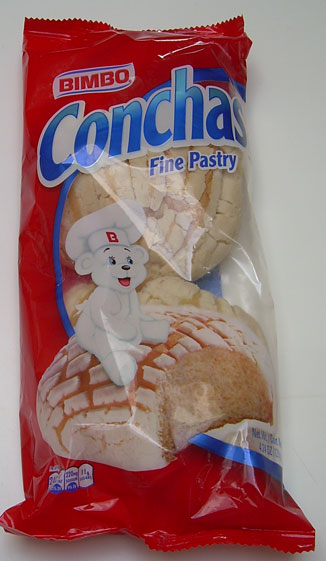
Bimbo Conchas


After living on the shores of America for several months, I must say that I flirted with the notion of changing this blog to "international snack reviews". I pondered that possibility for more than one reason. First of all, I wasn't sure of my ability to consistently access Japanese snacks and I was sure of my ability to get my hands on a plethora of food from other countries (especially Mexico at this point). Also, I want to branch out and try different things, especially after quite a few years of focusing on all things Japanese. However, my heart is still very much with Japan and Japanese snacks so I hope that my readers will tolerate my detours to other types of food on occasion while still accepting this blog as "Japanese Snack Reviews".

All of that being said, it was definitely experiences in Japan that brought me to this particular item. Well, there is that and the fact that the product's name smacks of being a euphemism for a harlot's hooters.  I was at a convenience store on San Juan Island and I saw something called "conchas" being sold there which looked a great deal like Japanese melon pan. Since a lot of Japanese baking culture has been influenced by Portugal (and other European countries), I wondered if melon pan was a riff on conchas. I didn't buy the pink-topped monstrosity I saw there, but I found a less scary version with a funnier name later.

For those who don't know, "melon pan" does not taste like melon, but rather is designed to resemble it. It is a bread-like bun covered with a cookie-like outer layer that is poured over the bread dough. The top is then scored to make it look like the rind of a melon. Conchas, similarly, is a bun with a different sort of dough that is scored to look like a conch shell. I've read several recipes for conchas and they seem to be very much the same except that there is division on the side of the Mexican sweet bread about whether or not the shell should be soft or crispy. Some insist it should be soft and others say crispy. Note that, in Japan, melon pan comes with both soft and crispy tops.


I bought this packaged conchas with the slutty maker name at Target, but the Bimbo brand is available at many different places in California as well as in markets in Spain. My sister-in-law, rather coincidentally, took a picture of Bimbo brand bread in Madrid. It cost $1.38 (111 yen) for two buns. Each bun is 240 calories and a decent size for breakfast or a snack. The second ingredient is egg and the first is flour. The third is high fructose corn syrup so beware those who fear it.

Packaged bread products are never the greatest, especially those that are designed for somewhat long shelf life, but this really wasn't too bad. The coating on top is a little moist and slightly sweet with a nice hint of cinnamon. This may help keep the bread from drying out too much. It has an interesting "doughy" flavor which resembles ever so slightly under-cooked bread. It's an interesting and certainly not unpleasant quality.

Conchas from a Mexican bakery, or melon pan. Po-tay-to, po-tah-to.

In terms of how closely this resembles Japanese melon pan, it's actually a very similar concept with a different execution. Mainly, the flavor and consistency of the topping is different. The underlying bread is almost dead the same. That being said, I went to a Mexican bakery and bought a conchas there and it was dead-on the same as melon pan with a crispy sugar-crusted top. It wasn't exactly the same as a Japanese melon pan, but it was so close as to not be terribly different. I'm sure that conchas is the well from which melon pan sprung.

As for the Bimbo brand Conchas, it's an okay packaged pastry, but hardly the "fine pastry" that it claims to be. If I were looking for a relatively mild sweet to have with coffee and had nothing more attractive, and by that I mean homemade or freshly baked, I would consider it. Chances are, however, that I wouldn't buy this again. It's not that it's really all that bad. It simply isn't all that good and I'm surrounded by more attractive similarly priced options.


Wednesday, July 4, 2012

Random Picture #120


One of my friends recently told me that he revisited his childhood by buying Otter Pops. Though he is about 17 years younger than me, those were a part of my childhood too. For those whose younger years were not graced, or disgraced depending on you viewpoint, with the dubious joys of Otter Pops, I'll say that they are plastic tubes of sugary liquid that you toss in the freezer for a cheap frozen treat. Parents can buy them by the 100 and give their kids something cold to shut them up in the summer. 

When I saw these Koala School drink tubes, it reminded me a lot of Otter pops, though the cartoon animals and plastic tubes really are pretty much where the comparison ends. As far as I could tell, these are not meant to be frozen and the flavors include orange, yogurt, and strawberry (whereas Otter Pops have 8 flavors). Even though these are really cheap, 88 yen/$1.10, they aren't as cheap as Otter Pops. I did like how these seem to be designed for kids, but show a bartender shaking a shaker on the front. 

Monday, July 2, 2012

Furuta Green Tea Sand Cookies


Shortly before I returned to the United States, the Oreo cookie, perhaps the world's most famous sandwich cookie, turned 100 years old. The concept of two cookies with some sort of sweet filling between them likely pre-dates the venerable Oreo by centuries as it seems natural for someone to see a couple of plain cookies and think about how it might be interesting to put some honey, jam, cream, butter, or other sweet filling between them. However, the processed packaged sort of sandwich cookie is a product of our modern age and bless the person who invented them. I haven't found even a bad sandwich cookie that I hated, though I've certainly had a few that I didn't exactly love.

As I've mentioned before, having grown up poor, I never ate Oreos. We had store brand cookies. You know, the sort that you used to buy in industrial sized packages for about a dollar. Each plastic package had enough empty calories to keep you energized but malnourished for weeks. Of course, my mother didn't buy those cookies all that often because, you know, poor folks back in my day didn't do that too often. We were too busy poaching deer so we'd have meat for awhile or stealing a Christmas tree from the distant areas of some poor sap's farm. 

At any rate, I love sandwich cookies, but I rarely buy packages of them for one big reason. They are almost always calorie-dense. My husband and I bought some peanut butter Oreos when we were still on the San Juan islands because Japan doesn't sell peanut butter and chocolate sweets and the idea was so marvelously American that we had to indulge. Unfortunately, the package, which was a "regular" one, took us a little over a month to consume. Both of us are still a little taken aback by the way in which it's hard to buy very small portions outside of convenience stores and their supposed "snack packs". When I checked the nutrition information, I noted that each peanut butter Oreo was a whopping 71 calories. For that price, I could enjoy three vanilla meringue cookies or an entire piece of most types of fruit. 

Still, sometimes, you have to spoil yourself (as Ned Flanders says), and you have a craving for a sandwich cookie with its crispy outer planks and creamy inner filling. And sometimes, you've lived in Japan for a long time and are "homesick" for its flavors and decide that green tea sounds pretty damn good right now. Such was the case for me when I found these at the Daiso Japan for a $1.50 (120 yen). The box contains 10 somewhat largish (a bit bigger than an Oreo) sandwich cookies and they come with the bargain calorie count of 51 calories each. They're also fortified with Calcium and that may provide you with some comfort if you're the sort of person who feels the need to nutritionally justify your junk food consumption (I'm not). 


Most people feel that the sandwich cookie succeeds or fails on the cream filling, but I'm actually more about the quality of the outer cookies. Sure, the cream is important, but if the cookie is bad, that makes the filling irrelevant. It's like a good cup of coffee. It doesn't matter how great the cream you use is. If the brew is not good, the experience is ruined.

Fortunately, the cookie exterior on this is very nice. It has a nice snap with the right amount of fat-induced flakiness. It either has a good carmelized sugar flavor or is made with brown sugar because it definitely has that sort of edge to it. The ingredients do not specify anything other than "sugar". It probably helps that they are made, at least in part, with whole wheat flour and their is a small hint of earthiness rather than the flat blandness of white flour.

The filling is a bit scarce, but that's okay because it carries just the right balance of green tea bitterness with some sugary sweetness. The only thing which could be better is some more textural decadence with more fatty interior, but I'm not complaining. These are solid cookies on every front, though they absolutely don't carry the sort of over-the-top sweetness that Oreo cookies do. The best thing about that is that there is nice flavor depth. You can taste the cookie's quality's as well as the filling. I'd definitely buy these again. Though I can't say I'd want to keep them on hand at all times, I'm not sure I can say that of most of the things I enjoy. If you're a green tea fan, they're absolutely worth a visit.

Note: If you can't access these any other way, I found them online at a place called eFood Depot for $3.95 a box. They're a little expensive there, but for those determined to try them (especially serious green tea lovers), they're likely worth the price.