Showing posts with label canned food. Show all posts

Wednesday, February 19, 2014

Random Picture #202


Assuming you cannot read Japanese or haven't taken a moment to scrutize the picture from a vending machine shown above, I'd like you to take a moment to guess at what is being sold in these cans. All of these feature Mt. Fuji at different points in time - in winter, in spring with cherry blossoms, and the last one says, "diamond Fuji" which I imagine is the sun over Fuji in summer? What cannot item do you think fits the motif?

The truth is that I'm not sure what sort of canned food fits these scenes, but I wouldn't have guessed that it would be what it turned out to be. These cans are full of bread. From left to right is adzuki (red bean) bread, plain bread, and then coffee bread. I guess that, if you climb Mt. Fuji, you might benefit from a canned carb boost. That would make more sense if this picture was taken on the ascent up that mountain, but this machine was nowhere near it. It was in Tokyo in Kichijoji's Inokashira park. Perhaps the bread was made from something on Mt. Fuji, but I doubt it. My guess is that it's just a tourist thing. Any thoughts?

Friday, May 24, 2013

Fumido Kanoko (chestnuts in chestnut paste)


One of my students brought me a sample of the "kuri kinton" that her family had for the New Year's holiday as part of their traditional holiday "o-sechi". Those are more Japanese words than I usually put in a sentence, so I'll say that it's just chestnuts in a sweet puree made up of sweet potato and chestnut that is served as part of their traditional elaborate holiday meal(s). I loved what she gave me. In fact, I raved about how good it was because it had two great tastes that taste great together.

When I left Japan, I lamented to her that I'd never see the likes of kuri kinton again. I was wrong, sort of. I did see it again, but at a price that justified the "kin" (gold) in kinton. Fortunately, this student remembered my love of said dish and, as part of her goodbye gift to me, she gave me a box that contained two cans of "kanoko", which she said was like kuri kinton and would keep for up to a year. 


When I got to the U.S., in a fit of nostalgic craving, I had one can in the first month of my stay at Lopez Island. I stashed the other away and had it a little over a year later, but it was none the worse for wear. It kept well in it's stylish tin can, and tasted every bit as good as the first can consumed a little over a year earlier.

This is made by a company called Fumido which makes a variety of very Japanese types of sweets and sells them largely at department stores, but also offers them online. They are beautifully packaged and don't come cheap. One can is 1,260 yen or about $12.60. Two are 2,520 yen, which shows you that there are no economies of scale (as is so often the case in Japan). This means my student spent some pretty pennies, or yen, as the case may be, on this gift for me.


The contents of the can are large halved and whole chestnuts resting comfortably in a thick paste of chestnut and sugar. Fumido makes it a point to let you know that the chestnuts are domestic (from Japan) and that there are no chemicals whatsoever added to it. It is simply chestnuts and sugar, so, while it may not exactly be "health food", it's not full of artificial badness either.

What it is full of is chestnut goodness. Each can contains 260 grams of paste and nuts and 100 grams is 257 calories. That's a whopping amount of energy, especially when I had to restrain myself to eat the can in 3 sittings. It packs a caloric punch, but it is decadent and delicious with the mild chestnuts and the smooth paste having the right level of sweetness and nutty flavor. It's a simple, but warm and enriching experience.

If I could buy this again, I absolutely would. If you're going to Japan or are in Japan and want to buy someone and delicious gift, this is a great fit if you know they like chestnuts. Yes, it's expensive, but for something which is an elegantly presented slice of Japanese cuisine and culture that can safely stick around on a shelf for awhile, it's well worth it.


Wednesday, July 6, 2011

Random Picture 69


My husband and I dropped by a market designed to sell products in bulk to restaurants and people with big freezers and little cash to pick up a jumbo pack of their smoked chicken. We don't have a big freezer, but we do have fairly little cash. The market also sells a lot of "off brand" items at discount prices (39 yen for some generic cola when cans of Coke retail for 120 yen). The canned coffee pictured above caught my husband's eye because of the message printed on it.


I'm sure it is meant as a gentle promise, but to me it comes across as a command. The impulse to look obediently at the can and say, "yes, master," was hard to resist.

Just a gentle reminder that there is a contest running for two weeks to win a few snack and snack-related goodies. If you'd like to enter, the details are in this post.

Thursday, January 6, 2011

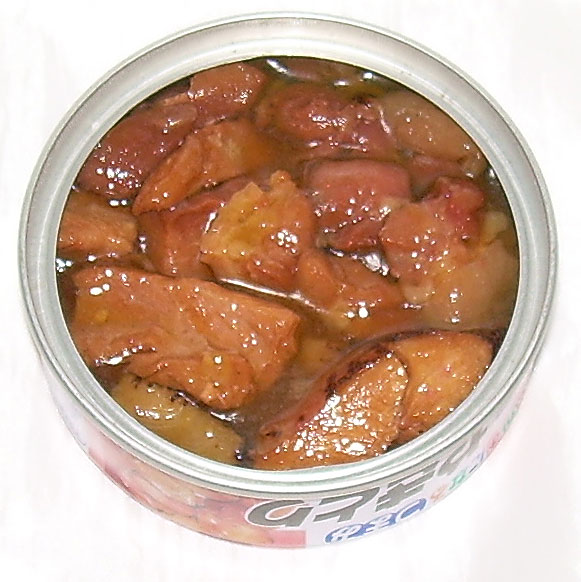
Hagoromo (canned) Yakitori


A variety of food review bloggers, including the Onion's AV Club, have reviewed canned hamburgers. The point that this has in common with I'm about to review is that both yakitori and hamburgers are foods that should never be sold in a canned version. If you've had the real thing, you know that it can be a tasty and almost sublime experience that can only be realized in a freshly prepared presentation.

I found this abomination at Lawson 100 and bought it on impulse because I'd never seen canned yakitori on sale anywhere else. Hagoromo is more familiar to me as a maker of crappy canned tuna rather than crappy canned chicken.


 There are plenty of little bits of chicken skin, and precious little actual chicken. The can is 55 grams and offers 139 calories, but the web side says that that includes everything (sauce, skin, chicken), not just the edible chicken parts. That makes sense because I couldn't imagine such a high calorie count for what little is there. In fact, I'd guess this would be the equivalent of one stick of actual yakitori if you were to get the real deal. I think this stuff is designed mainly as earthquake survival food. You can keep it in your emergency bag for up to 3 years, or you can serve it as a side dish to people that you don't like very much.


Before I popped the top, I expected that this would smell like that usual canned food smell. You know, a sort of eau de dog food? Yeah, it smelled like that and just a bit like chicken. Inside were some chicken tidbits suspended in some sort of gelatinous substance. I figured that it might be more palatable if I warmed it up and allowed the goo to liquefy.

Despite the unappealing look and smell, I wasn't too grossed out by the idea of eating this. I've had bad canned food before, after all. The texture of the chicken was horribly dry and stringy. It needs to be chewed quite a bit unless you prefer to swallow it whole. It has that canned food taste which I always guessed was due to pressure cooking mass amounts of the food as well as whatever preservatives are used. There is also a hint of a smoky, char-cooked flavor and, of course, low quality chicken. The sauce is slightly sweet and salty. It's not bad, but it's far from good.

This was bad, but not in a way that renders it awful. It's just overcooked, processed canned food that fails entirely to be more than one expects, even when one expects very little. If you need something for your earthquake survival kit, this wouldn't be the worst possible choice if you can't find anything else. Otherwise, give it a pass.