Showing posts with label Japanese KitKat. Show all posts

Monday, April 28, 2014

KitKat Baked Purin (Pudding) mini


I've spoken before about how there must be a think tank of sorts inside Nestle Japan in which they're sitting around trying to figure out what new gimmicks they can use to try and separate their product from the horde of consumer-grade confectionery. The person who decided that they should create a way for something that usually melts to be baked probably got a gold star, and possibly some fairly quizzical looks and disapproving frowns from those who doubted his ingenuity.

Speaking of said ingenuity, I'm not sure what had to be done to these to make them bake-able without making them turn into a puddle of white chocolate goo. The ingredients list includes chocolate, wheat flour (for the wafer, no doubt), vegetable oil, lactose, sugar caramel powder, whole milk powder, cocoa powder, yeast, cacao mass, cocoa butter, soy lecithin, artificial flavor, baking soda, and "yeast food". The final item appears to be "mineral yeast" which is used to alter the way dough works (not as sticky, softer), so I don't know if it is the magic ingredient. My lack of food chemistry knowledge means that I can't pinpoint what keeps them from becoming ooey messes, but someone did some alchemical homework.

At any rate, I'm on the late side to this party because it took awhile for this to reach my shores. I found this at Nijiya market in San Jose. Given the high novelty factor, and my husband's shared interest in trying these, I forked over the $5.99 without a second thought. How often do I get a chance to set my toaster oven on fire in the name of blogging?

The instructions on the back tell you to line the toaster oven tray with foil. It explicitly says that you should not use aluminium cups or foil pans. Apparently, the difference between sheets of aluminum foil and folded containers ostensibly made with the same stuff is another chemistry lesson I need to learn. At any rate, I wasn't going to argue with the people who made the product... at least not until I actually tried the product and had a reason to do so.

Once you have lined your tray with foil and lined up your KitKats - the illustration shows four bars being made at once, but I only wanted to make two so I may be violating the recipe in some fashion - you're supposed to bake them for about two minutes at 1000 W. In Japan, my toaster oven had wattage listed on the instructions. My oven here has temperatures (in both Celsius and Fahrenheit) and food types.

So, I did some research and got myself thoroughly confused about what the temperature should be. Answers ranged from complex formulas that I tried to use, but gave me ludicrous results like I should be using 1000 degrees F. to "watts measure something different and can't be converted to temperature settings".  I decided to take the middle road and use 350 degrees because I'd rather it cooked too slowly then exploded in a burst of sugary molten madness. That temperature seemed to be a good one.

I had been warned to keep an eye on it by readers who commented on the product announcement and it is a warning I will repeat. This will go from uncooked to nicely browned in the blink of an eye. I didn't burn it, but I'm thinking it will burn fast. Do not walk away from it unless you want to risk it being ruined.


The plain, uncooked bar tastes like very sweet white chocolate and has the nuanced flavor of Japanese "purin" (pudding). It's the barest hint of caramel flavor. Since the bag touts the inclusion of .5% caramel powder, this is no surprise. When I gave it a sniff just after opening the package, caramel was the only thing I could detect aside from the white chocolate itself.

I think this is actually sweeter than other KitKats I've had recently, but that could be because many of my most recent tastings have been the "adult" versions which have tamped down sweetness levels. As an uncooked bar, it's probably a mediocre experience for someone who isn't an enormous fan of white chocolate and a bad one for someone who hates it or very sweet candy.

The sad-looking baked version.

The real question is whether or not it gains something in the baking and the answer is that it does. I sampled this slightly warm and my husband tried it cool. I wanted to try it both ways to see how the texture changed. In both states, baking it takes on a caramelized sugar flavor which reminded both of us of the sauce used in flan. It's not nearly as intense, but the bar is definitely better in its baked state.

This is what happens if you try to pick it up while warm.

In terms of whether you should eat the baked version warm or cold, I definitely say wait for it to cool. If you try to remove it from the sheet warm, it will separate and fall apart. The warm chocolate is an interesting sensation, but you loose the lacey edges which carry much of the intensified caramel flavor (and it sticks to the sheet).

A cooled half - much easier to handle and you don't lose any part of it.

The cooled version not only keeps all of the caramel edges intact, but comes off the sheet cleanly and is easier to handle. Clearly, this was never intended to be eaten warm off the sheet and, if you don't want to risk a burned tongue (I didn't get burned, but it is a risk) or a disintegrating bar, then be patient... not that I was impatient.

At the price I paid ($5.99 for a bag of 13 minis), these are 46 cents per bar. This actually is  not an outrageous price per piece. It's not exactly cheap, but it's not incredibly expensive. In Tokyo, you'd probably pay closer to $3.50-$4.00 (350-400 yen), but it's not really fair to compare import prices to domestic ones. You will always pay between 50-100% more for rare or imported items. These are currently being offered on eBay for $8.54 by someone (including shipping).

A better bet if you want to try these and have no access to an Asian market that carries them is Candysan. They have them for the bargain price of 345 yen at present, but the shipping is 480 yen. However, if you make a larger order, you get a better per item deal on shipping as it scales more slowly (or not at all) after the first item. They also carry other somewhat exotic items which may be worth trying like purple sweet potato KitKats and "big little" orange KitKats. Of course, they have other interesting items as well. At present, I'd say that Candsan offers the best prices on Japanese snacks by mail order in terms of a place that allows you to choose what you receive (as opposed to the services that send you monthly or bi-weekly surprise packages).

In terms of whether or not you should try this, I'd say that it is for people who have curiosity or desire novelty in their food rather than as a "must have" treat. It's a different sort of experience. It's fun and it tastes pretty good as well, but it's not fine quality stuff. I think it'd be a great thing to do with your friends if they're the sort that enjoy unique things and are open-minded. I imagine kids would go crazy for it as a general concept. I have to imagine that since I don't have kids. ;-) At any rate, I'm happy that I tried it, but I'm not sure that I'd go for it again. Once is a good experience, and it's enough.


Thursday, June 6, 2013

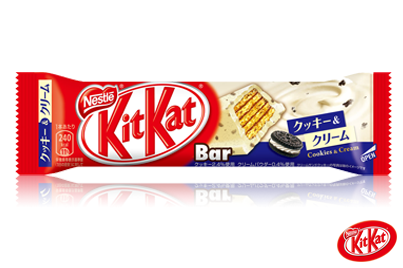
KitKat Cookies & Cream Big Bar (Product Announcement)

Image from Nestle Japan.

I love the KitKat big bars, but I hate white chocolate and have never been a big fan of cookies & cream as a candy flavor. In fact, I feel that the whole point of the cookies and cream concept is to add textural variation and flavor to ice cream. As a candy bar with cookies that add texture and its own flavor already, it seems silly to add cookies and cream to cookies and white chocolate. OK, perhaps it's not so  much "silly" as quite unimaginative. These big bars are coming to a convenience store in Japan soon and if I was still there, I would not bother to buy one. If you're more open to conventional flavors than me, let me know if you've tried this. I'm guessing that it'll have 5 layers of satisfying crunch surrounded by somewhat too sweet and perhaps even slightly chalky white chocolate infused with just a hint of bitter chocolate cookie and some creamy richness, though not enough of the good stuff to justify the calorie load.

Thursday, May 23, 2013

Passionfruit Adult Sweetness KitKat (product information)


Nestle Japan has (finally) stepped up and released a new and somewhat interesting variety of KitKat. Just in time for summer, you can pick up a passion fruit KitKat and allow it to melt in your backpack. The web site for this candy says that it has some mild acidity and, because it is part of the "adult sweetness" line, there are finely crushed biscuits in it. The truth is that I've never eaten said fruit and I have no idea what it tastes like, so I guess that step 1 would be to try the fruit. Step 2 would be to try the candy bar. Step 3 would be to write my impressions of it. That being said, while I can say this sounds interesting, it doesn't sound "inspiring". If you've given this a try, let me know what you think.

If you'd like to give it a try, Candysan is offering it for a short time for 180 yen/$1.83. They will stop selling it because they won't ship chocolate throughout the summer due to the potential damage from heat. Personally, I'm going to have a peak at Japanese markets in my area and see if I can find some in their air conditioned shops for something less than the price of gold.

Friday, March 29, 2013

Nestle Adult Sweetness Matcha KitKat campaign and Gran Wafer


As I've mentioned before, Nestle Japan has changed its marketing. The days of a revolving door or weird flavors seem to be over. Indeed, they are now focusing a lot of attention on expanding their market toward less sweet and relatively approachable flavors. The core product line is split between regular milk chocolate KitKats in various types of packaing, regional KitKats, and the adult sweetness line. 

The adult sweetness line is offered in white, semisweet, and green tea flavors. They're all good, but, surprisingly, I like the green tea one best. I say that because I'm not a huge green tea fan. However, the texture and mixture of bitter and sweet flavors make it a pretty extraordinary mixture of the elements. 

Nestle Japan is pretty savvy in how they're shifting the product line and marketing. The birth rate in Japan was 1.3 for 2012. That means the number of kids out there looking to try new candy is going down while the number of adults is much higher. They're going where the money is, and catering to conservative tastes (less sweet, more common and known flavors). 

They've done their marketing and 70% of women between the ages of 20-30 are pleased with the matcha adult sweetness KitKat. Their PR talks about how the changes in Japanese society are creating a situation in which women are expected to work late just as men are and they want to position their candy as a way of relieving stress. To that end, they've made a few commercials showing a very thin Japanese business woman being given candy to help her get through the trials and tribulations of her day. 

Blogger won't let me embed a video from YouTube Japan, but I'll link to each one here. The one for a green tea KitKat shows the hapless heroine apologizing in English as foreign guests exit. Everything is just fine though after her coworker hands her a box with a green tea KitKat and she munches on it. The second one, for the bittersweet version, shows her exiting a meaning after apparently having done some sort of poor job and being consoled by the same coworker with candy again. Yes, professional failure can always be fixed with candy. 

Though this is a pretty stupid set of commercials, which makes it little different from most commercials, the focus is a good one. Many Japanese women have sweets while they're working at the office. They don't eat copious amounts of them, but every female coworker I ever had in Japan kept snacks in her desk. Nestle figures that it might as well be a KitKat. 


Beyond catering to the needs of hapless female business people, they're encouraging housewives to enjoy a "gran wafer" with their coffee while their tots nap. The gran wafer (which appears to have lost a "d" somewhere along the way) is a KitKat with chocolate wafers with chocolate between them and no chocolate coating. It is, essentially, a sugar wafer. They're sold 9 to a box as minis, so, you can "have a break", but not a very big one. I guess moms with sewing machines need to sugar-up a bit less than office workers. 

Monday, March 25, 2013

Nestle Ujimatcha Latte KitKat


Back when I did my Regional KitKats post, I mentioned that there was no need to despair over not being able to get these supposedly limited options because many of them have been released or will be released as regular flavors. Ujimatcha is a type of green tea grown in the Uji area and is known for being intense and sweet because the amino acids are kept intact when it is prepared. I don't know if this is true, or exactly what it means, but it's supposed to be vibrantly green and more finely milled than more pedestrian types of green tea. Uji is an area in Kyoto, and this is sold as a regional flavor KitKat.

The package you're seeing pictured here is a consumer level bag of minis sold pretty much anywhere that sells them. So, you see, no matter where you live, you can get this supposedly regional flavor. So there! Okay, this isn't exactly the same as the regional one since this has a semi-sweet chocolate base paired with the white chocolate ujimatcha top and is a "latte" flavor and the regional one is all green tea.


I found this as Nijiya Japanese market for $2.19 (206 yen). It's a pack of 7 single finger mini bars that look like a fat version of half a mini bar. For the quantity, it's slightly pricey, but not ridiculous. The strange thing about this KitKat was that I couldn't locate it on Nestle Japan's web site. That doesn't mean it's not there, but it is strange that it is not featured prominently somewhere. I do check the site regularly, and the expiration date on the bag is September 2013, so it can't be so old that it is outdated. This is the sort of thing that you think about when you're me.

As for the bar itself, it is actually quite different from the regular green tea KitKat. This has a creamy flavor which balances out both the semisweet base and bitter green tea very nicely. I generally don't care for green tea mixed with fairly present chocolate flavors, but it all came together really well in this tiny little bar. It has depth of flavor, but it doesn't come across as lacking in flavor harmony. It's neither too sweet nor lacking in sweetness. I was surprised at how nice it is.

I think this is absolutely one of the nicer consumer-level chocolates you can buy and well worth a sampling if none of the component flavors are something you're averse to. I could see this particular flavor profile with a better quality chocolate being produced by a more prestigious chocolatier. That being said, I still like the adult sweetness green tea bar better, but not by a huge margin.


Monday, January 21, 2013

Tokyo Regional Rum Raisin KitKat (and new releases)


Based on when I ran a contest to win a box of these particular KitKats and the timing on reviewing them, you might guess how high my level of enthusiasm is for them. Yes, I've had them around for weeks and only yesterday did I get around to breaking the seal on my box. It's not that I thought it was going to be bad or anything. I just didn't expect it to be particularly "good". I felt that the best I could hope for was that it would be "interesting" and not too disgustingly sweet. The question before me as I unwrapped a mini bar was whether or not Nestle Japan was going to manage to struggle over the very low bar that I was setting for this candy.


These smell vaguely fruity, which is slightly disturbing considering there is no sign of actual raisins in them. The bars are smooth white chocolate over nice, crispy wafers. The first thing that hits you is the very, very sweet white chocolate followed by the rum. The raisin comes through at the end on the initial taste, but builds in intensity as you eat more.


Since I don't drink alcohol, I don't know what rum tastes like. I asked my husband to try this. He took a bite, made a bad face, and said it was "too raisiny" and said essentially that it did not taste like rum to him. Personally, I think that rum raisin in general is one of the less approachable flavors, but that it can have its charms. Depending on the presentation, they can be like the guy everyone wants to talk to at the party, or the one that has people making excuses to escape to the bathroom or looking at their watch and talking about having to go home. This bar is somewhere in between. If this bar were the metaphorical equivalent of a guy at a party, I'd talk to this guy for a little while, but not for too terribly long. 

I got this box by asking my brother-in-law to pick it up at Narita airport on his way to visit family over the holidays. I was shocked to discover that it is being sold currently on Amazon for a pretty penny. You can procure it at less dear a price via J-Box. I caution those who may think this will be the most interesting thing since sliced bread that it mainly has novelty value. I expect to take months to eat twelve of these. It'll have to be one of those things where the spirit moves me for me to have one. It definitely would not satisfy an authentic chocolate craving, nor one for wafers. I don't regret asking my brother-in-law to pick it up, but mainly that's because I was keen to review it. I wouldn't buy it again.


And a few bits of news just for added fun:
Images from this point on are from Nestle Japan's web site.

Incidentally, Nestle Japan is currently marketing something they call a "KitKat chocolate lab". To the best of my ability to tell, Nestle has a deal where you can order a box of KitKats with a custom cover featuring a picture of your choice. You have to buy 10 boxes and each box has 3 mini bars. The price for this is very reasonable at 2310 yen ($25.66). In yen, that sounds a lot less expensive than it does in dollars.


This target for this isn't people who want their kids to appear on a box of candy. It is for people who want personalized favors such as those having weddings or special events. At 231 yen ($2.56) a box for what amounts to about half of what you get in a regular KitKat bar box for half that price, it is not good candy value for money, but it's rather nifty for a major brand to be a part of your personal event. I can't imagine people having the chance to customize a box of Snickers bars, for example. 


Nestle Japan seems to be shifting their marketing now from issuing a ton of weird KitKat flavors (which perhaps are not selling especially well) to packaging. In addition to the custom boxes in the aforementioned paragraphs, they are also releasing a box with a MOS Burger theme (available at the Japanese fast food joint, MOS burger) with a space to write a message, so perhaps these are meant to say, "I was picking up a fast food burger and I thought of you. Here's some consumer-level chocolate to express my feelings."


The red and white packaging.

Exam pack with messages imprinted on milk chocolate bars.


The "snake" packaging.


Picking over the Nestle Japan site, I could not find anything in the way of new flavors. There is a "red and white" bag of minis which has white and milk chocolate bars as well as an "exam pack" which has bars imprinted with encouraging messages for students preparing to take exams. Finally, there is a box with the Chinese year of the snake motif. It was directly targeted toward grandparents for distribution to their grandchildren at the New Year.

I'm wondering if, at least for a little while, the days of a plethora of funky KitKat flavors are over. I saw enough of the weird ones end up in massive bargain bins at snack discount shops like Okashi no Machioka to know that they probably did not sell all that well. Also, when novelty flavors are the norm, it's not surprising that the market loses interest. I know that I certainly lost interest as time went on. In terms of the cost to Nestle Japan, targeting markets based on packaging is probably a better idea. They can still hold the novelty market by focusing on regional flavors (which don't change often, and have appeal as they represent the flavors/foods of a particular area), but make most new releases target lifestyle rather than taste buds. 

Tuesday, December 25, 2012

Winner of Tokyo Regional KitKats Contest

Kitty-chan Christmas buckets for the kiddies in Japan, because a plastic bin full of cheap treats is what all the letters to Santa are asking for.

Merry Christmas to all of my readers! I wish that I could give everyone a prize as a demonstration of the spirit of the holiday, but, alas, I have but one gift to give.

The winner was chosen by a random number generator (no favoritism here!) and it is brit_brat100. Please contact me at orchidsixtyfour@gmail.com about sending your prize to you. Congratulations!

Thanks to all of my readers for their entries, and, of course, for reading! Happy holiday!

Sunday, December 16, 2012

Tokyo Regional Rum Raisin KitKat Contest


I've also recently acquired a spare box of the Tokyo regional rum raisin KitKat so it's time for a contest. Also, it is near the holiday season and wouldn't be a bad time to give something back to my readers. So, I'm running a contest to win a box of this special KitKat. It contains 12 individually wrapped mini bars, so you'll be winning enough to share with friends and family. It also seems somehow appropriate that a KitKat which is flavored with rum can be consumed around the New Year when liquor is freely flowing.  

To enter the contest, leave a comment on this post only (comments on any other post will not be eligible) and tell me what you would most like to try among the items that I have reviewed (a stroll through the archives should jog your memory if you don't have one particular item that has stuck with you). In your comment, you can just say the name of the product or you can tell me more like why it is of interest to you. The more information, the better so don't be afraid to be verbose.

This contest will run until Christmas day when I will announce the winner. 

Monday, November 26, 2012

Raspberry and Green Tea Adult Sweetness KitKats


As I mentioned in a previous post, November is KitKat month at SakuraBox. If you're interested in wrapping your lips around a good sampling of Japanese KitKats (5 different ones - pretty much the current line-up of non-regional options in Japan), this is your chance. With the weather finally turning more autumnal, it's safe for them to break out the chocolate, and, boy howdy, they are doing it right.

The two minis that I'm reviewing today are part of the monthly candy box. As full disclosure, I should mention that they send me one of these boxes gratis. You can consider me bribed, or you can consider me grateful for their generosity. I consider me lucky that after years and years of never getting one thing for free for review purposes, I can finally catch a ride of the small gravy train that I'd seen many other bloggers hitch onto.

All of that being said, I should say that how I feel about the snacks SakuraBox sends me has nothing to do with them. I already reviewed their service, which is the thing that directly reflects on them. How I feel about the KitKats is all on the fine folks at Nestle Japan. Today, I'm going to review two of the "adult sweetness" line which I have not reviewed before. The theme of this line is these KitKats are not as sweet as the regular ones. Therefore, they hold the promise of not being as cloyingly sweet as some of the other ones, especially the ones made with white chocolate.

In the past, I have favorably reviewed the white chocolate and regular chocolate ones, so I had high expectations of these ones. Note that, among the regular offerings of KitKats at present, the adult sweetness ones are quite prominent. It's my guess that these are going over pretty well with the Japanese market. This is no surprise as one of the big points that Japanense folks who visit America whine about is that the food is too sweet for them.


The first bar I tried was the raspberry adult sweetness bar. I was really hoping that this wouldn't be painfully sweet, and, happily, it wasn't. It smelled very intensely of raspberry so I was concerned about some strong artificial flavoring, but it actually was on the subtle side. It was ever so slightly tart and had approachable raspberry flavor. The outside was very soft and the wafers were crispy and fresh. This was very tasty and I appreciated that those who formulated it didn't feel it necessary to make it an avalanche of intense berry flavor and went with something that felt more like raspberries mixed into white chocolate.

As for the other bar, I sort of think of green tea as "mundane" in terms of flavors. I guess only someone like me who lived in Japan and was spoiled by the plethora of green tea options would consider a green tea variety "mundane". Sometimes, it is easy to forget that not everyone has had access to such goodies and that, yes, this may be exotic for some folks. After the subdued sweetness of the raspberry bar, I was actually slightly concerned that the bitter green tea might not be sufficiently offset by sugary goodness.

Fortunately, there was no bitterness nor was it overly sweet. There was a nice pure green tea flavor that was mellowed not by sugar, but by milky notes from the white chocolate base. Like the other, the wafers were nice and crispy, but this was mixed with a slightly grainy, finely gritty (but not at all unpleasant) texture in the chocolate. I loved the contrasting textures, and was surprised at how present but not overbearing the green tea flavor was. 

I really liked both of these bars, but found the green tea to be slightly better because I enjoyed the strength of the flavor more. I would certainly recommend either of these for anyone interested in flavor depth. They are absolutely better than some of the overly sweet bars I've sampled in the past.

I have been keeping an eye on the KitKat site off and on since I left Japan, and I'm wondering if Nestle Japan is changing their approach to the market place. While they may be selling weird flavors on occasion, I haven't seen any regular bars that are very esoteric on their web site for quite some time. Either they're not advertising them (unlikely), I missed them (somewhat likely), or they've figured out that too many of the bizarro flavors were ending up in candy bargain bins so they're reducing the frequency of issuing them (more likely). If this is so, this is good news for those who actually enjoy eating them, but not so good news for those who are tickled by dreams of wasabi or ginger ale KitKats.

Friday, November 9, 2012

Regional Japanese KitKats (product info.)

All images are taken from Nestle Japan's web site.

Nestle Japan announced its newest in its vast line of regional KitKats on October 9, 2012. This one is for Tokyo and it is rum raisin. The blurb on their site for this says that it has a sense of sophistication and luxury, and that image is suitable for Tokyo. You know that's the truth because of the elegant snifter of rum that is part of the illustration on the box. I'm guessing that if they put a drunken pirate with a mug of grog on it, they'd believe it was a little less classy. This seems to be replacing the soy sauce Tokyo regional flavor, which has been around for donkey's years. However, I imagine the soy sauce variety will find its way back into the rotation at some point.


Regional Japanese KitKats are the holy grail for many aficionados of bizarre flavors. Part of the reason for this is that they're supposed to be something you only can get by visiting the region that it is introduced in. As I've said before, this is not always so. They are sold in Ameyokocho at Niki no Kashi as well as at Narita airport. The truth is that they are not reliably available anywhere, not even in the regions they're sold at. It's not like you can walk into any convenience store in Tokyo or train station kiosk and find this Tokyo regional variety in Tokyo. You always have to be at a shop that carries specialty or souvenir items. Such places are often at the major train stations of the areas.

Le Lectier (Niigata specialty)

Many of the regional KitKats are sold in boxes with 12 mini bars for 840 yen ($10.52). Just to refresh people's memories about them, they are marketed primarily for people to buy and give to others as a souvenir of an area they are vacationing in or doing business at. They are not really designed for the average snacker to take home and eat on her own. In my opinion, based on my knowledge of Japanese culture and tastes, the strange flavors are not meant to be the sort of thing you crave again and again in the future. They are novelties, much like cactus candy and venison jerky.


Though the regional varieties are supposed to be special, many of them have been issued as regular KitKats as temporary flavors (and you can buy most of them through Amazon Japan). The KitKat zunda (above) was issued as a regular bar after the earthquake on March 11, 2011 and continues to be available in the regional format. Similarly, the blueberry cheesecake KitKat (pictured after the 1st paragraph), was issued in several incarnations while I was in Japan (single finger, regular bar) and continues to be a Koshinetsu regional variety. The apple KitKat is also a regional issue (Shinshu), but was once a short-term flavor for a standard-size bar. My point is that, if you can't get a regional flavor, you don't have to really sweat it because chances are you will have or have had access to it at one point or another as a regular bar.


For those who need fewer souvenir bars, there is also a smaller box available for some flavors in some regions. Those boxes are 350 yen and include 5 mini bars. The one pictured above is hojicha flavor, of which there was (and may still be) a larger box available at one time. The wasabi KitKat that I reviewed came in one of these smaller boxes. However, there is absolutely no difference between the versions as sold in the various incarnations in terms of flavor.


In my experience, some of the regional KitKats also showed up in UFO Catcher games, though it tended to be something which was quite unpredictable. The yubari melon (cantaloupe) version seemed to be especially popular as a prize as I saw it several times over a long span of time. I wonder if it was chosen because it was especially desirable or sold poorly. My guess is that it was the former. This particular variety, I should note, breaks the general pattern of the way the regional KitKats are presented. It has 4 bars for 580 yen ($7.26).


I did not try every regional KitKat, but I tried a fair number of them. Frankly, I was rarely blown away, but I found most interesting and enjoyable enough to finish the box. The very best one and the only one I could say I'd actively want to buy again was the Golden Citrus blend. The rest were mere curiosities, some pleasant and some less so. The citrus blend is currently one of the few varieties which is on offer in both the standard 12-pack (pictured in the linked to review) and a 5-pack (pictured above).

Yatushashi KitKats 

The tricky question is how to get your hands on these if you are not in Japan. This is definitely a difficult one. Some online sellers, such as the Asian Food Grocer, occasionally carry limited edition flavored KitKats, but not the regional ones. You can get a regional flavor when it is issued as a regular bar if you get lucky. Rakuten also occasionally sells some KitKat specialties, but right now most appear to be sold out. You can get a Japanese KitKat ball marker from them for an exorbitant price, but that's a bit off the topic.


"Adzuki sandwich" KitKats ("Ogura Toast" from the Tokai region)

Frankly, what I would recommend to anyone who wants these  is to try and set up a food exchange with an ex-pat living in Japan or a Japanese person looking for a penpal and a cultural exchange. Many people pine for certain specialty foods from back home and may be willing to do a care package exchange and some Japanese folks are happy just to make a friend in another country or to practice their English.


Kobe pudding (purin) in a special souvenir box representing housing in a historical district (ijinkan) in that area. Note that this flavor was once issued as a big bar and a mini, albeit in milk chocolate rather than white.  

I know that there are some Americans who will send you Japanese snack packs in exchange for Reese's peanut butter cups, licorice, and Cap'n Crunch (all of which are hard to come by in Japan). As for how to find such folks, well, that's another issue entirely. You'll have to try out forums for foreigners in Japan and see if anyone has an interest. The main difficulty in such exchanges is that you cannot send anything via seamail from the U.S. anymore so postage rates are a huge chunk of change. You would need to negotiate an exchange value that incorporates that disadvantage (or both agree to pop for airmail across the board).

Beniimo (purple potato) KitKat representing Kyushu-Okinawa. Love this box design! Though I never tried this particular variation on sweet potato, I did sample two other sweet potato KitKats. 

From my point of view, and I know that I've had years of experience and am quite jaded, I don't think it's worth the trouble. Yes, it is a little thrilling and cool at first to try these things, but after awhile, the weird KitKat flavors all sort of blend together. In terms of long-term enjoyment, I'd recommend going to Cost Plus World Market and finding their British or Canadian bars (hazelnut, orange), and just having those. What they lack in freaky coolness, they make up for in flavor staying power.

Monday, November 5, 2012

KitKat Vanilla Ice Cream


With little chunks of ice and a waffle cone with a few scoops of vanilla ice cream on the package, it will surprise no one to learn that this is a summer leftover KitKat. It was introduced on June 25, but according to Nestle Japan's web site, it's still on the roster. On the one hand, thanks to climate change, we appear to be finding that we're generally giving autumn a miss and living in a prolonged summer, so those who continue to sweat into the early autumn may find the illusion of a cooling treat appealing. On the other, seasonal flavors in Japan are something all the natives and non-natives alike look forward to. I'd be saying, "bring on the sweet potato and chestnut", but right now the newest mini variety is a white chocolate "adult sweetness KitKat". I guess Nestle Japan isn't in the fall spirit yet.

Since most of the new KitKat flavors are a crushing disappointment, I have been unwilling to invest in buying them despite having more reasonably priced access than most via Nijiya Japanese market. I'm particularly reluctant to pop for the $7 price tag on the standard large size bag of minis when I have a strong feeling that they'll taste like overly sweet disappointment. The only reason I went for this was that it is a smaller than usual bag of minis. With only 4 small bars and at a price tag of only $2.19 (175 yen), I figured that the chances that I'd be suffering buyer's remorse was relatively low.

I'm using my KFC Christmas plate for white food because they photograph better on a dark background, and this is all I have in my puny selection of dishes at present.

The bar does smell a bit like vanilla. Fake vanilla is, after all, a pretty potent scent. The bars have a very sugary, slightly gritty texture in addition to the trademark wafer crispness. The white chocolate coating is soft and yielding with no snap of its own. The first bite carries with it a potent, but not overbearing, vanilla flavor coupled with something which is reminiscent of frozen dairy confections. Subsequent bites, however, reveal an odd fake flavor which becomes increasingly reminiscent of powdered milk and the cheapest ice cream in the store. At the end of the second finger of the mini, it was potent enough to overwhelm the experience.

This is not a bad bar, but it's not an especially noteworthy one either. It is, like most of these white chocolate bars, extremely sweet. While I don't regret picking up this 4-pack for the price I did, I'm glad that I didn't buy a bigger bag as it'd feel like a huge waste of money. As it is, I sampled a bar, my husband will likely eat one, and a craving for super sweet candy will see us through the other two. However, I would not buy this again, and unless you truly enjoy artificial flavoring, powdered milk, and very sweet white chocolate, I would not recommend this to my readers.


Wednesday, October 3, 2012

Random Picture #133


One of the KitKats which I eyeballed but never bought was the "hojicha" KitKat. For those who don't want to dash off to the linked Wikipedia page, hojicha is roasted green tea (that's why it's brown). My main issue with it is that it is a regional KitKat that comes in a big box of minis and I hated to have to buy a large number of them just to sample one. These are designed, incidentally, to be purchased by traveling business people and brought back to the office as a souvenir snack. That's why the boxes contain 12 minis and you can't get them as regular bars or smaller boxes of minis. If I hate the flavors of these, I've wasted a lot of money. I didn't work in an office when I started this blog, and I didn't have anyone on whom to fob off unwanted candy. My husband certainly wouldn't have touched a tea-flavored KitKat with a 10-foot pole!

Beyond my sense that I didn't want to squander my hard-earned yen on a dozen untested KitKats, there was also the fact that my readers either know the taste of hojicha or they don't. While many have tasted conventional green tea, this variation is not so common. There wouldn't be a whole lot of meaning to saying whether it was authentic or not. What is more, there are other reviews out there of this KitKat, though they frankly rather suck in the way I was afraid my review would suck if I'd done one. That is, they say it captures the flavor well and is therefore tasty.

Some of those reviews also suck because they rave about how insanely rare these are because they're regional (Kyoto), but that's not exactly true. Yes, they are not sold on every convenience store shelf in Tokyo, but they are sold at major train stations (e.g., Shinjuku), Narita airport, and at the Odaiba souvenir shop in which my picture was taken, not to mention some snack shops in Ueno's Ameyokocho. The truth is that, if you are in Japan and really want a regional KitKat, you never have to actually go to that region. There is no such thing as a "very rare" KitKat, except those that were issued as limited editions and sucked so badly (I'm looking at you lemon ginger ale KitKat) that they will never ever show up again.

Friday, June 29, 2012

Japanese KitKat Pakkana Series (product information)

It was often the case in Japan that I would find KitKat variations that I would never purchase for one reason or another. Sometimes, it was because the flavor was a repeat, particularly strawberry or green tea varieties. At other times, it was because the variation was based on the packaging, size of the candy, or some other aspect rather than on the candy itself being different. That  latter is the case with these products.

I'll be honest and say that I don't know what "Pakkana" means, but I'd guess that it's an onomatopoeia for the sound of something shaking in a box.  I could be wrong, and I'm guessing that, if I am, the language-philes out there will pounce on me and let me know my grotesque inadequacy in no uncertain terms.

Images from Nestle Japan's site.

Nestle Japan created a series of three boxes with 20 mini KitKats. There are 10 milk chocolate (regular) KitKats and 10 "adult sweetness" (semi-sweet chocolate) mini bars. The first is  a "circus" box which you shake lightly in order to get the clown to appear. According to the blurb, this is to help you enjoy the circus along with the KitKat. This seems like it would appealr to the type of people who are easily distracted by shiny objects. 

The second design is a "cracker" design, and I don't mean the salted dry snacks that we enjoy spreading peanut butter on or garnishing with slabs of cheese. This is in the sense of a Christmas cracker. They claim in their blurb that having this on hand will enhance the image of a fun and lively party, if you're having a party.


The final design is targeted toward sophisticates who think that boxes of KitKats can make attractive decorative pieces in their homes. This is called the "piano black" design and they encourage you to place it on your kitchen counter or in your office to impress people with your refined sensibilities. Of course, if you're that pretentious, I think you'd be better off parking a box of Godiva chocolates on your counter instead of KitKat minis. 

These are on sale for 630 yen ($7.91) per box and were introduced at the beginning of March while I was still living in Japan. However, I never saw them on sale anywhere and was around for about 3 weeks of their release. The web site does say that their availability is limited so you may have to look around a bit if you're a collector and just want the boxes. If you just want the candy, you can find the adult sweetness and regular bars anywhere and everywhere. 

Wednesday, May 23, 2012

Random Picture #114


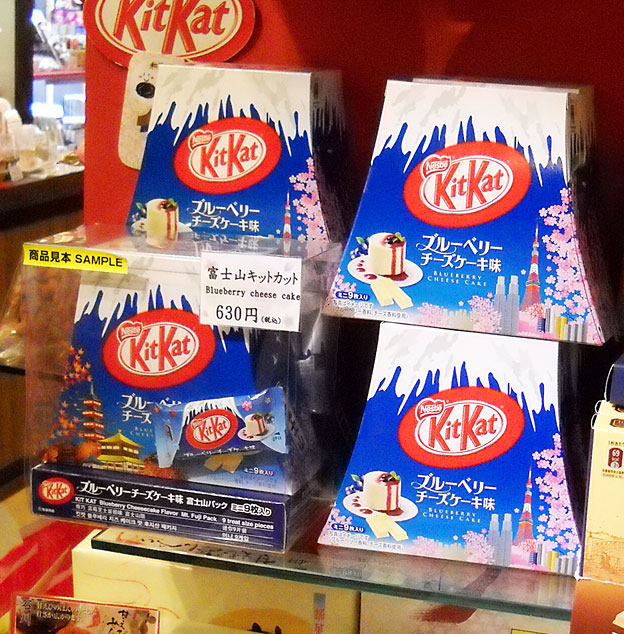
I'm pretty sure that I saw blueberry cheesecake KitKats were available in Japan in at least 4 different packages. I bought them as single stick bars quite some time ago and saw them as a regular bar with 4 fingers at one point. I also saw them in a conventional regional KitKat box. Just as I was leaving, I saw them on offer in these Mt. Fuji style boxes. The boxes are rather cute and very appealing from the viewpoint of being a souvenir from japan, but I wasn't too keen on the blueberry cheesecake KitKats when I tried them before and can't imagine these would be appreciably different. Still, I may have gone for them on "my way out the door" (leaving Japan).

Monday, May 21, 2012

Tokyo Nihonbashi Kuromitsu KitKat


This is one of the regional KitKat varieties that I picked up at the airport on the way out the door when I left Japan. It's important to say that my husband was the one who spied this and wanted it because he interpreted "kuro mitsu" (black sugar syrup/honey) in Japanese to mean "brown sugar". Since this was going to be one of the last things we'd purchase on Japanese soil, I didn't want to rain on his parade and I said, "sure, go ahead". The truth is though that I didn't think this wasn't going to taste like brown sugar as he knows it.

People who bake know that there are different types of brown sugar. People who eat may know so as well, but for most people sugar is sugar. Most people don't know what caster, demerara, muscovado and turbinado sugar are. The more sophisticated sugar consumer tends to know three things; white, brown, and powdered. I'm no culinary snob so I don't care if people can separate different types of sugars. Unfortunately, my husband is one of the types who knows only the three shades of sweetness previously mentioned. It's dark and sugar, so, it's going to be brown sugar. Yay! Brown sugar! He loves brown sugar.

I'm here to say that kuromitsu ain't no brown sugar. It's a type of syrup that is often used on warabi mochi and other Japanese sweets. It's fine and dandy for various applications, but it's not pleasing to the palate of someone who is looking for that very definable flavor that comes with oatmeal cookies, pecan pie, and spoonfuls of cavity-creating pleasure taken straight from the brown sugar bag. The question of whether or not the flavor pairs well with the white chocolate and wafer combo of a KitKat is also a very valid one.


I'm sorry to say that, having spend 840 yen ($10.63) and having 12 mini bars (69 calories each) on hand, that it isn't the greatest pairing. Speaking as someone who likes the sublime combination of kuromitsu when drizzled over soft blobs of kinako-coated warabi mochi, I was especially disappointed, but not surprised. I think that the bland mochi and nutty toasted soy flour (kinako) are a nifty pairing, but sweet white chocolate is not its friend. It's sweet and intense paired with more sweet and slightly milky.

On top of this being a very so-so KitKat, there is also the fact that it has to be one of the oddest  regions to offer a KitKat from. Nihonbashi is a business district in Tokyo. It's not a bad place to go or anything, but it's hardly a heavy tourist district and, as far as I know, it is not really related to kuromitsu. It does relate to the Mitsui family who brought Mitsukoshi department store to Japan so this may be a play on words (mitsu, Mitsui), but it seems a tenuous connection at best. I think Nestle Japan is either trying to hard, or not trying nearly hard enough.