Showing posts with label jelly. Show all posts

Saturday, April 21, 2018

Orihiro "Standing" Jelly


The latest in my continuing marathon of reviews of my ZenPop box is a "health" drink/snack from Orihiro. Orihiro specializes in food targeted toward women who are calorie-conscious and up on all the latest food fads that are supposed to keep you younger looking and in the pink. These are the women that keep the price of Manuka honey in the stratosphere because someone told them it'll cure every illness known to man and they believe much in the same way Fox Mulder believes in aliens - they want to believe.


People think wasabi KitKats are part of the "weird" Japan food culture. They've got nothing on this squeeze pouch of mutant gelatin snack. I have to say this one caught me by surprise in multiple respects. The first surprise was when I sqeezed the tube to see what popped out and some juice squirted me in the face. This is less a tube of jelly as it is thick gelatin globs floating in some sort of juice.

You have to make sure it is in your mouth when you squeeze it. It'll be a textural Russian roulette which one you get. My main problem was that I wanted to see what it looked like and get a picture for this blog. My loss is your gain since you won't have to actually have the bottle disgorge anything onto your body in order to know what is inside before you suckle on it.

In terms of how this tastes, the peach flavor is actually very pleasant and tastes a lot like nectar drinks. The ingredients list includes real peach juice. The main problem is that it is insanely sweet and you can taste the artificial sweetener all too well. It's made with both Sucralose and acesulfame K. Honestly, for something that is sold by a company with "health" in their URL, this is not especially healthy. It's a chemical cocktail to satisfy your sweet tooth with a low calorie load, but it's even sweeter than conventional sugar-free gelatin.

I wanted to like this, but it was just too fake-tasting for me, and I'm someone who uses Splenda everyday in hot beverages so it's not a sensitivity to sweeteners. I think they really just needed to dial back on the overall sweetness level and this could have been a nice way to satisfy a craving.



Friday, March 7, 2014

Biscuit Chocolate Orange Marmalade Lobes


So, the way I've  named the product in the title sucks, but I can't read much of anything on this box and am flying blind here, so, give me a break, okay? You try to translate Cyrillic without having any experience whatsoever with the language and see how far you get in figuring out company names. Harrumph.

My husband and I picked these up because we love jelly slices and these looked very appealing indeed with their large sugar crystal coating. One might think "sugar-coated" = cloyingly sweet, but the sugar on these has more of the effect that powdered sugar has on donuts or waffles. It adds a light exterior sweetness rather than an enormous wallop of sugary overload.


Though the center is not super sweet, they are still very tasty. The orange flavoring is strongly reminiscent of orange juice, though that is not one of the ingredients. The ingredients list includes "flavour" (orange) and citric acid. I'm also pleased to note that this does not contain artificial colors and is dyed with curcumin. If you are keeping up on dietary supplment fads, that's a hot one right now.

The slices are a little hard on the outside, like a slightly crispy sugar shell and quite soft on the inside. They are not like a gummy, but rather like a pate de fruits inside. This is a splendid combination. You also get good crunch from the sugar granules. There could be a touch more of a citric acid bite for my tastes, but I'm not complaining.

The company that makes this, Biscuit Chocolate, makes a fair number of confections with a much heavier focus on chocolates than this type of fruit candy. They do make jujube, which is a lot like these slices except in a different shape. They offer a lemon slice version in addition to this orange one. I'd try the lemon one in a heartbeat if I can find it. Note that this uses pectin and agar to jell the candy, so I'm guessing it may be safe for vegetarians. It uses egg white though so it's a no-go for vegans.

I found these for $3.49 at a market in Palo Alto that specializes in Eastern European and European food (a lot of it is Ukranian). I found them on Amazon without a price in different packaging, but they are definitely the same thing though the Amazon one is a mix of lemon and orange. If you like pate de fruits and are looking for something more low rent than what is generally available at the types of stores that sell it (which tends to be the expensive kind), then I recommend giving these a try. They'll satisfy your desire without hitting your wallet too hard.


Wednesday, January 8, 2014

Random Picture #196


One of the problems I had before leaving Japan was that there were all sorts of nifty things which I wanted to buy and bring back with me as souvenirs, but I knew I couldn't fit them all in our bags. I also knew that, cute as some of them were, they didn't have much in the way of utility. I could justify buying a yukata, but not a plastic figure. 

It seems that I did not necessarily leave that temptation behind. The above picture is of plastic bento boxes with shelf-stable gelatin ("jelly", as it is called in Japan) desserts inside of them. The price is a bargain considering that the cheapest bento box that you can buy is $1.50 (at Daiso Japan) and is not as cute as these. You get gelatin and a keepsake. Tempted as I was to pick up one of these for posterity, I just could not think of a good use for the box so I reluctantly passed. If I could have found a pragmatic reason, one of those cat face boxes would be in my possession right now.

Thursday, September 12, 2013

Glico Dororich Cafe (product announcement)

Image courtesy of Glico.

I sometimes wonder if some sort of "assembly" is supposed to make a food more attractive to people or if it just is all about creating a unique end product by not preparing everything beforehand. This product has a layer of "coffee jelly" on the bottom and whipped cream on the top. You're supposed to shake the snot out of it and then some sort of fluffy, foamy beverage that you will be impressed by. Personally, I've never found the notion of drinking thin gelatin mixed with whipped cream through a straw a very enticing proposition. Of course, it's also not something I've ever thought would be offered to me either.

The truth is that coffee jelly in Japan is actually quite good, especially with a little whipped cream on top. However, I'm not sure that I'd like this considering that it's good because you can get the textural contrast between the gelatin and cream as well as the flavor variation between the bitter coffee jelly and the lightly sweet, milky cream flavors. By mixing them together, you're killing at least half of the fun.

Wednesday, January 30, 2013

Random Picture #147


Recently, my husband and I ran across an enormous heart-shaped box of chocolates in Safeway Supermarket. It was about as big as his chest and he held it in front of him and I took a picture of it to show our friends back in Japan. The idea was to illustrate this ridiculously huge novelty box with a little over 2 lbs. (a little under a kilogram) of low quality chocolate in it.

The reason that it's such a good shot to show Japanese folks is that novelty containers of any appreciable size are not especially common due to the smaller dwellings. Tirol will make a few novelty boxes, but they are small and generally made to be immediately disposed of when you get a tad bored with them. It's not only about storing the packaging, but it's also about finding the space in the trash to dispose of them. Trash cans in Japan aren't the behemoths that you see in the U.S., and you are obliged to break things down for recycling (and to wash them).

What is shown in this picture are two novelty containers for "jelly" confections. These are essentially shelf-stable gelatin (made with agar agar, a substance derived from seaweed) in fruit or yogurt and fruit flavors. I'm guessing the market these are designed for are parents or others buying gifts for children, but in Japan it's just as likely to be designed for office girls as you don't have to be a child to get your Hello Kitty on.

Monday, October 15, 2012

Kinjo Imo Yokan


Part of the unwritten "mission" of this blog is to allow people who encounter what appears to be odd Japanese snacks to understand what they're buying. Another part is for me to just have an outlet to prattle on about and try and be creative about something which is, at its core, pretty mundane (talking about food). Sometimes I succeed at one or both of these, and at others, well, I just phone it in because I'm only making like 10 cents a post here from my ads and I can't always bust my brain pan for you people... not that I wouldn't like to, but sometimes life is rather busy and sometimes I'm rather lazy.

Yokan is definitely one of those mysteries to the average tourist or newcomer. The history of this sweet is mentioned on Wikipedia, but essentially it's one of those things the Japanese ripped off from another country (in this case, China), and then gets credit for inventing. This is like "Japanese cheesecake", castella, chitose ame, and "Japanese bread (shoku pan)". I thought this might have been some sort of effort to preserve food, but it's actually a variation on a Chinese treat made from boiled sheep. Yum. Yum. I'm glad that Buddhists decided it would better to thicken things with agar agar and red bean paste and let the poor sheep alone.

I found this, alone with many other yokan options, at Daiso Japan, but this is an extremely popular and easy to find treat in Japan as well as Nijiya Japanese markets in the U.S. It is cheap (only $1.50) and keeps for quite awhile. In the summer, it's nice if  you eat it chilled, but I generally think the flavor is better at room temperature.


This doesn't really smell like sweet potato, but it does have a distinct aroma which is hard to put ones finger on. It smells like something sweet, like sugar that has been cooked for a long time, but without any strong notes of a particular scent. The flavor is like red bean paste mixed with sweet potato that has just reached an intensity before it becomes overbearing and settled at the furthest point before it becomes unpalatable. It's intense, but not in a bad way. Unsurprisingly, because the second and third ingredients respectively are sugar and corn syrup, it's quite sweet, but not cloying. This isn't meant to be wolfed down. The whole 4.8 oz./130 gram bar is supposed to be two and a half servings (a whopping 170 calories per serving), after all.

The real star for me of this is the texture. It is firm, but smooth, and has just a bit of grain from the beans. It's like gelatin, but without the slippery, slickness of it and with more flavor depth and just enough texture to give it heft. I wouldn't be surprised if part of the process of making this was to finely filter it such that very little that hasn't been pureed into smithereens didn't get through.

I loved this, but then I love both bean paste and sweet potato. That being said, this is far from the "beaniest" treat that one can have in Japan and is very accessible to those who hate anko. It's a good gateway experience for those who think the whole idea of sweet bean paste is gag-inducing, at least if they like sweet potato. The texture is like the inside of a jelly bean, and that can't be wrong, can it? I'd definitely buy this again.


Wednesday, July 27, 2011

Random Picture #72

Click for a bigger picture. Note that many of these are yogurt and fruit combos, though all of them have so much sugar in them that they can hardly be considered healthy for such inclusions.

Displays of gelatin (what is called "jelly") in Japan are being beefed up because of the hotter than hell summer and weaker than a new-born kitten air conditioning. At first, I thought this might be all about fooling people into thinking tossing one of these tubs in the refrigerator and gulping down a slithery bit of gelatin coolness would make them forget that they'd sweated an embarrassing huge web spot on their shirts, but I'm starting to believe otherwise. The shops themselves aren't exactly showering us with cool relief which means that their chocolate stores have a good chance of melting in 82 degree F./28 degree C. settings. It's far safer to stock jellies than to stock other sorts of sweets in the summer.

Thursday, July 7, 2011

Tarami White Jelly


I keep talking about summer in my reviews, but with people melting onto the pavement and sweating in the intense humidity of the rainy season, and the various food companies pandering to all of us, how can I ignore the fact that the heat drives snack product introductions. That means less chocolate, more lighter, fruitier options, and especially more things that go down smooth and easy from the refrigerator case. That leads me to "jellies" (or, as we call them in the U.S., gelatin). There has been an explosion in the number of individually packaged gelatin options and most of them are pretty mundane fruit options. This "white jelly" caught my eye, because I don't know what "white" tastes like. That phrase could really be taken the wrong way...

I found this for 178 yen ($2.28) at Family Mart for 290 grams (10 oz.). That's on the expensive side, but it is a pretty large portion size. This is zero calorie jelly and I'm guessing the large amount is to fill a belly that wants to be full without any risk of weight gain. There are more and more of these products in Japan all of the time as the quest for an alien body image has spread here from the West to the East.

The company that makes this, Tarami, specializes in making a wide variety of gelatin desserts. Their main business is doing the kind with sugar based on fruit and real fruit flavors. Their zero calorie lines are split into two sizes with the smaller ones being fruit flavors and the bigger ones adding more esoteric varieties like cola and "white" to the line up. Their web site shows farms and lots of orange trees, but somehow I doubt their 400 or so employees are working the farms to fortify their gelatin desserts.


As for what "white" tastes like? It tastes like a sweet, slightly fruity Asian fruit cocktail and is somewhat yogurt-like. It's both a little tart and sour, but the flavor is on the mild side with no overwhelming sweetness. Since I'm accustomed to artificial sweeteners, this didn't bother me. In fact, I'm nearly immune to the chemical cocktails (Acesulfame K, Sucralose, Aspartame) that are used to formulate diet foods.

The part where this shines is in the texture. It's a cool, soft and slick jelly with chewy bits of nata de coco in the bottom. The textural variation that comes from the nata de coco is quite welcome and lends the illusion that you're eating something with a bit of substance. I should note that many Japanese gelatins like this include blocks of konnyaku jelly or nata de coco.

I liked this just fine, but I wasn't mad about it. The truth is that I can make more flavorful zero calorie jelly myself using plain gelatin, packets of artificial sweetener and whatever flavoring agent I want (coffee, tea, lemon, lime, etc.). That doesn't mean I couldn't see myself buying this again and it was perfectly pleasant. However, I'd only purchase it under the most unique circumstances because the size is bigger than I need and the price higher than I'd prefer to pay. Chances are, I'll never sample it again.

Just a gentle reminder that there is a contest running for two weeks to win a few snack and snack-related goodies. If you'd like to enter, the details are in this post.

Friday, May 6, 2011

Kan-etsu Mikan Gelatin Dessert


When I first searched for this company as part of my research, I came across a company with exactly the same name and a Japanese domain name which did construction. For a moment, I wondered if this was some mutant food product created from industrial chemicals that usually go into building houses. Perhaps the construction company wanted to diversify their business model by branching out into calorie-free desserts. Fortunately, I came across the food making Kan-etsu, which has a non-Japanese domain name (.com, not .co.jp)

I found this at Peacock supermarket while I was searching for cheese for my husband's sandwiches for lunch. I had been driven to Japanese cheese because it seems all or most of the Costcos in Japan have been shut down since the quake. More than a month after the quake, the Tamasakai branch that we usually go to was barred and denying us access to the Colby Jack cheese and cheap Starbucks espresso beans that we so desperately need. In desperation, I bought 8 small (18 gram/.63 oz.) plastic-wrapped slices for a whopping 278 yen ($3.42), and this 100-gram pack of gelatin for a mere 98 yen ($1.21). There were 4 flavors on offer - coffee, grape, mikan (Japanese tangerine), and grapefruit. The retail price is 148 yen ($1.82), so this was a "bargain".

The first bite has a nice hit of orange (mikan) flavor followed by unpleasant bitterness. I assume this is related to the aspartame and Sucralose that sweetens it. After two or three bites, the bitterness goes away and the sweetness amplifies. Unfortunately, the orange flavor also mellows with future bites. The gelatin, which is made with Japanese agar agar rather than animal products, is shelf stable (doesn't require refrigeration), but quite soft at any temperature.


This is a fairly large serving of gelatin, and though it claims it is zero calories, it's actually 5 calories for the whole 100 grams (3.5 oz.). That probably comes form the orange flavoring which is from fruit juice concentrate. It also has added antioxidants. The whole point of this is to fill a craving for dessert or to fill a grumbling belly when you don't want to eat something more fattening. To that end, it does work, though I believe the sugar-free Jell-O gelatin, which I haven't had for about 4 years but can still recall, tastes a bit better. Both this gelatin and Jell-O brand (sugar-free) have an aftertaste from the artificial sweeteners, but the latter has a more citric acid zest to it which makes it taste more like orange.

If you're trying to reduce your calories, and desperate to quiet a grumbling belly, this will do you. I wouldn't expect too much from it though and I don't think I'd buy it again. There are better calorie-free gelatin/jelly options out there that will fill the bill as well or better.

Wednesday, June 30, 2010

Slim & Slim Mango and Grape "Jelly"


When I first came to Japan, diet foods were pretty much nonexistent. There were pleasantly chubby Japanese girls, but they were seen as "healthy", not "fat". In the past decade and a half, diet foods and focusing on weight loss has grown exponentially. You see more products with "Zero" on them every year.

Part of me is sad about this because I think that it reflects diet obsession, which is never a good thing. Part of me is glad because I am a willing consumer of such foods. Of course, I have an excuse, I arrived in this country "pre-corrupted" by Western obsessions with dieting. Sometimes I think that the more we focus on our eating, the fatter we get, and I worry that the Japanese may eventually fall victim to the same problems as Westerners as their culture learns to promote fear of weight gain to sell products which eventually end up causing weight gain and food obsession.

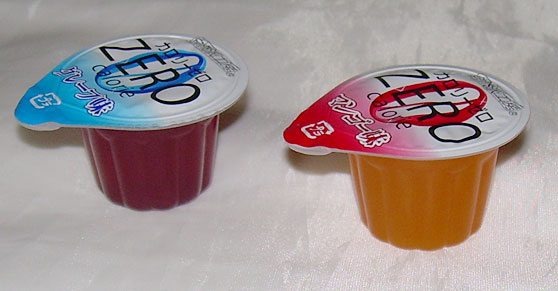
Sociological issues aside, and I'm sorry to get so serious, but sometimes things take on a life of their own, I decided to finally dive in and try one of the plethora of zero calorie "jellies" (actually, it's what we call "gelatin" in the U.S.). I've seen big, single-serving size tubs of them in convenience stores and snack shops for quite some time and had passed on them. When these two varieties of smaller size jellies showed up for 89 yen (97 cents) per bag at Okashi no Machioka, I decided to dive in.


Note that I have tried regular (that is to say, sugar-filled) Japanese single serving gelatin tubs before. I wasn't a fan of them because they seemed toothachingly sweet. I can compare these sugar-free versions directly to that version. The first ingredient is Erythritol on both flavors and their respective fruit purees are the second. I don't understand how each can be zero calories and contain fruit puree, but there it is. The mango version is colored with carotene and paprika.

The mango has a pleasantly fruity smell and a nice mango flavor. It's not too strong, but it is rather sweet. It mainly lacks the citrus tones that you get with a real mango, but the flavor isn't bad at all. The grape smells like a grape lollipop and pretty much tastes like one. I think both of these would have a bit more punch with some citric acid or the equivalent.

I tried these both refrigerated and at room temperature and they're more pleasant when cold. The texture is pretty much what you'd expect for gelatin, though this is less firm and rather soft set compared to American gelatin like that you make with Jell-O mixes. Both also have a bit of liquid which tastes like juice around the outside.

These are pleasant tasting and not painfully sweet (which is better than the sugar-based jellies I tried before). They're even a little bit of a refreshing mouthful (each tub is 22 grams/.77 oz.) in hot weather when you have them cold. The thing that did surprise me though is that they tended to suppress appetite. Perhaps the gelatin is designed to achieve this effect, or it was just psychology, but I really did find that eating two of them (I tended to eat one of each flavor each time) killed my hunger for awhile.

I'd recommend buying these and putting one in your refrigerator if you're on a diet or have a tendency to eat more than you'd like. I think the mango is better than the grape, but both are fine. These aren't healthy at all since they have a chemical cocktail (Acesulfame K, Sucralose), but they seemed to serve me well when hunger struck and I either couldn't eat or didn't want to.

Wednesday, March 10, 2010

TopValu Light Meal Konnyaku Jelly (Lychee)


Some time last year, I started to notice more and more zero calorie jelly (what we call gelatin) products for sale in convenience stores. This "light meal" nutritionally balanced drinking gelatin is something which has also been around for years, albeit not in as many zero-calorie forms. I wanted to sample it for my week of diet/health foods, but I'm a bit squeamish about the prospect of a drinking jelly.


I squeezed some of this into a glass, and what I saw didn't encourage me. You can't see it from the picture I took, but there are little wispy shreds of clear jelly suspended in a yellowish liquid. They resemble amoebas with a thyroid disorder. Of course, you're not supposed to squirt this stuff into a glass and drink it. You're supposed to suck it out of the tube at the top. This is good because it's very difficult to squeeze out. The packet is designed to keep it from spilling out. It works like a steel can of evaporated milk that only has one hole pocked in it. There's not enough of an exchange of air to allow the free flow of the jelly.

This is made with konnyaku jelly, something which I have been far less than keen on in the past. I tend to dislike the texture of it when it's put in stews and other Japanese dishes. If you don't want to read the Wikipedia entry, I'll tell you that it's jelly, often in a mottled gray block form, made from a plant (konjac). Konjac is a "corm", which is similar to a tuber or yam, but doesn't have the same properties. It is consumed for its texture, and its high fiber, which fills the stomach and aids digestion. In Japan, it's usually salty and used in traditional dishes, but it's popular in Asia in jelly drinks as well. People sometimes choke to death on it, but I can say that there is little risk of choking on the soft konnyaku in this beverage. It's too wispy for anyone to get lodged in his or her throat.


I chose the TopValu brand because it was cheap. I paid 98 yen at a local supermarket for this 180 gram pouch. There are a plethora of other choices, and I'm guessing most of them are roughly similar to this one in consistency and in having a huge list of added nutrients. Clearly, this is meant to fill the belly of dieting people who want to feel full, get nutrients, but consume no calories. This packet was fortified with B vitamins, D, E, Folic acid, and Panthothenic acid. It contains a pretty hefty cocktail of artificial sweeteners including Erythritol, Acesulfame K, and Sucralose. It also contains kale, which is popular in Japan for its nutritive properties. You can buy powdered kale and dissolve it in water to drink; it tastes as good as it sounds.

In theory, this is a great idea. The big question is about how it works in practice. The texture isn't nearly what I thought it would be. It's not slimy, but rather like drinking super soft tapioca bubbles. I have never had bubble tea, but I imagine this is a distant cousin to it texturally. The smell is rather fruity, like a cross between an apple and a peach. The taste at first is very sweet and like a fruit gelatin. I rarely eat lychee, so I can't know how faithful the flavor is to the fruit. It's not an impressive flavor, but it's unoffensive. The main drawback is that there is a bitter aftertaste after you've sucked down (literally) some of it. The only other drawback is that I feel goofy as an adult suckling on a tube like a baby with a bottle.

This type of food isn't meant to be some fantastic and tasty snack, but rather as a palatable health food to stop you from snacking on things that aren't good for you. I can say that it is inoffensive, and the sweetness is initially quite gratifying if you're hungry. I can also say that, without a doubt, it made my stomach feel full and that I would recommend anyone who counts calories and struggles with hunger give this a try. I don't know if it would actually replace a meal, but it would certainly help you stave off a case of the munchies between meals and I'd buy this again. In fact, I wouldn't mind keeping one on hand when I'm having one of those days when I just want to eat all day. Note that these last for months.

Wednesday, February 10, 2010

Kinsei Purple Potato and Sweet Potato Jellies


In what I have to imagine is a last gasp of seasonal treats for winter, I came across this bag of purple and sweet potato jelly candies at Seiyu supermarket. The front of the bag touts the fact that they have potato "paste" in them. I'm not certain how one makes "potato paste", but it doesn't sound appetizing. Nonetheless, seeing these little jewel-colored cubes of candy through the clear plastic package drew me in.

Like many of these relatively unglamorous types of candies, these are made by a "no name" company which doesn't have a web presence. I couldn't research anything about them and I can only say that their logo and name, Kinsei (金成), are unfamiliar to me.

Most of the hard candy, jellies, and manju that are sold in clear plastic packages in bigger markets are made by such companies and they're the final frontier in Japanese snack adventuring. They're far less likely to be constructed in the same manner as European-style treats or contain familiar flavors and they're a bigger mystery to those who are unfamiliar with Japanese snacks. I like to try these types of things, but I often feel they are of far lesser interest to my readers than things like Pocky, Japanese KitKats, chocolates, and Hi-Chew. Also, frankly, I can't eat them fast enough to sample them constantly as they tend to be in family-size bags.

There were 15 candies in my bag and 10 were purple potato and only 5 sweet potato. I don't know if this was just the luck of the draw, or intentional. It did seem like quite an uneven distribution though. I had to calculate the calories based on the weight of the entire bag because the information was only given as per 100 grams. Each candy is about 31 calories.

note the edible wrapping sticking far above the cube of jelly

When you unwrap a jelly, it has what looks like an over-sized thin bit of plastic film wrapped around the sticky cube. The film is edible rice wrapping which is similar to the coating on medical gel caps. I had to figure this out by tearing some off and putting it in my mouth to see if it'd melt. It doesn't add any taste, but it is an odd texture sensation to bite through what feels like thin cellophane wrapping. It's hard to escape the feeling that you were too stupid to take off the wrapper. Soon enough, the wrapper has melted away though.

Both of the jellies are firm, but not rubbery. They are easy to bite into and chew. The texture seems strange at first, but I quickly got used to it and rather liked it. It's like a very chunky version of a classic Western-style fruit gem without all of the sugary coating. It also turned out that it didn't matter how many yellow and purple cubes there were as they did not taste appreciably different. Both had a nice sweet potato flavor, were quite sweet, but not too over the top and the exact same texture.

I really liked these. In fact, the more I ate them, the more I enjoyed them and thought one or two were a great sweet to have with a cup of tea. If you like sweet potato and jelly candies, definitely give these a go if you run across a bag of them. The only thing keeping these from getting a "very happy" rating is the wrappers. I wish they were more carefully wrapped so that the excess didn't stick out around the cube and make you think you were eating plastic.

Wednesday, July 15, 2009

Nico Nico Niccori Jelly


These Japanese "jelly" candies are really just gelatin in disguise. This is something which I sort of forgot when I bought this bag of "jellies", but was quickly reminded of when I sampled them. These are essentially prepared, all weather (as in they require no refrigeration), individually wrapped tubs of gelatin made from kelp instead of animal parts. I must say, looking at it that way either makes these much more attractive (hurray! no animal died in the making of these gelatin treats) or less attractive (yuck! eating seaweed derivatives).

I don't know many people who make their own gelatin desserts in Japan. There are boxes of gelatin as well as plain gelatin available in shops, but the variety and quantity is very limited. Most people buy these individually packaged versions. I guess that the joy of slowly moldering Jell-O in the fridge and it's fake fruity jiggliness hasn't caught on here.

back row: orange, melon, pineapple front row: grape, strawberry

You can get about one-cup-size tubs or ones with tiny amounts of gelatin like the ones I sampled. If I had to guess at the volume in one of the containers in the package I bought, I'd say it's about a tablespoon. The bag I bought lured me in because it was incredibly cheap. It contains 27 itty bitty tubs of gelatin for only about a dollar (98 yen). There are five flavors, grape, orange, melon, strawberry, and pineapple.

The first ingredient in these is grape sugar and puree, fruit sugar and puree from the various fruits represented by the flavors, and kale. The fact that there are a lot of sugars in them is a clue of what is to come. These are very, very sweet. In fact, they're far sweeter than any Jell-O I've ever made from a mix or gelatin I've had back home.

An unmolded orange jelly, with a small deformation from pushing it out of its tub.

When I opened the bag, it smelled like lollipops. Even though the tubs look airtight, they clearly are not or the bag itself wouldn't smell so fruity. Eating these requires you to tear back the top and then push the bottom to "pop" the gelatin out. The size, shape, and mechanics make it clear that you're meant to pop them directly into your mouth. No utensils, no mess, no fuss, but a lot of trash for a tiny bit of gelatin.

I was going to review each flavor individually, but the truth is that I can sum up the flavor of each of them in the same manner: super sweet and intense. The fruit flavors are real, but concentrated. It's a lot like eating a spoonful of cheap, off-brand jelly (yeah, the type you spread on toast) on the flavor front and slightly soft gelatin on the texture front.

It wouldn't be bad to toss these in the refrigerator (Nanao Seika recommends you eat them cold) and have one on a hot day as a quick, sweet pick-me-up, but I really am not a fan of the super sweetness or the concentration of the flavor. Frankly, I think these might be marketed more towards children rather than adults. More expensive and larger size versions of these types of gelatin desserts tend to have bits of fruit in them, which adults might favor. I gave away the rest of the bag and I don't plan on buying them again.