Showing posts with label Korean. Show all posts

Friday, June 20, 2014

Haitai Choco Flavor Homerun Ball


I'm not a person with a plethora of bad habits. In fact, I'd say that I have far fewer of them than the average person. I don't procrastinate. I don't smoke or drink alcohol. I maintain good sleep hygiene habits. I don't watch much T.V. nor engage in any activity to excess. I do appear to have one habit which I might want to consider breaking. That habit is making decisions about food based on how amusing I find the names of the products to be.

I picked this snack up at a Korean market because the idea that it was named after baseball struck me as funny. Now that I have tried them, nothing about them is the least bit entertaining. I'm not even sure now why I found the name amusing, but I guess it's because it seemed weird for a Korean snack to be named after something related to baseball.

Incidentally, if you look at the picture, you will note that their is a graphic of a gold emblem in the upper right which says "premium". Now that I think of it, that is the most hilarious part of this. The product contained inside is about as far removed from being "premium" as I believe a treat can get.


The picture on the outside shows you what looks a little like a chou ball filled with chocolate cream. The little balls of dough contained therein are reminiscent of a choux pastry. They are airy and actually taste similar to those French delights. The point at which they diverge is the texture. If you bought a choux and left it sit in a closet for 6 weeks or until it reached a desiccated state more akin to Styofoam packing peanuts then injected it with a bit of chocolate, you'd have these. In fact, the major failing of these, and it is an incredibly enormous one, is that the balls are so dry and the texture is spongey and lacking in all delicacy.

It could be that there is some truth is advertising involved in this product. I've never chewed on a homerun ball and these might actually have verisimilitude with a baseball if you tried to eat one. I can't imagine it could be a whole lot worse than one of these.


Friday, May 30, 2014

Nongshim Banana Kick Snack


I've often thought that it would be cool to work for the art department of a snack company. You can come up with all sorts of kooky mascots for equally kookily (not actually a word, I know) named products. I'm sure someone sat around frowning in concentration to come up with a banana that is kicking into the air at an invisible soccer ball when pondering this bag's design.

The "genuis" of this design isn't the anthropomorphic 'nana. No, that was easy. The hard part was deciding his attire, and, I'm sure, if he might have been a scandalously nekkid banana. I'm sure there was much more frowning and thinking as the designer came up with a little word association to think of what to do besides put on a flirtatious and energetic-looking banana. You could imagine him saying, "hmmm... hmmm... (though likely he said "hmmm..." in Korean since this is a Korean product)... bananas... banana split... banana boat... banana peel... bananas shake... bananas and... bananas and monkeys! Yes, who doesn't associate monkeys and bananas? So, we've got a monkey. Why would a banana hang out with a monkey? Well, he must be on safari. Yay! Ideao acquired!

Now that I've gone through the sophisticated creative process, I'm far less certain of the cool factor of working in the art department of a snack company. Perhaps it would be better to design the flavors or food varieties, but that's a post for another time. I've procrastinated long enough and it's time to talk about the actual food contained within the bag.


I bought these because, frankly, they sounded awful. I picked them up at a Korean market for about a dollar and I did it because it was too strange not to. It's not strange because it's banana, but rather because it's a banana salted snack puff. We don't tend to put fruit flavors on our puffs here, so this seemed like a chance to try something quite different.

I assumed this would be sweet, and I'm not exactly a stranger to sweet corn puffs after living in Japan for awhile. It is sweet and has a strong, but not particularly fake, banana flavor. The puffs themselves are super light and crispy. I've had this bag sitting around for more than 2 months, but it stayed fresh (shockingly). That being said, the date was July 11, 2014, so I beat the expiration. Of course, it was sealed.

The banana aspect of these reminds me a great deal of the type of banana chips that are shellacked with sugar on the outside and that people eat because they are supposed to be healthy. There is also an undercurrent of basic corn puff flavor. This could be a cereal, except that it is sweeter than even something like Cap'n Crunch.

The first ingredient in this is corn flour followed by sugar, rice bran oil, banana powder, palm oil, skim milk powder, artificial flavor, salt, lactose, egg white powder, and turmeric (no doubt for color). It's no shock that these are so sweet given that sugar is second on the list. They are surprisingly not so fattening. The entire bag (45 grams or about 1.5 oz.) is only 190 calories. For a salty treat, that's not bad.

These are not bad really, but it is too sweet for my tastes. I was never a fan of banana chips in general, but I could see this really appealing to someone who loves them. Not only does it tastes like them, but these are more fun to eat due to the light texture. They're very close to being something I like, but ultimately, just too sweet to merit a "happy" rating.


Friday, April 4, 2014

Spicy Ocean Snack Dried Roasted Seaweed


Among the many free magazine subscriptions that I acquired when I started poking around for what people will give me for nothing in America was "Us" magazine. Of the freebies that I got, this is the one which I generally regret the most. For one thing, I didn't realize that it was a weekly and I have to toss out more issues than I ever imagined. For another, it's making me sad. It's not that I don't recognize most of the celebrities - though I don't - it's the way in which the material is clearly presented to make people with sad and empty lives feel like their lives are just like those of celebrities and that makes me sad, but that is a point I've mentioned before so I won't belabor it here.

At any rate, the issue that arrived today endeavored to educate the populace on why Gwyneth Paltrow and her husband (whose name I forget and really don't care enough to look up -  I think he sings for some British band like Oasis or whatnot*) have decided to "consciously uncouple". I noted that Gwyneth only feeds her kids kelp and the finest Oxygen molecules that Harrod's has to offer, and it made me think that perhaps I should live a healthier snack lifestyle.

Though I don't have access to much in the way of kelp, I have been seeing a line of "Ocean Snacks" at the local Grocery Outlet Bargain Market. I figured that, while my blogging income doesn't allow me to live a GOOPy lifestyle, it does allow me to purchase nearly expired discount seaweed products from Korea. They may actually be from North Korea, for all I know, and that might mean they're radioactive or contain Kim Jong Il's ashes or something, but they only cost 99 cents for so I can't really complain.

There are three packages with little plastic trays inhabited by the wispiest of seaweed paper. I had this stuff in Japan on occasion, but it was never as thin as this and the truth is that I like it much better this way. Eating it in Japan, whether it was wrapped around a rice ball or just eating it as a sheet, was a lot tougher when it was thicker. This seaweed paper is like onion skin writing paper, only, tastier. Each sheet is a little crispy, has the grassy notes you'd expect from seaweed, and has a little spicy red pepper kick at the end. It starts to melt a little on your tongue, but it doesn't suck all of the moisture out of your mouth. It's really a pretty good experience, especially for being something which gets washed up on the beach along with dead sea life.


In addition to trying this as a straight-on snack, I also made my first onigiri with the intention of wrapping this around it. Unfortunately, my onigiri was a "jumbo" and two sheets of this stuff couldn't wrap around it's enormous girth. It did stick very nicely to the rice, but it wasn't potent enough to add much except a small grassy note to the experience. The pepper got lost in the blandness of the sticky rice, but these aren't designed to wrap onigiri so I'm not blaming the manufacturer. I just need to make less pregnant-looking rice balls next time.

I've heard that seaweed consumption creates rather vile breath and was sure to only eat this when my husband wasn't going to be around and snogging was not a possibility. That is the only drawback to eating these. Well, there's that and the fact that 20 of the 30 calories that a pack contains are fat calories. I don't know how they manage that, but I'm guessing this is deep-fried seaweed or something. With those stats, I'm not sure that Gwyneth would approve, but I do.


*I kid. I know he sings for Cold Play, but since I don't know what either band sounds like and that they're both British bands, I figure they are essentially interchangeable to my febrile mind.

Wednesday, February 5, 2014

Random Picture #200


My apologies for this being a random picture of something which is not Japanese, but this was a curiosity that I had to ponder and ask my readers about. The sign on this, if you can't see it, says "NS Indian Bob Snack". I don't know if this is supposed to be a Native American whose name is "Bob" (which would be a somewhat unusual name in such a case) or if "Bob" means something in Korean which I do not know about. I'm also not sure what being "Indian" (or more properly since the headdress makes it clear, Native American) has to do with this salted snack product. They are, apparently, made from corn so that may be the missing link.

The manufacturer's web site for this offers not insights other than this is a snack with somewhat politically incorrect overtones that is good for the whole family. 

Friday, October 25, 2013

Nongshim Sweet Potato Snack


One of the lessons that I used to teach Japanese students had to do with symbolic hand or finger gestures. The sign for "ok" in America, creating a circle with thumb and forefinger and raising the other fingers, means "money" in Japan (or so I'm told). Humans do not naturally fall into the same sensibilities about symbols. However, due to globalization, we are coming to share more and more of the them.

I never thought too much about this point until I investigated the web site ran by the  South Korean maker of this snack. I saw that this company is a distributor for American brands that I would not have expected to see abroad. In particular, they sell products made by Welch's, V8, McCormick's, and Kellogg's, and, most strangely to me, Morton. That logo of the little girl with the big umbrella walking through the rain? I'm guessing they must recognize that in South Korea, too. It's weird to consider that they know salt the way I know salt. 

This is my first experience with a product by this company and they lured me in with the promise of a sweet potato experience. The potato on the front is the equivalent of a stick figure in potato form, but he does look pretty happy. I'd like to join him in yam happiness.

I should have looked at the ingredients list before forking over my 99 cents for this 55-gram/1.9-oz. bag of salty snackness. The first item is not sweet potato, but rather is "flour". This is supposed to be a sweet potato snack, not an alchemical abomination! You can't make sweet potato gold out of ground wheat. That is madness.

The second ingredient is sweet potato, but is listed as "white sweet potato". When it comes to sweet potato, I'll admit that I'm a bigoted woman. I like them yellow or orange and am fully prejudiced against white ones. If it's white, it ain't sweet in my opinion. So, I've already gotten off on the wrong foot with this snack and the other ingredients including one that takes up an entire line by itself - fructoooligosaccaride - is not encouraging me to go on.


Nonetheless, I tried to approach this mutant snack with an open mind, and then wished it had stayed closed. The substance within is fried, no doubt, and it is lightly salted, but it is far from being "sweet" or "potato". In fact, what it mostly tastes like is frying oil that has seen far too many re-uses. If you're really eating slow (which I don't recommend as then that frying oil taste is in your mouth all the longer), you can get a very vague somewhat sweet potato-y after taste, but your taste buds have to be flexing all of their buddy muscles to catch this. On a "lucky" bite, you may get an errant bit of sesame seed (a few pieces have one) and it'll taste better. Some are also sweeter than others (no doubt due to getting more sugar-coating), but they'd need a lot more than the occasional extra bit of sugar or sesame seed to make me decide not to throw most of it away.

This was a major disappointment and I won't be finishing the bag. It's not so much that it lacks appeal as the frying oil flavor makes it actively unpleasant. I'd rather have it tasteless than taste like French fries made in oil that had been used all day without a change. It's been awhile since a product has been bad enough to  warrant an unhappy rating, but this one easily took the "prize."


Friday, September 20, 2013

Lottesand Black Cookies


When I saw this box on display at a Korean market, the English sign in front of it said, "Black Sandwich Cracker". This intrigued me because what is pictured on the box resembles a knock-off of an Oreo cookie, not a cracker. I wanted to know if the contents of the box actually were cracker-like confections and it only cost me 50 cents to find out.

When I got home and started looking more carefully, I saw that these are made by Japanese snack-making power house, Lotte. In fact, if you peruse the Korean web site, you'll see that there is substantial product overlap between countries including Ghana chocolate bars. I think that products produced for both countries are essentially identical. However, I could not find a chocolate sandwich cookie (or cracker) option on Lotte's Japan site. Perhaps they threw in the towel in that market and gave in to Oreo.

The main benefit of these cookies for me over Oreos are that they are sold more cheaply and in a smaller package. The first time my husband and I bought a standard size package of Oreos after returning to America, it took four months to eat it all. The second time, it took longer and we had to throw the rest away. It's just too much cookie for a couple of people who aren't gobbling them down like a crazed 8-year-old.


Of course, a 50-cent box is unlikely to live up to the greatness of Oreo, right? Well, maybe... The truth is that these were very good cookies. The bitter chocolate cookie exterior was flavorful and had a good texture. It lacked some of the fatty, crumbly nature of an Oreo, but it did not go anywhere near "cracker" territory. It was a more than serviceable cookie with just enough cream to make it interesting without making it too sweet or cloying.

Frankly, for my tastes, these were better than a standard Oreo, but I'm guessing those who are into double-, triple-, and whatever multiple numbers of "stuffs" they enjoy in Oreos will find the filling amount paltry and insufficient. It truly depends on how sweet you like your cookies. Oddly, the calorie count is not enormously lower despite the lesser sweetness and white stuff. The cookies are 45 calories each, but are smaller than an Oreo.

I wouldn't say that one should bust a gut scrambling down to the local Korean market (I got these at a place called "Super Kyo-Po Plaza"), but I'm guessing you could get them at any Korean market... provided you have access to one. I certainly would buy them again if I wanted to have an "Oreo" cookie around. They're not "better", but they are different in a way that suits my tastes (and pocketbook) better.


Wednesday, September 18, 2013

Random Picture #180


A word of advice to my readers about Korean vs. Japanese snacks - there is a lot of overlap between the markets. It's not only Lotte, which operates big time in both countries, but many other snacks as well. I've discovered that many of the products I saw in Japan were identical to Korean ones. If you want to try "Japanese" snacks, you can often just buy the Korean versions and it's the same food with different packaging at an often significantly lower price.

The item pictured above is a pretty good example. These "Choco Boy" cookies look very much like the "kinoko no yama" cookies that are easy to find in Japan (and in my area as well). The big difference is the price. You can't get the Japanese cookies any cheaper than $1.50 per box in my experience and these are a mere 79 cents. One of these days, I'll pick up a box of these and try them for comparison. For now, I'd just like to say that sometimes cheaper is not only just as good, but precisely the same. 

Monday, April 15, 2013

Haitai Sweet Redbean Bar


There's a scene in the second Indiana Jones movie in which he and the blond woman who kept screaming all of the time and the little boy they were running around with for some reason in which they are all served monkey brains. The brains are evocatively served in the heads they were once functioning within. The point of the entire dinner scene is to watch the hapless heroine, who was so annoying that I saw the movie once or twice and never watched it again, and the little boy, who was annoying but not nearly as much as the ditzy woman who later married Stephen Spielberg, freak out over the weird food. Their hosts nosh happily on these delicacies, but they are abhorrent to their guests.

One thing about food is that one man's feasting fungi is another man's toe fungi. The Japanese would eat live prawns, partially filleted but still living fish, poisonous blowfish, and offal. Some of these are delicacies and some are just plain people food (that'd be the offal). What one culture considers good eats, another finds disgusting. I've learned, for instance, that there are parts of the world that think mixing chocolate and peanut butter is a vile idea and that there are even more that find root beer truly disgusting (the Japanese certainly hate it, I know because I gave it to some to see how they'd react).

Even the most disgusting things can, over time, become quite palatable and even enjoyable with time, experience, and just generally allowing yourself to get used to the fact that it's something people find pretty tasty. In my early years in Japan, the idea of buying a brick of sweetened bean jelly for a snack would have seemed pretty gross. It's not monkey-brains-level gross, but I didn't even like beans in their more common savory presentations in America. I surely didn't think I'd like them mixed with sugar. Perish the thought!

Well, many Americans still recoil at the idea of sweet red bean paste (anko), but we're starting to see an awful lot of recipes for things like black bean brownies and cake as well as blondies made with white beans or chickpeas. There are entire blogs by fresh-faced, skinny, young white girls that are filled with sweets subbing in beans for flour to add moisture and density without the evils of flour. We're not through the sweet bean looking glass yet, but we're well on our way, kids.

Getting to the matter at hand, I had a moment that I thought I would never have at a grubby little Korean market located near Little Russia in San Francisco. Note, there is very little "Russia" in little Russia in that city and it was pretty disappointing. At any rate, I nearly "squeed" my pants when I saw this bar on sale and was even happier that it was only 50 cents for a 1.9 oz/55 gram bar. The reason it is so cheap is that it is a "product of Korea" that is marketed in both Japan and its native country. If I've learned anything from frequenting Asian markets in California, it's that anything made in Japan costs at least double what is made for Japan in other Asian countries. This is why more and more snack products aren't actually being made in Japan.

The company that makes this is Korean, but it used to be owned in part by big name brew maker Asahi. Two years ago, Asahi sold it's 20% stake in the company because it decided it would rather hitch its wagon to Lotte (who wouldn't? Lotte makes Ghana, after all!). Howver, Haitai makes a product called "choco homerun ball", so I find it hard to believe Asahi walked away from a product so named. Just think of all of the risky jokes they could have made! Though I linked to the English site, the Korean site is much better if you don't count the fact that I can't read any of it. Note that this bar isn't prominently mentioned on the site, but I guess that they have to focus on their more major products like the "Oh, Yes!" cakes and the aforementioned balls.


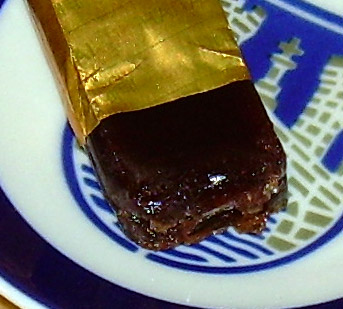
This bar is what the Japanese call "yokan" or jellied bean paste. It's very soft and I have to squeeze it up through its foil tube like super thick toothpaste to eat it. It is actually less "jelly" than "paste" and has a nice soft texture which feels like super smooth fudge without any of the pesky things like fat or chocolate. It is quite sweet, but not cloying, and does have that familiar undercurrent of red bean flavoring.

I'm not going to try and persuade anyone who sees this as monkey brains that they're going to love it. The truth is that you have to sometimes make a special effort to love some things that are outside of your general native cultural palate and many people aren't really interested in bothering (for which I can't blame them, really). I learned to love this after many years and really enjoyed this bar. I'd absolutely buy it again, especially considering how cheap it is. If you like anko, this is a treat. If not, this is not going to win you over.


Friday, November 18, 2011

Kkul Tarae (honey skein) Walnut and Chocolate Court Cake

Before I get too far in this review, I should state that this is not Japanese, but Korean. One of my students visited Korea for 5 days of sauna, massage, shopping, and luxury hotel enjoyment. This is a very popular course of action for young Japanese women these days since Korea is a hop, skip and a short swim away, though most take a cheap plane flight. It's well-recommended for vigorous rubdowns that slough the top layer of your disgusting dead skin away and brutally hot spa experiences. So, if you want to sweat and then have strangers scrub down your naked body in every nook and cranny, Korea is the place for you.

It's also the place for you if you want to try some unique treats, and I'm not talking kimchi, which is so common these days (at least in Tokyo) that it's absolutely mundane fare. My student picked this up from a street vendor and offered it to me rather apologetically because it wasn't particularly expensive. This sort of behavior, both gift-giving and then feeling obliged to express regret about the price despite the fact that the thought really does count more than anything, is something I will always associate with Japanese people and a culture which strongly encourages generosity and modesty.

The box provides a bilingual explanation including a story about how this is a "court cake of ripened honey and malt". In the past, it was supposedly presented to the king and guests of sufficient distinction that they deserved a treat that included 16,000 strands of honey. The box goes on to say that the strands suggest prayer for longevity, health, luck and wish-fulfillment. It also says it is good cold or frozen and then enjoyed with tea.

Because I can't read Korean at all, and the web site of the manufacturer is composed largely of graphics which can't be translated by Google's translation facilities, my ability to understand the ingredients or other information about this treat is extremely limited. This makes for a "purer" experience when sampling this food because I have to rely on sensory experiences rather than on what I read, but does limit my ability to provide meaningful information to my readers. I don't even know if the "honey skein" on this is actually honey. It sure doesn't look like it.

The outside of the candy is quite firm, but not brittle. When you bite into it, it yields like soft plastic and as you chew it, it becomes more pliable and chewy. Though the box claims it doesn't stick to the teeth, it does. In the end, it takes on a consistency similar to taffy. The outer "skein" doesn't have much flavor, but lends a delicate sweetness and a lot of texture. Most of the flavor comes from the mix of crushed nuts and seeds that are on the inside. They have a nice, meaty mixture of flavors including some very marginal bitterness with a warm, walnut finish. Though the box says "walnut and chocolate", I couldn't taste any chocolate at all.


This is an unusual treat which is very hard to describe because of the "honey skein" exterior and the combination of flavors inside. It's an interesting experience, but not necessarily a "great" one. However, it definitely is not a bad one either. In Korean drinks and snacks, I have experienced very creative use of nuts and walnuts in particular. I like it, but it's not the sort of thing which is easily accessible to all palates. If you're the type who just wants some sweet which won't challenge your texture and flavor perceptions, this will likely disappoint. However, if you're looking for something a bit more interesting, I'd heartily recommend giving this a try.


Friday, May 20, 2011

Market O Real Brownie


I've been seeing big boxes of these "Market O Real Brownies" at Costco for quite some time. One of my students even bought a case of them while she was there and only later realized that as a petite single woman, she might be eating them for the next two years. I wasn't going to gamble on a big box of an untested baked item, no matter how grandiose it's claim is about producing a "real" brownie. Brownies are very difficult to get right even when fresh, and it's that much harder when they're packaged to be shelf stable.

Because I have the chance to buy these slightly cheaply at Costco, I jumped at the chance to buy just one 35-gram (1.2 oz.) serving for 120 yen ($1.35) at 7-11. Note that though these are being heavily marketed in Japan, they are produced in Korea. The scribbly characters on the front of the package are Korean, not Japanese, but all of the information on the back of the package is in Japanese (not a sticker over a Korean label, but originally done in Japanese). So, we have a Korean brownie with Japanese packaging and clip art depicting a Western woman and her kid around 1950. These are cross-cultural brownies.


The brownie is nicely chocolatey, but quite sweet. It has a strange aftertaste that may be associated with preservatives. It tastes like a chalky version of actual chocolate as opposed to an actual brownie. It's lacking in that quintessential "baked" flavor of a brownie. The small brownie has 173 calories, which is pretty dense for such a relatively small morsel, but not out of line for something made with butter and sugar.

I can certainly make a much better brownie than this, but that's not really the question. The question is whether or not this would satisfy you if you wanted a brownie in Tokyo and couldn't or didn't want to make your own. The answer is that "it might". It really depends on where you place the bar for your brownies and how you like them. This is dense and somewhat rich without being very fudgey or moist. It's certainly better than most of the brownies you can buy in bakeries in Japan, which tend to be closer to dry cake than an actual brownie. In fact, compared to a standard bakery brownie, this is actually quite good. It just doesn't come close to a homemade brownie or one made from a Western-made mix, but if I was jonesing for a brownie to accompany a cup of coffee, I'd choose this over any of the other available convenient options. I wouldn't buy a case of them, but I'd pick up another single brownie if I was in the right mood.

Thursday, April 14, 2011

Dong Won Hot Tuna


My husband and I made a repeat visit to the "Korea town" area of Shinjuku in Tokyo last week and dropped in on a supermarket this time. My husband picked up several snacks, and I couldn't resist this tuna because of the name. I'm sure that it's all pretty tame stuff in Korean, perhaps the equivalent of "Trader Joe" there. To me though, I had to titter at the connotations. Besides, even without the awesome name, I would have considered sampling this since I do like tuna and spicy food. 

Based on the picture on the can, I expected this to be bits of tuna with little hot peppers sprinkled among it. My first surprise was that when I popped the seal and tried to "drain" the tuna, a red fluid ran out. After removing the top, I caught a whiff of that "dog food" type of smell that you sometimes get from canned meat products, even when they are for human consumption.


Looking inside, I could see something that resembled hash more than canned tuna. At this point, I was experiencing some pretty serious buyer's remorse. I wasn't sure it looked like something I'd want to put in my mouth, but I'd already forked over my 240 yen ($2.82) so I decided that I was going to, at the very least, get a review out of it.

It really doesn't look much better in a sandwich, except to the extent that you can see less of it this way.

Tentatively, I dipped my fork into it and speared what looked to be a tiny cube of white potato and gave it a sample. It tasted slightly spicy and modestly flavored with tuna. Actually, it tastes pretty good. Heartened by the sampling, I pondered exactly how I was going to eat it now that it wasn't what I thought it was. I was thinking I'd make some sort of spicy tuna salad by mixing it with mayo, but this isn't that sort of thing. There is a lot of sauce in it so it's not like dry, flaked fish. In fact, this appears to be a salad that is pre-made and canned so I just slathered half of it on a cheese croissant roll I had in the freezer and chowed down.

The tuna flavor is very present, but tamed by the spicy flavors of the red chili sauce and diluted by what look like carrot, onion and potato pieces. You can't really taste the vegetables though because they are very tender and well-cooked as well as well-marinated in the chili sauce. The sauce is only mildly hot and spicy, and slightly sweet. Keep in mind that there was no Japanese translation over the ingredients and I can't read Korean at all so I can't determine anything about the ingredients. That's actually a little refreshing for me since I can just rely on my senses rather than having to do research.

This was surprisingly good right out of the can and didn't betray much of the "canned food" taste that some of these sorts of foods have. I'm guessing that has to do with the tuna and chili sauce having strong flavor profiles. At 190 calories for the whole can (and one can offering two servings for the likes of me), this was a surprisingly tasty and low calorie lunch option. The only problems with it are that it's slightly expensive and  that I can only buy it at Korean supermarkets and they aren't exactly frequently dotting the landscape. That being said, I'd definitely pick up a can if I was in the area. It's a nice novel taste experience and a tasty quick meal.

Wednesday, March 16, 2011

Random Picture 54


There are parts of Tokyo which can be described as "Korean towns/districts" and my husband and I walked through one a few weeks back. We came across this food stand selling a type of pancake that it called "Jongno Hotoku" as well as something the Japanese call topoki (what the Koreans call "tteobokki", I believe). The topoki is a spicy  mix of rice tubes and what looks like a tomato-based sauce. The truth is that I've never had topoki, but I did once try a Korean salted snack based on it. The snack was slightly sweet and tasted like bell peppers.

The cheese pancake.

The jongno hotoku pancakes could be had in cheese, red bean or honey flavors. We tried the cheese and it had a somewhat chewy texture and tasted a bit like a conventional pancake. My feeling was that it was too bland, and needed some salt to bring out the flavors. It didn't help that the cheese that was used was processed and pretty flavorless. Still, it was only 200 yen ($2.40) and not a bad food stand snack. Next time, we'll probably try the honey version (my husband isn't a red bean fan).

Thursday, December 2, 2010

Korean Corn Tea (Oksusu-cha)


This blog is called "Japanese Snack Reviews", but it's my blog and I'll cover non-Japanese products on a very infrequent basis if I want to. Also, I'm guessing this is the sort of thing that anyone can pick up in a Korean or Asian grocery store and may be of interest to at least a few of my readers. To make a tenuous connection to Japan though, I will say that, if it weren't for one of my students, I would never have sampled this tea so living here is responsible for this review both in terms of my discovering the existence of corn tea and my having ready access to it (as there is a tiny little Korean goods shop not a minute from my apartment).

The student who told me about this said that she bought it because corn tea is supposed to be good for your skin and overall beauty. I did some research and corn tea is loaded with Vitamin E. It's also supposed to be good for digestion, high blood pressure, and to help those with diabetes for reasons I am unaware of. Only at the end of one article about corn tea and my second big cup of this tea did I learn that strongly brewed corn tea is supposed to be a potent and expedient laxative. I'll get back to you on that particular effect by the end of this review should it prove to be valid.


The import shop I bought this at sold this box of 15 bags for 230 yen ($2.76). At first, I thought this was a tad on the expensive side, but the truth is that I pay similar prices for about 10 bags of flavored teas made by Lipton such as maple, caramel, or mint tea. Lipton, incidentally, is considered more of a "premium brand" (especially the "yellow label" variety) in Japan than it is back home, where I consider it the dusty sweepings off of the tea leaf processing floor.

I only realized after getting the box home and turning it over that this isn't a box with 15 tea bags for 15 cups of tea, but that each bag prepared 2 liters of tea. This makes this much better value, but presents a bit of a pickle for the likes of me. I live with a devout non-tea drinker and putting away two liters by myself is going to take at least 3 days, if not longer. Also, I have no room in my small Japanese refrigerator for lots of drinks of any sort. Finally, I don't even have a 2 liter-size vessel to make the tea in!

Since necessity is the mother of invention, I improvised and made the tea in a pot and then poured it into two 1 liter decanters (which I couldn't fit in my fridge, but never mind). The leaves smell of roasted grain and the prepared tea smells a lot like popcorn. In its default state, it has a hint of Japanese barley tea (mugi-cha) as well as roasted corn flavoring. I think the roasting is what brings on the resemblance to mugi-cha since both oksusu-cha and Japanese barley tea use roasted grains. I didn't take a picture of the brewed tea, but it is a pale gold or deep gold color depending on how long you brew it. It can be drunk either hot or cold (though I marginally preferred it cold).

Plain, this is good, but with a little sweetener or sugar added, I would upgrade it to "great". It is tea, however, and one mustn't expect it to blow ones socks off, but the flavor is really very pleasant and carries a good deal of the essence of roasted corn. I'd definitely buy it again if I could get individual teabags rather than these monster 2-liter-making bags which force me to drink a lot and store a lot. If my refrigerator were less puny (and if I had a 2-liter container), I wouldn't even hesitate to buy these monster size teabags again. And that fast-acting laxative thing? It doesn't seem to be the least bit true, fortunately.