Showing posts with label bean cakes. Show all posts

Friday, April 28, 2017

Hina no Sudachi (white bean cakes)


I think my faithful readers will find that little has changed since I last blogged. I'm still using a crummy little digital camera and struggling to get shots that are bright enough and in focus. I still write posts that are too long. I still try to be funny and fail a lot of the time, and I still making typing errors that make me look like I don't understand basic grammar and spelling and fail to proofread.

Getting back into this blog will be nostalgic for all of  us. And, I don't mean the good kind of nostalgia like opening Christmas gifts when you were a kid and it all seemed so magical and wondrous because you hadn't yet learned that the fat guy who left gifts, ate your cookies, and drank your milk was your dad (or mom). I mean the kind of nostalgia that comes from a bad Thanksgiving meal full of relatives with political views you don't share and who feel its their responsibility to convert you to either their religion or their atheism. Somehow though, you feel like you need to keep coming back anyway.


As I mentioned in my previous post, the first item I'll be reviewing is Hina no Sudachi. This is a "steamed bun with bean jam using egg yolk," according to the package. If the ingredients list is any indication of quantity, and in the U.S., the first ingredient is supposed to make up the largest amount, egg yolks are the top ingredient followed by white beans. Oddly, I didn't find the interior of the cake to be as yellow as I'd expect nor as yellow as the store displays show (that's a Facebook link and won't work unless you have an account - a Yelp one of lesser quality is here). That is okay because I'm less interested in the color than the taste.


I will note that my husband and I both have a great fondness for this particular type of sweet. That is, we love the white bean ones with the cake-like shells and continue to reminisce about the ones we bought regularly in Japan like Kamome no Tamgo and Koganei Imo. In fact, these are the only types of Japanese sweets my husband actually likes. He may tolerate others to a limited extent, but he is happy to eat these because the bean filling is finer and not especially "beany" compared to red bean (adzuki) types.


This cake didn't have a high bar to vault over though as neither of us expected it to surpass our favorites. We just expected it to be a solid white bean cake option, and, it was. The external cake was tender, but not too moist and didn't crack or crumble. When I tasted the shell alone, it seemed to have a buttery flavor (which has to be fake or my imagination).  It is quite thin and separates easily from the filling if you cut the cake in half as I did.

When you see the inside, it is exactly what you'd want it to be. That is, it is moist and holds together so it doesn't have the powdery, dessicated texture that some snacks do. I wouldn't recommend cutting it unless you're splitting it with someone as it's better to have an intact shell to hold the filling. If the filling falls out, it stays in a moist (but not too wet) lump so it's easy to pick up and put back in.

The bean filling is sweet, though not especially so by American standards, and has a flavor which is hard define, but is still appealing. It's more of a generic "baked goods" taste, but it does seem to have a bit of what could be vanilla. The ingredients include artificial flavors as well as beta carotene (natural coloring). Though it seems a bit buttery, it contains cottonseed and soybean oil, but no cow-based fats. It was in the spectrum of what you'd find in a sweet, baked item and not the least bit beany (as expected).

I will note that I wasn't sure if this product was produced only for the American market (which would be weird, but I never saw this in Japan), and I did have issues finding it online. However, it is actually a product of Hokkaido and I found a blog that referenced it as part of a souvenir multi-pack. There's also a pointless 16-second video of one here. So, it's definitely sold in Japan, but my guess is that it is regional enough to not be easily found in Tokyo.

As I was gearing up to do my research, as I did so often in the past, I realized that I have never used a Windows PC to write my blog posts before and had no idea how to swap to Japanese language. I'm still not sure how to use it as well as how I once did on my old Mac Mini, but I'll get used to it. I'm definitely rusty and hope to get back to my previous level of highly inadequate and pathetic Japanese input and usage rather than remain at my current level of confusion.

Information:

Where I bought it: Nippon-ya (San Francisco branch) - can be mail-ordered from them
Weight: 23.8 oz.
Price: $15

The big question I have to ask myself is whether or not I'd buy this again. The answer is that I would, but not every single time I order from Nippon-ya. It's tasty, but it's not out-of-the-ballpark amazing. It's also the heaviest box of sweets in my current crop so there is a premium attached to buying it as opposed to trying something new so I'd be likely to order this once in awhile rather than as a staple. That's in no way saying it's not worth it, but just recognizing that this doesn't rise to the same level as our other white bean cake favorites.


Wednesday, August 7, 2013

Random Picture #174


When I was a kid, if someone had told me that, some day, I'd be standing in a store pondering whether to choose cakes filled with sweet beans that were shaped like ducks or bunnies, I would have thought they were insane. What sort of peculiar dystopian future would lead me to make such choices?

Nonetheless, there I was in a Japanese market, faced with said choice and this was the one I did not make. These are "garugamo" or "spot-billed duck" cakes. The reason that the bunnies won the contest was that they were filled with white beans and the ducks were filled with red ones. While I'm fine with either type, my husband only sanctions white beans and I wanted someone to help me eat the lot of them up. Also, frankly, the bunnies were cuter and who doesn't like their food to be as adorable as possible?

Monday, August 5, 2013

Usapyon Manju


There's this thing in America where the kids like this singer named Justin Bieber. I'm not sure what the appeal is because he looks like just another pretty boy teen idol to me, but his face is all over school supplies and he gets mentioned a lot here on the web. It's one of those things which I'll never really "get" because it's a corner of pop culture that I have no interest in exploring.

In Japan, similarly, there was a large swath of the pop culture that I knew nothing about and that was in anime. Had I followed it, I would have known what "usapyon" meant. I knew that "usagi" meant "rabbit". "Pyon", apparently, is the sound a rabbit makes in Japan. Animals make the same sounds in every country, but the way humans hear them varies. I looked this word up and there's a character in a cartoon that translates to something like "pretty cure" that is called "Usapyon". It's a stuffed bunny toy that comes to life for some reason every once in awhile. So, now, I understand why these bunny-shaped cakes are named "usapyon" instead of something like "usagi-ju" or the Japanese equivalent of "bunny bun".

I found these cakes at Mitsuwa Japanese market for $4.99. That is actually on the cheap side for bean cakes. They were on sale, which may mean that they won't be around for long or simply that I got a good deal the day that I was there. This brand of bean cake was one that I never encountered in Japan, but that's no shocker. There are myriads of little manufacturers and bakers who have limited market penetration and the chances that you'll encounter all of them or any particular one is pretty small. The same goes for the U.S., and I'm sure other countries.

I chose these not only because they were reduced in price, but also because they have white beans in them. It's actually somewhat challenging to find something which doesn't have red beans. The main difference is that the white ones are milder in flavor and lack the earthiness of the red ones. These carry more of the flavors of the other ingredients.


The bunny "ears" and "eyes" that you see are only on the plastic package. Once they are removed, the "bunny" is represented by bumps alone. Inside is somewhat soft, tender mashed bean that has been mixed with sugar and other flavors. One of the ingredients is condensed milk powder, which may be lending sweetness and richnessThey have more of a sweet, floury, baked good sense to them. They remind me a bit of vanilla pancakes without the syrup. Though sweeter than a red bean cake, they are not as sweet as most cakes and cookies.

I really enjoyed these and would definitely buy them again. They brought back very positive memories of my time in Japan both in terms of the adorable form factor and the taste.


Wednesday, April 3, 2013

Random Picture #156

Note the cool sample on the right which shows plastic versions so they don't get all gross and rotted while on display. 

One of the first images of Japanese food that was burned into my memory was of a bean cake that looked like a chick. There is a famous manju that used to be advertised on television quite frequently so I have the entire thing along with the inane music that accompanied it burned into my brain. I'm sure it's filed in the same spot as the "Meow Mix" commercials in which cats sing a tune by uttering nothing more than "meow". And don't blame me if you watch the linked commercial and want to drink until you kill all of the involved neurons.

The version shown in this picture, P-chan, is not the one in the commercial I used to see. This is a cheaper variety sold at a discount snack shop in Omotesando, though it looks pretty much exactly the same as every other chick-shaped bean cake. They have white bean in them instead of red. I think most foreign folks find the white ones more palatable than the red. Incidentally, I like to think of these as the Japanese version of "Peeps". ;-)

Monday, May 14, 2012

Kamome No Tamago


Since leaving Japan and becoming a woman of leisure (i.e., unemployed), I've been taking advantage of the time to do things which I lacked the free hours to do in Tokyo. One of those things is putting my hand to various types of food preparation which is time-consuming, yet the sort of thing which is either a basic skill I never learned, or a creative endeavor I never engaged in. For instance, I like cooking with beans, but I never prepared dry beans. I always bought canned ones. As a woman of a certain leisure (i.e., income-less), it struck me that it would be a good idea to finally learn how to cook dry beans because it saves material waste and is much more economical.

My first foray into a world that my parents and grandparents were already familiar with (i.e., super cheap cooking with the cheapest and most flatulence-inducing protein provider) was with a 1-pound (2.2 kg.) bag of black beans. I'm pleased to say that they cooked well despite it being my first attempt. Of course, it's not exactly rocket science. I just had to not be a total impatient dumb ass and keep the temperature down and stir the pot once in awhile. 

The end result of my foray into dry bean land (a great name for a theme park for those who require little to amuse themselves) was a plethora of cooked black beans. What better way to put them to use than to experiment with some recipes that are off the beaten path? I looked up one of the many recipes for cakes and brownies made with black beans and promptly made my first creation. This is it:


The response you tend to get to the idea of making sweets with beans is, "ewwww!" And, the first question people tend to ask when you make such things is, "does it taste like beans?" The answer is, "no, it tastes like cake." No matter how many assurances you offer the average Western consumer, they are unlikely to truly believe you until you get them to place a bite into their yobs and allow them to personally witness the lack of beaniness. 

Now, if you change the location of this situation to Japan and you are talking to a Japanese person, their response is "yum!" Well, more accurately, they will say, "oishii!" Because bean sweets are so common in Japan, they don't bat an eye at the notion that you can make a delightful treat with beans of all sorts. They've been living this reality for years, yet most Western folks are still giving you a look that says, "you're trying to get me to eat something good for me by wrapping it up in something that resembles something delicious, but you're not fooling anyone."

I asked my husband when I made the black bean cake if he would have been willing to sample it had he not had years of experience eating bean treats in Japan. He said that he was pretty sure that he would not. One of the gifts we received from our experiences with food there was an open-mindedness about food and what can and can't be used in certain dishes. The bean cake I'm reviewing today is one of the first ones that got my husband started on a profound love of such things, Kamome No Tamago (which means "sea gull's egg").


I consider this one of the "staple" consumer treats in Japan. I see them in most supermarkets year-round and they are relatively reasonably priced for a higher quality bean treat. They aren't the same as the fresh types that you can pick up at dedicated sweets shops, but they are very tasty and approachable to Western palates. Part of the reason for this is that the white bean filling is surrounded by a thin shell of soft, but firm cake coated in the thinnest layer of white chocolate. The center tastes of the stuff of cake, but is not overly sweet. The texture is moist, but not too heavy or dense. It would be unfair to say the center adds nothing to the flavor, but it also would be wrong to say it tastes like beans as Westerners tend to conceptualize them. They've been mashed into a near fudge-like texture and mixed with magic (sugar and margarine) to make them a textural and taste delight.

My husband and I usually bought our Kamome No Tamago for 525 yen ($6.56)  for a pack of 6 egg-size cakes at Inageya supermarket, but I saw them at many other shops. They weren't sold at convenience stores for the most part, but they were in many different types of grocery stores and department stores. During our years in Japan, we likely consumed well over a hundred of these bean cakes between us, possibly each. They're one of the things we decided to carry back to America with us with our limited luggage weight capacity. They are worth the weight in your pack, the yen in your wallet and the calories.


Monday, March 5, 2012

Awashimado Adzuki Bean Boy Cake


I chose this treat entirely for one reason and that was that "adzuki bean boy" is too cool a name for a product to pass up. In fact, I'm pretty sure that this is why a "Po Boy" sandwich is popular wherever it is popular. I'm too lazy to do research into where that might be, and I actually don't know of what the sandwich is composed. Still, I'd order one if I saw it on a menu because it has "boy" in the name. In fact, the only thing better than attaching "boy" to a product name is adding "monkey". If this had been named "Adzuki Bean Monkey", I would have bought a half dozen on the spot. If it had been "Adzuki Bean Monkey Boy," I'd have cleaned out their entire stock.


As it was, I wish I had bought more than one after sampling this. This was one lovely bean treat. In fact, to me, it tastes like what "Japanese cookie dough" would taste like if the Japanese weren't utterly grossed out by the idea of eating raw cookie dough (which they are for the most part). The outside is a soft cake like wrapping with little to add to the experience other than a neat packaging. The center is super moist and sweet with a rich, buttery flavor and a soft texture except where it is studded with beans that add a grainier feel. The package calls it "milk taste" but I'm not sure what that is supposed to mean. It doesn't taste like milk so much as the aforementioned cookie dough with bits of adzuki bean to spice it up.

I found these for 98 yen (about $1.24) at Inageya supermarket and since buying the first one, I have purchased three more. The company that makes them makes a variety of bean-based sweets including a delicious super moist sweet potato version which I have also eaten three of. This is the sort of thing I'm going to seriously and truly miss when I go back home as I'm sure they will be a rare find with their short shelf life. Right now, my consumption of them is limited by the desire not to get fat on moist tasty bean cakes. Though these may seem healthy, they pack a big punch calorie-wise at 260 calories each and are full of fat and sugar. I'm not fooling myself that this is much better than eating a candy bar or big cookie. Still, I consider it well worth the investment in dietary fats and sugar, but I have to buy one at a time or risk eating myself sick.


Wednesday, January 11, 2012

Random Picture #95


This seems to be the year that the 7 lucky gods are hitting center stage in Japanese marketing ploys. While walking home from a local shrine on New Year's Eve, I saw a poster featuring them. Each individual god is not unusual to see, especially Ebisu, who has his own beer in addition to being placed in front of various establishments. Unless you are on a pilgrimage to the groups of shrines that are all over Japan and house them, you don't tend to see them displayed all together. One of my Facebook friends posted a picture of bean cakes that showed their faces and I found a different variety of said cakes on sale at our local green grocer. These are filled with coarsely mashed sweet red beans. Last year, Ryoma Sakamoto's visage was plastered all over snacks. This year looks like it'll be the 7 lucky gods turn. I guess that all that matters is that the images are royalty free and no one has to pay the descendants any royalties. On that front, a septet of mythical people is a much better deal. 

Tuesday, April 19, 2011

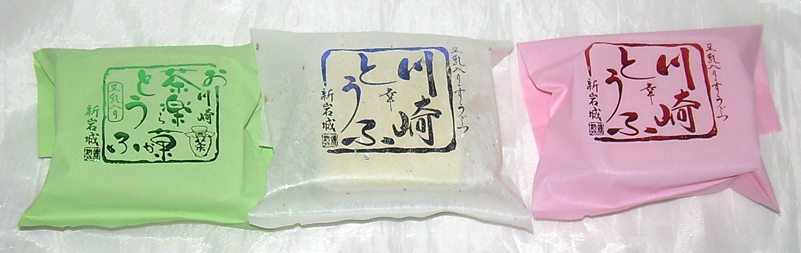
Shin Iwaki Kawasaki "Tofu" Cake


Sometimes the name of a product is meant to convey something about the ingredients, and sometimes it's a play on another type of food. That is, it is meant to resemble that food, but doesn't actually use it as a material. I've made some tofu-based sweets before including a fake cheesecake, and they turned out pretty terrible. I like tofu as a savory component, but I have never taken to it in sweets. I'm pleased to say that these cakes are pure cake. They are just served in a similar style of little plastic container as tofu is sold in. The resemblance to tofu, oh so very fortunately, stops there.

I didn't purchase these cakes. They were a souvenir given to my husband by one of his students who is aware of my blog and kindly gave him one of each type so that I could sample them. The student was in Kawasaki, where this is sold by a shop in Kawasaki station that has been doing business since 1923. The web site says that these are freshly baked every morning, but they are packaged to keep for awhile. They are sealed pretty well and have moisture absorbing packets in them. If you have a chance to pick them up (the shop information is here), they will keep until you can get them home and share them with family and friends.

The cakes are very moist and soft and feel very rich in texture. The filling for each is a thin layer of bean jam. The jam is flavored differently according the cake type so as to compliment it. The first ingredient is eggs, followed by flour. I think the dense, moist texture comes from the heavy use of eggs as well as the moist filling.

There are three flavors available:

Green Tea:


The first bite yields a strong green tea bitterness that mixes well with the lightly sweetened cake and filling. I'm not a green tea fanatic, in fact, it's just "okay" by me, but I really enjoyed this.

Strawberry:


The strawberry flavor of the cake itself is quite subdued, but the bean jam filling is a bit more intense and actually quite realistic. I don't know if it uses real berries, but this in no way is fake or overbearing. Though strawberry isn't my favorite, I still enjoyed the subtle sweetness and delicate flavors of this. 

Sesame:


This was the one that I was most looking forward to sampling and I was not disappointed. The filling in the center tasted like "sesame butter" rather than bean jam. The sense of it being like peanut butter strongly flavored with sesame was rather strong. The flavor was intense, quite sweet and delicious. 

I loved these, though sesame was my clear favorite. If I find myself in Kawasaki, I would definitely pick some up for myself. As souvenir cakes go, they are a great option for foreigners while still retaining their essential nature as a Japanese sweet. If you're searching for something which isn't too overbearing in the sweetness department and is very moist, these will definitely please you.

Thursday, March 24, 2011

Sumo White Bean Cakes


My husband and I are sumo fans from our earliest days in Japan. In fact, that was how he learned a lot of his kanji (Chinese characters), and sumo characters are the ones I best recognize to this day. Though to non-sumo fans of any nationality (Japanese folks included), it may seem odd to find a couple of naked fat guys bumping into each other for about 20 seconds interesting as sport, I can promise you that it's far more sophisticated than it appears. It can't all be about overweight men slamming up against each other and emanating homoerotic undertones...


Actually, I'm not really one for making sumo jokes. In fact, I boycotted the Tokyo Metropolis magazine for nearly a decade for a horrible article on sumo written by someone who talked about "fat faggots" and generally displayed no understanding of the sport whatsoever. In the wake of so many scandals in sumo (fixed bouts or yaocho being the big one), it's hard to feel quite so strongly attached to it. Still, trust me when I say that it was once an incredible experience watching sumo. There were players whose skill and dignity were absolutely awesome, and I hope that one day there will be again.


I have been to Japan's national stadium (kokugikan) in Ryogoku many times to watch sumo bouts, but I haven't gone lately. My husband attended a tournament with some friends and I asked that he bring me back one things, a box of bean cakes. Being the dutiful husband that he is, he delivered. The box comes gift-wrapped, as these are intended mainly as a souvenir that people who attend a day of sumo bring back to share with those who didn't go with them. The box lid has a sumo ring (dohyo) motif and some cut out wrestlers and a referee inside so you can play after you enjoy your bean cake. Since these are souvenirs, there is no nutrition information about them on the box.


The cakes themselves are made by one of the many companies in Japan that have no real presence or image, but acts in the service mainly of providing products for more high profile clients. I've lost the packaging, but I did investigate their web site and they only offer products for sale at the Ryogoku Kokugikan in Tokyo, so, if you want these, you'll need to attend a tournament (which I recommend anyway) or ask someone who can attend one to pick you up a box (9 cakes for 2000 yen/$24.76), and, yes, you will want them to buy you one. These are terrific.

There are varieties of sweet bean "jam" in Japan, and the white kinds are finer and usually sweeter than the red ones. The flavor of these cakes quite sweet, but not cloyingly so, with a surprising and well-balanced taste of actual honey. The beans themselves mainly lend an almost fudgey texture and a nice heft, though you can taste them, too. Keep in mind that these beans don't taste like kidney beans, lima beans, etc. They aren't super "beany". So, don't be turned off by the presence of beans.

The outer shell is a soft but flexible cake which has a lovely baked smell. Sometimes white bean cakes are very dry and almost powdery, but there is none of that nonsense with these. I also personally believe these are a very "approachable" bean cake for Western palates. That is to say that the would not be considered too "weird" for fussy eaters who aren't open-minded about what they eat.

I wish I could offer an easier way to get your hands on these than to go to a day of sumo, but some things are pretty specialized. Since both are unique Japanese cultural experiences that I feel are worthwhile, I'd say time any trip to Tokyo such that you can see the sumo, and treat yourself to a box of these delicious cakes.

Thursday, November 25, 2010

Koganei Imo


I try not to cover too many freshly produced sweets that can only be purchased if you actually live in or visit Tokyo. However, this is an exception because it is the first bean cake in Japan that I actually loved. It is, by far, the most accessible Japanese sweet for Western palates while maintaining a completely Japanese nature. Maybe everyone won't adore it as I do, but there's almost zero chance that a set of fully Westernized taste buds will dislike it.

 The box of 12 as it is given to us.

Koganei Imo means "golden (colored) potato", and while that is what these are called, they are not made with potato. They are simply fashioned to resemble one. The actual cake is finely mashed white beans mixed with sugar and egg yolk then wrapped in a tender crust and liberally rolled in cinnamon. It is the cinnamon that gives these the real edge over any other bean cake I have tried, but they are also incredible because they are hand made and fresh everyday.

The box under the paper wrapper with silk-screened (by hand, very likely) paper. This is classic Japanese gift wrapping with a layer of wrapping under a top layer.

The interior of the cakes is soft and sweet and the aroma of cinnamon wafts at you the minute you start to peel back the paper on in. If you warm one just a bit in the microwave (don't overdo it), they are a slice of cinnamon heaven which carry all of the appeal of a cinnamon bun without the calories or sugary overload. The beans themselves lend only texture and not taste so there's no need to be squeamish about them because they're made with beans. The filling carries mostly the sugar flavor with the richness of the egg yolks.

A whole cake with it's wrapper covered with cinnamon. It's supposed to look like a potato. You can judge what it looks like.

You can buy these in Ningyocho in Tokyo at a shop called Kotobukido. There's a good write up on the shop with address and phone number at Tokyo Food Life and another write-up at Food Sake Tokyo. They are a little expensive, but well worth the cost. My box of 12 cost 1250 yen ($15.15). Each is about 6-7 cm (2.4 -2.7 inches) long and makes for a modest treat. You can buy them individually in paper packets or in souvenir size gift boxes. The shop will serve you hot tea in the winter and cold in the summer when you enter, and you can eat your bean cake there or take it with you.

If you visit Tokyo, I strongly recommend seeking out this shop and sampling this unique and approachable sweet. I go there less often than I'd like, but when I do I buy a dozen, immediately wrap their paper wrappers with plastic wrap and freeze them for long-term enjoyment. They don't suffer for it, and 20-25 seconds in the microwave takes one from frozen log to cinnamony ambrosia.

Thursday, August 5, 2010

Chichibu Jizou-san Sesame bean cake


I don't travel much in Japan anymore either for pleasure or for business. There are several reasons for this. The big one is that I've been in Japan for a long time and therefore have already spent hours and hours of my life exploring many places. It's rather a shame in some ways because when I used to crack open all of the nooks and crannies of various areas, I never paid heed to the food. I was mainly in it for the second-hand record shopping, looking for rare collectibles to add to my personal booty or to sell to others (and this was before eBay).

Fortunately for me, one of my students travels for business and has been kindly picking up regional sweets for me to try. I'm immensely grateful for her efforts and this lovely bit of manju (traditional Japanese sweets usually made with beans) is courtesy of her. She got it in Chichibu. That's a city which rests in a bowl created by surrounding mountains in what might be considered a suburb of Tokyo called Saitama. In the summer, my student tells me that this topography causes Chichibu to be a sweltering nightmare. She bought these bean cakes in a nondescript 6-pack while killing time and sweating. I'm the lucky recipient of one of them.


This picture was lightened a bit to show texture and composition better.

The picture on the package is a mascot for Chichibu, O-jizuou-san (地蔵さん).  The cartoon pretty much tells you that this is the name of a Buddha representation. I don't know how much these cost, but I don't think they were outrageously expensive or very cheap. If I had to guess, I'd think 6 of them cost between 500-800 yen ($5.77-$9.22). The ingredients list included sugar, sesame seeds, and red beans.

These smell heavenly, like sesame seeds but with a real nutty and rich aroma. The texture is also lovely. It has a moist cake with an almost fudge-like bean filling (minus the sense of fattiness). The beans are very finely ground and form a ganache-like filling. Based on the sheer volume of black sesame seeds, it's no surprise that this is very flavorful. There's a good rich sesame flavor complimented by the mildly sweetened red beans.

The sesame adds a great nutty flavor and the occasional meaty nut-like textural element. The only drawback is that the seeds are whole and you can get them stuck between your teeth. However, this is really a great presentation of classic Japanese sweets elements (red beans and sesame).

My student called this a "grandmother's snack" and she said that she didn't feel that it was really exclusive to Chichibu. She felt that one might be able to find similar cakes in other areas of Japan. I'm sure she's right, but I don't know if they are all going to be as well made as this one was.

Friday, November 27, 2009

Marukyo Seika Manjuu Variety Pack


Japanese food has a reputation for freshness and Japanese people value it, yet you do find that there are a fair number of foods that are prepared and sold in a state which is anything but. I'd been eyeballing this variety pack of manjuu (various bean cakes) for quite some time, but I'd been resisting it because I knew they were going to be dry. These were relatively cheap for the number of very small cakes (18 for 250 yen/$2.78), so I figured I'd take the plunge and give them a try. I'm trying to branch out into snack areas that I haven't covered much and manjuu has been rather neglected.

I'm not sure what the target demographic is supposed to be for this product or how people are supposed to regard them. Do you keep them on hand for guests who pop in for tea? Do you keep them around for your kids or grandma to have as a snack with tea? I can say that they aren't high quality enough to serve formally or to give as gifts. That doesn't mean they are bad, but it does mean that they are second-rate, consumer-level manjuu.

The manufacturer, Marukyo Seika, makes a variety of bean-filled treats including selling all of the components of this variety pack in single flavor packs. If one of these is a hit, I can then buy a whole bag of them if I like. One of the appealing points of these cakes is supposed to be the appearance. You'll note that 3 of them have fairly nice designs and the ones which are ugly lumps stay hidden from view on the package cover.

Red bean mix:


This is the biggest of the cakes at a little over 5 cm (about 2 in.) in diameter. There are only 2 of them in the package and each is 100 calories. After you get to the inside, it smells of red beans. Yes, that's quite a surprise. The beans are very dense and moist and have a pleasant taste. The cake is appreciably, but not overly, sweet and the exterior cake has almost no flavor of its own and its texture is indistinguishable from the moist bean filling. The beans are very finely mashed and densely packed so this would be good for someone who doesn't like the texture of beans but enjoys the flavor.

Chestnut:


This is designed to resemble a chestnut with a top that has been brushed with egg or some other wash to make the top brown more heavily and tiny seeds across the bottom. There were only two of these in the package as they were some of the larger cakes. The smell you get, even when it is cut open, is most of the cake exterior which is thin, pliable and flavorless. The interior is very dry. It's almost like densely packed powder with some somewhat firmer bits of chestnut in it. The flavor was very good, modestly sweet chestnut flavor, but the texture too dry. This was 74 calories and 5 cm (1.9) wide at the longest points.

Milk Chestnut:


This variety had a more cake-like exterior with a better texture and it seemed to also carry some classic flavors like butter (or margarine). It was slightly sweeter than the aforementioned chestnut one, but had a somewhat less dry interior. For those who are squeamish about bean cake flavors and texture, this might be a better bet. This is blandly nice. There were 4 of these and each is a mere 43 calories. They are 5 cm x 3 cm (1.9 in. x 1.1 in.).

Soba manju:


This doesn't smell like anything in particular. It has a cake-like smell and the texture is moist and almost doughy. It's quite sweet with a subtle bean flavor. These are only 40 calories because they're so tiny, about 3 cm (1.2 in.) in diameter.

Green Tea:


This looks, smells, and is the same size as the soba manju. It's also only 40 calories. The main difference is the very subtle green tea flavor which tends to come across mainly as a roasted flavor. It's actually pretty good. It's a green tea manju for those who don't like strong green tea flavors. Like the soba version, it's also quite moist and has a doughy texture.

I had the highest hopes for the chestnut one, but it actually was one of the least appealing due to its parched interior and somewhat leathery exterior shell. The one I liked best was the soba manju because it was moistest and had a pleasant flavor. The second best one was the red bean mix, again, because of the moister interior.

This was a nice enough mix, though definitely not the best bean cake experience one can have. You can get better off of the same shelves in the market that these are sold on, but you can't necessarily get the same low price, longevity and variety. The two types of bean cakes that I reviewed previously were much better than these, but they also cost a lot more and are not built to last. I probably wouldn't buy these again, but that's only because I have a lot of other better options. It's not that these are bad in any way. They simply aren't great.

Wednesday, September 24, 2008

Mamador Bean Cakes

Two gifts from two different students in one day. A box of Mamador bean cakes from Takashimaya in Shinjuku and some macademia nuts from Saipan.

Sometimes I wonder how long I'd have to live in Japan to sample every white bean cake on the market. No matter how many we try, more keep popping up. And, we've tried a lot. My husband was given a new variety today as a gift from a student for no particular reason. Japanese people are like that.


When I say "new", I mean "new to us" only. Apparently the company that makes these has been in business since 1946. It's easy to miss any particular Japanese sweet when you're shopping. Department stores have miles and miles of them available and it'd be impossible to buy or try them all. That means that some real gems can slip under your radar and these cakes are pretty, shiny diamonds amongst white bean cakes. In fact, they're my husband's new favorite among the types you can pick up pre-boxed (and locally).


The picture of the inside of these cakes makes them look like like they're full of some sort of yellow or fruit jelly, but they are full of super moist white beans surrounded by a moist cake-like shell. Most bean cakes are relatively dry and their fillings can be downright powdery at times. These are full of butter and milk and the flavor is reminiscent of vanilla cake.

It strikes me that these would make an excellent souvenir to take back home as it's a Japanese sweet which I'm sure even squeamish eaters would enjoy. They're just a little hard to find though unless you happen to live in the right location.

Thursday, September 18, 2008

Banana Kamome No Tamago (Seagull Eggs)

Note the fact that the packaging could easily accommodate 9 of the banana-flavored eggs, but was cleverly designed to only hold 8.

One of the snacks my husband and I like to keep around our apartment at all times is Kamome No Tamago (かもめの玉子). This is a type of bean cake designed to resemble an egg ("tamago" is the Japanese word for egg, kamome refers to a seagull). A standard package (pictured below) of the regular variety includes 6 "eggs" for about 525 yen ($4.80 USD). The standard eggs are about the size of an actual large egg. They are filled with yellow beans and covered in a thin shell of cake with a thin covering of "white chocolate" (not really chocolate). They are mildly sweet and make a satisfying snack.

The regular "seagull eggs" in their work-a-day packaging.

This series of Japanese sweets is produced by a company called Saitoseika. I only ever see these bean cakes at one of our local markets and we have 4 large markets in a 15-minute radius of our apartment so they aren't easy to find at random shops. One can order them on-line from the manufacturers site, provided that one can read Japanese well enough and has a computer system which can allow one to view the proper characters rather than gibberish. One nice benefit of looking at the web site is that new flavor announcements can be tracked on their front page. For fall, for instance, they're going to offer chestnut flavor.

The gift wrapped box of banana bean cakes.

Since we enjoy the regular variety of Kamome No Tamago so much, I decided to pick up a box of the banana flavor when it unexpectedly showed up at a local market. The banana version came in a gift-wrapped box and clearly is marketed for purchase as a souvenir rather than as a run-of-the mill snack. It costs 735 yen ($6.75) and contained 8 rather small eggs. I'd say they are as small or smaller than the smallest chicken eggs. The regular variety are clearly a better value.

I'll be upfront about the fact that I am not a fan of banana-flavored things and that this was purchased with my husband in mind. Of course, I did sample these and was not surprised to find that I hated them. The taste was overwhelmingly strong and artificial. It reminded me of the banana esters we worked with in our high school chemistry class. The eggs are soft and fresh (just like the regular variety) and have a nice textural contrasts between the coating, cake, and bean "jam" interior, but the flavor was like eating concentrated or distilled banana puree.

The inside of the "eggs" is made to resemble an actual banana. The coating on the outside is light yellow to reflect the flavor as well.

My husband, on the other hand, is quite fond of these. He felt they were on par with the regular ones in terms of taste, but even he felt the banana flavor was pretty intense. He felt that these were the sort of thing a person was either going to love or hate and that there would likely be little variation in between. If you are the sort who finds banana-flavored treats appealing and can be open-minded about potentially artificial-tasting banana flavor, you may want to give these a try. Otherwise, I'd say find the regular variety and enjoy as they are a complete treat.

I usually like to provide nutrition information with these reviews, but, unfortunately, I threw away the little slip of paper with the ingredients already so I can't tell you what is in these. I do feel that they are probably a better snack for you than most other treats because they contain beans which have to carry some protein with them. However, that may just be wishful thinking on my part.