Showing posts with label KitKat. Show all posts

Sunday, July 27, 2014

KitKat "Starter Kit" (promotional information)


Nestle Japan started a KitKat cafe some time ago at which you can get your chocolate and wafer fix. They're looking to expand the menu with a little help from their friends. It would actually be more accurate to say they're hoping to do it with help from their customers who run restaurants or cafes. The whole baked KitKat business is one that they're investing more in as time goes by and they want to see recipes featured on menus and are willing to reward people with a starter kit if they fulfill certain criteria. Among those are providing links to their establishment's web site and posting the recipe on Facebook for Nestle to inspect. They'll send qualifying businesses a KitKat toaster oven and some KitKats to work with (as shown in the picture above).

This is a very interesting promotional choice. My guess is that this is to spread the possibilities one can explore with the idea of baked candy... well, besides setting your kitchen on fire or charring sugar until it sets your smoke alarm off. ;-)

Tuesday, May 20, 2014

KitKat raspberry adult sweetness (product information)


Nestle Japan is reissuing their raspberry flavor "adult sweetness" KitKat. I already reviewed this product when it was initially released. It is a pretty tasty variation and I'd recommend giving it a try if you're a fan of "framboise" or just like to try exotic KitKats in general. The packaging has been revamped and you can get it in two sizes, though both sizes contain mini bars. Candysan will be carrying both sizes for reasonable prices (it's currently out of stock, but I believe this reflects the fact that it is newly re-released and that they will have stock soon).

I'm a little disappointed that this flavor is being reissued rather than a new one being introduced, but, as I said in yesterday's review, I'm not surprised. Nestle Japan has been taking an increasingly conservative approach to its KitKat line, and probably for good reason. 

Monday, May 19, 2014

Nestle Strawberry Adult Sweetness KitKat (mini)


I received today's item free from CandyWarehouse, which is actually pretty awesome... at least for me.

My mother had a Japanese pen pal when she was in high school. I believe he lived in  Hiroshima and at one point he sent her a Japanese doll in a glass case. I knew about this because there was a black and white picture of this man with his two children leaning against what looked like a fairly old-fashioned Japanese house in one of our photo albums for years. At that time, I didn't think much about Japan or this man. It would never have occurred to me that I'd ever visit Japan, let alone end up living there for most of my adult life.

This pen pal stopped writing to my mother at one point and she told me he had been killed in an earthquake. I accepted this at face value for many years, but now I realize she simply made this up. She never heard any news of a major earthquake, but this was the explanation she chose to work with to explain why he got bored with or tired of writing to her. Unfortunately, making things up is something my mother did and continues to do habitually.

Most of my mother's knowledge of Japan comes from her correspondence many moons ago (from the 1950's) when Japan was a very different place. Her notion of life there was (and may still be) frozen in what that pen pal told her. When I first arrived there and talked about the logistical complexity of getting myself, my husband and seven enormous pieces of luggage from the airport to our new apartment in 1989, her response was, "can't you just get a rickshaw?"

Getting my mother to change her notions of what life in Japan was like 30-40 years after she corresponded with one of the natives was nearly impossible. People do tend to have difficulty abandoning a notion once they've settled upon it. One such notion that persists and I'm sure will continue to persist is the "crazy KitKat flavors" releases.

Nestle appears to have stopped rapidly running a treadmill of releases of freaky flavors and settled on a new strategy. However, people still believe otherwise. The occasional odd flavor release as well as the existence of unusual regional flavors (which are available year-round) will reinforce such notions, but the truth is that things have changed a lot. The marketing has skewed to reflect changes in the demographics in Japan. There are more older people and fewer younger people. Japanese people have endured a long period of relative economic decline and take comfort in more old-fashioned and conservative flavors.

The days of ginger ale, apple, cola, and lemon squash KitKats are likely over. It's not that we'll never see another weird flavor again, but just that the extremes are less likely and less frequent. As a point of comparison, I will say that, at its height, such strange flavor releases appeared to hit the convenience stores every 2-3 months.

The core line-up of KitKats these days strongly reflects the conservatism of the company's choices now. Their main releases are the plain chocolate KitKat and various similar big bars and the "adult sweetness" line-up which includes bittersweet chocolate, milk/vanilla, green tea, and strawberry with a very occasional new flavor (like passionfruit or raspberry). Mostly, these are available as individually wrapped mini bars either in boxes or bags. The whole position of these KitKats is that they are less sweet to cater to adult tastes since kids tend to like things much sweeter than grown-ups. The size is also meant to cater to the smaller adult appetite for treats.

Of these "adult sweetness" options, the only ones that I had not already tried were passionfruit and strawberry. Fortunately, CandyWarehouse offered me the opportunity to sample the strawberry without having to fork over a pile of cash to buy a bag at a Japanese market. Generally, it costs $6-$7 to buy them locally. They are, obviously, much cheaper in Japan as compared to buying them as an import.


The bar is a little soft on the outside, which is often the case with white chocolate, but the inside has nicely crispy and super fresh-tasting wafers. The chocolate lives up to the claim of reduced sweetness and lacks the cloying and weird artificial notes that white chocolate blends sometimes possess. The strawberry flavor is nicely blended in and neither too potent nor too weak. It's exceptionally balanced in terms of giving just enough sweetness to be a good experience, but not so much as to be overpowering. There is good flavor depth - you can detect the white chocolate, the strawberry, the sugar, and the wafers - and good textural variation with the wafers crispness and the creaminess of the white chocolate.

The entire adult sweetness line is a winner and this surprised me because I'm not a fan of either white chocolate or strawberry chocolate, but the balance on this is perfect. I could definitely see having this again and will be quite pleased to finish the bag. I wish Nestle would provide a similar line for the American market, but I'm guessing that the "all or nothing" nature of American tastes - that is, either eschewing sweets altogether or wanting them to put you into sugar shock - would make them too unpopular to survive here. This is a fresh and pleasant way to get your sweet on, and at only 70 calories per bar, a nicely portioned treat.


Tuesday, March 18, 2014

Nestle Baked KitKats (product announcement)


This is a party I'm a little late to so you may have already heard of this. Nestle Japan is offering a KitKat that you can bake and it won't turn into a melted pile of goo. It's supposed to brown up and taste like custard or vanilla pudding. Apparently, this is availabel at the Chocolate Cafe in Ikebukuro in Tokyo. The cafe is open from 10:00 am to 9:00 pm (except closing at 8:00 on Sundays and holidays) so you can get your baked KitKat on between those hours.

You're supposed to bake them for 2 1/2 minutes in a toaster oven at 1000 W. They say you should put foil down on the tray first and keep an eye on it because it could catch fire if you overdo it.

This is the brainchild Yasumasa Takagi, their chef in residence it would seem. The concept is supposed to yield a result which turns the outside the texture of candy-like sugar, caramelize the flavors, and create a unique textural experience once it has cooled down to safely eat.

This sounds like an absolutely awesome concept, but I have my doubts that it will be a great flavor experience. Still, if these come up in shops around here, I'll certainly buy one and try it.

A bag of 13 bars is 525 yen (about $5.25). It will be available from March 24 for general purchasing at supermarkets. Let's hope that a spate of housefires are not the outcome of this experiment.

Thursday, February 6, 2014

Nestle Royal Milk Tea Kit Kat big bar (product information)

Picture from Nestle Japan.

Nestle Japan continues their environmentally friendly ways with the recycling of flavors. In my experience, there was never a royal milk tea big bar before, but there was a regular KitKat available in that flavor. And it was good. Though I haven't bought this particular reincarnation of that flavor, I'd wager that it's a very similar experience. That means that, if you're a tea fan, it's likely worth a shot. This is a limited edition that came out several days ago. You can get one from Candy Japan is you have no other options (and, no, they're not giving me free stuff to promote them or paying me - that's purely FYI).


Thursday, December 19, 2013

Nestle Kobe Pudding Regional KitKat (product announcement)


In November, Nestle increased its line of regional KitKats by just a hair by adding in a "Kobe Pudding" variety. I honestly did not know that Kobe was famous for it's pudding - which is more often referred to as "purin" in Japan and really looks and tastes like flan. My best research reveals that the sauce on Kobe's version is supposed to be flavored with some citrus and the basic pudding is less sweet. I'm betting that this KitKat will be plenty sweet, however, as my experience with white chocolate ones is that they are over the top in their sweetness.

The strongest link between Kobe and pudding is probably the same as its link to wagyu (beef). The cows are supposed to produce superior milk as well as superior meat. However, this is my pure speculation and I'm betting that, no matter how the milk in Kobe might be, it's not going to really be reflected in a KitKat. Nonetheless, I'd be curious if any of my readers have sampled this and what they think of it. Please share in comments if you've had a taste of this.

Tuesday, November 26, 2013

KitKat "Merry Christmas Happy Box" (product announcement)

All images come from Nestle Japan.

Some of my readers may recall that it is common around the end of the year for merchants to sell "lucky" or "happy" bags or boxes. They are usually associated with the New Year and are sold on or after the first. This one, by Nestle Japan, has "Merry Christmas" above it so I'm not sure if they're targeting Christmas or the New Year. My guess is that it's both, but it is mostly for Christmas.


The assortment that you can buy via mail order includes 1102 grams of candy for 2500 yen (about $24). Shipping is "free", but my feeling is that the price of what you're getting essentially more than encompasses the cost of postage. The thing is that the collection isn't really anything special. It includes the commonly available "adult sweetness" KitKats (vanilla, chocolate, strawberry, green tea), Nestle Crunch bars, Milo, and Aero plain chocolates. It's a little like receiving a bag or box of Hershey's candy that anyone can buy in a regular supermarket. 

This is not necessarily a bad package, but it's nothing special in terms of contents. Certainly, a recipient would be "happy" to get it, but there's nothing "lucky" about it - unless they put some sort of golden KitKat in every millionth box.

Thursday, June 6, 2013

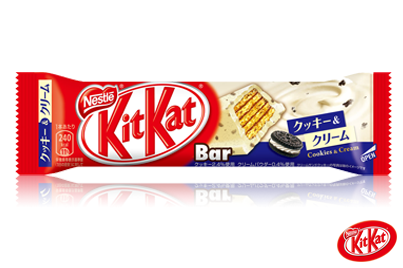
KitKat Cookies & Cream Big Bar (Product Announcement)

Image from Nestle Japan.

I love the KitKat big bars, but I hate white chocolate and have never been a big fan of cookies & cream as a candy flavor. In fact, I feel that the whole point of the cookies and cream concept is to add textural variation and flavor to ice cream. As a candy bar with cookies that add texture and its own flavor already, it seems silly to add cookies and cream to cookies and white chocolate. OK, perhaps it's not so  much "silly" as quite unimaginative. These big bars are coming to a convenience store in Japan soon and if I was still there, I would not bother to buy one. If you're more open to conventional flavors than me, let me know if you've tried this. I'm guessing that it'll have 5 layers of satisfying crunch surrounded by somewhat too sweet and perhaps even slightly chalky white chocolate infused with just a hint of bitter chocolate cookie and some creamy richness, though not enough of the good stuff to justify the calorie load.

Tuesday, April 9, 2013

Condensed Milk Strawberry KitKat (product announcement)

Image from Nestle Japan

Yesterday, Nestle Japan released a "new" big bar flavor, condensed milk strawberry KitKat.  It was placed on convenience store shelves yesterday, and takes its rightful place among the dozens of strawberry KitKat bar releases which inspire this blogger to yawn in ingratitude. I wouldn't buy this if I saw it, because I'm already sure that it tastes like overly sweet powdered milk with some fairly decent, but unimpressive strawberry flavor. If I'm proven wrong, feel free to say so in comments. I can take it.

I should mention that condensed milk and strawberries are a very popular combo in Japan. When the berries come in season, bins or baskets of toothpaste-tube style condensed milk are usually not far from the tony (read: expensive) homes of the juicy red beauties. The packaging is designed to let you squeeze some disgusting goo on the precious fruit as you eat it. In the U.S., condensed milk is sold in cans because we don't tend to think of it as something we slather on unsuspecting fruit, but rather as something we roll into sugar-laden, hyper-fatty baked goods.

Tuesday, April 2, 2013

KitKat World Assort Rebooted (product info. bonus post)


Before I left Japan, there was a KitKat "World Assort(ment)" that failed to inspire me. It was essentially a bag of chocolate KitKats in their various incarnations from around the world. While it's true that the various KitKats from Australia, America, the U.K. and Japan taste somewhat different (and, frankly, the European ones are best in my utterly subjective opinion), it was a pretty uninspired choice for a "world assort".

Apparently, someone got with the program and this rebooted version offers 6 hazelnut mini bars and 7 orange ones (the reason for such an imbalance escapes me). Both of these, in my experience, are from the U.K. versions. I've seen them for sale at Cost Plus Imports for a slightly high cost. If I were in Japan, I'd be all over these because hazelnut in particular is an underrepresented flavor among confections in Japan, and you can never lose with orange and chocolate. As flavors that might interest those who are interested in Japanese sweets, these aren't going to float many boats. For those who are interested in testing the way the wind is blowing in the world of Japanese KitKat, this is somewhat interesting news. 

If you're in Japan, word is that these were released yesterday and they should be showing up on local shelves soon if they aren't already there. 

Monday, March 25, 2013

Nestle Ujimatcha Latte KitKat


Back when I did my Regional KitKats post, I mentioned that there was no need to despair over not being able to get these supposedly limited options because many of them have been released or will be released as regular flavors. Ujimatcha is a type of green tea grown in the Uji area and is known for being intense and sweet because the amino acids are kept intact when it is prepared. I don't know if this is true, or exactly what it means, but it's supposed to be vibrantly green and more finely milled than more pedestrian types of green tea. Uji is an area in Kyoto, and this is sold as a regional flavor KitKat.

The package you're seeing pictured here is a consumer level bag of minis sold pretty much anywhere that sells them. So, you see, no matter where you live, you can get this supposedly regional flavor. So there! Okay, this isn't exactly the same as the regional one since this has a semi-sweet chocolate base paired with the white chocolate ujimatcha top and is a "latte" flavor and the regional one is all green tea.


I found this as Nijiya Japanese market for $2.19 (206 yen). It's a pack of 7 single finger mini bars that look like a fat version of half a mini bar. For the quantity, it's slightly pricey, but not ridiculous. The strange thing about this KitKat was that I couldn't locate it on Nestle Japan's web site. That doesn't mean it's not there, but it is strange that it is not featured prominently somewhere. I do check the site regularly, and the expiration date on the bag is September 2013, so it can't be so old that it is outdated. This is the sort of thing that you think about when you're me.

As for the bar itself, it is actually quite different from the regular green tea KitKat. This has a creamy flavor which balances out both the semisweet base and bitter green tea very nicely. I generally don't care for green tea mixed with fairly present chocolate flavors, but it all came together really well in this tiny little bar. It has depth of flavor, but it doesn't come across as lacking in flavor harmony. It's neither too sweet nor lacking in sweetness. I was surprised at how nice it is.

I think this is absolutely one of the nicer consumer-level chocolates you can buy and well worth a sampling if none of the component flavors are something you're averse to. I could see this particular flavor profile with a better quality chocolate being produced by a more prestigious chocolatier. That being said, I still like the adult sweetness green tea bar better, but not by a huge margin.


Tuesday, December 25, 2012

Winner of Tokyo Regional KitKats Contest

Kitty-chan Christmas buckets for the kiddies in Japan, because a plastic bin full of cheap treats is what all the letters to Santa are asking for.

Merry Christmas to all of my readers! I wish that I could give everyone a prize as a demonstration of the spirit of the holiday, but, alas, I have but one gift to give.

The winner was chosen by a random number generator (no favoritism here!) and it is brit_brat100. Please contact me at orchidsixtyfour@gmail.com about sending your prize to you. Congratulations!

Thanks to all of my readers for their entries, and, of course, for reading! Happy holiday!

Monday, November 5, 2012

KitKat Vanilla Ice Cream


With little chunks of ice and a waffle cone with a few scoops of vanilla ice cream on the package, it will surprise no one to learn that this is a summer leftover KitKat. It was introduced on June 25, but according to Nestle Japan's web site, it's still on the roster. On the one hand, thanks to climate change, we appear to be finding that we're generally giving autumn a miss and living in a prolonged summer, so those who continue to sweat into the early autumn may find the illusion of a cooling treat appealing. On the other, seasonal flavors in Japan are something all the natives and non-natives alike look forward to. I'd be saying, "bring on the sweet potato and chestnut", but right now the newest mini variety is a white chocolate "adult sweetness KitKat". I guess Nestle Japan isn't in the fall spirit yet.

Since most of the new KitKat flavors are a crushing disappointment, I have been unwilling to invest in buying them despite having more reasonably priced access than most via Nijiya Japanese market. I'm particularly reluctant to pop for the $7 price tag on the standard large size bag of minis when I have a strong feeling that they'll taste like overly sweet disappointment. The only reason I went for this was that it is a smaller than usual bag of minis. With only 4 small bars and at a price tag of only $2.19 (175 yen), I figured that the chances that I'd be suffering buyer's remorse was relatively low.

I'm using my KFC Christmas plate for white food because they photograph better on a dark background, and this is all I have in my puny selection of dishes at present.

The bar does smell a bit like vanilla. Fake vanilla is, after all, a pretty potent scent. The bars have a very sugary, slightly gritty texture in addition to the trademark wafer crispness. The white chocolate coating is soft and yielding with no snap of its own. The first bite carries with it a potent, but not overbearing, vanilla flavor coupled with something which is reminiscent of frozen dairy confections. Subsequent bites, however, reveal an odd fake flavor which becomes increasingly reminiscent of powdered milk and the cheapest ice cream in the store. At the end of the second finger of the mini, it was potent enough to overwhelm the experience.

This is not a bad bar, but it's not an especially noteworthy one either. It is, like most of these white chocolate bars, extremely sweet. While I don't regret picking up this 4-pack for the price I did, I'm glad that I didn't buy a bigger bag as it'd feel like a huge waste of money. As it is, I sampled a bar, my husband will likely eat one, and a craving for super sweet candy will see us through the other two. However, I would not buy this again, and unless you truly enjoy artificial flavoring, powdered milk, and very sweet white chocolate, I would not recommend this to my readers.


Wednesday, October 3, 2012

Random Picture #133


One of the KitKats which I eyeballed but never bought was the "hojicha" KitKat. For those who don't want to dash off to the linked Wikipedia page, hojicha is roasted green tea (that's why it's brown). My main issue with it is that it is a regional KitKat that comes in a big box of minis and I hated to have to buy a large number of them just to sample one. These are designed, incidentally, to be purchased by traveling business people and brought back to the office as a souvenir snack. That's why the boxes contain 12 minis and you can't get them as regular bars or smaller boxes of minis. If I hate the flavors of these, I've wasted a lot of money. I didn't work in an office when I started this blog, and I didn't have anyone on whom to fob off unwanted candy. My husband certainly wouldn't have touched a tea-flavored KitKat with a 10-foot pole!

Beyond my sense that I didn't want to squander my hard-earned yen on a dozen untested KitKats, there was also the fact that my readers either know the taste of hojicha or they don't. While many have tasted conventional green tea, this variation is not so common. There wouldn't be a whole lot of meaning to saying whether it was authentic or not. What is more, there are other reviews out there of this KitKat, though they frankly rather suck in the way I was afraid my review would suck if I'd done one. That is, they say it captures the flavor well and is therefore tasty.

Some of those reviews also suck because they rave about how insanely rare these are because they're regional (Kyoto), but that's not exactly true. Yes, they are not sold on every convenience store shelf in Tokyo, but they are sold at major train stations (e.g., Shinjuku), Narita airport, and at the Odaiba souvenir shop in which my picture was taken, not to mention some snack shops in Ueno's Ameyokocho. The truth is that, if you are in Japan and really want a regional KitKat, you never have to actually go to that region. There is no such thing as a "very rare" KitKat, except those that were issued as limited editions and sucked so badly (I'm looking at you lemon ginger ale KitKat) that they will never ever show up again.

Friday, September 14, 2012

KitKat Senses Hazelnut


There are a lot of facts out there of little or no importance to the public at large. They're the sorts of things that may end up as a Trivial Pursuit question or only be asked when someone is a niche blogger who notices small things which aren't really worth noticing. Though others were already aware of this, I finally figured out that KitKats are made by two different companies and this may account for the way in which American ones differ from those around the world. Hershey's makes the U.S. version and Nestle makes the rest. A good comparison and explanation can be read here.

I worked all of this out because I was pondering why America generally has only boring KitKat flavors (white, milk, and dark) and thought perhaps that I should research whether or not there are some varieties that I didn't yet encounter. That's when I discovered that Hershey's runs the show in the U.S. and they make it the most boring show ever. I guess the fact that KitKats are the best selling candy bars in the world makes them complacent. Frankly, I feel taken for granted, Hershey's, and I refuse to buy any of your boring KitKats even though I am back in America again.

I tried to figure out or research why these are named "Senses", and it seems it is nothing more than implying this will delight your senses. The commercials seem to emphasize the lower calorie nature (165), lightness, and the added "surprise" of the hazelnut cream. There is another variety, which may or may not be on the market, which includes caramel cream instead of hazelnut. I can't understand why anyone would think that was a good idea.

Clearly, this is not an American bar since it is hazelnut, which is really not the most exotic flavor out there, but it is very attractive to those of us who can't buy a jar of Nutella for fear that we'll eat half of it at once with nothing more than a spoon. I found this at "Zad Grocery", a place that I saw while my husband and I were driving around near his former childhood home and decided to stop at because it had Arabic writing on it. It was, unsurprisingly, a(n awesome) Middle-Eastern/Indian/African food shop and this bar held appeal because it had Arabic writing on it. However, it was made in Poland. So, I guess that this is an international bar. If you want to get one of these, I'm guessing you can find one easily in Canada or Europe in most shops. In the U.S., I've seen them at Cost Plus World Market and you can find outlets to buy them online.


This bar has 5 little segments so that you can break off small portions. My picture doesn't do a very good job of showing this, but there are wafers on the bottom and a light whipped hazelnut cream on top. It's all covered with the milkiest of milk chocolate. It's very European in taste and smell and closer to Cadbury chocolate than a Hershey's Kiss. The flavor is rich and the texture is very light, but the hazelnut is less a flavor addition which is distinct from the chocolate and more of a modifier of the overall chocolate experience. It is quite sweet, even though it is not American. Frankly, it made my teeth ache a bit when I ate a square, but I loved the taste.


This is a very good bar if you like hazelnut cream, milk chocolate and the crispiness of wafers. If you're familiar with the Kinder Bueno bar, this is like a slightly heavier version of one of those. The Bueno has more hazelnut cream and wraps the wafer completely around the creamy center. This stacks the wafers and puts the cream on top and has a thicker amount of milk chocolate. The Bueno's chocolate coating is a bit inferior to this (and tends to flake off the wafer). In a contest between these two similar bars, I think that ones mood would dictate the winner (sweeter and heavier or lighter and less sweet). I'd definitely have this again though, and it means I have one more chance to tell Hershey that I'll keep patronizing Nestle if they can't justify my KitKat love.


Friday, June 29, 2012

Japanese KitKat Pakkana Series (product information)

It was often the case in Japan that I would find KitKat variations that I would never purchase for one reason or another. Sometimes, it was because the flavor was a repeat, particularly strawberry or green tea varieties. At other times, it was because the variation was based on the packaging, size of the candy, or some other aspect rather than on the candy itself being different. That  latter is the case with these products.

I'll be honest and say that I don't know what "Pakkana" means, but I'd guess that it's an onomatopoeia for the sound of something shaking in a box.  I could be wrong, and I'm guessing that, if I am, the language-philes out there will pounce on me and let me know my grotesque inadequacy in no uncertain terms.

Images from Nestle Japan's site.

Nestle Japan created a series of three boxes with 20 mini KitKats. There are 10 milk chocolate (regular) KitKats and 10 "adult sweetness" (semi-sweet chocolate) mini bars. The first is  a "circus" box which you shake lightly in order to get the clown to appear. According to the blurb, this is to help you enjoy the circus along with the KitKat. This seems like it would appealr to the type of people who are easily distracted by shiny objects. 

The second design is a "cracker" design, and I don't mean the salted dry snacks that we enjoy spreading peanut butter on or garnishing with slabs of cheese. This is in the sense of a Christmas cracker. They claim in their blurb that having this on hand will enhance the image of a fun and lively party, if you're having a party.


The final design is targeted toward sophisticates who think that boxes of KitKats can make attractive decorative pieces in their homes. This is called the "piano black" design and they encourage you to place it on your kitchen counter or in your office to impress people with your refined sensibilities. Of course, if you're that pretentious, I think you'd be better off parking a box of Godiva chocolates on your counter instead of KitKat minis. 

These are on sale for 630 yen ($7.91) per box and were introduced at the beginning of March while I was still living in Japan. However, I never saw them on sale anywhere and was around for about 3 weeks of their release. The web site does say that their availability is limited so you may have to look around a bit if you're a collector and just want the boxes. If you just want the candy, you can find the adult sweetness and regular bars anywhere and everywhere. 

Monday, May 21, 2012

Tokyo Nihonbashi Kuromitsu KitKat


This is one of the regional KitKat varieties that I picked up at the airport on the way out the door when I left Japan. It's important to say that my husband was the one who spied this and wanted it because he interpreted "kuro mitsu" (black sugar syrup/honey) in Japanese to mean "brown sugar". Since this was going to be one of the last things we'd purchase on Japanese soil, I didn't want to rain on his parade and I said, "sure, go ahead". The truth is though that I didn't think this wasn't going to taste like brown sugar as he knows it.

People who bake know that there are different types of brown sugar. People who eat may know so as well, but for most people sugar is sugar. Most people don't know what caster, demerara, muscovado and turbinado sugar are. The more sophisticated sugar consumer tends to know three things; white, brown, and powdered. I'm no culinary snob so I don't care if people can separate different types of sugars. Unfortunately, my husband is one of the types who knows only the three shades of sweetness previously mentioned. It's dark and sugar, so, it's going to be brown sugar. Yay! Brown sugar! He loves brown sugar.

I'm here to say that kuromitsu ain't no brown sugar. It's a type of syrup that is often used on warabi mochi and other Japanese sweets. It's fine and dandy for various applications, but it's not pleasing to the palate of someone who is looking for that very definable flavor that comes with oatmeal cookies, pecan pie, and spoonfuls of cavity-creating pleasure taken straight from the brown sugar bag. The question of whether or not the flavor pairs well with the white chocolate and wafer combo of a KitKat is also a very valid one.


I'm sorry to say that, having spend 840 yen ($10.63) and having 12 mini bars (69 calories each) on hand, that it isn't the greatest pairing. Speaking as someone who likes the sublime combination of kuromitsu when drizzled over soft blobs of kinako-coated warabi mochi, I was especially disappointed, but not surprised. I think that the bland mochi and nutty toasted soy flour (kinako) are a nifty pairing, but sweet white chocolate is not its friend. It's sweet and intense paired with more sweet and slightly milky.

On top of this being a very so-so KitKat, there is also the fact that it has to be one of the oddest  regions to offer a KitKat from. Nihonbashi is a business district in Tokyo. It's not a bad place to go or anything, but it's hardly a heavy tourist district and, as far as I know, it is not really related to kuromitsu. It does relate to the Mitsui family who brought Mitsukoshi department store to Japan so this may be a play on words (mitsu, Mitsui), but it seems a tenuous connection at best. I think Nestle Japan is either trying to hard, or not trying nearly hard enough.


Monday, May 7, 2012

Yawataya Mini KitKat


When I was given wasabi KitKats, I remember having a discussion about chocolate with one of my students in which I mentioned that putting chili in chocolate was fairly common in America. She was shocked, and grossed out, at the idea of this combination. Of course, she thought that including wasabi was also pretty weird, but accepted it as something reasonable as a regional variation for novelty value. This is one of those rare cases when a combination is actually a bit stranger in Japan than in the West. I've been reading about American releases of chili paired with chocolate on other blogs for years.

If you look at the top of this box, you can see that there is an old-timey picture in sepia (because that's how we can tell it's "old-timey"). This is because this flavor is supposed to represent what was popular in the Shinshu area during the Edo period. The origin of the hot pepper that is used is thought to be the Amazon basin rather than Japan. It's a transplanted flavor that is commonly called "togarashi" in Japan. Apparently, we have Columbus to thank for spreading it all over the globe, first to Europe and then to Asia. I doubt that makes up for all of the stuff the Spanish did to indigenous peoples nor does it make up for the fact that he is seen as discovering something which was hard to miss and probably was located by many explorers before him, but, hey, credit where it is due. He spread some hot peppers for us all to enjoy, especially the folks in Nagano (formerly the Shinshu area).

I picked this box of 5 mini KitKats up at the airport on my way out of Japan. I don't remember what I paid, but the retail price according to Nestle Japan's web site is 350 yen ($4.38). As is so often the case with these types of KitKat, it represents significantly bad value for the quantity, but one does not buy these for the volume, but rather the novelty. Each KitKat is two mini fingers (about the size of one and a third regular KitKat fingers) and has 67 calories.


When I opened the packet on these, I smelled a very pleasant bittersweet chocolate smell. I deeply inhaled the scent of the bar to try and detect any spiciness or hint of the chili pepper, but there was really no hint. My first bite yielded a mild, slightly sweet bittersweet chocolate flavor with the usual crispy wafer freshness of a KitKat. Only after this did I get a bit of heat on the tongue. Each subsequent bite was the same. It was a one-two punch with each flavor hitting quite distinctly.

This is a pretty nice tasting KitKat, largely because it is a slightly dark, bittersweet flavor which is not too sweet and pairs well with the wafer's crunch. However, the spicy portion seems almost superfluous. It does not detract from the chocolate, but it seems to add nothing. It's like eating a candy bar and then a little hot pepper alternatively. 

I think this works best as what it is, a novelty. If you're in the area (or at the airport) and want to take something back for your friends to try which won't make them gag, but will surprise them, this ought to fit nicely. The heat isn't so intense that someone will have a burning mouth. You'd have to be extremely sensitive to hot pepper to suffer for sampling this. Though I'll finish this box (slowly), I don't think there would really be any reason to buy this again. 


Friday, April 20, 2012

Nestle KitKats of the World Limited Edition Mini (product info.)

Image pilfered from the Nestle Japan web site. 

As my very first product information post, I'm pleased to show you something which Nestle Japan was boring me with just before I left Japan. I actually feel a little guilty putting it that way because proceeds from the sales of this release are for charity. Twenty yen (about 25 cents) from each bag of 13 mini KitKats sold will go to help rebuild the Sanriku railway which was badly damaged in the Tohoku earthquake last March. The theme of "world" relates to recognizing all of the messages of support that Japan got from all over the world in the aftermath of the disaster. Each bag retails for 500 yen (525 with tax/$6.46). Nestle Japan doesn't tell you how long it will be available, but it was released on March 5, so I imagine it won't be too hard to find in the coming months. 

The reason that I didn't buy this when it popped up in Japan is that it is essentially a bag of various milk chocolate KitKats. There are 5 each of the British and Australian versions of KitKats and 3 of the Japanese ones. Thirteen seems like an odd (and unlucky, if you are superstitious) number of bars to offer. It seems a bit chintzy not to just give 5 Japan bars and make it 15, but there it is.

I'm sure there are subtle taste variations between every version of a milk chocolate KitKat world-wide, but the notion of sampling such minor differences didn't wow me into buying a bag. Minis never represent the best value for KitKats anyway, so I have to be heavily enticed by the flavor to buy them when they're not on a steep discount sale. That being said, if you want to be charitable, there are worse ways to get your generosity on. 
Image also pilfered from Nestle Japan. 

As a related aside, Nestle Japan has announced that it has changed the basic KitKat for the first time in 37 years by making the wafers crispier. It was common in Japan to see the words "saku saku uppu! (crispier)" on man, so it seems that the Japanese market loves nothing more than brittler forms of its favorite snack treats. I'm sure that researchers in various food labs all over Japan are furrowing their brows in concentration trying to wring a few more molecules of moisture out of their processed treats. 

Monday, April 2, 2012

Citrus Golden Blend KitKat


I have whined before that I would not fork over 840 yen ($10.23) for boxes of region-specific KitKats. There is something about standing in an airport knowing that this is the last time I'll be there and have a chance to turn my nose up at these somewhat expensive candy bars that makes me put my nose back down and plunk down my yen. There are lots of regional KitKats around, and many had been for sale just down the street from where I used to work in Shinjuku. With the knowledge that I can no longer go down the street to buy such things in the forefront of my mind, I bought this and another box of regional KitKats for review.

These KitKats represent the regions of Chugoku and Shikoku, both of which grow citrus fruit and I'm guessing that is pretty much where any regional connection is born and passes gracefully away. I say they "represent" because clearly they aren't only sold there if you can buy them at Narita International Airport. The fruit blend is sudachi, mikan (a Japanese tangerine), and lemon. I have seen sudachi before, but thought it was a lime. It's supposed to be zestier than lemons and limes, and I'm pretty sure that I've had it in various Japanese dishes.


The bar smells like a mixture of lemon, orange, and white chocolate. The first burst of flavor is definitely a pretty nice juicy orange task followed by a very mellow lemon. I only ate one small bar (as that would be one serving size), and thought it was pretty good. With any white chocolate candy, I'm mainly hoping that the sweetness doesn't overwhelm and it isn't too cloying. Getting depth of flavor rather than some one-note overbearing taste, is a bonus, and I'm pleased to say that this has that going for it as well.

There are 12 mini bars in one box and each is 69 calories. Breaking down the price, each bar is 70 yen (85 cents), which is not a ridiculous price, but still more expensive than buying regular 4-finger boxes of specialty or regular KitKats. However, this is a pretty tasty variation and worth at least one sampling, especially if you are a fan of citrus white chocolate candy. It may not be the requisite "weird Japanese KitKat" flavor, but at least it's good.