Showing posts with label red bean. Show all posts

Friday, April 25, 2014

Sogo Bakery and Red Bean Bread review

The red bean bread on display. (Click any picture in this post to load a larger version.)

One of my late pleasures during my time in Japan was "koshian" or red bean bread. I especially enjoyed a version sold at the "Good Morning Bakery" that was about a 10-minute walk from our apartment in Asagaya. I was hoping to have a somewhat similar experience with this bread after discovering it on sale at what had to be one of the cruddiest little Chinese malls in San Jose (in an area closer to Cupertino).

The counter that comprises pretty much the entire "store front".

Sogo Bakery is a chain that has its own branches as well as sells products trough the chain of 99 Ranch Asian markets. All of the branches listed on their web site are in California. I don't know if their products can be had elsewhere, but they appear to specialize in a variety of Chinese and other sweets and breads targeted at the Asian market.

Apparently, UFOs are cheaper than Europeanism (whatever that is).

The one I went to in San Jose was at the front of a small mall that included a deli, a Chinese yogurt shop, a medicinal herbs shop, and some miscellaneous jewelry and other sundry items shops. The place was quite old and a bit dingy, though I have to say that it was worn, but not really dirty. When I used their restrooms, I noted that they were clean. If you want to know just how well-kept a space is, don't look at the middle of the floor space. Look at the corners. Most American bathrooms and older stores will have a built-up pile of crud in the corners where someone has mopped the floor hastily and a lot of it has been shoved into the corners. This place had clear corners, so someone is looking after it very well. Don't let old exteriors lead you to believe it's "dirty".

Mung bean, wife, and sun pastry buns.

The entire little mall was very interesting because the menus for the deli were only in Chinese. You had to speak Mandarin to be employed there and my husband and I were the only white people in the mall. This is the sort of situation in which most people here who are not of the dominant ethnicity of the client base feel uncomfortable in, but so many years of being a part of an extreme minority makes us just fine with walking around what other Caucasians feel is an "alien" environment. Besides, that's where all of the good finds can be found!

This option gives a whole new meaning to, "look out, he's got a grenade!"

The bakery was pretty much the usual affair for Asian places in that it had a pastry case full of elaborate decorated cakes, tarts, pies, and cupcakes in the front and less expensive bread options away from the cashier. A lot of the bread and buns were either European (including some pretty nice-looking garlic bread) or Chinese. There wasn't much in the way of green tea (so not particularly Japanese), but there were a fair number of bean items and a smattering of muffins. The prices were not especially expensive or cheap for this area. The best bargain, in my opinion, was the red bean bread at $3.75 per loaf. It's a lot for that price, and competitive with packaged, mass-produced bread that is not a store brand and is of higher quality.

A view of the red bean bread (koshian), that I had in Tokyo from the "Good Morning Bakery". One fat slice of this cost about 300 yen or about $3. This was the standard to live up to.

Regarding the concept of bread with red beans, I know it sounds horrible, but it's actually a moist, lightly sweet, and utterly delicious concept. It's more akin to cinnamon-swirled bread or jam-swirls inside of a loaf of white bread than what you might imagine. It's moister and heavier, and I'd say it makes a "light" snack except that the bread is incredibly heavy and not particularly low in calories.

A slice of the Sogo Bakery red bean bread.

In fact, I weighed the loaf of bread that I bought before tucking in and it was 1 lb. and 11 oz./765 grams! It's got some heft from the weight of the bean paste. Each slice is a whopping 240 calories, though it does make a breakfast or hardy snack all by itself.


As you can see by comparing the pictures, the Japanese koshian is much more marbled with bean paste. It is in generous swirls that integrates almost completely with the bread. The Sogo Bakery bread has had rolled out dough spread with red bean paste and it was rolled up and baked. I get the feeling the Good Morning stuff took a lot more effort to get that much distributed through it. Clearly, I got more bean for my money from the Good Morning type and it showed in the taste.

The red oval shows the misaligned slices that were changed to hide the plain end piece.

The bread is lightly sweet on its own and the areas with bean paste is a bit sweeter and carries the flavor of the paste. It's not intense, and that isn't a bad thing, but I would have liked more. The bread is fresh and soft and very good as a bread even without the beans. It makes me believe that their regular bread is probably pretty good stuff.

The hidden piece with very little in the way of red bean in it!

I also have to say that they pulled a little trick on their customers with how they package the bread. They take the outer two slices and turn them around so you can't see the end. I noticed that the two front slices seemed mismatched in terms of how the sizes lined up. It looked like they were cut off a different, smaller loaf, but then I realized they were just turned around to hide the largely plain on one side slice that was on the end. This is a bit of a cheap trick in my opinion. I realize customers won't be as attracted to the bread if one end looks plain and the other is a crust (and it is), but they should simply not include that slice rather than hide it in this manner.

Even with this little cheap trick and the fact that it wasn't as good as what I had in Japan, I'd still buy this bread again without hesitation. It's fresh, tasty, sweet, and a unique treat. I froze the loaf I bought after having a slice and I plan to have it as toast from here on (or rewarmed in the toaster oven while wrapped in foil). My experience in Japan with koshian was that it lost a lot the next day and freezing bread tends to slow down the quality loss. The only thing about this which I wish was different was the amount you buy. I would have preferred to buy no more than four slices at once since I'll be the only one eating it. It will take me a long time to consume an entire loaf. If you're near one of these bakeries (or see this bread in a market), I'd recommend picking one up and trying it. It'd be an especially good choice as a unique option at a potluck or as a baked treat for a party with open-minded friends.


Monday, February 17, 2014

Imuraya Adzuki Bean Ice Pop


When I was working at Nova conversations school during my first few years in Japan, one of my students told me that she wasn't allowed to have chocolate or other sweet snacks when she was a child. She said that the only snack that she was allowed to have were bags of dried fish. The reason for this was that she had bad teeth and her parents wanted her to get added Calcium from the bones in the tiny little fish (she told me this, I don't know if they are a good source of Calcium) and they didn't want her exposed to the tooth enamel-rotting aspects of candy.

I thought of that student when I tried this bar. The main reason for this is that this bar seems like the kind of snack that you buy your kids when you don't want them to eat something more decadent. An ice bar made of beans has got to be better for you tha one made of chocolate and cream, right? Well, maybe not. This has 2 grams of protein, but so does a Fudgesicle. This has 110 calories for 70 grams and the Fudgesicle has 100 calories per 65 gram bar. This does clock in with less Sodium though (35 g. vs. 80 g.), but the Fudgesicle has less carbohydrate (17 g. vs. 24 g.). Finally, this actually has more sugars (24 g. vs. 14 g.) than a Fudgesicle. All in all, not an especially nutritious option despite the presence of beans.

I didn't look carefully at the ingredients before I bought this. For 80 cents (about 85 yen), I'm not terribly fussy and am always keen on a new experience. This is made from sugar, red beans, glucose syrup, cornstarch, and salt. In that short list, you will note that there is not type of dairy product at all. This is not a type of red bean ice cream. It is, quite literally, sweet frozen bean juice on a stick - a sort of perverted popsicle as it were.


Because this has cornstarch and beans in it, it's very grainy. Because it has no dairy, it isn't creamy at all. You cannot lick it or suck on it. You pretty much have to bite into it and chew on frozen wads of bean. Bad as that sounds, this doesn't taste bad at all as long as you like adzuki beans. On a flavor level, this is rather too sweet (no surprise with two types of sugar in there) and has only two notes - the sugar and the beans. The texture is satisfyingly thick, but easy to cleave even while frozen pretty solid.

This is a weird experience, but not in a bad way. I definitely didn't have to choke it down, but it felt a lot closer to "food" than "treat". Since I chose to eat it when I was between meals and feeling pretty hungry for something more substantial, it hit the right spot between food for fun and food to fill. That being said, if you're looking for dessert or just something to eat for fun, this is likely to let you down as it is so "beany".

I liked this fine, but I really don't think I'd buy another. If someone gave me another, I'd surely eat it eventually, but I'm not a fan of something that feels like ice cream but eats like food. The main drawback is the texture, which is weirdly gritty, followed by the somewhat overwhelming sweetness.


Tuesday, October 8, 2013

Haagen Dazs Japonais Ice Cream (product announcement)


Starting from October 6, Haagen Dazs will be offering a "Japonais" flavor of ice cream in single serving containers. I have done the minimal amount of investigation and learned that the name of this is French for "Japanese". I guess that lends this an air of elegance, but it seems a little silly using a French name on an American ice cream in Japan. That being said, I'm sure that this is not a rare attempt to add a little European flair to a product by giving it a more "exotic" sounding name.

I've mentioned before in this blog that what people who aren't Japanese regard as more adventurous or exotic flavors than the dreck we get here at home are actually pretty conservative in Japan. This red bean and green tea ice cream, though it looks lovely in the illustration, is downright boring in its flavor options. Red beans and green tea are the equivalent of peanut butter and chocolate in Japan. They're everywhere and they're safe choices to cater to a market with conservative tastes. It's designed to set the hearts of young women with enough disposable income to pay $3-$4 for a tiny serving of ice cream aflutter.

Monday, April 15, 2013

Haitai Sweet Redbean Bar


There's a scene in the second Indiana Jones movie in which he and the blond woman who kept screaming all of the time and the little boy they were running around with for some reason in which they are all served monkey brains. The brains are evocatively served in the heads they were once functioning within. The point of the entire dinner scene is to watch the hapless heroine, who was so annoying that I saw the movie once or twice and never watched it again, and the little boy, who was annoying but not nearly as much as the ditzy woman who later married Stephen Spielberg, freak out over the weird food. Their hosts nosh happily on these delicacies, but they are abhorrent to their guests.

One thing about food is that one man's feasting fungi is another man's toe fungi. The Japanese would eat live prawns, partially filleted but still living fish, poisonous blowfish, and offal. Some of these are delicacies and some are just plain people food (that'd be the offal). What one culture considers good eats, another finds disgusting. I've learned, for instance, that there are parts of the world that think mixing chocolate and peanut butter is a vile idea and that there are even more that find root beer truly disgusting (the Japanese certainly hate it, I know because I gave it to some to see how they'd react).

Even the most disgusting things can, over time, become quite palatable and even enjoyable with time, experience, and just generally allowing yourself to get used to the fact that it's something people find pretty tasty. In my early years in Japan, the idea of buying a brick of sweetened bean jelly for a snack would have seemed pretty gross. It's not monkey-brains-level gross, but I didn't even like beans in their more common savory presentations in America. I surely didn't think I'd like them mixed with sugar. Perish the thought!

Well, many Americans still recoil at the idea of sweet red bean paste (anko), but we're starting to see an awful lot of recipes for things like black bean brownies and cake as well as blondies made with white beans or chickpeas. There are entire blogs by fresh-faced, skinny, young white girls that are filled with sweets subbing in beans for flour to add moisture and density without the evils of flour. We're not through the sweet bean looking glass yet, but we're well on our way, kids.

Getting to the matter at hand, I had a moment that I thought I would never have at a grubby little Korean market located near Little Russia in San Francisco. Note, there is very little "Russia" in little Russia in that city and it was pretty disappointing. At any rate, I nearly "squeed" my pants when I saw this bar on sale and was even happier that it was only 50 cents for a 1.9 oz/55 gram bar. The reason it is so cheap is that it is a "product of Korea" that is marketed in both Japan and its native country. If I've learned anything from frequenting Asian markets in California, it's that anything made in Japan costs at least double what is made for Japan in other Asian countries. This is why more and more snack products aren't actually being made in Japan.

The company that makes this is Korean, but it used to be owned in part by big name brew maker Asahi. Two years ago, Asahi sold it's 20% stake in the company because it decided it would rather hitch its wagon to Lotte (who wouldn't? Lotte makes Ghana, after all!). Howver, Haitai makes a product called "choco homerun ball", so I find it hard to believe Asahi walked away from a product so named. Just think of all of the risky jokes they could have made! Though I linked to the English site, the Korean site is much better if you don't count the fact that I can't read any of it. Note that this bar isn't prominently mentioned on the site, but I guess that they have to focus on their more major products like the "Oh, Yes!" cakes and the aforementioned balls.


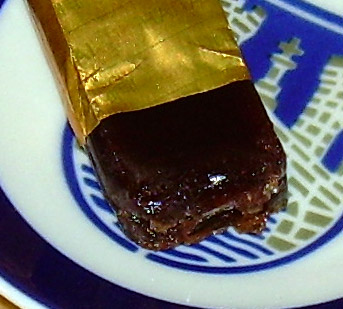
This bar is what the Japanese call "yokan" or jellied bean paste. It's very soft and I have to squeeze it up through its foil tube like super thick toothpaste to eat it. It is actually less "jelly" than "paste" and has a nice soft texture which feels like super smooth fudge without any of the pesky things like fat or chocolate. It is quite sweet, but not cloying, and does have that familiar undercurrent of red bean flavoring.

I'm not going to try and persuade anyone who sees this as monkey brains that they're going to love it. The truth is that you have to sometimes make a special effort to love some things that are outside of your general native cultural palate and many people aren't really interested in bothering (for which I can't blame them, really). I learned to love this after many years and really enjoyed this bar. I'd absolutely buy it again, especially considering how cheap it is. If you like anko, this is a treat. If not, this is not going to win you over.


Monday, January 14, 2013

Tochinomi Daifuku (chestnut and red bean)


People have been telling me about various "Japan Towns" since I returned to the U.S. I'm not sure what I expected when I heard about such areas, but it really was not what I experienced. I guess that I expect "Japan Town" to feel like, well, Japan. That doesn't mean I expect that Japanese people will be milling about, staring at their phones like zombies and gawking at the white girl with piles of red-blonde hair. The truth is that, I am not sure what was missing, but I think that the atmosphere created by the crowds, cramped spaces, the frenetic activity of employees trying to look like they're performing their tasks perfectly, the constant cleaning and tidying, and the conversations in Japanese.

I've been to two "Japan Towns" since coming back home. The first was in San Jose, and I had the misfortune to go there on a Monday when, apparently, it is mainly shut down. This was a big disappointment because one of the reasons I went there was to visit their traditional sweets shop, Shuei-do. I'm not sure, but they appear to have vanished from the Japan Town web site and may have gone out of business. All I know is that the Japan Town in San Jose was so tiny that I haven't been motivated to go back on another day.

The other Japan Town that I went to recently was in San Francisco, and it has more to offer, but is still largely just a shopping arcade plus a few other shops located near the Peace Pagoda. It is definitely more interesting than the San Jose equivalent, but not as much as I'd hoped. I think I simply expect too much. As an oasis of "Japan-ness" in the U.S., it's actually pretty good. There are a lot of Japanese restaurants, several Japanese stores including a bigger, nicer Daiso than the one I frequent, a gaming arcade, and some sweets and grocery stores. However, it's all pretty streamlined. You don't get much of a real ethnic feel from it. There aren't little grubby mom and pop shops for the most part (as I hear you may experience in China Town). Of course, the Japanese aren't exactly known for doing "grubby". 

The best part for me was Benkyodo, a place selling hand-made Japanese sweets, and Nippon-ya. Nippon-ya is where I procured today's snack for review. The latter offers boxed sweets which are pretty much the same as those sold in train stations, the airport, and souvenir shops around Tokyo. It is the sort of thing I thought I'd never encounter after leaving Japan. I was a kid in a Japanese candy store when I say stacks of gift-wrapped boxes of sweets topped by the usual plastic display of samples with cutaways to show you what was inside.


There were so many options and I wanted to buy them all, but I can't really justify doing so when I am the only one who is likely to consume the contents. The prices were in the $9-$10 range for boxes with 16-24 pieces. This is incredibly reasonable and in line with the average prices in Japan. Most of the time, these cost about 1000 yen ($11.21) per box in Japan, often more than that. Someone on Yelp said that they felt these were "expensive", and they may appear to be so by U.S. standards, but I was more than happy to fork over $9.25 for a box of 20 small daifuku.


I agonized about what flavor to buy since there were many that looked appealing, but ultimately went for chestnut since it is one of my seasonal favorite. I figure the fruit flavors are likely to stick around until spring or summer, and this will vanish with the cold weather. The display promised chestnut bits in red bean paste with a hint of caramel. As you can see from the cutaway above, there aren't any chestnut bits to speak of in the one that is shown here. This was the third one I ate, and I haven't found any pieces in any of them. 

The flavor balance is definitely heavy on the mochi and red bean side and there is absolutely a hint of caramel. The chestnut flavor is very subtle, and you actually have to be looking for it. Overall, the flavor profile is not intense, but tends to settle in slowly. These are sweet enough without going overboard. I only wish there was a stronger chestnut component. The ingredients list starts with "sugar", followed by rice, and red bean and only then does it get to chestnut followed by emulsifiers and caramel. You can see what it's not so big with the chestnut. 

The main reason for selecting daifuku in my opinion is the interplay of textures, not so much the strength of the flavors. The soft chewy pillow of mochi contrasts with the smooth paste inside. This is light on the filling, but the mochi is fresh and soft. It's definitely very much on par with relatively shelf stable mochi in Tokyo. When I say "relatively shelf stable", I mean that there's an expiration date in a few months, not next year. This one expires on March 2, 2013. 

I like these, but I can't say that I adore them. I have no regrets about buying them and will enjoy eating them slowly but surely. They absolutely remind me of some of the Japanese sweets I purchased in Japan in that not every one was exactly what I wanted it to be, but they all tended to be decent enough. The main failing in these is not enough filling and not enough chestnut. They're good, but they could have, in my estimation, "should have", been better.


Monday, August 13, 2012

Awashimado Adzuki Tart


Sometimes it seemed to me that the Japanese randomly assigned English names to various things. On the front of this treat, the big characters say "tart" or "ta-ru-to". This is in no way a "tart". I know because I looked it up to be sure that I hadn't missed some sort of alternate definition of the word. Wikipedia will back me up on the fact that a tart requires a pastry base, which this does not have.

Of course, the Japanese absolutely do not need to conform to our limited Western definitions of our own words. For a country that often focuses on conformity, this reveals a bit of a rebellious streak. Kudos to them for finding a way that expresses their inner rebel while still not ruffling any feathers. When mom and dad don't see won't hurt them... unless there you're dumb enough to leave wrappers of any sort lying around the betray your illicit activities, but that really has nothing to do with red beans or tarts or even food. 

This confection is made by Awashimado, the company that makes Adzuki Bean Boy cakes, a product which I described as the Japanese equivalent of cookie dough. I probably put on an entire pound of Adzuki Bean Boy by the time I'd left Japan. After scarfing down too many of those hefty bean cakes, I wanted to sample some of the company's other products and this was one of them. 


The main benefit over this misnamed tart over the bean boy is that it is only 170 calories (whereas it's brother was a whopping 260). I certainly didn't expect as much buttery richness from this, and I didn't get it. What I did get though was a very, very sweet, thick and satisfying smooth yet hefty filling of red bean paste wrapped in a moist bit of sponge cake. The cake is similar to castella, but slightly softer and, frankly, a much better textural compliment to the filling. 

This was a wonderful variation on a Swiss cake roll and I would absolutely have it again and again, if I could find access to it. I purchased this for 98 yen ($1.24) in a Tokyo supermarket, Inageya. I'm hoping to locate some of Awashimado's line in California after I have a chance to explore the various Japan towns in San Francisco and San Jose. If you find this (or the Adzuki Bean Boy), I'd recommend picking one up and giving it a try, but do it on the spot so you don't regret buying a big stash if you end up loving them a much as I do.

(If you'd like to download some wallpapers with the cute, simple mascots that Awashimado uses to promote its foods, you can find them here.)


Friday, April 13, 2012

Lawson VL Jumbo Dorayaki


I've always been curious about the origin of various foods and wary of the notion that any food was solely invented by one particular culture. Long-time and attentive readers will recall that I question the notions of “Japanese bread” and “Japanese cheesecake” as these are not Japanese at all, but minor variations on European cuisine (as are many other baked food items). All of that being said, I think there are some things which make sense as food concepts which likely were "discovered" simultaneously in various cultures. Pancakes would fall into the category of things that you could easily see being created all over the world without input from other cultures. How imaginative does a person have to be to think about adding (any type of) flour to liquid and then deciding to pour into onto a hot, oiled surface?

Dorayaki is something which I haven't reviewed before because it is most often sold filled with chunky sweet red bean paste (tsubuan) and I'm more of a fan of koshian (finer paste that has had the skins sifted out and has more of a smooth fudge-like texture). As time has gone by, I've grown a lot mellower about coarser versions and as our departure from Japan approached, I became more and more attracted to traditional Japanese sweets including those with chunky-style sweet red beans.

It's important to say at this point that I didn't go 23 years in Japan having never eaten dorayaki. It's a very common treat and I'd been exposed to it before, but didn't really pay much attention to it when I ate it. My first really positive experience with it came at a Japanese all-you-can-eat buffet that had a dessert bar which included some damn fine dorayaki. This 100 yen ($1.22) super large (about the diameter of my open hand with splayed fingers) “jumbo dorayaki” wasn't something that I expected to live up to that aforementioned red-bean-filled pancake, but it certainly was more accessible since it was on sale at the local Lawson 100 shop a few minutes from our apartment.


Dorayaki is basically two pancakes sandwiching some sort of filling, usually bean paste. The main question is not what it will taste like, but what the textures will be like. Will the cake be sticky and weird on the outside (sometimes they are), dry (ditto), or tough (double ditto)? Will the beans be too sweet or too bland? In the the case of this dorayaki, the pancake had a very nice flavor and texture and was only slightly tacky on the outside. It was tender and appropriately sweet for a relatively bland wrapper for the bean filling. The beans themselves were quite sweet and lacked a strong “beany” taste. I could have done with a bit more flavor depth on that front, but I can't say it was terribly disappointing and I felt that it was sweet and had a satisfyingly dense texture.

I can't say this is the best dorayaki ever, but I can say that the value for the size and price is on the amazing side. It is quite tasty and I'd definitely buy it again if I had the chance. It's important to note that this really is a "whole lotta dorayaki" at 490 calories for the entire thing. A quarter makes a serviceable snack, half makes for a nice continental breakfast, and the whole thing for an enjoyable pig-out. You can guess which I went for.


Tuesday, January 25, 2011

Shogoin (Red Bean) Yatsuhashi


Some foods in Japan are familiar to me mainly through my former work and this is definitely one of them. I hadn't seen yatsuhashi for at least 6 years when my husband brought home this box of traditional Japanese sweets. I don't know if families are buying these for themselves and snacking on them, but this is something I personally associate with obligatory souvenirs that salesmen brought back from business trips as a way of saying, "sorry that you're all stuck in this stuffy office while I go out on sales trips and spend half of the time doing tachiyomi instead of actual work".

The gift box, which doesn't tell you much about what the food looks like and that's why I didn't put it at the top of the post.

Though this traditonal Japanese sweet was made by a company called Shogoin, it almost certainly doesn't matter who makes it if you pick up a box. There is a very low chance that it will be appreciably different as long as it is fresh. In fact, one point about this is that it is actually "raw" rice flour dough which resembles chewy mochi and has to be eaten quickly. The packaging says you've got to eat it within three days and keep it refrigerated.

Note that you can buy various cooked versions of yatsuhashi, but it is markedly different in texture and taste. In fact, I didn't even realize that the cooked version was the same basic material as the raw version as this is like a super soft pastry coated in cinnamon and the cooked version (at the top left of the linked page) is like chewing on a hard cinnamon stick. Research for this post educated me about this fact. This is definitely something which I'd strongly recommend in its raw form over the cooked version despite the limited life span on it.

Yatsuhashi is a food associated with  Kyoto, Japan's former capital and magnet for tourists who prefer to think of Japan as a quaint, quiet place full of people who are politely mincing about in kimono and geta rather than the noisy, modern, and rude place it is (at least if you live in Tokyo). My husband was given this box of sweets by a student who returned from a New Year's trip. Our box included both green tea and basic versions, but I'm only reviewing the basic one.* The wrappers sometimes have other flavors added to them including black sesame seeds or even strawberry, but I'd only encountered the plain cinnamon version before. Various fillings, including peach as on offer by Shogoin at the time of this review, are also possible.

Yeah, it's a crappy picture, but the best of three attempts.

These are an interesting experience from a Western palate's point of view. The smattering of red beans in the center is small enough that it doesn't overcome you with beany flavor but is enough to add something more to the mix. The wrapper is like eating raw pie dough in some ways, but with a little more heft and texture as it is slightly chewy but not the least bit stretchy. The main appeal for me is the sweetness coupled with the cinnamon which is so generous as to be actually hot. Note that, this being a souvenir, there is no nutrition information on the box, but the "Calories in Japanese Food" site provides an estimate of about 66 calories per (about 4"/10 cm) sweet.

This is a curious sweet, but I still enjoyed it. I think it is one of those things which can be an acquired taste for those who were not raised around similar Asian sweets. I love the soft yet chewy texture, and the cinnamon flavors, but I think some people may find it all a bit strange. If you come across this in an Asian grocery or while in Japan, I'd say buy a small amount and give it a try, but I wouldn't gamble on a big box if your tastes run more toward traditional Western sweets and their various derivatives.

*I am only reviewing the basic one because I'm giving away the green tea version. This is not because I expect to dislike it, but rather that there are too many of them for my husband and I to eat in the limited time they should be eaten and I'd rather share them with a grateful person than have some of them go to waste. And while the person I'm giving them to would probably take the open package, I think it's better manners to offer a sealed one.

Wednesday, September 8, 2010

Ogura (red bean) Pretz


Awhile back, I reviewed the gyoza (potsticker) Pretz and said I would also be reviewing this red bean variety. Shortly after that review, I put the second box of Pretz into a basket on top of my refrigerator (in which snacks wait for sampling) and forgot about it. Fortunately, these are still on sale so this review hasn't lapsed into irrelevance.

You can find these in most snack shops and convenience stores, but I got this at a discount snack shop in Koenji called  Okashi no Marche. They cost 99 yen ($1.14). Each box has two 27.5 gram (about 1 oz.) foil packets of pretzels and there are 135 calories. This is pretty average for this portion of pretzels. The ingredients list is as expected (flour, margarine, etc.), excepted that it includes adzuki powder.

Yes, this is the same picture from my other review. The pretzels look exactly the same. Only the powder flavoring is different.

It's rather a shame that I waited so long because these are really good. I've never had a sweet pretzel that really wowed me that wasn't coated in some form of chocolate, but this came about as close as a pretzel can to doing so. The red bean flavor isn't as "beany" as these things can be. It's more of an essential essence with the beaniness removed. They're lightly sweetened, but not so faintly that you can't detect the sweetness.

I would recommend these for red bean sweet novices. They introduce you to the flavor without any of the elements which tend to put people off of them. I really liked them, but those who really, really love adzuki and its textural elements may find it too limited an emulation of the red bean experience. I'll definitely buy them again though.