Showing posts with label rice. Show all posts

Tuesday, January 25, 2011

Shogoin (Red Bean) Yatsuhashi


Some foods in Japan are familiar to me mainly through my former work and this is definitely one of them. I hadn't seen yatsuhashi for at least 6 years when my husband brought home this box of traditional Japanese sweets. I don't know if families are buying these for themselves and snacking on them, but this is something I personally associate with obligatory souvenirs that salesmen brought back from business trips as a way of saying, "sorry that you're all stuck in this stuffy office while I go out on sales trips and spend half of the time doing tachiyomi instead of actual work".

The gift box, which doesn't tell you much about what the food looks like and that's why I didn't put it at the top of the post.

Though this traditonal Japanese sweet was made by a company called Shogoin, it almost certainly doesn't matter who makes it if you pick up a box. There is a very low chance that it will be appreciably different as long as it is fresh. In fact, one point about this is that it is actually "raw" rice flour dough which resembles chewy mochi and has to be eaten quickly. The packaging says you've got to eat it within three days and keep it refrigerated.

Note that you can buy various cooked versions of yatsuhashi, but it is markedly different in texture and taste. In fact, I didn't even realize that the cooked version was the same basic material as the raw version as this is like a super soft pastry coated in cinnamon and the cooked version (at the top left of the linked page) is like chewing on a hard cinnamon stick. Research for this post educated me about this fact. This is definitely something which I'd strongly recommend in its raw form over the cooked version despite the limited life span on it.

Yatsuhashi is a food associated with  Kyoto, Japan's former capital and magnet for tourists who prefer to think of Japan as a quaint, quiet place full of people who are politely mincing about in kimono and geta rather than the noisy, modern, and rude place it is (at least if you live in Tokyo). My husband was given this box of sweets by a student who returned from a New Year's trip. Our box included both green tea and basic versions, but I'm only reviewing the basic one.* The wrappers sometimes have other flavors added to them including black sesame seeds or even strawberry, but I'd only encountered the plain cinnamon version before. Various fillings, including peach as on offer by Shogoin at the time of this review, are also possible.

Yeah, it's a crappy picture, but the best of three attempts.

These are an interesting experience from a Western palate's point of view. The smattering of red beans in the center is small enough that it doesn't overcome you with beany flavor but is enough to add something more to the mix. The wrapper is like eating raw pie dough in some ways, but with a little more heft and texture as it is slightly chewy but not the least bit stretchy. The main appeal for me is the sweetness coupled with the cinnamon which is so generous as to be actually hot. Note that, this being a souvenir, there is no nutrition information on the box, but the "Calories in Japanese Food" site provides an estimate of about 66 calories per (about 4"/10 cm) sweet.

This is a curious sweet, but I still enjoyed it. I think it is one of those things which can be an acquired taste for those who were not raised around similar Asian sweets. I love the soft yet chewy texture, and the cinnamon flavors, but I think some people may find it all a bit strange. If you come across this in an Asian grocery or while in Japan, I'd say buy a small amount and give it a try, but I wouldn't gamble on a big box if your tastes run more toward traditional Western sweets and their various derivatives.

*I am only reviewing the basic one because I'm giving away the green tea version. This is not because I expect to dislike it, but rather that there are too many of them for my husband and I to eat in the limited time they should be eaten and I'd rather share them with a grateful person than have some of them go to waste. And while the person I'm giving them to would probably take the open package, I think it's better manners to offer a sealed one.

Wednesday, July 14, 2010

Lawson VL Yaki Onigiri


I think that onigiri (rice ball) is probably the number one snack in Japan, though it isn't glamorous enough to get talked about much and is close enough to real food that it's not seen as a "snack". Any time a Japanese person feels peckish, but doesn't feel like a meal, they tend to grab one of these at convenience stores. Onigiri is on offer at most "conbini" for 100 yen ($1.14), often in a familiar triangular presentation. They usually have a filling (seafood in most cases) or are mixed with other seasoning elements (fish flakes, beans, etc.), and nori (dry, paper-like seaweed) is separated from the rice so that it can be wrapped around the rice ball without absorbing the moisture. Onigiri is a handy snack which provides energy and enough substance for a full feeling.

Before I came to actually like plain Japanese rice, I liked onigiri and occasionally bought them at 7-11 when I worked at Nova language school so very long ago (19 years ago). My favorite has always been grilled ("yaki") onigiri, which is a rice ball that has been brushed with a soy-sauce-based seasoning and cooked until the exterior is brown and slightly crispy. When my friends and I went to our favorite yakitori joint, I'd always order yaki onigiri.

These days, I tend to just make my own plain white rice and haven't enjoyed a nice grilled rice ball for a long time. Part of the reason for this is that they're much more expensive than just making rice myself. That being said, I can't grill rice balls because I don't have the proper type of grill and I'm also frankly too lazy to mess about forming the balls and brushing them with sauce.

I needed something to eat with the remaining lemon basil chicken that I reviewed previously (yes, it took me many weeks to eat the rest of them) and I figured this pack of 3 grilled rice balls from Lawson's 100 yen shop would do the trick. I figured that if I were desperate enough to eat frozen chicken, I'd probably be happy to have something else that was frozen along with it as I generally resort to frozen food in moments of fatigue, illness, or dire hunger brought on by waiting too long to start preparing food.


These rice balls are quite small. Each is about a half cup of rice pressed into a fairly firm ball. The instructions on the package offer different cooking times based on microwave wattage and how many rice balls you are cooking at once. I made only one because 93 calories of carbohydrate is enough for me for lunch. The outside of the onigiri is nicely brown with soy sauce and possibly is actually grilled. The inside is just plain rice. I put this in the microwave when it was frozen solid and one minute and ten seconds at 600 watts brought it out steaming hot.

The rice was tender, yet firm. The smell was actually very nice because of the seasoning. The soy sauce-based exterior was flavorful and had a good balance. The only thing that separated this from the yaki onigiri that I ordered at yakitori restaurants was the lack of a crispy outside. Still, I think it would be hard to make this the same as a freshly grilled rice ball, particularly when heating it in the microwave as crispness is usually the first thing you lose when freezing and irradiating food.

I liked this quite a lot and would definitely have it again if I was feeling lazy or simply wanted to keep something on hand in the freezer to have with a meal and I didn't have time to cook rice. If rice is fairly boring to you, this may float your boat because of the soy sauce flavoring. At 100 yen for 3 balls, it's also pretty reasonable economically.

Tuesday, June 15, 2010

Kagome "Rice Menu Set": Chicken Doria and Spicy Tomato Curry

Kagome Chicken Doria (236 calories)

As part of my attempts to review instant or frozen food on occasion, I picked up these shelf stable "heat and eat" meals at Seiyu supermarket on sale for 198 yen ($2.16). There are several of these in a line by Kagome geared toward weight-conscious women. That's why the calorie information is displayed so prominently on the front of the boxes. These boast not only low calorie counts, but some added fiber through the use of a barley and rice mixture. I chose the "chicken doria" because I have a fond experience with that dish from a local restaurant, and the tomato curry because, well, it's curry.


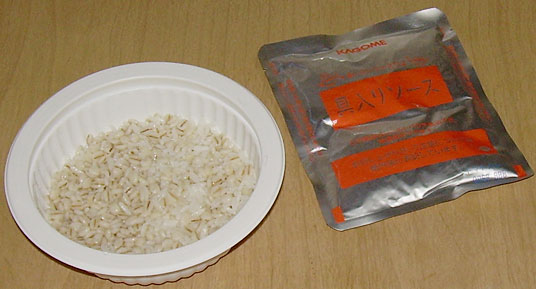
Both of these dishes have a bowl with a bit under a cup of grain in the bottom and foil packets that contain sauces. The Doria has separate mixtures for white sauce and red sauce. In the end, you mix it all together anyway so I don't quite understand the point of the separation. I'm guessing it's for aesthetic reasons. The tomato curry had one large foil pack only.


Going into sampling these, I knew I would try them alone once, and then I would augment them with leftover chicken breast. These sorts of meals are not well-known for their high protein content. I started with the chicken doria which had microscopic bits of tomato, the odd rare crumb of carrot, and tiny little bits of chicken mince. The red sauce with chicken smells like tomato and not much else. the white sauce has a bit of a dog-food/canned food type of smell. It was not encouraging.

This didn't taste like not much of anything. There's some very mild tomato juice flavor and ever so vague hints of some sort of cheese. You have to strain to taste it though. In fact, I'd recommend invoking the power of imagination and hope that you can turn your desire for cheese taste into reality through the power of your mind. I couldn't taste chicken at all. It's also one of those prepared foods that has a lot of sodium, 350 mg., but you still need to add salt to it to taste anything.

The texture was rather gelatinous. You can tell the sauce is mainly made with cornstarch. While the rice is not bad at all and is relatively firm and decent, good pre-made rice is really not hard to come by in Japan.

This was palatable only because I added 90 grams of leftover chicken breast to it and the rice was fine with it. The sauce mainly added some moisture and texture. I was very disappointed in this and probably wouldn't have eaten it all if I hadn't already mixed the chicken in with it and had nothing else to really consume.

The Chicken Doria gets a well-deserved:


Spicy Tomato Curry (235 calories)

After my experience with the Chicken Doria, I had even lower expectations of this. I felt a bit more hopeful after I opened the sauce packet and smelled it. The aroma was about what one would expect of spicy curry and tomato. You can see how little I expect of these things when they end up smelling like they should and I'm pleasantly surprised.

The base component of this was similar to the chicken doria version. The plastic bowl has about three-quarters of a cup of rather dry rice and barley with a foil packet of sauce. After squeezing the sauce onto the rice mixture, I put it in the microwave with the lid on as instructed and the lid blew off about 1 minute and 15 seconds into the process. Curry bubbled up and splattered on the edges of the bowl before I could stop it.


I took it out and gave it a stir and noticed that it was very, very soupy. The rice seemed rather dry at first, but the texture improved after it sat for about 5 minutes. There are small blobs of soft tomato in the sauce, and no other detectable vegetables. I sampled it as is and it is not bad at all. It's nicely spicy in terms of warmth and intensity of tomato flavor. The curry flavors are rather muted, but it's really rather piquant. It's just a bit salty, but not in a too overbearing manner.


After a taste of the curry "as is", I added 85 grams (3 oz.) of leftover chopped, cooked chicken breast and stirred it in. Because there is a lot more sauce than necessary, this worked quite well. There was more than enough sauce to coat the chicken and the combination was very good. I didn't need to add salt to the bland chicken because the sauce is spicy enough to cover.

I actually liked this. If I were inclined to pick up a prepared meal to avoid preparing all of the components, I'd definitely buy this again. For this sort of food, this was pretty good and the low calorie count (235 calories alone, 372 with the added chicken) is appealing. It's not stellar, but it is tasty enough to be worthwhile, especially if you have no time to cook.