Though I'm sure people who don't live in Japan think that there are bizarre food options lurking at the front of every shelf when you live here, that is far from the truth. This is especially the case when you've spent the last 3 years or so going out of your way to sample anything which doesn't contain shrimp (which I dislike with the intensity of a thousand suns and won't review well, and is hardly an esoteric flavor anyway). Occasionally, I'll locate something which is Japanese and uncommon even though it is domestically produced.
In the case of this soft drink, which I found at a shop in Shinjuku which sells products from Hokkaido, this is one of those rare items. I chose this one because it was the only sugar-free version, and I prefer to get my calories from chocolate and salty stuff. This cost 147 yen ($1.81) for a 500 ml. bottle.
I intentionally did not research what "Guarana" was before I sampled this. I didn't want objective facts to interfere with my subjective taste perceptions. If I expected to taste something, it might increase the chances that I'd detect it. I first gave it the deep inhalation test. That doesn't mean I snorted it, but I did come close to doing so in an attempt to pick up all of nuances of its bouquet. At first, I thought I detected a grape-like fruity aroma, then something medicinal. A final sniff reminded me of bubble gum. That was the impression that stuck with me as I prepared to dive in and take a sip.
A fruity bubblegum flavor definitely came through on the first sip. It had a strong shot of the flavor I recall from penny candy versions of said wads of gum, which is probably some particular chemical. That was followed by a strong chemical flavor and then what seemed like a hit of, shockingly, root beer. The sense of root beer was only at the very end. I'll give this points for at least having flavor depth, if nothing else.
After a proper tasting, I looked up guarana and discovered that it is a plant from the maple family which is known for its fruit and the fact that said fruit has twice the caffeine of coffee. Here is where we get to the appeal of such a beverage to the Japanese market, which excels in offering strong legal stimulants to keep businessmen awake all night as they labor away in their offices. It has always been rather ironic to me that a culture which is so anti-drug so heartily embraces certain drugs, alcohol and caffeine, with what appears to be complete ignorance of the fact that these are stimulants and depressants and not merely foodstuffs.
Guarana soft drinks are, apparently, quite popular in Brazil and out-sell more internationally better known cola beverages. It is considered a health tonic there, which is a little bizarre. It mainly seems to have the same effects as any caffeinated product including increased fat metabolism and cognitive boosts. In my research, it did indicate that it has a fruity taste when mixed with sugar.
This is an energy drink by any other name. In the shop where I purchased this, there were a lot of varieties of guarana drinks made by various manufacturers, but I never see them stocked in regular stores. Since I don't drink energy drinks, it's very likely that some common ones, sold in little brown bottles in refrigerator sections of various stores, contain guarana extract and that is well-known among members of the peppy drinkers club. This is marketed in Japan as a health tonic and claims to fight obesity, arteriosclerosis, and improve stamina. Chances are, however, that what it'll help fight is sleep.
This was okay in terms of taste, but nothing I could see craving. I would only buy it again if I were severely sleep deprived and wanted to have something more potent than coffee or tea. The chances of that being the case are pretty much zero, but I wouldn't write this off as something I'd never have again.
Showing posts with label zero. Show all posts
Monday, November 7, 2011
Co-Up Guarana Zero
Thursday, July 7, 2011
Tarami White Jelly
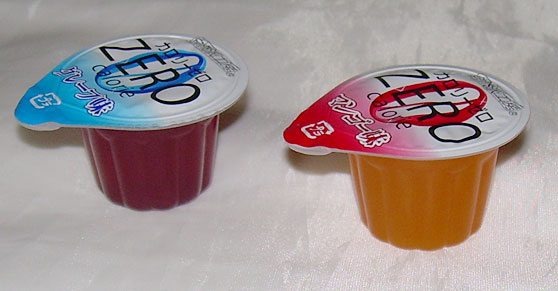
I keep talking about summer in my reviews, but with people melting onto the pavement and sweating in the intense humidity of the rainy season, and the various food companies pandering to all of us, how can I ignore the fact that the heat drives snack product introductions. That means less chocolate, more lighter, fruitier options, and especially more things that go down smooth and easy from the refrigerator case. That leads me to "jellies" (or, as we call them in the U.S., gelatin). There has been an explosion in the number of individually packaged gelatin options and most of them are pretty mundane fruit options. This "white jelly" caught my eye, because I don't know what "white" tastes like. That phrase could really be taken the wrong way...
I found this for 178 yen ($2.28) at Family Mart for 290 grams (10 oz.). That's on the expensive side, but it is a pretty large portion size. This is zero calorie jelly and I'm guessing the large amount is to fill a belly that wants to be full without any risk of weight gain. There are more and more of these products in Japan all of the time as the quest for an alien body image has spread here from the West to the East.
The company that makes this, Tarami, specializes in making a wide variety of gelatin desserts. Their main business is doing the kind with sugar based on fruit and real fruit flavors. Their zero calorie lines are split into two sizes with the smaller ones being fruit flavors and the bigger ones adding more esoteric varieties like cola and "white" to the line up. Their web site shows farms and lots of orange trees, but somehow I doubt their 400 or so employees are working the farms to fortify their gelatin desserts.
As for what "white" tastes like? It tastes like a sweet, slightly fruity Asian fruit cocktail and is somewhat yogurt-like. It's both a little tart and sour, but the flavor is on the mild side with no overwhelming sweetness. Since I'm accustomed to artificial sweeteners, this didn't bother me. In fact, I'm nearly immune to the chemical cocktails (Acesulfame K, Sucralose, Aspartame) that are used to formulate diet foods.
The part where this shines is in the texture. It's a cool, soft and slick jelly with chewy bits of nata de coco in the bottom. The textural variation that comes from the nata de coco is quite welcome and lends the illusion that you're eating something with a bit of substance. I should note that many Japanese gelatins like this include blocks of konnyaku jelly or nata de coco.
I liked this just fine, but I wasn't mad about it. The truth is that I can make more flavorful zero calorie jelly myself using plain gelatin, packets of artificial sweetener and whatever flavoring agent I want (coffee, tea, lemon, lime, etc.). That doesn't mean I couldn't see myself buying this again and it was perfectly pleasant. However, I'd only purchase it under the most unique circumstances because the size is bigger than I need and the price higher than I'd prefer to pay. Chances are, I'll never sample it again.
Just a gentle reminder that there is a contest running for two weeks to win a few snack and snack-related goodies. If you'd like to enter, the details are in this post.
Labels:
diet,
fruit flavors,
gelatin,
jelly,
nata de coco,
Tarami,
zero
Thursday, October 28, 2010
Dydo Peter Rabbit Fruit Tea (Season Blend)
Dydo is one of the first Japanese drink companies that I heard the name of, though I didn't come across it firsthand. My husband, before he was Mr. Orchid64, spent a year in Japan alone as a teacher and sent me a picture of a Dydo vending machine and with our inexperience with Japanese culture at that time, we thought it was a funny-sounding name. Little did we know that there were far more amusing words to be discovered.
I don't see many of their machines in my particular neighborhood, and honestly don't recall seeing many of their drinks on store shelves. This was a little surprise to me when I discovered it in the cold drink case at a 100 yen ($1.20) shop in a neighboring area. The inclusion of grapefruit as a flavor is what drew me in, though I haven't had the best experience with grapefruit drinks in the past.
Peter Rabbit is pretty popular in Japan among the young women set. Kids don't seem so much into that character, but university students and young OLs are known to pick up Peter Rabbit goods at expensive import shops like Sony Plaza. Unsurprisingly, this is promoted as "woman friendly" due to its zero calorie status. They catch your eye with Peter Rabbit, and get you to buy it because it won't make you fat. The character is so popular that about 25% of visitors to the cottage where the character was created are Japanese. I find myself wondering just how much Dydo had to pay the estate of Beatrix Potter to use this character.
A whiff after opening the bottle reveals both tea and citrus fruit, unsurprisingly. The ingredients include grapefruit and the scent really confirms this. The taste is a balanced blend of grapefruit and plain tea. The grapefruit flavor hits the tongue first and the tea after, but both are there clearly and cleanly. The bottle mentions that ginger and honey are also flavor components, and one can detect the faintest hint of honey and ginger. Since this is a zero calorie drink, I don't understand how both "grapefruit sugar" and honey can be ingredients and keep the calories at nothing, but there is a note that says that this is not absolutely zero but less than 5 calories per 100 ml.
This is a pretty nice tea. I can detect complex flavors and everything that is promised on the bottle's label is present. If you are sensitive to artificial sweeteners, you may not want to try this. If not, it's certainly worth a taste. I'd buy it again if I found it and was in the right mood. It's refreshing and has the right amount of pretty much everything to make a tasty fruit tea.
I don't see many of their machines in my particular neighborhood, and honestly don't recall seeing many of their drinks on store shelves. This was a little surprise to me when I discovered it in the cold drink case at a 100 yen ($1.20) shop in a neighboring area. The inclusion of grapefruit as a flavor is what drew me in, though I haven't had the best experience with grapefruit drinks in the past.
Peter Rabbit is pretty popular in Japan among the young women set. Kids don't seem so much into that character, but university students and young OLs are known to pick up Peter Rabbit goods at expensive import shops like Sony Plaza. Unsurprisingly, this is promoted as "woman friendly" due to its zero calorie status. They catch your eye with Peter Rabbit, and get you to buy it because it won't make you fat. The character is so popular that about 25% of visitors to the cottage where the character was created are Japanese. I find myself wondering just how much Dydo had to pay the estate of Beatrix Potter to use this character.
A whiff after opening the bottle reveals both tea and citrus fruit, unsurprisingly. The ingredients include grapefruit and the scent really confirms this. The taste is a balanced blend of grapefruit and plain tea. The grapefruit flavor hits the tongue first and the tea after, but both are there clearly and cleanly. The bottle mentions that ginger and honey are also flavor components, and one can detect the faintest hint of honey and ginger. Since this is a zero calorie drink, I don't understand how both "grapefruit sugar" and honey can be ingredients and keep the calories at nothing, but there is a note that says that this is not absolutely zero but less than 5 calories per 100 ml.
This is a pretty nice tea. I can detect complex flavors and everything that is promised on the bottle's label is present. If you are sensitive to artificial sweeteners, you may not want to try this. If not, it's certainly worth a taste. I'd buy it again if I found it and was in the right mood. It's refreshing and has the right amount of pretty much everything to make a tasty fruit tea.
Labels:
beverage,
dydo,
grapefruit,
Peter Rabbit,
tea,
zero
Thursday, October 7, 2010
Mitsuya Cider All Zero
There's no way for my readers to know this, but I used to have an internet stalker. This person first discovered me via a personal blog, and followed me to this one. As this person's preoccupation with me started to ramp up, my stalker started to post comments under various made-up names. The main point of such comments was to post moderately critical or contradictory statements. If I said I didn't care for something, this person would say it was a favorite.
The reason this stalker (who I believe has since lost interest in me) comes to mind is that one of the sock puppets this party created asserted that I wasn't posting enough beverage reviews. This was despite the fact that I had posted about 25 drink reviews at that point in time. The main residue of my experience with this stalker is that my husband has moderated comments since that experience began so that I wouldn't have to think about them. That's right, my husband filters your comments, not me! A secondary one was that I disabled anonymous commenting (to make it more troublesome to post under fake identities). The tertiary one is that I always remember that person's phony baloney assertion that I don't review enough drinks every time I review one now. So, as I review this Mitsuya Cider, I remember that my stalker wanted more of these types of reviews, or at least pretended to.
The last time I reviewed what the Japanese call "cider" it was the Fanta Zero Cider. Mitsuya Cider has been around a lot longer and is a more popular brand than Fanta. I didn't know what to expect, but part of the reason for that was that I had forgotten what the Fanta Zero was like. That was an experience that floated back as I sampled this.
This smelled like bubblegum The taste was very hard to pin down. It has some vague elements of ramune with its lemon-lime notes, but it's very weak compared to something like 7-Up or Sprite. It's a light soft drink, which probably suits Japanese tastes with it's less overbearing flavors. It's very heavily carbonated so it really bubbles on the tongue. In fact, this is like a lightly flavored club soda. I can see how it would suit Japanese tastes since, by and large, they prefer subtle flavors.
The web site for this is here. The site recommends various drinks with this as a base including adding mint and lemon and honey and ginger. I think that this can certainly be enjoyed "as is", but may be seen as being a bit on the weaker side flavor-wise. It probably occupies a similar space in the market to ginger ale in the United States (though it is weaker in flavor than that beverage).
Though this was fine, I wouldn't buy it again because the experience lacked a strong impression. On the bright side, it doesn't taste as strongly of artificial sweeteners as the Fanta Zero Cider. If I had no other option, I'd drink this without hesitation, but I wouldn't seek it out.
The reason this stalker (who I believe has since lost interest in me) comes to mind is that one of the sock puppets this party created asserted that I wasn't posting enough beverage reviews. This was despite the fact that I had posted about 25 drink reviews at that point in time. The main residue of my experience with this stalker is that my husband has moderated comments since that experience began so that I wouldn't have to think about them. That's right, my husband filters your comments, not me! A secondary one was that I disabled anonymous commenting (to make it more troublesome to post under fake identities). The tertiary one is that I always remember that person's phony baloney assertion that I don't review enough drinks every time I review one now. So, as I review this Mitsuya Cider, I remember that my stalker wanted more of these types of reviews, or at least pretended to.
The last time I reviewed what the Japanese call "cider" it was the Fanta Zero Cider. Mitsuya Cider has been around a lot longer and is a more popular brand than Fanta. I didn't know what to expect, but part of the reason for that was that I had forgotten what the Fanta Zero was like. That was an experience that floated back as I sampled this.
This smelled like bubblegum The taste was very hard to pin down. It has some vague elements of ramune with its lemon-lime notes, but it's very weak compared to something like 7-Up or Sprite. It's a light soft drink, which probably suits Japanese tastes with it's less overbearing flavors. It's very heavily carbonated so it really bubbles on the tongue. In fact, this is like a lightly flavored club soda. I can see how it would suit Japanese tastes since, by and large, they prefer subtle flavors.
The web site for this is here. The site recommends various drinks with this as a base including adding mint and lemon and honey and ginger. I think that this can certainly be enjoyed "as is", but may be seen as being a bit on the weaker side flavor-wise. It probably occupies a similar space in the market to ginger ale in the United States (though it is weaker in flavor than that beverage).
Though this was fine, I wouldn't buy it again because the experience lacked a strong impression. On the bright side, it doesn't taste as strongly of artificial sweeteners as the Fanta Zero Cider. If I had no other option, I'd drink this without hesitation, but I wouldn't seek it out.
Wednesday, August 11, 2010
7-Up Clear Dry
On the heels of the "Pepsi Strong Shot" comes this release of 7-Up Clear Dry. While it may seem that they have nothing in common, the label reveals that they both have the same goals in mind; they want to caffeinate you up until you develop heart palpitations and believe that you can run with the blurry speed of the Roadrunner.
I should note that 7-Up is not a common drink in Tokyo. Occasionally, I see it in the odd vending machine, but it has much less market exposure than Coke or Pepsi. Note that 7-Up is distributed by the makers of Pepsi in Japan, so this isn't someone pilfering an idea (adding lots of caffeine as the selling point). It's more like a company that lacks imagination recycling one.
Just like the Pepsi Strong Shot, this boasts more caffeine, in this case 85 mg. for a 500 ml. bottle. This is about 10 mg. less than 8 oz. of brewed coffee so it isn't going to send you over the moon. Unlike the Pepsi Strong Shot, this isn't hyper-carbonated.
I passed on reviewing the Pepsi Strong Shot because I suspected that it was going to taste like regular Pepsi and, as the review from Marvo at the Impulsive Buy that I linked to above says, that is exactly what it was. The same can be said for this 7-Up. It tastes and smells just like regular Diet 7-Up with it's fairly clean lemon-lime flavors. The big difference is that the regular stuff is promoted as being caffeine-free as one of its selling points in the States and this Japanese version is full of wake-up drugs.
The main draw for me with this beverage is that it is a diet drink. This is the only zero calorie version of 7-Up in Japan and a welcome addition to the woefully small line-up of sugar-free and zero calorie soft drinks. While I am not a huge fan of 7-Up, I do like having the option to have it occasionally. Unfortunately, I'm guessing this "Clear Dry" thing will be short-lived and I'll have to stock up before it vanishes in the next few months if I want to occasionally enjoy a 7-Up without sugar.
If you are in Japan and want another calorie-free beverage, go buy up all of this that you can now. I found it at AM/PM convenience store for 147 yen ($1.72) and I think that it is unlikely that it'll show up more cheaply or at markets, though I hope I'm wrong about that. It's probably available at other convenience stores. However, if you're not a 7-Up fan, don't bother as this is certainly nothing special except for the extra caffeine.
I should note that 7-Up is not a common drink in Tokyo. Occasionally, I see it in the odd vending machine, but it has much less market exposure than Coke or Pepsi. Note that 7-Up is distributed by the makers of Pepsi in Japan, so this isn't someone pilfering an idea (adding lots of caffeine as the selling point). It's more like a company that lacks imagination recycling one.
Just like the Pepsi Strong Shot, this boasts more caffeine, in this case 85 mg. for a 500 ml. bottle. This is about 10 mg. less than 8 oz. of brewed coffee so it isn't going to send you over the moon. Unlike the Pepsi Strong Shot, this isn't hyper-carbonated.
I passed on reviewing the Pepsi Strong Shot because I suspected that it was going to taste like regular Pepsi and, as the review from Marvo at the Impulsive Buy that I linked to above says, that is exactly what it was. The same can be said for this 7-Up. It tastes and smells just like regular Diet 7-Up with it's fairly clean lemon-lime flavors. The big difference is that the regular stuff is promoted as being caffeine-free as one of its selling points in the States and this Japanese version is full of wake-up drugs.
The main draw for me with this beverage is that it is a diet drink. This is the only zero calorie version of 7-Up in Japan and a welcome addition to the woefully small line-up of sugar-free and zero calorie soft drinks. While I am not a huge fan of 7-Up, I do like having the option to have it occasionally. Unfortunately, I'm guessing this "Clear Dry" thing will be short-lived and I'll have to stock up before it vanishes in the next few months if I want to occasionally enjoy a 7-Up without sugar.
If you are in Japan and want another calorie-free beverage, go buy up all of this that you can now. I found it at AM/PM convenience store for 147 yen ($1.72) and I think that it is unlikely that it'll show up more cheaply or at markets, though I hope I'm wrong about that. It's probably available at other convenience stores. However, if you're not a 7-Up fan, don't bother as this is certainly nothing special except for the extra caffeine.
Labels:
7-Up,
7-Up Clear Dry,
beverage,
calorie-free,
Pepsi,
sugar-free,
zero
Wednesday, June 30, 2010
Slim & Slim Mango and Grape "Jelly"
When I first came to Japan, diet foods were pretty much nonexistent. There were pleasantly chubby Japanese girls, but they were seen as "healthy", not "fat". In the past decade and a half, diet foods and focusing on weight loss has grown exponentially. You see more products with "Zero" on them every year.
Part of me is sad about this because I think that it reflects diet obsession, which is never a good thing. Part of me is glad because I am a willing consumer of such foods. Of course, I have an excuse, I arrived in this country "pre-corrupted" by Western obsessions with dieting. Sometimes I think that the more we focus on our eating, the fatter we get, and I worry that the Japanese may eventually fall victim to the same problems as Westerners as their culture learns to promote fear of weight gain to sell products which eventually end up causing weight gain and food obsession.
Sociological issues aside, and I'm sorry to get so serious, but sometimes things take on a life of their own, I decided to finally dive in and try one of the plethora of zero calorie "jellies" (actually, it's what we call "gelatin" in the U.S.). I've seen big, single-serving size tubs of them in convenience stores and snack shops for quite some time and had passed on them. When these two varieties of smaller size jellies showed up for 89 yen (97 cents) per bag at Okashi no Machioka, I decided to dive in.
Note that I have tried regular (that is to say, sugar-filled) Japanese single serving gelatin tubs before. I wasn't a fan of them because they seemed toothachingly sweet. I can compare these sugar-free versions directly to that version. The first ingredient is Erythritol on both flavors and their respective fruit purees are the second. I don't understand how each can be zero calories and contain fruit puree, but there it is. The mango version is colored with carotene and paprika.
The mango has a pleasantly fruity smell and a nice mango flavor. It's not too strong, but it is rather sweet. It mainly lacks the citrus tones that you get with a real mango, but the flavor isn't bad at all. The grape smells like a grape lollipop and pretty much tastes like one. I think both of these would have a bit more punch with some citric acid or the equivalent.
I tried these both refrigerated and at room temperature and they're more pleasant when cold. The texture is pretty much what you'd expect for gelatin, though this is less firm and rather soft set compared to American gelatin like that you make with Jell-O mixes. Both also have a bit of liquid which tastes like juice around the outside.
These are pleasant tasting and not painfully sweet (which is better than the sugar-based jellies I tried before). They're even a little bit of a refreshing mouthful (each tub is 22 grams/.77 oz.) in hot weather when you have them cold. The thing that did surprise me though is that they tended to suppress appetite. Perhaps the gelatin is designed to achieve this effect, or it was just psychology, but I really did find that eating two of them (I tended to eat one of each flavor each time) killed my hunger for awhile.
I'd recommend buying these and putting one in your refrigerator if you're on a diet or have a tendency to eat more than you'd like. I think the mango is better than the grape, but both are fine. These aren't healthy at all since they have a chemical cocktail (Acesulfame K, Sucralose), but they seemed to serve me well when hunger struck and I either couldn't eat or didn't want to.
Labels:
diet,
fruit flavors,
grape,
jelly,
mango,
slimandslim,
sugar-free,
zero
Wednesday, March 10, 2010
TopValu Light Meal Konnyaku Jelly (Lychee)

Some time last year, I started to notice more and more zero calorie jelly (what we call gelatin) products for sale in convenience stores. This "light meal" nutritionally balanced drinking gelatin is something which has also been around for years, albeit not in as many zero-calorie forms. I wanted to sample it for my week of diet/health foods, but I'm a bit squeamish about the prospect of a drinking jelly.

I squeezed some of this into a glass, and what I saw didn't encourage me. You can't see it from the picture I took, but there are little wispy shreds of clear jelly suspended in a yellowish liquid. They resemble amoebas with a thyroid disorder. Of course, you're not supposed to squirt this stuff into a glass and drink it. You're supposed to suck it out of the tube at the top. This is good because it's very difficult to squeeze out. The packet is designed to keep it from spilling out. It works like a steel can of evaporated milk that only has one hole pocked in it. There's not enough of an exchange of air to allow the free flow of the jelly.
This is made with konnyaku jelly, something which I have been far less than keen on in the past. I tend to dislike the texture of it when it's put in stews and other Japanese dishes. If you don't want to read the Wikipedia entry, I'll tell you that it's jelly, often in a mottled gray block form, made from a plant (konjac). Konjac is a "corm", which is similar to a tuber or yam, but doesn't have the same properties. It is consumed for its texture, and its high fiber, which fills the stomach and aids digestion. In Japan, it's usually salty and used in traditional dishes, but it's popular in Asia in jelly drinks as well. People sometimes choke to death on it, but I can say that there is little risk of choking on the soft konnyaku in this beverage. It's too wispy for anyone to get lodged in his or her throat.
I chose the TopValu brand because it was cheap. I paid 98 yen at a local supermarket for this 180 gram pouch. There are a plethora of other choices, and I'm guessing most of them are roughly similar to this one in consistency and in having a huge list of added nutrients. Clearly, this is meant to fill the belly of dieting people who want to feel full, get nutrients, but consume no calories. This packet was fortified with B vitamins, D, E, Folic acid, and Panthothenic acid. It contains a pretty hefty cocktail of artificial sweeteners including Erythritol, Acesulfame K, and Sucralose. It also contains kale, which is popular in Japan for its nutritive properties. You can buy powdered kale and dissolve it in water to drink; it tastes as good as it sounds.
In theory, this is a great idea. The big question is about how it works in practice. The texture isn't nearly what I thought it would be. It's not slimy, but rather like drinking super soft tapioca bubbles. I have never had bubble tea, but I imagine this is a distant cousin to it texturally. The smell is rather fruity, like a cross between an apple and a peach. The taste at first is very sweet and like a fruit gelatin. I rarely eat lychee, so I can't know how faithful the flavor is to the fruit. It's not an impressive flavor, but it's unoffensive. The main drawback is that there is a bitter aftertaste after you've sucked down (literally) some of it. The only other drawback is that I feel goofy as an adult suckling on a tube like a baby with a bottle.
This type of food isn't meant to be some fantastic and tasty snack, but rather as a palatable health food to stop you from snacking on things that aren't good for you. I can say that it is inoffensive, and the sweetness is initially quite gratifying if you're hungry. I can also say that, without a doubt, it made my stomach feel full and that I would recommend anyone who counts calories and struggles with hunger give this a try. I don't know if it would actually replace a meal, but it would certainly help you stave off a case of the munchies between meals and I'd buy this again. In fact, I wouldn't mind keeping one on hand when I'm having one of those days when I just want to eat all day. Note that these last for months.
Wednesday, February 24, 2010
Lipton Peach Tea Zero

Occasionally, people will write me an e-mail or leave a comment asking how, as a reviewer, one might score freebies for review purposes. My answer is, "when you find out, let me know." Since I don't get paid for this blog, and make pennies on each post from advertising most days, I'm very cheap about acquiring the food I review. Take this Lipton Zero Peach Tea for example. I had seen it at several convenience stores and pondered sampling it, but thought I didn't want the experience enough to fork over a whole 100 yen ($1.10). Yes, I'm really that cheap.
I was cruising the dairy and juice aisle at the local market when I noticed that they had a carton marked down to 80 yen (88 cents) with an expiration date of tomorrow. I decided that was the price at which they'd pry the yen out of my grubby, cheap fingers. The thing I can't figure out is what can go bad in this tea. It's essentially water, peach juice, and chemicals.
Note that I'm overstating my cheapness a bit here. I will pay more for things which I'm really keen to sample, but beverages that are not carbonated are close to lowest on my list of things to try as I can make pretty much anything which isn't fizzy. It's hard for me to pay for tea when I can make it with a teabag for about 7 yen (8 cents) and add my own artificial sweetener.

Like the Lipton Zero orange tea, I can't figure out how peach juice can be used in this and it can still be zero calorie. Still, the carton says that this has 3% peach juice and I believe them based on the flavor. It smells lightly of peaches and has a nice, refreshing peach taste coupled with slightly bitter straight tea flavor. Perhaps I'm getting used to the way artificial sweeteners are mixed into zero calorie Japanese drinks, but I wasn't really troubled by any aftertaste. In fact, I thought this was a really good fruit tea blend and would definitely consider buying it again if I'm too lazy to brew my own tea and feeling like a bit of a spendthrift.
Tuesday, January 5, 2010
Love Mode Ginger Zero

This soft drink has been around for awhile, but I've been too cheap to pay 147 yen for it. When it finally showed up in the local 99 yen shop, I took the plunge. This is one of those absurdly named and oddly designed items which is almost certainly going to be all potatoes and no meat, all style and no substance, and whatever else you want to add which conveys the idea that it looks exciting on the outside and is going to be boring on the inside.
I figure that any drink that is trying so hard to look exciting has to have little going for it. Beyond the bling-like design of the name on the front of the label, there is a sexually suggestive leather zipper on the side of the bottle which runs along the perforation on the plastic sleeve where you tear it and remove it. Also, pink ginger ale? Pink? For those who don't know, pink is generally seen as a color associated with sex in Japan. I think this is intentional design to try and make this drink look, well, sexier.
I didn't take a shot of the drink in a glass because you can see through the bottle. Suntory promotes this as being "sweet and dry". This is actually truth in promotion. It's a little sweeter than Canada Dry ginger ale and has a dry finish. It's made with a cocktail of artificial sweeteners including acesulfame K, Sucralose, and aspartame. Unlike most of the diet drinks I've tried in Japan, you can't detect the sweeteners so obviously. Note that I am accustomed to diet sodas and may not be able to taste them as clearly as someone who doesn't tend to drink them so often.
My response to this is a bit mixed. I think it's a good sugar-free ginger ale blend, but the ginger part is somewhat subdued. I actually liked it better as a stand-alone drink than Diet Canada Dry ginger ale and if they were both the same price and I had a choice and I didn't want to mix it with something (and I sometimes mix with orange juice), I'd go for this. I wish it weren't pink though. I keep thinking it should be tropical punch when I drank it.
Wednesday, December 30, 2009
CC Lemon Zero

C.C. Lemon is one of those drinks that I've had an interest in for quite some time because it is packed with Vitamin C and who doesn't enjoy a good lemon beverage? My former boss used to drink it on occasion and some of my students swear by it as a way of keeping colds at bay.
I don't like to drink my calories and I particularly don't like to drink sugary acidic sodas because they have a bad effect on the teeth. This is what has kept me from sampling C.C. Lemon for all these years. I especially wanted to try it around the time that the Simpsons were used heavily in their promotions as there were some nifty bits of swag available at that time. Unfortunately for me, the Simpsons aren't being used now when a zero calorie version is available.
I investigated the name "C.C. Lemon", but didn't come up with any explanation of what the "C.C." stands for besides the fact that it's supposed to be packed with a lot of Vitamin C. The American Wikipedia page says that there has been some controversy about whether or not the advertised amount of C is really as claimed, but the Japanese page doesn't mention anything about it. The weird thing is that they don't mention the amount of Vitamin C in terms of usual measures, but as the number of lemons worth of C. A 500 ml. bottle of C.C. Lemon zero supposedly contains 70 lemons worth.

The soda smells pleasantly lemony and you can tell it's lightly carbonated when you open the lid since it makes less of a "pop" noise than other fizzy beverages. The lemon flavor is pronounced, but not overwhelming. The sweetness level is just a tiny bit higher than I'd personally prefer and you can detect the fact that this is made with a cocktail of artificial sweeteners, but it's far less obvious than some of the other diet beverages I've sampled. After the first several sips, the artificial sweetener taste tends to mute (but not disappear) a bit as your tongue grows accustomed to it.
This was a very refreshing lemon drink with a good balance of flavors and a very mild citrus bite. It's flawed because I wish it had a little less of an artificial sweetener flavor, a little more carbonation, and a little more citrus bite and less sweetness, but it's pretty good for a diet version of a beverage. My feeling is that diet soda beggars can't be too choosy, but this is pretty good regardless. I will definitely revisit this if it doesn't end up vanishing as so many zero-calorie drinks in Japan seem to do.
Suntory's web site for C.C. Lemon is currently sporting a strange space ship made from a drink bottle motif. It includes a little Flash-based game, but you have to read Japanese to play it and some desktop pictures and a screen save that can be downloaded. Among the desktop pictures, I find the diagram of the internal structure of the imaginary spaceship rather amusing because of all of the lemon-shaped furnishings.
Monday, November 2, 2009
Coca-Cola Plus with Fiber

On October 26, Coke released yet another version of its expanding "plus" line of no calorie beverages. Though I've only reviewed the green tea version, I have tried the version with Vitamin C, and I wasn't a fan. That being said, I wasn't offended by it. I just am not a huge fan of the lemon with Coke flavor that is in it.
If you live in Japan, you might realize that the Coke Plus line of drinks is a way of more directly competing with Pepsi Nex. First, there was Coke light with 50% of the calories of regular Coke. Pepsi introduced zero calorie Diet Pepsi so Coke finally came out with zero calorie Diet Coke (Coke light is part of history now). Now, they sell Coke Zero. Then Pepsi came out with a diet lemon-flavored version called Pepsi Nex and Coke countered with this stuff. It's interesting that Coke is constantly playing catch-up with Pepsi in Japan when it's the reverse in the U.S.

Though I didn't care for the lemon Diet Coke that is Coke Plus, the fact that this has fiber hooked me in. I paid 147 yen for this at 7-11 because I imagined I'd pour this into a glass and see little bits of grain floating around in it. Of course, that's not the way it is. It's more like Metamucil has been dissolved in it, I'd guess. It looks like normal Coke, has the mouth feel of, and smells like Coke with a twist of artificial lemon.
This isn't awful, but the difference between this, Coke Plus with Vitamin C and even Green Tea Coke is practically non-existent. There's a Simpsons episode about the making of "Duff beer" where they show the beer pouring down three pipes into different containers. The pipes says "regular Duff", "Duff Dry" and "Duff Light", but the liquid pouring into the pipes is coming from the same central barrel/vat. This image came to mind after sampling this Coke Plus. It's as if Coke is pouring the same stuff into different bottles.
If for some strange reason you'd like a desktop picture with Sarah Jessica Parker hawking Diet Coke beverages or the design on the bottles, you can download them here.
Wednesday, October 7, 2009
Calpis Soda Grape Zero

Let's get the big laugh out of the way first. When you say "Calpis", it sounds like "cow piss". The makers of Calpis either didn't know or didn't care about that when they made the name. The "cal" is for Calcium and the (rather unfortunate) "pis" is from Sanskrit and supposedly means "supreme taste" and is used because it is part of Buddist culture (and Japanese culture has elements of Buddism). Note that in English-speaking countries, this is called "Calpico".

Despite having been here for 20 years, I've never been tempted to buy Calpis. I chuckled about it a few times when I first got here, and promptly lost interest. The drink is supposed to be yogurt-like and feature milky flavors. It's called a "lactic acid" beverage. The color of this beverage certainly would bear that out as it is very cloudy and appears to be mixed with something milky.
This attracted me to it because it is zero calorie, though the first ingredient is, oddly "grape sugar". I'm guessing that it is not absolutely zero, but one of those deals where it is essentially zero per 100 ml. The other ingredients include the usual cocktail of artificial sweeteners.
This smells like grape soda, and on first sip, tastes like it. It has two strange aftertastes. The first is likely the lactic acid/milk element and the second is the artificial sweetener. I don't know what it is about Japanese low calorie sodas, but with the exception of Diet Coke, they all seem to have a heavy chemical flavor. This one is better than some on that front, but the weird bitterness and somewhat metallic taste that chases every sip spoils what might have been a promising beverage. So, while I drank the rest of the bottle, I wouldn't buy it again.
Subscribe to:
Posts (Atom)