I have been farming the kid's snacks bins of various odd snacks or things which are difficult to tell the nature of merely by looking at the package and its shape. This little bar, which is about the size of a Snickers candy bar, caught my eye both because of its graphics and the fact that I'd never heard of bidango before. I found it for a mere 28 yen (33 cents) at Okashi no Machioka, but these are the types of things that tend to show up in the kid's treats areas of supermarkets like Seiyu.
There is no information on the package about the calories or size, but it can be guessed at by comparing the average as offered on the Calories in Japanese foods site. I had to weigh it myself and it's 45 grams and that would appear to be about 140 calories for the entire bar. If this is the same composition as that on that aforementioned site, ki-bidango is rich in copper and carbohydrates.
When I unwrapped this, I wasn't sure what I was going to get. The Wikipedia page on this type of thing shows little white balls which resemble traditional dango or mochi. What was revealed looked like a block of youkan wrapped in edible plastic.
This doesn't smell like much of anything. The texture is chewy, though not tough. It is slightly reminiscent of gum without the elastic properties. In terms of taste, it's rather hard to pin down. At first, it reminded me of brown sugar or molasses, then it took on more of a red bean flavor. The taste is actually quite subtle and it's mildly and pleasantly sweet.
The ingredients include sugar water, red beans, sugar, flour, powdered mochi, vegetable oil, honey, and salt. Of course oblaat is also an ingredient because it is the edible wrapper on the outside of the sticky bar. It was actually quite difficult to cut with a knife to get this shot.
This is an interesting snack, and it's not bad at all. The taste is pleasant. The texture is interesting, and it's pretty satisfying. That being said, though I'd eat this if it was offered or given to me as a gift, I wouldn't buy it again. It's not that it's bad in any way, but rather that it's not the sort of thing I would "crave" as a sweet treat. It feels more like actual rice-based food that has been modified to become a sweet. I guess that's part of the reason that it is on offer for children. It's probably seen as more wholesome than the average chocolate bar or salty treat.
If you'd like to share your experiences with weird foods and enter a contest for a chance to win a silly prize, please read this post and make a comment.
Showing posts with label dango. Show all posts
Thursday, September 23, 2010
Ki-bidango (millet dumpling)
Labels:
dango,
indifferent,
kid's snacks,
sweets,
traditional sweets
Saturday, April 17, 2010
Random Weekend Picture 8
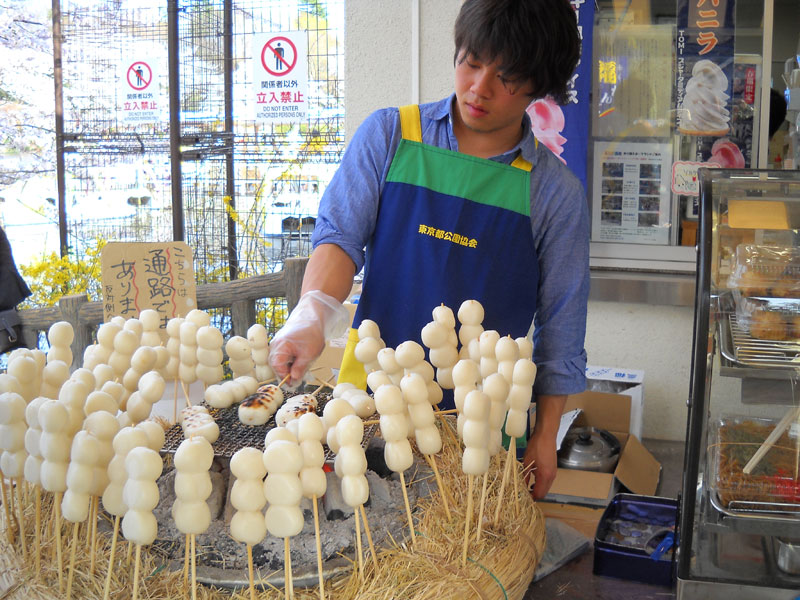
My husband and I went to Inokashira Park in Kichijoji (Tokyo) to see the cherry blossoms on April 6 and took quite a few pictures. One of the shots is of a young man grilling balls of dango. Dango are similar to mochi (pounded rice cake) and are usually made with rice flour. We didn't buy these because my husband doesn't eat this type of thing and I wasn't hungry, but there were a lot of folks walking around eating them. The idea of freshly grilled dango was very attractive to me, however.
Though I have reviewed some candy based on dango flavors, I have never actually sampled real dango. It's something I hope to get to eventually. I'm just waiting for the right situation where I'm in the mood and the flavors on offer are too enticing to pass up.
Labels:
cherry blossom viewing,
dango,
grilled,
ohanami,
random picture
Thursday, March 12, 2009
Tirol Dango Chocolate

With White Day (March 14, the companion to Valentine's Day in Japan) coming up, lots of sweets in pastel packing are crowding onto store shelves so that men can give women who gave them chocolates on February 14 a return gift. I can't say for certain that Tirol had White Day in mind with these, but it seems likely.
These candies are meant to imitate flavors used in a Japanese snack called dango. Dango are little balls made of rice flour. They're similar to mochi (rice pounded into stretchy goo) both in composition and texture. You can buy them in different colors and flavors and with different sauces.

These candies are sold in a long package of 9 pieces (3 of each flavor) for 99 yen ($1.01). Each candy is in its own wrapper and the packages are perforated so you can easily separate them from the rest. This makes them easy to distribute to others while keeping them in an airtight package. The three flavors are uguisu, mitarashi, and sakura. Each of them have a "mochi" center which is a little like a gummi candy, though with a slightly different texture. Each candy is 33 calories.

"Uguisu" in Japanese means "nightengale", and no, these are not bird-flavored. Nightengales are green and brown and uguisu dango is named for the color similarity, not the taste. That being said, I've never tasted a nightengale and have little desire to try. The uguisu candy is, unsurprisingly the green one. It smells vaguely of green tea and white chocolate. The flavor is mild green tea, a hint of soy, and white chocolate. It's pretty sweet, but not cloying.
"Mitarashi" dango is made with a sweet soy sauce, but I didn't have much of a sense of soy from this candy. It smells like white chocolate. When I bit into it, I got a strong hit of what seemed like bitter orange flavor from the syrup. The flavor mellows out then becomes very sweet at the end. There is definitely more depth and variation to this particular candy compared to the others.
"Sakura", as many people already know, is cherry so the flavor of this was no surprise. The sakura was the same as the Tirol premium sakura candy. That is, it's perfume-like and like eating cherry soap. I'm thinking that I'll be giving the remainder of the sakura ones away to unsuspecting victims.
All of the "mochi" centers are similarly chewy though the mitarashi one is somewhat tougher and thicker than the sakura and uguisu ones. I'm guessing this has to do with the syrup on top. It's possible that the recipe has to be firmer to stop the syrup from being absorbed into the gummi mochi center.
I wouldn't recommend this multi-pack because the cherry is so awful that you're throwing away one-third of the value. The uguisu is good for green tea lovers who don't want the flavor to be overbearing and the mitarashi is complex and interesting, though neither is particularly addictive. If the latter two were available as single purchase flavors for 10 yen or as premium flavors, I'd say they were worth a sample, but otherwise I'd say skip this one.
Subscribe to:
Posts (Atom)