Showing posts with label sugar-free. Show all posts

Monday, March 12, 2012

Kanro Green Tea Candy


I once read a book called "Turning Japanese" by a nisei, a young man born of Japanese parents in the United States. He had been raised entirely in America and culturally, aside from the influence of his family, he was American. I read the book quite some time ago, but I recall that I didn't like it. I recall that he visited Japan at one point and reached a lot of odd conclusions about how he was actually Japanese based on a lot of superficial and tenuous links. Among the few things I remember was that he didn't like to drink a lot at once and that he learned/concluded/speculated/guessed that Japanese people had small bladders and didn't like to drink a lot either. My feeling about that is that he clearly has never been to a "nomikai" or "drinking party" in which businessmen can imbibe copious amounts of fluids regardless of their supposedly teeny tiny bladders and long-suffering livers.

This fellow was hardly the only person who felt he was "turning Japanese" from just spending some time hobnobbing with the locals, and at least he had a family cultural heritage and bloodline to back up his claims (though, as an American, I don't believe blood determines ethnicity, but rather culture... this is my particular bias). I've known more than enough lily white foreigner who felt he or she was "turning Japanese". One of my former coworkers, a British woman, came here with a head full of voluminously curly brown hair and an eclectic wardrobe. She left here with black, straight hair and the same sort of muted, boring wardrobe that you see in autumn in Tokyo. Another claims that all things Japanese are superior to all things back in her home country, or at least she did up until Fukushima when all of her faith in Japanese society crumbled with the nuclear reactors' external housing.

One of the reasons I spent a lot of my early years in Japan actively rejecting anything that was "too Japanese" was that I felt people who were clearly not of this culture pretending they could somehow be of it was foolish and, frankly, embarrassing. Let's face it, this is not an inclusive culture and the only person you fool is yourself if you believe assimilation is possible. It was a huge turn-off for me when people "went native" and lost all perspective about the yin and yang of life in all cultures. Unfortunately, my distaste for such people manifested in distaste for the things they attached themselves to and it wasn't until I started blogging about life in Japan and doing this food blog in particular that I started to more fully open up and embrace what was on offer. Beans in my sweets? Stretchy rice cake? Green tea sweets? No thank you.

Well, I've grown up a bit and I adore beans in my sweets now and have turned into a real mochi aficionado. However, I still have not strongly taken to green tea treats. If I'm served a cup of green tea with a meal set, I'll drink it. I'll even drink the cup my husband is served, too, but I won't order one or pay extra for it. If I'm given a green tea-flavored cake by a student, I'll eat it and probably enjoy it to some extent, but I won't buy it myself. With this in mind, no one was more surprised than me to find that I had a craving for something green tea flavored and found myself purchasing these Kanro green tea hard candies. I don't know what came over me. Perhaps I grew up just a little bit more in my final month in Japan or I just am so bored with the usual options that I was ready for something "new".

I found these for about 150 yen at Okashi no Machioka discount snack shop. Each sugarless candy is a nice shiny green pellet and only about 11 calories. There are two varieties. One has milk in it and the other is pretty much the "straight" green tea (matcha) version. The milk one is less bitter and mellow. The darker one carries much more of the usual straightforward bitterness of tea as you drink it from a cup, albeit with sweetness. Both of these have a rounder flavor and texture than conventional hard candies and are super smooth on the tongue. Though they are sugarless, they include margarine (yes, margarine) as an ingredient as well as cream, and I believe the added fat adds to the smooth, slightly rich feeling in your mouth.

When I consumed one of these on the way home from work, my husband got a funny look on his face and asked what I had in my mouth. I told him it was a green tea candy to which he tactfully replied that something smelled "funky". That was his nice way of saying that he really didn't care much for the stink of the candy. That means that I'm far less likely to buy these again. However, if I really loved them, I would keep buying them and eat them when he's not around. There are other things I love that he finds the scent of unpleasant that I buy and eat anyway (like sembei), but the bar is raised if he finds it nasty to be around, especially if it inhibits talking or kissing. Personally, I think these are pretty nice for green tea candies and if I developed another inexplicable desire for a green tea sweet, I might even buy them again. I imagine a true green tea fan would find them quite enjoyable, but I think this will be my last bag. I guess that I'm really not "turning Japanese" as they aren't quite suited to my tastes.


Tuesday, January 18, 2011

The Guardman Nodo Ame


As long-time readers may already know, I'm a sucker for interesting packaging. In fact, I think that sales to foreigners who find packaging with weird English or bizarre graphics to be of paramount interest could quintuple if the marketers started playing to that particular angle. I would recommend things like "The Rice Farmers Daughter" sembei shaped like 8's (to resemble breasts). Those would do well.


Though this doesn't have a funny English name attached to it, the characters say "The Guardman" nodo ame or "throat candy". The combination of the name and the fierce-looking fellow on the front of the package as well as the price to sell (100 yen/$1.20) and the fact that these are sugar-free piqued my curiosity. It also reminded me a lot of a statue that I saw at Mt. Takao of a red guy who I christened "angry flower nipple man". Look at the picture above and you'll have to agree that the resemblance is uncanny. Perhaps that fellow escapes the blue picket fence he's trapped behind at night and slips off to his own factory to make throat drops for people with scratchy throats. Maybe the herbs are from the very same flowers that he attaches to his nipples for his day job in front of the shrine.


I don't know why this strapping figure of an angry man is on the cover of these throat drops, but I know that they are fiercely medicinal and definitely have the power to keep a sore throat at bay. Unlike a lot of the "nodo ame" that I've had in Japan before, these are not minor variations on a lollipop pretending to help you with a scratchy throat. They're packed full of intense herbal extracts including ginger and Eucalyptus and include catechins, which are supposed to act as antioxidants. The entire bag has 186 calories, which I calculated out to be about 9 calories per candy.

I found these at a local supermarket and haven't seen them anywhere else since then. If you are the type of person who likes strong herbal drops, these are the bee's knees. Even if I don't have a sore throat, I occasionally like to have something like this as an intense flavor experience. However, I'm guessing most people would only want them if they were actually sick, or liked really weird packaging.

Thursday, October 7, 2010

Mitsuya Cider All Zero

There's no way for my readers to know this, but I used to have an internet stalker. This person first discovered me via a personal blog, and followed me to this one. As this person's preoccupation with me started to ramp up, my stalker started to post comments under various made-up names. The main point of such comments was to post moderately critical or contradictory statements. If I said I didn't care for something, this person would say it was a favorite.

The reason this stalker (who I believe has since lost interest in me) comes to mind is that one of the sock puppets this party created asserted that I wasn't posting enough beverage reviews. This was despite the fact that I had posted about 25 drink reviews at that point in time. The main residue of my experience with this stalker is that my husband has moderated comments since that experience began so that I wouldn't have to think about them. That's right, my husband filters your comments, not me! A secondary one was that I disabled anonymous commenting (to make it more troublesome to post under fake identities). The tertiary one is that I always remember that person's phony baloney assertion that I don't review enough drinks every time I review one now. So, as I review this Mitsuya Cider, I remember that my stalker wanted more of these types of reviews, or at least pretended to.

The last time I reviewed what the Japanese call "cider" it was the Fanta Zero Cider. Mitsuya Cider has been around a lot longer and is a more popular brand than Fanta. I didn't know what to expect, but part of the reason for that was that I had forgotten what the Fanta Zero was like. That was an experience that floated back as I sampled this.

This smelled like bubblegum The taste was very hard to pin down. It has some vague elements of ramune with its lemon-lime notes, but it's very weak compared to something like 7-Up or Sprite. It's a light soft drink, which probably suits Japanese tastes with it's less overbearing flavors. It's very heavily carbonated so it really bubbles on the tongue. In fact, this is like a lightly flavored club soda. I can see how it would suit Japanese tastes since, by and large, they prefer subtle flavors.

The web site for this is here. The site recommends various drinks with this as a base including adding mint and lemon and honey and ginger. I think that this can certainly be enjoyed "as is", but may be seen as being a bit on the weaker side flavor-wise. It probably occupies a similar space in the market to ginger ale in the United States (though it is weaker in flavor than that beverage).

Though this was fine, I wouldn't buy it again because the experience lacked a strong impression. On the bright side, it doesn't taste as strongly of artificial sweeteners as the Fanta Zero Cider. If I had no other option, I'd drink this without hesitation, but I wouldn't seek it out.

Wednesday, August 11, 2010

7-Up Clear Dry

On the heels of the "Pepsi Strong Shot" comes this release of 7-Up Clear Dry. While it may seem that they have nothing in common, the label reveals that they both have the same goals in mind; they want to caffeinate you up until you develop heart palpitations and believe that you can run with the blurry speed of the Roadrunner.

I should note that 7-Up is not a common drink in Tokyo. Occasionally, I see it in the odd vending machine, but it has much less market exposure than Coke or Pepsi. Note that 7-Up is distributed by the makers of Pepsi in Japan, so this isn't someone pilfering an idea (adding lots of caffeine as the selling point). It's more like a company that lacks imagination recycling one.

Just like the Pepsi Strong Shot, this boasts more caffeine, in this case 85 mg. for a 500 ml. bottle. This is about 10 mg. less than 8 oz. of brewed coffee so it isn't going to send you over the moon. Unlike the Pepsi Strong Shot, this isn't hyper-carbonated.

I passed on reviewing the Pepsi Strong Shot because I suspected that it was going to taste like regular Pepsi and, as the review from Marvo at the Impulsive Buy that I linked to above says, that is exactly what it was. The same can be said for this 7-Up. It tastes and smells just like regular Diet 7-Up with it's fairly clean lemon-lime flavors. The big difference is that the regular stuff is promoted as being caffeine-free as one of its selling points in the States and this Japanese version is full of wake-up drugs.

The main draw for me with this beverage is that it is a diet drink. This is the only zero calorie version of 7-Up in Japan and a welcome addition to the woefully small line-up of sugar-free and zero calorie soft drinks. While I am not a huge fan of 7-Up, I do like having the option to have it occasionally. Unfortunately, I'm guessing this "Clear Dry" thing will be short-lived and I'll have to stock up before it vanishes in the next few months if I want to occasionally enjoy a 7-Up without sugar.

If you are in Japan and want another calorie-free beverage, go buy up all of this that you can now. I found it at AM/PM convenience store for 147 yen ($1.72) and I think that it is unlikely that it'll show up more cheaply or at markets, though I hope I'm wrong about that. It's probably available at other convenience stores. However, if you're not a 7-Up fan, don't bother as this is certainly nothing special except for the extra caffeine.

Friday, August 6, 2010

Calpis Soda Refresh Zero

I sought out this drink after one of my readers recommended it to me. You wouldn't think I'd need to have people telling me to try things, but the truth is that far more things are released than a single reviewer could ever manage on her own. If I had a stable of writers willing to try all of the things I don't want to try, then there's a slim chance most of the bases might be covered.

Of course, they'd have to be a stable of writing slaves since there's no money in blogging, but it would nonetheless be the only way to cover more food and drink. I can only eat and drink so much junk before the risk that my office chair will collapse becomes very real. There's a reason I mention calories in every post, and that's that I'm all too aware of what I'm eating and how much I can tolerate on a regular basis.

At any rate, I found this Calpis "Refresh Zero" soda at Seiyu supermarket for 98 yen ($1.12), but it is currently available in a wide variety of places including most (but not all) convenience stores. Seiyu was simplest the cheapest place to get it. This is a 500 ml. bottle with no sugar, though it says it has 1% real lemon juice. The first ingredient is lemon, followed by Erythritol. It includes powdered milk and lactobacillus cultures.

The combination is an uncommon one. It's the sort of thing you could never really have in real life because lemon and milk are not flavors that usually mix because lemon curdles milk. If you don't believe me, make yourself a cup of lemon tea and add milk. Watch the little curds float around.

At first, I thought this was just weird. Mainly, it seemed like lightly-sweetened, lemon mixed with club soda with a hint of milk. About halfway through the bottle, I started to actually like it and the mix of sour lemon and milk took on a yogurt-like feel which I found pleasant. I think this is one of those things that can be perceived as so new as to be hard to figure out how you feel about it at first, but then you either grow to like it, or decide it's really not your thing. It's an acquired taste, and, fortunately, I acquired it. That being said, it may not be everyone's cup of tea, or Calpis, as the case may be.

Wednesday, June 30, 2010

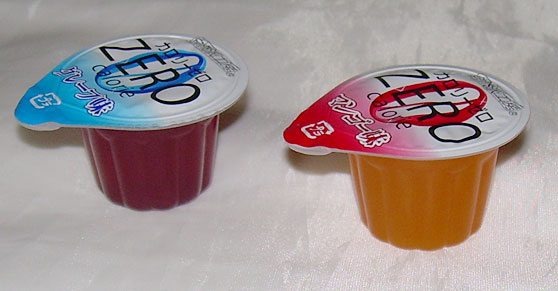
Slim & Slim Mango and Grape "Jelly"


When I first came to Japan, diet foods were pretty much nonexistent. There were pleasantly chubby Japanese girls, but they were seen as "healthy", not "fat". In the past decade and a half, diet foods and focusing on weight loss has grown exponentially. You see more products with "Zero" on them every year.

Part of me is sad about this because I think that it reflects diet obsession, which is never a good thing. Part of me is glad because I am a willing consumer of such foods. Of course, I have an excuse, I arrived in this country "pre-corrupted" by Western obsessions with dieting. Sometimes I think that the more we focus on our eating, the fatter we get, and I worry that the Japanese may eventually fall victim to the same problems as Westerners as their culture learns to promote fear of weight gain to sell products which eventually end up causing weight gain and food obsession.

Sociological issues aside, and I'm sorry to get so serious, but sometimes things take on a life of their own, I decided to finally dive in and try one of the plethora of zero calorie "jellies" (actually, it's what we call "gelatin" in the U.S.). I've seen big, single-serving size tubs of them in convenience stores and snack shops for quite some time and had passed on them. When these two varieties of smaller size jellies showed up for 89 yen (97 cents) per bag at Okashi no Machioka, I decided to dive in.


Note that I have tried regular (that is to say, sugar-filled) Japanese single serving gelatin tubs before. I wasn't a fan of them because they seemed toothachingly sweet. I can compare these sugar-free versions directly to that version. The first ingredient is Erythritol on both flavors and their respective fruit purees are the second. I don't understand how each can be zero calories and contain fruit puree, but there it is. The mango version is colored with carotene and paprika.

The mango has a pleasantly fruity smell and a nice mango flavor. It's not too strong, but it is rather sweet. It mainly lacks the citrus tones that you get with a real mango, but the flavor isn't bad at all. The grape smells like a grape lollipop and pretty much tastes like one. I think both of these would have a bit more punch with some citric acid or the equivalent.

I tried these both refrigerated and at room temperature and they're more pleasant when cold. The texture is pretty much what you'd expect for gelatin, though this is less firm and rather soft set compared to American gelatin like that you make with Jell-O mixes. Both also have a bit of liquid which tastes like juice around the outside.

These are pleasant tasting and not painfully sweet (which is better than the sugar-based jellies I tried before). They're even a little bit of a refreshing mouthful (each tub is 22 grams/.77 oz.) in hot weather when you have them cold. The thing that did surprise me though is that they tended to suppress appetite. Perhaps the gelatin is designed to achieve this effect, or it was just psychology, but I really did find that eating two of them (I tended to eat one of each flavor each time) killed my hunger for awhile.

I'd recommend buying these and putting one in your refrigerator if you're on a diet or have a tendency to eat more than you'd like. I think the mango is better than the grape, but both are fine. These aren't healthy at all since they have a chemical cocktail (Acesulfame K, Sucralose), but they seemed to serve me well when hunger struck and I either couldn't eat or didn't want to.

Friday, May 28, 2010

Clearin' Sugarless Nodo Ame Fruit


I used to teach a lesson on giving advice where I would give students a sequence of problems and they had to make a statement advising me on how to deal with the problem. One of the problems that I'd mention was, "I have a sore throat". The students often would say, "you should eat some candy." No, the students weren't thinking I'd be happier if I ate a little candy, though honestly I've always found chocolate ice cream to be the bee's knees for sore throats. You get both the chocolate enjoyment and the cooling ice cream.


The recommendation to have candy is the result of a literal translation of "nodo ame" or "throat candy". It's obviously what we'd call throat lozenges or drops. That being said, my experiences in Japan with throat soothing drops has been less than impressive. There seem to be two kinds of drops for sale. Either they are so strongly herb-packed and medicinal that they taste utterly vile or they are so weak that they might as well be lollipops. If you want sugar-free drops to spare your tooth enamel, your options are even worse.

There is one variety that I rely on which is made by Kanro. Unfortunately, this variety is somewhat difficult to locate at times, so I occasionally sample something new. While I was perusing a variety of convenience stores, I came across this pack of Clearin' fruit-flavored drops by Teicalo at Family Mart for 198 yen ($2.14). I've had one variety of Teicalo's drops before and enjoy the texture and taste of them, but find their herbal aspect too weak to feel like they help an inflamed throat. I was hoping these might be a bit better.

The ingredients in these include: Reduced maltose syrup, fruit juice (apple, grapefruit, lemons, grapes), herbal extracts, isomaltose, vitamin C, flavorings, artificial sweeteners, artificial colors, and emulsifiers. It's pretty much in line with what you might expect from a sugar-free candy. Each candy is 9 calories and there are 22 of them in the bag.


The drops themselves are quite beautiful. They're partially clear with a gradient of bright color on the opposite side. The design is meant to release the herbal aspects more clearly and potently, but I don't know if it can really work like that. I do know that you taste the fruit more potently if you put the colored side down on your tongue.

grape: The grape flavor strongly reminds me of the cheap grape lollipops that I used to get as a kid. I'm talking about the kind on a white stick or a white loop of stiffened fiber that cheap people gave you for Halloween or the doctor gave you after poking you with a needle. There was the tiniest hint of some sort medicinal herbal flavor, but mainly, it was just a mundane piece of candy.

grapefruit: This one had a bit more bite and that telltale grapefruit bitterness. The herbal aspect shone through a bit more as well.

lemon: The lemon has a nice citrus bite and also is similar in herbal essence to the grapefruit. It was my favorite both in terms of flavor and the feeling that it had a medicinal impact.

green apple: Like the grape, this reminded me of a cheap lollipop with an herbal edge.

My feeling is that the herbal content of each is likely the same, but the impact on your sinuses is different based on the intensity of how you sense it. Those drops with a more intense herbal bite feel more helpful, even if they may not necessarily be more helpful. After sampling all four drops, my tongue felt pretty saturated with the herbal flavoring, but I don't think these helped my throat much more than simply chewing gum or sucking on any type of candy might have helped.

These weren't bad at all as fruit candy, though they weren't great as lozenges. If you're sensitive to strong herbal flavors and are hard-pressed to find a palatable throat drop, these might do in a pinch, but I wouldn't recommend them. Mainly, they're like sugar-free, slightly herbal lollipops.

Monday, May 17, 2010

Lotte "Beauty Life" Sugar-free Biscuit Chocolate


Sugarless chocolate is pretty hard to come by in Japan. You can find some types of sugar-free treats, gum and hard candy mostly, but chocolate is relatively rare. I think the Japanese take the common sense approach to sweets. Either you can have them in their full form, or you can't have them at all. People with diabetes or conditions which may require them to limit sugar consumption are largely out of luck.

This Zero chocolate has been around for a long time, though not in this packaging. I remember buying it at least 7 years ago in its plain chocolate form and not being overly impressed. For the record, I don't have a health condition that makes me want to limit sugar, but I am completely aware of two points about it which affect everyone. First, it is bad for your teeth. Second, eating sugar causes a spike and a crash so that you feel energized then very tired. Occasionally, it is nice to have a sweet and not concern oneself with these points, but there is always a price to pay in taste.

Sugar, like salt, has particular flavor aspects. There is an edge to the taste of sweets made with sugar much as there is one to foods made with salt. You can sense its absence, even when artificial sweetener is present and simulates its sweetness. That edge is absent in chocolates like Zero, and that's why they are not as good as the real thing even when they have cocoa butter and sufficient fat to emulate the real deal.When I first sampled Zero a long time ago, I noticed this flat taste, and experienced a strong bittersweet chocolate aftertaste. It was the strongest Japanese chocolate aftertaste that I'd ever experienced and literally left a bad taste in my mouth.


I decided to give this chocolate another chance when I saw the repackaged "biscuit crunch" version at Tomod's drug store. Note that this chocolate is generally more expensive than that with sugar. It's around 150 yen ($1.60) for 5 sticks that are each 10 grams (.35 oz.), each stick is 8.5 cm x 1.7 cm (3.3 in. x .67 in.). Each stick has 42 calories.

There isn't much of an aroma to this chocolate. I think it may actually have some sort of sealant to make the little bars shinier. The flavor is very intensely bittersweet chocolate which is quite sweet; you can tell it's made with artificial sweetener, but it's not really bad. It's just different. The chocolate is with crispy bits of cookie. The cookie doesn't taste like anything, but makes for a more interesting texture. I would definitely prefer the cookie version of this to the regular version.

This was good, and I'd buy it again if I were in the mood to spare myself the effects of sugar. I can't strongly recommend it for everyone, but if you want to have a sweet and avoid sugar, this is pretty good. Keep in mind that sugar-free doesn't translate into low calorie. This is actually pretty much as fattening as any sort of chocolate, but it just won't up your blood sugar levels.

Thursday, March 11, 2010

Smart Time Mild Chocolate Gum


There are two flavors which I've always found disappointing when they are used outside of their "proper" place. The first is cola. You can make lollipops, fizzy candies, etc. with cola flavor, but it's always flat and weird. Cola belongs in a carbonated beverage. The other flavor that is hard to transfer to unconventional places is chocolate, though it is certainly more flexible than cola.

When I bought this Smart Time Mild Chocolate gum, I was aware that I was flirting with potential disappointment. Chocolate isn't one of those things which tends to come across well in gum. Part of the reason for this is that gum has no fat, and chocolate foods usually have it. Part of the reason is that the texture of gum seems to exist in discord with the harmony of chocolate as a flavor, at least in my flavor world (of which I am the high queen as it's my blog and I'll rule if I want to).

The "Smart Time" line of gum, which is marketed under the Recaldent brand and made by Cadbury, is primarily designed to get women to chew gum rather than snack. That's why it's called "smart time". Smart women chew 3-calorie nibblets of gum rather than give in to the temptation to tuck into a drawer full of sweets. The liquid center is meant to offer the consumer a burst of satisfying flavor.


I found this gum for about 70 yen (78 cents) at Okashi no Machioka. Usually, a 9-piece pack of this gum is 100 yen ($1.11), so part of what made me decide to roll the dice was that I could sample on the cheap. Also, I've been chewing more gum lately as a way of eating less, and perhaps I can fool myself into thinking this 3.6 calorie per morsel gum is going to satisfy a chocolate craving.

The gum smells vaguely chocolate-like, and the first bite is a muted chocolate flavor mixed with coconut. Though there is no coconut in the gum according to the ingredients list, there is something called "butter oil" and that might be similar. It also contains cocoa butter, cocoa powder, and the artificial sweetener, Maltitol. The flavor is not quite what one would hope for if one were expecting a nice chocolate and the texture of gum after the burst of cocoa flavor feels disconcerting, but this is fairly good gum albeit a bit sweet.

If I was in need of some gum, this would certainly be a possible purchase for me in the future. That being said, this reminds me vaguely of a type of diet candy that my mother bought when I was a kid. This candy was little caramel-like blobs that women were supposed to eat to help suppress their appetite and tasted sweet, but a bit weird. This gum is a lot like that. It doesn't make it bad, just quite different.

The web site for Recaldent and Smart Time gum has an online coloring book where kids can color in the animated tooth mascot for these sugarless gums, Hamii-kun. If you have kids, or miss spending days with a box of Crayolas, it's here.

Friday, December 26, 2008

Plus X Grape Mint Gum


In Japanese business, there's a concept called "plus alpha". This means that an additional service is added on to whatever the usual package of services is offered. I'll note for those who have not lived in Japan that "plus alpha" is said in English, not in the Japanese equivalent of those English words. So, most Japanese people know what "plus" means even if it is written in English.

This grape mint gum says "plus X" which makes it sound as if something extra has been added. Lotte's web site says that the branding using "plus X" is specifically targeted at young people as a way of making gum made with Xylitol (a sweetener which helps strengthen tooth enamel) seem "fun" and "cool". I guess they feel that the whole idea of gum that is good for your teeth is too square for the likes of Japanese young people so it's hipper to make it vague by saying "plus X". Of course, I'm not sure how "fun" you can make tiny pieces of gum.


Lotte also mentions that the price of this gum is set at 100 yen (about $1), though I'm not sure why that should be so special. A lot of individual packs of gum are in the same price range, though there are some pretty expensive big plastic canisters of gum for around 500-800 yen (about $5-$8). Each pack has 14 pieces and if you chew the whole thing, it's only 37 calories. The pieces are rather sloppily wrapped in textured foil which is too big for the size of the gum. Perhaps Lotte is recycling packaging from more generously proportioned gum or they like the look of a product swaddled in foil.


The gum is similar to Chiclets in the U.S. though they are perhaps a little bigger. The pieces have a candy coating and don't have any scent at all. When you bite into it, you're hit by a faint grape flavor then by a very odd mixture of mint and grape. The mint is stronger than the grape, though they do tend to mix into a bit of a funky combination for a short time until the flavor peters out. The grape dies off entirely after about a minute and you're left with an almost bitter mint flavor. The flavor doesn't last all that long and the piece size is so small that even a conservative gum chewer might need 3 pieces to satisfy herself.

I'm not a serious gum chewer, but if I were, I wouldn't buy this again. It's not only that grape and mint do not make a great pairing, but also that the flavor doesn't last long and the gum isn't especially a great chew. I can't understand why fruit gum in Japan seems to be often paired with mint since that's not a particularly tasty combination. It could be that gum is mainly used to freshen breath and mint is seen as necessary for doing the trick. At any rate, I wouldn't recommend this.

Friday, November 28, 2008

Smart Time Citrus and Berry Gum


Japan is a country full of thin people. You wouldn't think they'd have all sorts of diet foods or appetite suppressants, but they do. The reason this gum is "smart" is that that you're supposed to be savvy enough to chew it instead of eating when you are hungry. While it does not claim to specifically inhibit hunger, the claim is that the fruit and citrus flavors will satisfy your taste buds and you'll forget about the need to consume actual food. The gum has a berry-flavored liquid in the center which is supposed to spread sweetness in your mouth and satisfy your need to eat.

It smells like citrus when you open the box. The gum is sugar-free and has a crisp candy shell. Each piece has 3 calories and is chock full of chemicals including Maltitol. This is a sweetener which, if consumed in too great a quantity, can result in multiple trips to the bathroom so you have to consume it conservatively.

When you bite into it, the liquid center does release onto your tongue and you get a strong dose of a medicinal berry taste. It is a bit like a good cough syrup flavor at first. It doesn't take long for that flavor to dissipate and you're left with the citrus flavor only. That being said, the citrus flavor lasts quite awhile and is pretty good, though non-descript.

This is not bad gum, but it in no way helps you conquer a rumbling stomach. I ate a piece around 5 hours after lunch when I'm dying for a snack and it only distracted my mouth. If you think you're hungry, but you are actually just looking for some sort of oral gratification, this would probably work fairly well, though not necessarily any better than other gum which you enjoy.

I will note that the gum comes wrapped in a Cadbury wrapper with its distinctive logo and being hungry and seeing the logo of one of the best confectioners in the world doesn't exactly help you distract yourself from eating. I guess that the Japanese aren't likely to make the connection between Cadbury's logo and a nice bar of Dairy Milk chocolate, but most foreign folks sure will. I'm off to find some chocolate.