Showing posts with label beverage. Show all posts

Thursday, April 24, 2014

Kirin Salty Lychee Drink (product information)


Kirin is doing some sort of promotion in which they talk about the combination of fruit and salt. I am very aware that salt can do a lot of things for various dishes, including boost the sweetness level of various types of fruit (watermelon in particular) as well as add complexity to chocolate and other types of sweets. However, for me, adding salt to a beverage with a sweet base turns it into something resembling an isotonic drink (like Gatorade). This is not what I sign up for when I buy a (hopefully) refreshing bottle beverage.

The inspiration for this is supposed to come from Thailand where pickled lychee beverages with salt are supposed to be a mother-made tradition. I get that information from Kirin, so I don't know if it is true. At any rate, each bottle apparently has a tiny little mother preparing a drink in a miniature kitchen for you so there must be some truth to it.

Kirin recommends some "recipes" if you buy this elixir. They say you can ice it up and crush a bit of mint into it, make ice cubes out of it and eat them, or mix them with seasonal frozen fruit to make a "punch". To me, no matter how you mix it, this has disaster written all over it, but then I'm not one for salty beverages.

Thursday, January 16, 2014

Suntory Green Dakara Drink with Face Mask (product information)

Images from Suntory.

During my long and far less than illustrious life, I've heard a lot of theories as to why people catch colds. The most common one, and in my opinion erroneous one, is that it happens when you get cold. Another is that you catch it from germs passed along. This is the one I believe, but I believe it only happens when your immune system is compromised or suppressed somewhat.

This can be caused by many things, but often happens when the homeostatic state of your body is severely disrupted by abrupt weather changes. I think the reason people think cold weather causes colds is that the shock to the system of a switch from warm to cold weather suppressed the immune system and people succumb to germs they might otherwise be able to fend off.


In Japan, Suntory talks about the threat to health should you allow yourself to become too dehydrated. They may have a point. I'm not certain, but it wouldn't be too far a stretch to say that dehydration also could suppress the immune system. Of course, they recommend you hydrate with their beverages including their Green Dakara drink. It's got green tea, vitamins, and minerals to help strengthen the body as well as moisten those vital tissues.

However, just in case drinking the Green Dakara won't do the trick when it comes to fending off colds, you can avoid inhaling the germs entirely by donning the free mask they'll give you with purchase. Whatever the risk, Suntory is doing its best to look out for your health. It has nothing to do with selling their drinks. No, sir.

Tuesday, December 3, 2013

Coke Santa's Christmas Ornaments (promotion information)


I've mentioned on my other blog that there was a time in Japan when I was laid up with terrible back pain. The remedy according to the doctor I saw was to stay in bed and get up as infrequently as possible for up to three months. He insisted that I was risking a permanent crippling if I did otherwise.

After two months of this and not getting any better, I took matters into my own hands and started walking little by little every day. One of the things that I did was walk to the local Inageya market and buy 1.5-liter bottles of Diet Coke. The time when I concluded that "enough was enough" was near Christmas and there was a promotion going on in which they gave away adorable little ornaments with the famous Coca-Cola polar bears on them with the purchase of such sizes.

I could only carry two bottles at a time because of my back, but walking there everyday and trying to slowly acquire every single type of ornament provided with early motivation to keep conducting my personally prescribed "physical therapy". My back got better, and I had a full collection of the nifty ornaments.

Unfotunately, I didn't bring them back with me when I left Japan, but Coke is putting out a new set for those who'd like to start their own collection. These aren't nearly as cute as the ones I got (they were all polar bear themed), but they're still worth collecting. They're one of the more useful little freebies that you can get with a snack or drink. I'd also encourage people to give Coke some business because I have to give the company at least a little credit for pulling me through a very difficult time. 

Thursday, September 12, 2013

Glico Dororich Cafe (product announcement)

Image courtesy of Glico.

I sometimes wonder if some sort of "assembly" is supposed to make a food more attractive to people or if it just is all about creating a unique end product by not preparing everything beforehand. This product has a layer of "coffee jelly" on the bottom and whipped cream on the top. You're supposed to shake the snot out of it and then some sort of fluffy, foamy beverage that you will be impressed by. Personally, I've never found the notion of drinking thin gelatin mixed with whipped cream through a straw a very enticing proposition. Of course, it's also not something I've ever thought would be offered to me either.

The truth is that coffee jelly in Japan is actually quite good, especially with a little whipped cream on top. However, I'm not sure that I'd like this considering that it's good because you can get the textural contrast between the gelatin and cream as well as the flavor variation between the bitter coffee jelly and the lightly sweet, milky cream flavors. By mixing them together, you're killing at least half of the fun.

Wednesday, July 31, 2013

Random Picture #173


This picture is courtesy of Coca-Cola and it's not a product announcement because the contents are nothing new. This is a limited edition design for cans sold only in Okinawa. It's a limited edition, so it won't be around forever. The illustration is of hibiscus flowers and they are apparently quite popular in the region as part of gardens and parks. They are not originally from the area as the plants were brought over from China and transplanted there.

I'm not using this picture because I want to give botany lessons. The truth is that the only thing I've ever successfully grown is green onions which pretty much thrive if you put them in a glass of water and leave them alone. I'm using this picture because the can is pretty. :-)

Friday, September 21, 2012

Temple of Heaven Gunpowder Green Tea


I've heard for years that the Chinese eat all sorts of weird things, and I've known for some of those years that things like 1,000 year old eggs aren't actually as nasty as they sound. Some other things, like bird's nest soup, are even worse than they may appear. FYI, 1,000 year-old eggs are preserved for a mere 100 days, which is somewhat less gross than those ten times older. Bird's nest soup, which sounds like some sort of crunchy Euell Gibbons bark-eating extravaganza that'll keep your bowels in working order, is made with a nest that is made with saliva, which is an incredibly disgusting notion.

Keeping in mind that oddly named Chinese food is an adventure, I found it hard to walk away from this box of "special gunpowder" green tea when I found it on the shelf of a middle eastern market for a mere $1.89. The market, if anyone is interested and in the area, is in Santa Clara, CA and is called "Zad Grocery". I mention it mainly because this is a very low price for this tea compared to what I found for it via online sellers. Amazon carries it for $5.69, but I'm guessing that ethnic groceries in various areas would offer a more competitive price just as Zad Grocery did for me.


When I bought this, I didn't really believe it was going to include gunpowder. Well, I sort of felt it might be. After all, bird's nest soup does include a spit-based bird's nest. Sometimes things are what they sound like. However, before I set the tea a steepin', I investigated it to see what the deal was and it is one of those things which has a name based on appearance rather than on ingredients. The tea leaves are rolled such that they resemble gunpowder. No actual gunpowder was to be ingested. Part of me was relieved. Part was disappointed. The latter part must be some sort of suicidal streak for which I should seek some sort of psychological intervention.


As for this tea, one thing I was careful about was the steeping time. I know from experience that over-steeping green tea of any sort can render it undrinkable. While overdoing black tea (English tea) can make it bitter and involve large lashings of milk to off-set the tannin overload, it completely kills green tea if you let it soak too long. I used a timer and watched the color and it seemed that around a minute and a half worked well for my tastes. It was strong enough for some distinct flavor, but not at a funkified state. Note that I used a tea ball infuser and only about half a teaspoon of tea leaves so there was plenty of room for them to bloom as it steeped. I also swished the infuser around several times during the steeping. The water was a shade below boiling.

I usually don't make hot tea in this sort of glass, but I had to use something clear to show the color. I risked burning my hand for my dubious "art". 

Note that I read awful reviews of this on Amazon from people who claimed that there was "dirt" in the tea. My guess is that they expected it to be like Japanese green tea which is, well, green. I've had "golden" green tea from Hong Kong before and it is actually brown. This tea is also brown. That's not because it's dirty or has dirt in it, but because that's rather a natural color for certain types of tea including black teas. You'd think people would be a little less freaked out by brown tea after years of Tetley and Lipton in their cups, but I guess they took the "green tea" part literally (though I'm guessing they didn't get nearly so worked up that it wasn't a box full of gunpowder and that that was not something they took literally).

 The smell and taste of the tea reminded me strongly of oolong tea. It had just a hint of chlorophyll which moved it a notch closer to Japanese green tea, but it's such a vague whisper that I may even have imagined it. This is a very serviceable tea for those who like it straight and with a vague almost "roasted" flavor and earthy highlights. I've heard that oolong tea is made by allowing the leaves to wither on the vine a bit, and I think that is what separates it from Japanese green tea.

I wouldn't say this is the most incredible tea I have ever had, but it is tasty and suits one on a cool autumn evening or a cold winter night. I imagine it'd be just as good or possible better served cold in summer. If you can get it economically, as I did, it's absolutely worth a try. I'm not sure I'd pay more for it than oolong tea, but I wouldn't mind always having a box around for when the mood strikes me, and I'm guessing drinking it may have some health benefits as well. Besides, having a box of it on your shelf is sure to be a conversation starter for those evenings when you're entertaining boring guests or relatives.


Wednesday, September 19, 2012

Random Picture #131

Photo courtesy of BlogD. (used with permission)

Have you ever asked yourself what the next frontier in coffee should be? It already has had milk, sugar, and various flavors added to it. The beans are roasted to various shades and harvested from different areas of the world. You can eat the beans by themselves coated in various candies, you can steep them in water, and chill the result or consume it hot (but never, ever reheat it!). You can bake it into a muffin, add it to a brownie, even put it in sauces for savory dishes. There is one thing that I personally believe that you should not do to coffee, but clearly, Suntory begs to differ. I don't believe that you should ever carbonate it. This has to be one of the most disgusting concepts I've ever heard of. Now, I'll just wait for Suntory to perform the same evil on tea.

Friday, January 20, 2012

Morinaga Yuzu-cha


There is a tendency among those who are not native to a culture to take assertions from media as if the natives are taking them at face value. This tea, for instance, is marketed as something which is meant to help conserve energy in these days of nuclear-disaster-induced cutbacks (setsuden). Of course, it seems that winter isn't really a big time of year for setsuden as most trains, shops, and homes are heated to within a few degrees of the temperature on the surface of the sun, but the concept of saving power lingers in the hearts and minds of PR folks all over Japan.

When I read Morinaga's PR site about this product and the other variations that are on offer (cocoa and ginger tea), I thought, "boy, the Japanese sure are gullible if they think they'll heat less water using this type of instant tea as compared to making it themselves." I'm  making the common assumption that the Japanese aren't rolling their eyes at the ludicrous notion that they will heat less water to dissolve a brick of pre-made yuzu stuff than if they simply stir yuzu marmalade into the same amount of hot water. So often, this is the root of a lot of erroneous cultural beliefs. If the media says it, the Japanese must believe it 100%, right? After all, we believe it when commercials tell us that Pop-Tarts and Sugar-frosted flakes are "a good part of a nutritious breakfast". 


As an enormous fan of yuzu, a flavorful citrus fruit which is a cross between a grapefruit, a lemon, and an orange in taste, it may surprise my readers to learn that I had no idea that it was used to make tea.  I've been seeing enormous jars of yuzu marmalade on sale at local grocers and thinking that it looked like a tasty option for my morning repast, but the volume was such that I'd have to eat it everyday for a couple of months to get through it. It was only after buying this rather expensive (198 yen/$2.58) bag of a mere 4 half-cup servings of tea and doing some research that I learned that people are plopping spoons of it into mugs of hot water.

This caught my eye at a local supermarket, Inageya, as I was heading for the register. Most instant tea and coffee in Japan is chock-full of sugar and high calorie, but this weighs in at a modest 29 calories per serving. I don't often feel truly excited about trying a new snack these days, but I was quite enthused about this. It did not disappoint.


As the instructions say, I removed a brick from its foil package and added 100 ml. (1/2 cup) of hot water. The brick fizzed up in a way that would make an Alka-Seltzer fanatic happy and settled in to make an intense yellow tea with bits of peel floating around in it. The smell is of heavenly citrus, unsurprisingly, and though this is called "tea", it has no leaves of the common tea plant (Camellia sinensis) in it. It is mainly yuzu and sugar in its purest form, but as this instant variety it has artificial sweeteners, potato starch and other unsavory chemicals to create the tidy little fizzing brick.

The taste of this is very intense and sweet. It packs a wallop in terms of both zest and a bracing sugariness. I can see how this would be the perfect pick-me-up after a walk in the brisk winter air and it would probably really help wake you up if you're tired. It's  not something that I could see relaxing and casually sipping at, but rather a slow drink that you take sips of and savor. Personally, I thought it was incredible, but I can see where others may find it too strong or too sweet. 

My guess is that it'd be vastly more economical and possibly even tastier to make the tea from a jar of marmalade rather than these instant packets. One of these days (very soon), I'll buy a jar and try the real deal for comparison. However, if you've never had yuzu tea and just want to try it, this is a good way to sample a small amount rather than invest in a big jar of marmalade (and I've only seen relatively big ones). Also, if you want something to keep in a back-pack or a desk drawer, this would be the bee's knees. I can definitely see buying this again, though I frankly wish it were a bit cheaper.


Monday, December 26, 2011

Starbucks Azuki Matcha Latte


One of the things that Japan used to be famous for was copious numbers of free samples. There was a time, in days gone by, that foreigners would remark that a trip through the food areas of a department store (the basement) would net you so many samples that you could get a free lunch. I'm here to say that those days are long, long gone. Samples are offered on occasion, but the only places that reliably pony them up are Costco and some of the posher traditional rice cracker (sembei) and sweets shops. Such shops still serve a cup of tea and a small sample in many cases, but things are far spottier in markets, bakeries and department stores.

Since most customers descend on open trays and baskets of free samples as if they were living in the midst of post-war famine, I can understand why various places have cut way back on offering them. Few customers tend to actually make purchases based on such samples anyway. In fact, one enduring frustration for my husband and I is that there are some things (especially in bakeries) that look good and if samples could be had, we might buy them. I don't blame the bakeries, but rather the greedy customers. Honestly, I've seen people hover over sample baskets trying to block other people's access while they feed themselves with two fists. I'm not talking about grubby homeless people or impoverished students (I'm not sure Japan actually has any poor college students), but middle-aged women in nice clothes with shopping bags bearing the names of tony shops.

My most recent experience with free samples came along this very day while I was hanging out in a local Starbucks waiting for my husband to finish a swim and rejoin me for a convivial walk home. I rarely sit in coffee shops because I'd rather walk about. However, with my recent surgery (on Dec. 20), I really felt too tired to spend an hour walking while he swam. Before half my thyroid was extracted and I attained a big piratey scar across my throat, I would have happily gotten some extra exercise instead of occupying space for the price of an expensive cup of coffee. As I sat there reading a medieval novel on my ancient Palm, one of the Starbucks employees walked over with a tray of samples and told me it was something for New Year's, but she said it so fast that I only caught the word "matcha" (green tea). Looking at it, I knew that it was a latte by the color, but I didn't know what the little brown swirl on the top was. It turned out that it was azuki (sweetened red bean) sauce. Frankly, I thought it might be chocolate syrup.

I'm not a huge fan of green tea. It's in the category of "if they serve it to me for free, I'll drink it, but I won't order it myself". I've tried a lot of green-tea flavored things including KitKats, cookies, cakes, bean cakes, ice cream, and actual tea, of course. On occasion, I've really enjoyed it because the right balance of bitter and sweet can really create something tremendous with green tea. At other times, I've felt far too much bitter or grassiness in the mix and that the green tea element was overbearing. To my taste buds, green tea flavoring is like coffee flavoring. It's easy to get wrong, and hard to get right.

This is how I remember my experiences when I'm out of the apartment and forgot to put my notebook back in my bag. Thank goodness for all of the advertising tucked into free packets of pocket tissues.

I sniffed the sample with interest and noted that the scent had some nutty elements as well as the familiar green tea scent. The taste was milky with a strong green tea flavor, but nearly zero bitterness. The creamy full fat milk and enough sugar to make it sweet but nowhere near cloying offset any unpleasantness that may have come from using such a strong green tea flavor. The azuki, which I perceived as chocolate based on the color and appearance, was too small in quantity to really add much, but it may have added a dimension that wasn't overtly "beany". It may have just added rather more depth of flavor. In fact, one thing that I really liked about this was that drinking it was such a multilayered experience. The texture was creamy, but not overly rich and the flavor was strong, but not overbearing. The manner in which the latte was made or the tea roasted left me with a good nutty finish.

I really liked this, and would actually buy one for myself now that I've tried it. Considering my relative indifference to green tea, that says a lot about how good it is and the power of offering free samples. I'm not sure how matcha purists would feel about this, but I thought it was truly delicious. That being said, don't be fooled into thinking the fact that this is green tea with red beans makes it healthy. If you drink one, you are essentially having dessert as a short one with regular milk has 180 calories, a tall about 300, and a venti nearly 400 calories. Since this is likely to disappear after the season is well and truly over, I'd recommend skipping dessert one day soon and enjoying one while you can.


Monday, November 14, 2011

Pepsi Pink


The fine folks at Pepsi continue to attempt to distinguish their brand image from Coca-cola's by offering up another uncommon flavor. Of course, this time, it's actually not particularly "uncommon" though since it is strawberry. Perhaps they have seen the lack of imagination at Nestle Japan with all of the strawberry KitKats and have decided to get themselves some of that boring, boring flavor action. 

Still, I have to give them props for offering up such a dainty label design and name. Women are definitely the demographic that sellers are gunning for in Japan these days, and why not? They're working more, marrying less, and throwing away disposable cash at an appreciable rate while the young men are cuddling anime-character-shaped pillows and waiting for robot girlfriends to become more affordable. Japanese women are traveling more and keeping what little of the economy that is still breathing alive.

At any rate, since "pink" isn't actually a flavor, the bottle announces that this is "strawberry and milk". Never mind the fact that neither strawberries nor milk are in the ingredients list. I'm sure that some sort of artificial chemicals are in there which approximate the real deals and that they are cost-effective. There are a few listings for "flavoring" so I guess that's where it all comes from.

This smells faintly like strawberry candy with a hint of bubblegum. Perhaps it is my imagination, but I'm beginning to sense bubblegum in every unusual soft drink I sample in Japan. I had my husband taste this and give me his impression before telling him mine, and he summed it up best of all by saying that it reminded him of a strawberry jellybean, though I must hasten to add that it's not as sweet or intense as one. It does also taste faintly of the essence of Pepsi, but it is a mere whisper in the background. The strawberry part delivers a sweetness punch, but the Pepsi element gives it a dry finish. This is not a bad combination at all. 

This tasted okay, but at 47 calories per 100 ml., I didn't drink the whole bottle. If I'm going to throw away nearly 250 calories, it's got to be on something more interesting than a Pepsified strawberry jellybean beverage. If you're a fan of fruity drinks which aren't too intensely fruity, this is certainly worth a sampling. It's not a revolutionary flavor, but it's also inoffensive and more interesting than the average strawberry drink thanks to the Pepsi influence.


Monday, November 7, 2011

Co-Up Guarana Zero

Though I'm sure people who don't live in Japan think that there are bizarre food options lurking at the front of every shelf when you live here, that is far from the truth. This is especially the case when you've spent the last 3 years or so going out of your way to sample anything which doesn't contain shrimp (which I dislike with the intensity of a thousand suns and won't review well, and is hardly an esoteric flavor anyway). Occasionally, I'll locate something which is Japanese and uncommon even though it is domestically produced.

In the case of this soft drink, which I found at a shop in Shinjuku which sells products from Hokkaido, this is one of those rare items. I chose this one because it was the only sugar-free version, and I prefer to get my calories from chocolate and salty stuff. This cost 147 yen ($1.81) for a 500 ml. bottle.

I intentionally did not research what "Guarana" was before I sampled this. I didn't want objective facts to interfere with my subjective taste perceptions. If I expected to taste something, it might increase the chances that I'd detect it. I first gave it the deep inhalation test. That doesn't mean I snorted it, but I did come close to doing so in an attempt to pick up all of nuances of its bouquet. At first, I thought I detected a grape-like fruity aroma, then something medicinal. A final sniff reminded me of bubble gum. That was the impression that stuck with me as I prepared to dive in and take a sip.

A fruity bubblegum flavor definitely came through on the first sip. It had a strong shot of the flavor I recall from penny candy versions of said wads of gum, which is probably some particular chemical. That was followed by a strong chemical flavor and then what seemed like a hit of, shockingly, root beer. The sense of root beer was only at the very end. I'll give this points for at least having flavor depth, if nothing else.

After a proper tasting, I looked up guarana and discovered that it is a plant from the maple family which is known for its fruit and the fact that said fruit has twice the caffeine of coffee. Here is where we get to the appeal of such a beverage to the Japanese market, which excels in offering strong legal stimulants to keep businessmen awake all night as they labor away in their offices. It has always been rather ironic to me that a culture which is so anti-drug so heartily embraces certain drugs, alcohol and caffeine, with what appears to be complete ignorance of the fact that these are stimulants and depressants and not merely foodstuffs.

Guarana soft drinks are, apparently, quite popular in Brazil and out-sell more internationally better known cola beverages. It is considered a health tonic there, which is a little bizarre. It mainly seems to have the same effects as any caffeinated product including increased fat metabolism and cognitive boosts.   In my research, it did indicate that it has a fruity taste when mixed with sugar.

This is an energy drink by any other name. In the shop where I purchased this, there were a lot of varieties of guarana drinks made by various manufacturers, but I never see them stocked in regular stores. Since I don't drink energy drinks, it's very likely that some common ones, sold in little brown bottles in refrigerator sections of various stores, contain guarana extract and that is well-known among members of the peppy drinkers club. This is marketed in Japan as a health tonic and claims to fight obesity, arteriosclerosis, and improve stamina. Chances are, however, that what it'll help fight is sleep.

This was okay in terms of taste, but nothing I could see craving. I would only buy it again if I were severely sleep deprived and wanted to have something more potent than coffee or tea. The chances of that being the case are pretty much zero, but I wouldn't write this off as something I'd never have again.


Wednesday, August 3, 2011

Cherie Dolce Oishii Soy Latte


I know my readers sit around believing I live the glamorous and fast-paced life of a small-time snack food reviewer. While you may believe that I'm showered with freebies from companies who are grateful to have their products displayed on my puny blog and that I'm sitting around in an evening dress and heels delicately ingesting delicious tidbits, the reality is quite different.* I am constantly torn between my desire to just eat what I buy and the need to take pictures of things and write a review as I enjoy something. Because of this, I often take a few crappy pictures (ample evidence of that on this blog), enjoy my food or drink and then place my garbage in a discreet location until I'm actually ready to write something. I have to keep the packaging until the review is done in such cases because I may need to refer to it. Also, it reminds me that if I want to stop attracting flies and roaches, I'd better get a review written before too much time passes.**

I found this for 160 yen ($2.02) at Sunkus convenience store. Cherie Dolce is their line of fresh snacks and drinks. It's something which I have little experience with because I tried some cheesecake type sweet from that line a long time ago and there were tiny little stale croutons at the bottom of it. I'm not exaggerating.*** This caught my eye on one of the many sweltering days we've been experiencing. I thought a cold coffee sounded good and was won over by the fact that a 190 ml. cup has only 106 calories. That makes it similar to what I'd make at home on the calorie front, though quite a bit more expensive.


This was quite sweet with a good strong, but not overbearing coffee flavor. The soy flavor seems fairly indistinguishable from milk-based lattes offered by other companies. Only at the end of a sip could I detect it rather slightly. All of these coffee drinks in Japan (and there are a lot of them) are either unsweetened or very sweet. This one was made with both maltodextrin and sugar as well as "creaming powder", soy milk, and coffee (of course).

I'd buy this again, though not often. This isn't because I didn't like it, but mainly because I tend not to buy cold coffee or tea beverages much and this wasn't spectacular. The packaging on these really makes me feel guilty, though you'd think that anyone in my line of low-paid work (snack reviewing) would be better at quelling her cognitive dissonance about the waste created by consuming processed foods. This is a decent enough cold coffee, but I wouldn't recommend anyone go out of their way to choose it over any other.

*That's all a lie. I know no one thinks that.


**That's also a lie. I have to wash trash before I can throw it away so it's actually clean.


***Really, I'm not. They were actually regular croutons like you get in a salad and they were stale.


Friday, July 29, 2011

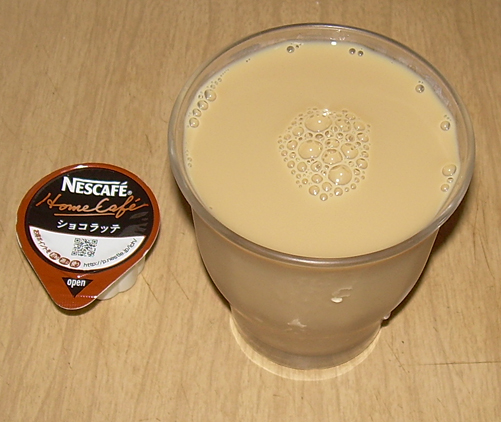
Nestcafe Home Cafe Latte and Chocolate Latte Syrups


I mentioned in a previous random picture post that marketers are gearing up to make it easier than ever to endure the heat in Japan due to higher air conditioner settings and reduced use to keep power consumption down while the Fukushima situation continues on. One of the things that is showing up all over the place from a variety of manufacturers are packages of liquid-creamer-style tubs of syrup to add to milk for instant lattes. Though these have been around before, the variety is greater this year, the prices are fairly low, and syrups with low calories rather than sugary powders seem to be the new cold coffee order.

The Japanese describing what this is translates as "potions". That conjures (no pun intended) up an image of magical transformation. No, I'm not fooled either. I think "syrup" is a much better translation, but I'm guessing the use of "syrup" often applies to sugar-based things (honey syrup, for instance) and brings up the wrong idea to Japanese consumers. So, "potion" it be.

The coffee latte mixed with milk.

When I saw bags of these syrups on offer for a mere 85 yen ($1.06) each at Seiyu supermarket, I figured I'd go ahead and take a bite... or a sip as the case may be. There are 4 servings in each bag, so it's only about 21 yen (26 cents) per serving, though that doesn't include the 180 ml. (a bit less than a cup) of milk that you use. It's still going to be a lot cheaper than a Starbucks latte, but then that isn't going to taste like some sort of instant coffee. And that is rather what the coffee version of this tastes like. It's not a bad version of instant coffee, mind you. It's actually pretty palatable and makes for a serviceable "coffee-flavored milk".

The "chocola" latte mixed with milk. 

The chocolate latte version of this mixes up a lot lighter and tastes a lot like you added Hershey's syrup to your milk. The coffee part is extremely subdued, but makes more of an appearance as you drink more. It's as if it needs a build-up in intensity to manifest. However, you really would be just as well off adding about a half teaspoon of instant coffee and a tablespoon of Hershey's chocolate syrup to your milk. It'd cost less.

My lukewarm-sounding review to these cold beverages isn't to be taken in a negative way. The truth is that I enjoyed both of these, though the way in which I consumed the chocolate version after the first sampling was not as one might expect. I like to have a frozen banana drink composed of skim milk, frozen banana, and crushed ice with a dash of vanilla. I put this in a blender and blend it is smooth and thick. Pouring the chocolate coffee syrup into this concoction was incredibly delicious. In fact, I'd wager the plain coffee would work pretty well in this drink, too.

I'd buy these again if I wanted a cold coffee beverage and didn't have the time to chill espresso, or if I wanted to vary my frozen banana drink. They're cheap and will keep for awhile. In fact, I'd think they would be ideal for the office if you have a refrigerator and can keep a carton of milk in there. Still, don't expect much in terms of a quality coffee experience or you'll be sorely disappointed.


Thursday, July 28, 2011

Pepsi Caribbean Gold

I'd read that this was going to be released on July 26 and dutifully went out to the local Family Mart to procure one. It is part of the snack reviewer's oath that one must sample high profile novelty releases ASAP. It's the same credo that says weight gain "for the cause" is to be seen as a noble expansion... taking one, two, or even three for the team is just part of the job. Incidentally, that job is currently paying about 35 cents a post and could be offering better compensation for the risks. Those risks can be quite considerable at times, believe me.

Despite my best efforts (which means I went to three different convenience stores) to procure this beverage the day of its release, Pepsi apparently was not in the mood to cooperate. I didn't find it until the 27th and found it while I was working and couldn't review it. But, here it is, Pepsi's latest attempt to capture our hearts and imaginations with a brew containing an obscure fruit that no one has ever heard of so they can't tell if it tastes like what it's supposed to or not.

A sniff of the freshly opened bottle reveals a vague fruity scent which reminds me of gum balls that I used to get from those machines that you put a coin into then crank three times for a disappointingly small number of balls. The taste on the first sip was very weak and it wasn't until a second sip that it revealed some syrupy fruity notes. This does taste like Pepsi mixed with something different, though it is hard to pin down what. The Wikipedia page for white sapote says that it can range in flavor and can taste like banana, peach, pear, vanilla, or just not much at all. I'd say that of those options, the Pepsi has vague peach and vanilla flavors, but it's really not a fair description.

At 47 calories per 100 ml. (that's 235 calories for the entire bottle), this would have to blow me away to be worth drinking it all. It really just struck me as a lighter version of Pepsi without the caramel colors and with lower acidity and with a hint of something fruity of some sort. It's pretty good tasting, but in no way worth pursuing beyond a casual purchase out of curiosity. Pepsi's variations when they are palatable seem pretty weak and when they are weird are pretty nasty. I probably won't even finish the bottle because I'd be just as happy with a Coke Zero and to be spared the sugar load.


Monday, May 30, 2011

Pepsi Dry

Since I already posted a picture of the bottles here, I'll give you a picture of the ad for Pepsi Dry that is running on the subway at present. The stick thin model speaks to the idea that this is a low calorie beverage, but the marketing is very much focused on the "dry" and less sweet angle. I think they're playing both sides (body conscious women, and men who like less sweet things). 

Well, that was fast. I said I wasn't going to review it, but one of my commenters said this tastes nothing like regular Pepsi and I found it for 98 yen ($1.20) at Seiyu supermarket. With the gauntlet of oddness rightfully tossed before me, and the option to be the cheap ass I am, I decided to take the plunge and do a review. Incidentally, note that I got the calorie information wrong on this when I talked about it in the random picture previously. I recollected it was 11 calories per 100 ml, but it is actually 21 per 100 ml. That makes an entire bottle 105 calories.

After opening the bottle, I gave it a good sniff. It smells like cola, but somehow a bit weaker than usual. This could be my imagination, but that's the story and I'll stick with it until someone who pays better attention to the scent of colas points out that I am wrong... then I will humbly accept the correction and make use of the strikethrough option. That being said, when I took a sip, I had a sense of why it didn't smell as strong as regular cola. That's because it tastes like a weaker version of it as well.

When I lived in the U.S., I was a Pepsi drinker for many years before I switched to Diet Coke. I remember Pepsi's flavor quite well and that I liked it better than Coke. It was only when I swapped over to the carcinogenic (aka diet) version that I gave up Pepsi. This tastes like something else which I drank for many years, RC Cola. That is, it's a pale imitation of a bigger brand name cola. The flavor just falls flat on the tongue and if you hold it in your mouth for awhile, it seems to dissipate into the taste of club soda. It's not a bad taste really, but it is just not particularly good or refreshing.

I've mentioned before that I experiment with sugar-free baking because of the way in which the use of sugar spikes blood glucose levels, so I know that one of the things which you lose when you give up sugar is the way in which it enhances flavor (and adds moisture, but this is plenty moist no matter how much sugar you remove). It seems clear to me after sampling this that taking out the sugar has removed the "bite" from Pepsi and no one has done anything to augment it's flavor (like adding tons of sodium like they do with diet sodas). It's like a watered down version of Pepsi and I'm not a fan.

Wednesday, May 25, 2011

Random Picture 64


Pepsi has introduced yet another in its small line of infinitesimally different Pepsi drinks. This is in contrast to its line of extremely odd and interesting drinks like Pepsi Baobab, Pepsi White, and the nadir of Pepsi weirdness, Pepsi Shiso. The main selling point of Pepsi Dry is that it is a less sweet version of Pepsi. Perhaps there is something wrong with my taste buds, but few colas strike me as overwhelmingly sweet. Of course, it could be that I just consume so many artificial sweeteners that my tongue has become deadened to the effects of real sugar. At any rate, this offering is 11 calories per 100 ml., which makes it a mere 55 calories per 500 ml. bottle. Clearly, less sweetness carries the benefit of also having less sugar and fewer calories. I haven't reviewed this, and I'm not sure that I will because I'm pretty sure it won't be significantly different from regular Pepsi. Also, I'm not quite ready to pay 147 yen ($1.80) for a bottle of soda. When it shows up for 100 yen in the cut-rate bins, I may give it a go.

Wednesday, March 30, 2011

Random Picture 56


I'm doing two pictures of beverages in a row as random pictures but this one rather stands apart from last week's picture. This curious display of shapely water bottles was on offer at a shop for people that aims mostly for consumers that are young enough to be my offspring called Village Vanguard. Each is 367 yen ($4.50) for what looks to be less than 500 ml. I'm wondering if even these, with their hyper-inflated prices, sold out during the great radiative water fear of the past week.

Personally, I like how the price tag seems to be censoring the front of Superman's tights. ;-)

Tuesday, February 1, 2011

Kirin Nuda Cooling Grapefruit

You have to admire Kirin's testicular fortitude and not because they named this drink "Nuda". Using anything that implies nudity actually takes no balls whatsoever because even a hint of sex sells more products. No, I think it's pretty gutsy of them to sell a "cooling" beverage in the winter time in a country where most of the people (especially the women) have the heat-retention capacity of those in the reptile family. The last thing people in Japan want when the temperature drops below 82 degrees F. (28 degrees C.) is anything which is "cooling".

The Nuda brand has been around for awhile, but this is my first sampling of it. I like grapefruit flavored food and drink, but not actual grapefruit. Oh, I have tried to get into eating the real deal but I just never saw the point in smothering something in sugar in order to make it palatable. I figure that, if I'm going to go for a large amount of sugar, I might as well eat a donut and stop fooling myself into thinking I'm eating something healthy because it was plucked from a vine before being saturation bombed with sucrose.

The  point of the "Nuda" line has nothing to do with supple naked bodies but rather with offering up light refreshment with bubbles. The basic "Nuda" is clear sparkling water and this is the same with a hint of grapefruit flavor. I found it for 87 yen ($1.06) at Seiyu supermarket. The question wasn't going to be about how well this bowled me over but rather about how they worked with the grapefruit flavor. Since this is just a flavored sparkling water, one can't expect too much.

When you unscrew the cap, you can smell a light grapefruit flavor. The water itself is carbonated adequately. You can really sense the bubbles if you hold it in your mouth for a few seconds before swallowing. I rather like this because I like the burn you can get from carbonated beverages. The grapefruit flavor is just enough to be detectable, but not enough to overwhelm. It is quite a good balance because the flavor is there, but there's absolutely no bitterness.

Kirin recommends their sparkling waters as office refreshment. Their ads hint that this will perk you up in meetings, brainstorming sessions, etc. I think that's expecting a bit too much from carbonated water. Nonetheless, this is good sparkling water and if you are inclined to go with bottled water, this is no more expensive than plain water and a nicer experience. I'd certainly buy it again if I were out and about and wanted some water and if it were available and it definitely beats club soda, which has always had a funky taste to me.

Tuesday, December 14, 2010

Asahi 9 pm

It seems that "night" and "adult" are themes for marketing products for late in 2010. I think this is because early in the year tends to be a focal point for selling things to young folks as they study and gear up for taking entrance tests. This is the reason why so many KitKats are released in the first part of the year and so few at this point in time. KitKats are mainly seen as something for kids or as special souvenirs.

This is my second "evening" themed food to review. Asahi recommends that you enjoy an "adult themed soda". That doesn't mean that you tipple from a beverage composed of gladiator sweat with a rich pheromone-based blend that only someone who has made it beyond puberty can appreciate the nuances of. It means you should kick back and enjoy this calorie-free drink after dinner or a bath. Yeah, I like the gladiator sweat idea better.

I first saw this beverage at AM/PM for 147 yen ($1.76), but being an incredibly cheap person, I waited for it to show up in my local Lawson's 100 for 100 yen ($1.20) for a 500 ml. bottle. It was sitting next to the Asahi Ultra Fiber Vitamin C that I tried before.

The advertising for this says that it includes orange and curacao. Curacao is a liqueur flavored with a citrus peel. It's also supposed to smell like vanilla and oak. To me, it smelled very faintly of orange and tasted like weakly carbonated club soda with a twist of orange. There is a little hint of bitterness, but not enough to put off someone who isn't incredibly sensitive to bitter flavors.

This is marketed as a soft drink, but there's really not much to it. If you like club soda with a bit of ever so slightly bitter orange, then this will fill the bill. The flavor is light and there is almost no sweetness to it (despite having artificial sweeteners). I think this would be best used as a mixer for alcoholic drinks or to mix with juice. It's not bad, and I'd buy it if I needed a bottle of water and this was the same price and I wasn't in the mood for plain water. The chances that I'll buy it again though, are exceptionally low.

Tuesday, November 9, 2010

Lawson VL Marron Latte


There are always a lot of appealing looking coffee beverages on offer in Japanese convenience stores. Unfortunately, they're all also usually full of sugar. While I'm fine to eat a little sugar, I have a problem with drinking it since liquids spend a lot less time on the tongue that solids. Nonetheless, the idea of a marron (chestnut) latte drew me in and I decided that it was worth 158 calories to give this cold coffee drink a try.

This 300 ml. (10 oz.) cup cost 100 yen ($1.20) at a Lawson 100 shop. the ingredients include brandy, coffee, dextrin, sugar water, and sugar. The ingredients list didn't include "kuri" or "marron" (words for "chestnut") that I could find. I'm guessing that the chestnut part came under the catch-all umbrella of "flavoring". It did smell like both chestnut and coffee, but the chestnut had the same olfactory presence of the types of syrups that get squirted into your coffee at upscale coffee houses.

I tried to peel back the top to get a picture of the coffee, but the plastic inner seal thwarted me. Trust me when I say, it  just looks like regular coffee and nothing special.

This had a unique flavor blend. The strongest element at first was the sweet chestnut flavor followed the the brandy and then the coffee. The three flavors come together very well to create a unique beverage. All of them are strong, but not overbearing. This tasted nice, but really is a bit like liquid candy because it is so very sweet.

I liked this quite a bit, and felt that the way in which all of the elements were balanced "worked". That being said, this isn't for coffee fans so much as for people who want an aspect of Mont Blanc, a dessert which has a heaping pile of chestnut paste that includes sugar and brandy, flavoring mixed in with coffee. If that sounds appealing, by all means, give this a try. If you're big into coffee that tastes greatly like coffee, this probably won't work for you.