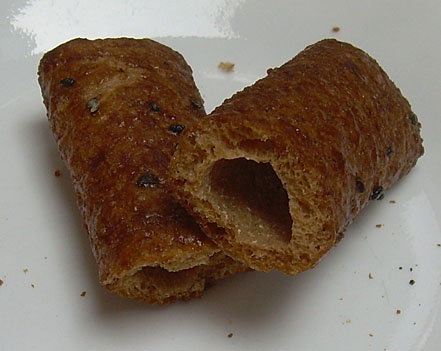
Awhile back, in a salt-craving induced buying frenzy, I picked up several sleeves of salty snack bits from Bourbon. This karinto sembei (rice crackers) completed my "petit" series trio of purchases from that time as the more accessible flavors fulfilled my craving and this one got left behind. They lay dormant in my aging snack pile for several months, so you can see how long it took me to get around to these things. I either need to eat faster, buy smaller packages, or review even less. Frankly, this is the "petit" series so I'm not sure it gets any smaller than this and I'd rather not cram more food into my snack hole just to get it used up.
Karinto is a brown sugar treat in Japan that resembles what you pick up after you take your dachshund for "walkies". I've only tried it once, karinto that is, not what comes out of ones wiener dog's digestive system. The type I tried was a cheap variety so I can't say I've given the real thing a fair shake. This sembei uses brown sugar from Okinawa, a place in southern Japan which is famous for a variety of foods including brown sugar. Of course, it seems that any place with an appreciable amount of agriculture is famous for a wide variety of edible substances, so it's hard to get too worked up by Okinawan brown sugar when they're also famous for things like sweet potato and goya.
These are marketed as "sweet" sembei, but they aren't really very sweet. They are as close to neutral as you can get before crossing the line to sweethood. They have a nice brown sugar flavor, but there's also a strange slightly herbal aftertaste which is vaguely familiar to me. I'm not sure that this is really any sort of spice, but it may be the effect of baking brown sugar to a hard crunch or highly cooked honey (which is also an ingredient).
The crackers are very crispy and you can taste both the honey and the brown sugar with every bite. The honey tends to hit in the front of your tongue at the start, followed by the mild brown sugar, and then the odd aftertaste. If it weren't for that, these would be a home run as a "buy again". I love brown sugar sembei and am pleased with the small size of the package.
I'm not sure whether to recommend these or not. I may be especially sensitive to that funky taste, or it may be something others would detect. I sort of like these. I love the crispy, somewhat hard texture and the honey and brown sugar flavors coupled with very light sweetness as well as the size (38 grams/1.34 oz.) for a low price even in the U.S. where they tend to sell for about a dollar (100 yen). If the main composition of this is appealing to you and you can get them cheap, I'd say give them a try.
Showing posts with label brown sugar. Show all posts
Friday, April 19, 2013
Bourbon Petit Karinto Sembei
Monday, February 4, 2013
Yuki & Love Brown Sugar Mochi
Writing a blog sometimes causes you to face problems that most others don't have to think about. For instance, the name of the maker of this product is "Yuki & Love". When I tried to use the name of the company as a part of the title of the post, Blogger threw up a red flag and said that I could not pass "Go" and I would not be given my $200 (aka, it wouldn't save my post with that name).
As you can imagine, it's a bit perplexing to see how my title so offends the Blogger gods, but I actually did know what it was on about. This is one of those dumb things about computers that you don't think about until it steps up and smacks you in the face. Blogger's glove slap to my cheek was the result of using an ampersand (&) character in a title. What was worse than that was the fact that it had a digital hissy fit was that it did it on a post I'd written on a Mac, but not on a similarly named post that I'd written on a PC (yes, I'm "bi-platform", call me a pervert if you like... in fact, I'd like it if you did call me a pervert).
This is one of those "under the hood" issues that makes no sense unless you're someone who has lived on the deeper edge of the computer-using continuum, and while, I'm no geek, I have had to tussle with these problems before as part of my work in publishing textbooks. All of these letters that are showing up on your screen have various codes and such associated with them and, while it may look like an ampersand is an ampersand to our eyes, the computer begs to differ with our assessment of such things. What you're seeing isn't necessarily what is being gotten. (Yes, I solved the problem by choosing a different ampersand with a different code from the Mac's character palette. Even though they looked the same, one choked the system and the other went down nice and smooth.)
Such is the case with this "Japanese style brown sugar mochi". What I seem to be seeing is a super creamy center that is just barely failing to ooze out of it's pounded rice cake wrapping. It looks like a chocolately delight, though, of course it's actually brown sugar. What I saw on the front of the box though, was not precisely what I got.
Opening the package and seeing the dusty little balls with a scuffed tops filled me with a sense of foreboding. Cutting one in half to reveal the dark innards further filled me with a notion that these were not going to be as good as my previous experience with the taro mochi. It resembles more closely what you'd scoop out of a cat's litter box than what is shown on the box with a sugary, creamy center.
One of the things I was extremely happy about when I tried the taro version was that the pounded-rice-cake was soft and chewy as real Japanese mochi should be. I was very disappointed when I discovered that the brown sugar version has a fairly tough mochi casing. The thing that tends to make or break these types of treats is the texture as they are usually not incredibly sweet or intensely flavorful. Ideally, you get a multi-faceted experience in which you get the texture of the smooth, somewhat grainy center with the soft, chewy rice cake with subtle but pronounced flavors. This was slightly better after I gave it 5 seconds in the microwave, but I have to caution readers from repeating that procedure as these types of sweets get molten hot super fast and the center can burn your tongue pretty badly if you go just a few seconds too far in your irradiating.
Though the texture was disappointing, my main problem was with an odd flavor that came along with it. I think this funky taste may have came from the use of sulphered molasses (the sulphur acts as a preservative, but it does make the molasses taste different). However, I'm really not sure of the source of this taste. I only know that it greatly undermined the quality of the experience of eating this. It tasted generally fine and sufficiently "brown sugary", but that off flavor which seemed concentrated in the powdery coating on the outside was a real spoiler.
When I reviewed the "Yuki & Love" taro mochi, I lamented that I hadn't taken advantage of a sale at Ranch 99 Market to buy up other flavors while they were on sale. As luck would have it, all varieties were placed on sale for $1.50 a box and I scooped up a few more. Given how happy I was with the taro version, I had high hopes that the brown sugar version would make me as happy as brown sugar appears to have made the Rolling Stones in their song. Alas, it failed to meet my expectations.
This isn't really "bad" mochi, and it certainly was in line with the price point, but it also was not especially "good" either. I'd call it a decidedly "meh" experience and I wouldn't buy it again. In fact, it's safe to say that I wouldn't really care to get a box for free, though I will likely slowly finish this box because it's still mochi.
Labels:
brown sugar,
mochi,
traditional sweets,
Yuki Love
Monday, December 17, 2012
Yuzuiri Kurobekkou Ame (brown sugar yuzu candies)
Anyone who read last Friday's post knows that I'm all for yuzu. This candy was not, however, a jam-inspired frenzy purchase (though wouldn't it be cool if jam could inspire a frenzy? I imagine there'd be bits of toast, scones, and spoons everywhere). I've actually had this pack of hard candies tucked away in my tin full of snacks to be eaten or reviewed for quite some time. It was in the "bargain" shelves at Daiso Japan for a mere $1 instead of the usual $1.50. That means it was probably at or near its expiration date two months ago, but, hey, it's hard candy. It's not like hard candy can really go bad, right?
Well, it can't go bad, but not so pleasant things can happen. Even though this has individually wrapped and sealed candies in a sealed bag, it still seemed to get that gummy, sticky quality that you often see develop when you have a lollipop or cough drop around long enough for moisture to start to do its thing on the outer portions of it. That doesn't make it inedible, but, in the case of this candy, it made it dangerously sticky.
If you've ever wondered why lollipops are on sticks, eating a lozenge-style candy which is on the large size will make it perfectly clear. Between the slightly gooey exterior and the large size disk, I was at risk of choking to death on this or at least having it lodged in the roof of my mouth until it naturally melted away. Three times while trying to suck on this, I got it jammed between the sides of my top teeth and had to dislodge it with my finger. I have a small mouth, grant you, but this seemed like it really should be sold on a stick. After the third time, I decided to hold it in my fingers and lick it like a lollipop until it was whittled down to size. I figured that three times of getting it jammed in my mouth was more than enough snack-related death temptation.
I'm certain the reason these are so large is that they have small bits of yuzu (Japanese citron) peel embedded in the candy. If they were a more normal size for a lozenge-style candy, there would probably be bits of peel sticking out like tiny tentacles trapped in amber. The illustration on the back of the package doesn't seem to be inspiring confidence in what is embedded inside, but I'm sure they couldn't do much with the limited color palette.
My hope with most of my reviews is that I will have the same sort of experience that Roger Ebert says he wants when he sees movies. He wants to see something which is good that he hasn't seen before a million times. I want to taste something which is good that I haven't tasted before a million times. To that end, this candy is a hit. The combination of brown sugar and yuzu is a good one. This is managed by not overdoing the molasses part of the brown sugar or underplaying the citron too much. There is just enough of both to add the right play of citrus bite with brown sugar sweetness. This is a unique and tasty hard candy that is well worth the 29 calories and risk of tooth decay. There's an odd textural difference when you reach the peel in the center, but it's not necessarily unpleasant. It's just not quite what it's like to get to the Tootsie Roll center of a Tootisie pop.
What I can't say for sure is whether or not it is worth the risk of choking if you buy these on the slightly older side or don't eat it until it has sat around and gotten a bit soft and sticky around the edges. Most people probably have bigger mouths than me and won't suffer my issues, but I'm knocking this down from a "very happy" to a "happy" based on the logistical issues I had eating it. I'd like to buy it again, but I'd either have to get sticky fingers holding it and licking it until it was smaller or I'd have to take my life in my mouth along with the candy.
As a little reminder to readers who may have missed it, or to those who haven't gotten around to entering, I'm offering a box of the current Tokyo regional KitKats (rum raisin) as a contest prize. You can read about it and enter here. The contest ends on Christmas day 2012, so enter early, but only once, please.
If you've ever wondered why lollipops are on sticks, eating a lozenge-style candy which is on the large size will make it perfectly clear. Between the slightly gooey exterior and the large size disk, I was at risk of choking to death on this or at least having it lodged in the roof of my mouth until it naturally melted away. Three times while trying to suck on this, I got it jammed between the sides of my top teeth and had to dislodge it with my finger. I have a small mouth, grant you, but this seemed like it really should be sold on a stick. After the third time, I decided to hold it in my fingers and lick it like a lollipop until it was whittled down to size. I figured that three times of getting it jammed in my mouth was more than enough snack-related death temptation.
Yuzu peel or worms? You decide.
I'm certain the reason these are so large is that they have small bits of yuzu (Japanese citron) peel embedded in the candy. If they were a more normal size for a lozenge-style candy, there would probably be bits of peel sticking out like tiny tentacles trapped in amber. The illustration on the back of the package doesn't seem to be inspiring confidence in what is embedded inside, but I'm sure they couldn't do much with the limited color palette.
My slightly melted candy. I have no one to blame but myself, really.
My hope with most of my reviews is that I will have the same sort of experience that Roger Ebert says he wants when he sees movies. He wants to see something which is good that he hasn't seen before a million times. I want to taste something which is good that I haven't tasted before a million times. To that end, this candy is a hit. The combination of brown sugar and yuzu is a good one. This is managed by not overdoing the molasses part of the brown sugar or underplaying the citron too much. There is just enough of both to add the right play of citrus bite with brown sugar sweetness. This is a unique and tasty hard candy that is well worth the 29 calories and risk of tooth decay. There's an odd textural difference when you reach the peel in the center, but it's not necessarily unpleasant. It's just not quite what it's like to get to the Tootsie Roll center of a Tootisie pop.
What I can't say for sure is whether or not it is worth the risk of choking if you buy these on the slightly older side or don't eat it until it has sat around and gotten a bit soft and sticky around the edges. Most people probably have bigger mouths than me and won't suffer my issues, but I'm knocking this down from a "very happy" to a "happy" based on the logistical issues I had eating it. I'd like to buy it again, but I'd either have to get sticky fingers holding it and licking it until it was smaller or I'd have to take my life in my mouth along with the candy.
As a little reminder to readers who may have missed it, or to those who haven't gotten around to entering, I'm offering a box of the current Tokyo regional KitKats (rum raisin) as a contest prize. You can read about it and enter here. The contest ends on Christmas day 2012, so enter early, but only once, please.
Monday, September 24, 2012
Taiko Brown Sugar Sticks
The translation of the word "bo" to English from Japanese is usually "stick", but a better translation of these would be "tube". In America, I can't think of any snack that is commonly sold in this format, to be honest. In Japan, there are both savory and sweet airy, crispy tubes to be had. The style allows you to present a large-sized snack without giving a heavy volume. It's easy to eat one or two and be satisfied and have the illusion that you've eaten a decent amount without putting away too many calories. I'm sure that really has nothing to do with why these are formed as tubes, but it is a little side benefit.
Thinking about this makes me wish I could have visited a factory at which this style of snack was made. The most popular "bo" snacks are made by Yaokin, a maker of oily, spicy corn-based tubes sold in foil packages with colorful cartoons on them. I'm guessing they would have been the most likely to allow for a factory tour, but I'm not sure they'd want my gaijin (foreigner) cooties nosing around their nice, clean corn snack facility. At the very least, they probably would require me to put on a hazmat suit and an industrial-sized hair net (I have a lot of hair).
Getting back to the point, I'm guessing these are tube-shaped because they are prepared on some sort of spindle. The hole in the center is likely whatever pole they're baked around. The fact that they're oblong means the batter droops off of the stick they're hanging on as they're prepared. It is likely an old-fashioned way of making things which America never adapted as it's a younger culture and most of what we have is shaped by the cold hand of technology and the assembly line rather than a process designed to be manipulated by human hands. It feels like a bit of cultural anthropology to over-think this, but it does seem that older cultures that build their cuisine on what was once a single portion size made by and sold by hand and sold to individuals that continue the same size even in the mechanical age have a leg up on portion control. History plays a part in such things, I believe.
This is my second go at Taiko's stick snacks and they earned my trust with the sweet potato cookies I sampled before. Just as I scored those at the Daiso Japan in Mountain View, I scored these. It was a toss up between a vanilla flavor and brown sugar and this won by virtue of being on sale for a dollar/78 yen (marked down from $1.50/117 yen). Also, I love brown sugar, though it's important to note that Japanese brown sugar is different from that in America. It's hard to quantify a flavor difference, but there is either less molasses in it or a different sort in the Japanese variety.
These sticks didn't taste as I expected. Mainly, I expected a more profound sweetness (though they are sweet, don't get me wrong) and stronger brown sugar flavor. The odd thing is that they were rather less sweet than the sweet potato ones despite being essentially sugar-flavored. I also felt that, while black sesame seeds (goma) paired extremely well with the sweet potato version, it wasn't quite so natural a complement to brown sugar. That is not to say that these are bad at all. They're perfectly serviceable and have the same satisfying crispiness and light airy quality as the other one I tried and less sweetness didn't necessarily mean they weren't good. The main drawback was that there was an odd taste which I would say was somewhat caramel-like or coffee-like which I could not pin down. I didn't care much for that flavor. I'm guessing it is something about how they are baked that creates it, not an actual additive since the ingredients list is brown sugar, sugar, wheat flour, bread crumbs, corn grits, vegetable oil, sesame, caramel color and soybeans.
I liked these pretty well, but not as much as the sweet potato variety. I love the texture and crunch of this line of snacks and will definitely try other varieties, but this isn't a flavor I'm likely to try again if I have other options. If I have no other choice, I would definitely get these again though rather than eschew them.
Monday, August 20, 2012
Karume Sugar Candy
I am not a rich person. For some reason, the handful of pennies that Google ads net me for these blogs hasn't really kept me in enough scratch for a new computer. I've been using a Mac Mini for several years and it's showing it's age in multiple ways. However, I am also a fan of the Diablo series of games from Blizzard. They released Diablo III last May and my little Mini barely met the graphics card specs. Hurray... except, not so much because playing the Mac version of the game would have required me to pony up $70 in OS upgrades. I don't know why, except, perhaps, oh, corporate greed, that the Mac side needs a more updated OS than the PC side. If you have a Windows box, you can get by on the venerable old Windows XP.
Unfortunately, I left my Windows computer in Japan because it required an extra plane to lug that behemoth home (and it was about 5 years old to boot). The way out of this for someone as cheap and relatively impoverished as me was to install XP on my Mac and boot back and forth between the Mac and Windows sides on the Mac Mini. Hurray! Problem solved! I could play Diablo III and nobody got more money out of me for an upgrade that I did not care about.
Unfortunately, I now find myself downloading pictures into both OS's. It is, essentially, the equivalent of two computers without the convenience of two separate hard drives and displays. I get extremely confused about which side of the Mac has photos and think sometimes that I've downloaded pictures when I have not, or I simply can't find them on the Windows side because I forget where they were put as it seems they are put in a different place each time. This is why I am losing my pictures. You see, if Blizzard hadn't required Mac OS 10.6 or higher or if Apple didn't charge for incremental upgrades, you'd be getting the pictures you deserve as my patient, patient audience.
I do have a small picture of the full bag which I can crop out of a large picture of all of my purchases. This is the best I can do. Write to Blizzard and Apple and complain for me, won't you?
So, on to the candy, which I bought ages ago at Daiso Japan for $1.50 (120 yen ) and have been slowly nibbling on over a couple of months. This is made by a company called Ogawa confectionery and they have no web presence so there was nothing I could learn about their other products. This is a fairly simple and old-fashioned offering of a brown-sugar-based treat.
Inside the bag are 3.2 oz./90 grams of stubby nubs that have a very crispy texture and are laced with air pockets. This makes them have the feeling of a honey comb and they shatter easily when you bite into them. The flavor depth is very shallow, unfortunately. The ingredients list is brief, but a little scary - coarse sugar, granulated sugar, baking soda, and two artificial colors (which is unusual for a Japanese processed food). The taste is pretty much like a spoonful of brown sugar, but the textural element does lend a nice quality to it. I'm guessing that the baking powder is what makes these nice and airy while they are cooked up inside of 6-sided mold.
I can't say that I regret buying this. I do like crispy things and brown sugar, but I haven't eaten it straight from the bag since I was a kid. I have been ever so slowly eating this, but ultimately, I need something more sophisticated to keep me coming back for more.
Monday, March 19, 2012
Kyoto Fukudaruma Cookies
In the eyes of many people who are not me, I have failed on many fronts as a foreigner in Japan. One of my many failures is not having gone to Kyoto during my long stay in the country. Apparently, this means I have failed to appreciate the culture and am simply existing in my gaijin bubble. Never mind that I have penetrated the deepest and most intimate recesses of Tokyo so often that I could be arrested for my perversity. Never mind that I know more about sumo than even an old curmudgeon who spends his days in Ryogoku chowing down on chanko nabe (sumo stew). Never mind that I can tell you the name of most of the food makers in Japan because I've sampled such a broad range of snacks. I haven't been to Kyoto!
One might ask why I haven't been to Kyoto, Japan's former capital. Well, the reasons are relatively simple. First, it's expensive to take a Shinkansen and I'd have to stay in a hotel overnight. Day trips to surrounding environs don't set me back nearly as much as travel outside the area and contrary to popular belief, foreigners who work in Japan aren't rolling in dough. The other reasons really relate to the fact that no one has told me something about the area which would lure me there. The food is traditional Japanese cuisine, particularly kaiseki (multi-course meals of traditional dishes that are beautifully presented) which sounds nice enough, but my husband doesn't like such food and I'm often so-so on it. Of course, one of my many character flaws is that I don't enjoy seafood and am indifferent to fish. The sweets, I've been told, are lots and lots of green tea delicacies, and I've mentioned before that I'm just "okay" with green tea. So, there's not much on the food front.
There are, however, temples! Yes, temples are so rare across Japan that I may actually walk as long as 20 minutes sometimes without seeing one. I realize the Kyoto temples are different. They're older, bigger, and exist in Kyoto. I enjoy a glance at a good temple, don't get me wrong, but I'm not going to pop for a Shinkansen ticket to see more of them. All in all, if someone covered my costs, I'd be delighted to go to Kyoto, but it just doesn't seem like it's a place that would light my fire. Yes, I'm a big "fail".
Fortunately for me, my Japanese friends are far greater successes than I and occasionally go to Kyoto. They're the reason I know so much about the lures (for others, clearly, I'm immune to the "bait"). One of those friends was kind enough to bring me back a bag of Kyoto Fukudaruma cookies as a souvenir. This delighted me no end because I could tell by looking at them that they are kin to soba boro cookies, which I absolutely love.
Like soba borrow, they have a burnt sugar taste which resembles dark caramel with a side of buckwheat. They are light and crispy. The main difference between soba boro and these fukudaruma (which means, "luck doll", by the way) is that these little fellows have what looks like a mustache and are smaller and harder. They mainly are a little denser in texture and slightly less intense in taste. They were so good, it was hard not to eat them by the handful like popcorn.
While I can't say that fukudaruma cookies are good enough to lure me to Kyoto, I can say that they are delicious and that I'd buy them again if they showed up somewhere near me. If you like crispy cookies with an earthy grain and dark sugar taste, you should pick them up as well.
Labels:
brown sugar,
fukudaruma,
Kyoto,
soba boro,
souvenir
Tuesday, April 12, 2011
Kurobo Brown Sugar Sticks
I often read blogs about cooking and one of the things that works a bit like a fingernail on a blackboard for me is people who talk about recipes for "Japanese bread" (shokupan), "Japanese castella" and "Japanese cheesecake" as well as "traditional Japanese baking". There are traditional Japanese baked items, but those things are all off-shoots of European culture, not "traditional Japanese baking". It's like saying "traditional American pizza". There is American-style pizza, but it's not "traditional". Be forewarned that I may be getting rather curmudgeonly in my old age. Feel free to ignore my silly crabbiness. However, I promise not to go on about having to tie an onion on my belt.
These types of cookies are a classic sweet in Japan, and as far as I know are not a derivative of a European treat. While their shape and size is reminiscent of a biscotti, the experience of eating one is in no way the same. The interior is coarse and spongy while the outside is crispy and sugary. The brown sugar exterior forms a slightly crispy "crust" which provides a pleasant textural contrast to the soft, springy interior. They smell a bit like brown sugar and molasses, but there is also an element of coffee. I'm guessing that that relates to some sort of roasting process involved in some of the ingredients.
I often say of traditional Japanese snacks that they are pretty much the same so it doesn't matter what sort you by, but the truth is that this particular treat is one in which quality seriously matters. I've had hundred yen shop versions and I've had types like this which are closer to 200 yen ($2.46). The cheap kind lack the sweet, crispy exterior and the pleasantly gritty brown sugar qualities that pricier types have. The company that makes these, Kurobo, makes a very fine version. It uses flour, eggs, and brown sugar syrup.
My students often talk about how black sugar is "healthy" and I sort of smile and move on to another topic. The back of this bag mentions that using black/brown sugar means that these have 50 fewer calories per 100 grams than those made with white sugar. I calculated the calories in each stick at 71. The web site also claims that these have more vitamins and a high alkaline content. Eating foods with high alkaline is supposed to reduce heart disease by balancing acids in the blood.
So, these "sticks" (actually, a type of cookie) are not only tasty, but also nutritious. In moderation, these would be an excellent part of a well-balanced diet. However, you shouldn't eat them for the nutrition. You should enjoy them for the brown sugar tastiness.
Monday, September 20, 2010
Karinto
Karinto is a traditonal snack in Japan which is deep fried and coated in brown sugar. Other flavors are also available, but the type you see most often, which resembles something you'd find floating in an unflushed toilet, are these brown sugar varieties. You can find karinto sold pretty much anywhere for a low price. I found mine at Okashi no Machioka discount snack shop in their 100 yen ($1.19) snacks area. This is a pretty typical price for karinto. The manufacturers vary, but most of them are not big companies, have no web sites and use relatively generic packaging, as was the case with the maker of my version.
This is a quintessential example of Japanese junk food as it is essentially a type of fried doughnut-style batter loaded with fat and sugar. These are not a low calorie traditional Japanese snack by any stretch of the imagination. Each piece is approximately 13 calories and is 6 cm long (2.4 in.) and just under 1 cm (.4 in.) wide. The entire 125 gram (4.4 oz.) bag is a whopping 591 calories. The first ingredients are brown sugar, sugar, and then flour.
They smell like a slightly burnt brown sugar donut with some unexpected ingredient which you can't put your finger on. They taste like a deep fried corn snack, like a Cheeto, with brown sugar saturating it at every level. There is a strong flavor of oil and an aftertaste of pure brown sugar. There is also a modest burnt sugar flavor going on.
Though not horrible, there was something about these which hit me as very, very wrong. My guess is it was the oiliness of them and the very sugary nature coupled with the corn snack style texture which I think results from them being a bit like a very dried out doughnut. They had a strong taste of having been fried in oil that had been used a lot and being saturated with oil. The texture was both soft and hard at the same time. I guess that is because they are deep fried, but sugary.
I don't believe that anyone who tries these will hate them, but I'm not sure that they'll love them either. There is a real sense of disharmony to karinto for me in which the elements are all fine or inoffensive, but they come together in a package which doesn't seem right. I also feel like they are really, really poor on the calorie cost to food pleasure ratios, and I almost certainly won't finish the bag and definitely won't buy them again.
If you'd like to share your experiences with weird foods and enter a contest for a chance to win a silly prize, please read this post and make a comment.
Labels:
brown sugar,
Grandma's snacks,
karinto,
traditional sweets,
unhappy
Wednesday, March 31, 2010
Kashiwado Jumbo Black Sugar Bread

Most of my snack shopping takes place in relatively predictable places like convenience stores, supermarkets or snack shops. Very occasionally, something interesting will show up in one of the local green grocer's catch-all bin of snacks and low price foods near their registers. The shop these were purchased at is a bit grungy, but the prices for vegetables, fruit, and meat are low. The snack foods in the big bin are often a jumble, and sometimes look worse for wear. The boxes can actually look beat up, scratched, or worn on some foods; it's like someone kept them in the back of their cupboard for a few months then decided to sell them.

Normally, I ignore the snacks at this green grocer, but my husband plucked this bag of brown sugar bread out of the bin while he was foraging for Portuguese strawberry cookies that they had recently started carrying. The shop I bought this from is called Takano and we paid 198 yen ($2.20) for a package with 10. Each is 20 grams (.7 oz.) and 7.5 cm. x 5.5 cm. (3 in. x 1.2 in.) in size. I'm not sure if you can call that size "jumbo" or not, but they are big for a cookie-like treat in Japan.

Though these are called "bread", this is one of those times when translation doesn't work very well. These are more like a cross between a bread and a cookie. They are a variation on the classic Japanese "tamago pan" (egg bread). That means they are firm, dense, and have a somewhat crispy exterior with a dry, but tender interior. They are a small carbohydrate bomb, and eating them is as much about texture as taste. The ingredients include flour, brown sugar, white sugar, egg, and margarine.
These smell of molasses and brown sugar and unsurprisingly taste fairly strongly of brown sugar and molasses. They are quite sweet, but not in a throat-burning way. Like other types of tamago pan, they have a slightly crispy exterior, and a dry, cookie-like interior. They are very satisfying with a cup of coffee or tea as a more substantial snack.
I liked these a lot, but I love the sort of dense, dry cookie-like interior these have. They remind me of the sugar cookies my mother used to make, which were not your usual crispy, sweet sugar cookie. I find the texture of tamago pan immensely satisfying. The flavor of these is icing on the cake. I can recommend them without reservation to people who like similar types of food, but I'm not sure they'd be a knock-out winner with just anyone.
Labels:
baked goods,
black sugar,
brown sugar,
Kashiwado,
tamago pan
Thursday, November 26, 2009
Sugarhouse Brown Sugar Candy

When I was a kid and wanted something sweet, I would sometimes nibble just a little brown sugar from a teaspoon. I loved the flavor, but you could so quickly get too much both from the intense sweetness and the heavy molasses flavor. Like salt, sugar is one of those things that, when used in the right amount, is a thing of great beauty, but too much is a disaster. I wish I could say that the Sugarhouse brown sugar candy was a thing of beauty, but it's definitely more of a train wreck.

When I bought this at an upscale market called "Queen's Isetan" for about 140 yen (about $1.45), I was lured by the resemblance to fudge that the picture on the front had. You'd think that this is a mistake that I'd stop making after so many years in Japan. Things here are not what they resemble back home. The bottom line is that this is little more than hydrated, formed blocks of brown sugar. The taste is just like those teaspoons of brown sugar I'd nibble at as a child. It's intensely sweet and overbearing, and can only appeal to people who like to eat sugar straight from the bag. If that sort of thing appeals to you, you can stick this packet in your pocket (which is one of its selling points) and put away 362 calories of brown sugar nastiness.
I tried to do some research on the company that made this, Sugarhouse, but they are too small-time to even have their own web site. The only thing I could find were a lot of references to the location of the company through various mapping web sites. I'm not sure what else they make besides this candy, but I hope they've got something else going for them because I can't imagine this is going to be a success for them.
Wednesday, July 1, 2009
Double Cream Brown Sugar Sembei

I've been questing to find a combination of a salty-sweet sembei marriage that pleases my picky palate. I knew it was out there somewhere, and brown sugar and cream (two-thirds of what makes caramel what it is) seemed like a good place to look for my edible salty-sweet fiance.

This particular bag of sembei didn't make the trip from the store very well. Several of my packets were smashed and the crackers broken. I'm not sure if that is how the shop got them, or if that is what I did to them when I crammed them into my backpack with 8 bottles of Diet Coke. At any rate, this bag has 24 large crackers packaged in 2-cracker packs for about 170 yen (about $1.70). Each two-pack is 62 calories and that doesn't seem too bad for something streaked with what appears to be sugary frosting.

The crackers are the "soft" or puffy type of sembei rather than the brittle thin type. They clearly are made by folding over the dough and are a little hollow in the center. They smell of brown sugary goodness and are nice and crispy. When you bite into them, they tend to let loose with a lot of little hard crumbs though so I recommend eating them from the packet and allowing the flotsam to fall back in the bag.
The taste is at first a bit of a "burnt" brown sugar flavor which is reminiscent of molasses followed by a clearly discernible, but not overpowering hit of salt. The combination seems to be in perfect balance. I can't really taste the cream, and to be honest it isn't high up on the ingredients list so I have my doubts about the volume of actual cream in them, but I don't think these need more of anything. They are great as they are.
I loved these and think they'd make an excellent substitute for a cookie if you were in the mood for something sweet. After I finished the bag, I wished I had bought another to have around. While I was able to control my eating for the most part, it was extremely easy to eat 6 crackers in one sitting when I was hungry and throwing caution to the wind. By all means, give these a try.
Labels:
brown sugar,
cream,
salty sweets,
Sanko Seika,
sembei
Wednesday, March 4, 2009
Kokuto Marubolo (Honey Brown Sugar Soft Cookies)

Brown sugar is supposed to be better for you than white sugar. In fact, the company that makes these cookies, Kurobo, devotes a page on its web site to letting you know how rich in minerals like iron, calcium and potassium phosphate, brown sugar is. Kurobo specializes in a variety of snacks which use brown sugar and honey. Kurobo has been making sweets since 1920. My translations claim that the name means "black bow", but I'm a little dubious of that. "Bo" means "stick" in Japanese and various sweets made in bar form are called "bo", so it's possible that it means "black stick" or "black bar". The company's top seller is a fried dough "cake" which looks a bit like dog dootie. I've seen that style of sweet in markets many times, but was never tempted to buy a bag of dachshund pellets. One of these days though, I'll have to cross that bridge.

There are eight cookies in each packet for about 200 yen ($2.23). The primary ingredients are flour, sugar, eggs, brown sugar, honey, "sugar water" (syrup) and vegetable shortening. The package doesn't give specific calorie details, but based on the calories per 100 grams and my rough guess of the weight of one cookie, I'd put them at 50 or so calories per cookie. Each cookie is individually wrapped in a Japanese paper packet, but they are not airtight as you can easily smell the cookies through their paper wrappers. I have a suspicion that these would dry out if not kept in a plastic bag.

The cookies smell like gingerbread, though that is mainly because the dark brown sugar used in them smells like molasses. There aren't any of the spices you expect in gingerbread. When you remove the cookie from the packet, it sticks a bit to the paper. The surface of the cookie isn't sticky, so I'm guessing that this is just accumulated moisture.

When I tore the cookie in half to take a picture of the inside, it was actually quite tough. In fact, it felt more like I was ripping it apart. The texture is very coarse and the cookie is soft, but dry. It's easy to chew, but it's more like bread than a cookie or cake. The flavor is very nice. It tastes of brown sugar and honey and is just right on the sweetness. I really enjoyed the flavor of these, but the texture leaves a lot to be desired. They are so tough for a cookie.
These are like a different version of a black sugar "stick" cookie which I have reviewed before and are readily available from various manufacturers. The difference is that these lack the sugary, semi-crispy exterior that those have. I probably wouldn't buy these again, but I will certainly consume the rest of the bag through time. If I was going to buy something along the lines of this cookie, I'd go for the sugary version over this plain version.
Thursday, October 16, 2008
Morinaga Black Sugar Milk Caramels

The packaging on a lot of Japanese sweets is pretty clear cut and designed to give you a good idea of what is inside. Most of it is also modern-looking. Morinaga, which has been in business since 1899, has quite a few products with rather old-fashioned packaging. One of my former students was married to a man who worked at Morinaga and she told me that the company was deeply steeped in old-style thinking and culture and reluctant to change their ways.
If you look at the box for these caramels, you can see a lot of their old-fashioned design on them. The same goes for their plain chocolate bars which come in a plain brown wrapper with an ornate frame design around the name of the company. The company's old-style logo (an angel holding an "M" can be seen in a square at the top of the box). There is a more modern-looking logo on other products, but its line of caramels, retains the old-fashioned design. This is probably because caramels were the first confection the company made and can be considered a signature product. They may also not appeal to young folks so much as nostalgic older people. I've noticed that the caramels are much harder to find than other Morinaga sweets.
At the moment, there are three types of these caramels on the market: the original milk caramel, black sugar and adzuki. I've never seen the red adzuki flavor box in any store, and I can only locate the black sugar ones in one of the 4 markets in my immediate area. "Black sugar" is what Western folks call "brown sugar", though it seems more heavily influenced by molasses than the "brown sugar" you buy in bags (to cook with) in Japanese markets. In fact, brown sugar sold for baking and whatnot is very light and only a stone's throw from white sugar in taste.
The black sugar sweets you can buy, on the other hand, are very richly flavored. These caramels are no exception. When you unwrap the foil, there's a smooth bit of caramel which is only the tiniest bit sticky to the touch so your fingers don't get messy. It smells sweet, milky and somewhat of honey. In fact, the American candy that it very much reminds me of is "Bit O' Honey."
Though the blocks are firms, they quickly soften up once you put them in your mouth and start to chew. They're also rather nice to just allow to melt a bit by sucking on them like a piece of hard candy. While it is sticky like most caramel, it doesn't stick terribly to your teeth. I'm not sure how Morinaga manages this feat, but it's appreciated. The caramel is rich and floods your mouth with a sweet, buttery, brown sugary flavor. It's delicious.
The ingredients include sugar water, brown sugar (60% grown in Hokkaido), milk with added sugar, sugar, vegetable oil, rice flour, salt, sorbitol, caramel coloring, and flavoring. As you might expect, you're essentially getting a whole lot of sugar in these. The size of the caramels is rather small which makes them much easier to chew as well as provides good portion control. There are 12 candies per box and a box costs about 130 yen ($1.24). The whole box is 245 calories so they weigh in at 20 calories apiece.
Given that these are both traditional and tasty, they are a great item to sample if you have a chance. I'm guessing they'd also be the ideal thing to just toss in a bag and keep around for awhile for those times when you'd like a little sugary pick-me-up.
Labels:
black sugar,
brown sugar,
candy,
caramel,
Morinaga,
sweets
Tuesday, September 16, 2008
"Oishi" (Delicious) Black Sugar "Marshmallow" Sticks

When you first arrive in Japan, there is a cornucopia of food items which look pretty strange. Some of them you will be brave enough to sample and others look just too strange to even consider. The snack item pictured above looks like something you might find floating in a toilet. The funny thing is that this is one of the better looking varieties of this particular snack.
The "translation" of this particular food is pretty weak. These aren't marshmallows, but, like sushi, there isn't a good word to describe this treat simply and easily. There are many varieties of these in Japan and they all are coated on the outside with brown sugar, or, as the Japanese call it, "black sugar". Some varieties are a little hard on the outside and firm on the inside and others are very soft on the inside and a little soft on the outside. The cheapest varieties are white on the inside. I'm guessing that they have less flavor and that's why they're cheaper. I have read that these are a specialty of Kyushu and it's possible that the more pedestrian varieties are knock-offs rather than the real deal.

My hunch regarding the reason these are (at least sometimes) translated as 'marshmallow' is that they are a bit spongy like a marshmallow and they are quite sweet. The process by which they are made is likely very different as the ingredients are different and these are more like a super airy coarse cake inside than a marshmallow though there is a certain textural resemblance when you bite into one. These are, essentially, a type of baked good. The information I found on them states that their origin in Japan is unclear, but that the speculation is that they are a sweet inspired by the West rather than something absolutely indigenous to Japan.
If you love brown sugar or molasses, these are an incredible treat. They are sugary and light. The firm texture on the outside makes an excellent contrast to the airy interior. They smell like molasses, but don't have an oppressively sweet smell. They aren't chewy and are a bit like eating a super soft, spongy biscotti. Though they feel quite hard if you press on one through the bag, they are actually very easy to bite into.
The main ingredient is flour followed by various types of sugar (brown (black) sugar, sugar, and grape sugar), eggs and a leavening agent. These are not nutritious, but they are also not high in calories. Each little bite (about 1.25 inches) is about 20 calories and you'd be hard-pressed to eat too many at one time given how sweet they are. They are very satisfying when you have a craving for something sweet and I can see how they'd pair well with coffee or tea.
This particular variety is a little more expensive than the types that are geared toward kids or families. This bag has 3 packages of about 16 bites (80 grams or 2.8 oz.) for 350 yen ($3.24 USD). It's worth every yen of it. I'm certain to buy these again. This variety is made by Nagashima (ナガシマ) and they are 'carefully' "handmade" in Kagoshima and have been making them for 70 years with flour and brown sugar made in Kyushu, Japan. I searched a bit on the Internet to see if I could find any on-line sellers who might be selling them in the U.S. and not only could I not find an agent that sold them abroad, but I couldn't locate them at Amazon Japan. You can get them direct from some of the manufacturers if you can deal with Japanese web sites, but the easiest way is to visit Japan or have a friend here pick you up some. I'd highly recommend giving them a try despite their suspect appearance.
Labels:
black sugar,
brown sugar,
chews,
marshmallow,
Nagashima,
sweets
Subscribe to:
Posts (Atom)