Showing posts with label souvenir. Show all posts

Wednesday, October 2, 2013

Random Picture #182


When I was a kid, I recall wanting my parents to bring me back something every time they went out without me. The whole "Did you get me something?" business was a part of my childhood behavioral pattern. That being said, my parents rarely went anywhere interesting so the best they tend to offer was a small bag of chips. If I was lucky, they were barbeque, but often they were plain chips or I got nothing at all.

Japanese kids who have a parent who does conventional business travel have much better possibilities in their lives. I daddy or mommy pass through a major hub, treats such as these "train-kun" cookies sold in train-themed tins could be proffered. I've been told that boys love trains, even big ones, so these might actually be more for the pappies in the crowd than their kiddies.

The cookie varieties from left to right are chocolate chip (bullet train/shinkansen), chocolate, caramel, "milk", and fruit. I'm not sure why the old-fashioned train car tin doesn't get a sample cookie propped on top, but I'm guessing making its flavor fruit reflects the fuddy-duddy nature of both the flavor and the container. The regular tins are 650 yen (around $6.63) and the shinkansen one is 980 yen ($9.99). Of course, the bullet train is more expensive. It always is.  

Wednesday, March 20, 2013

Random Picture #154


For my husband, there were two great problems living in Japan. No, it was not the language or the cultural differences. There were but trivial issues in the face of the things that truly bothered him, the horribly hot and humid summers and the donuts. My husband grew up in an area in which there were numerous places at which fresh donuts were hand-made by people who knew how to craft a fatty sugar bomb. When he went home to visit family, he always went to a local business that made the best crumb donuts in the area and stocked up. They only sold 1-2 per day and he'd get up early and buy them and immediately freeze them. When it was time to pack up and return to Japan, he'd remove his frigid stash and carry it back to Tokyo where we'd refreeze them and he'd enjoy them over a long period of time. Such was his love of a really good donut.

The above are ""new style honey stick donuts". They were the kind of dried out morsel which tasted like over-used stale oil and the most modest of sweetness that my husband hated. Though I do not possess his Homer-Simpsons-like love of donuts nor do I like super sweet things, even I often found these things to be a huge disappointment. While I still miss the angel cream donuts at Mister Donut, even I have to admit that the donuts in America are pretty awesome compared to those in Japan.

Wednesday, June 13, 2012

Random Picture #117


When I left Japan, my Japanese friends and students were incredibly generous toward me. I will forever be touched by their gestures and generosity. Many people gave me snacks because they are the sort of thing that they knew I'd enjoy, but also because food gifts are very common in Japan in general. The picture above was a "care package" that a student sent to me from her home town during my final week in Tokyo. Her home area is Miyazaki and she had given me a hyuga-natsu fruit and cookies before and I loved both. She gave me these as other souvenirs of her home area.

From lower left clockwise, these are: hyuga-natsu and mango "jellies" (like a cross between gelatin and pudding), natural cheese cookies, hyuganatsu sandwich cookies, hyuga-natsu tea (delicious and tangy), and mochi sweets filled with red bean paste (daifuku). I drank the tea since I had a cold the last week that I was there and ate the pudding, but took the rest home with me to enjoy during my first month back. If you visit Japan and have a chance to sample some hyuga-natsu treats, I definitely recommend giving them a try.

Monday, June 4, 2012

Sugar Butter Tree Sand

The tagline under this poster advertising "Sugar Butter Tree Sand" says, "the cereal sweets". I like how they use the definite article in English, as if they need to differentiate it from all of the other cereal sweets as the one and only. 

There is a category of snacks and sweets in Japan that I haven't really seen in the United States which this particular snack falls into. Granted, I've been back in the U.S. for only two months and I've spent that time largely on one small island with two stores in the San Juan Islands, but I'm not sure that I'm wrong when I say that there is a layer of snacking in Japan that lies between what you buy at the local market or convenience store (like a KitKat) and what you buy in a department store (e.g., Godiva or Leonidas chocolates). The closest I can come to something akin to this in the U.S. is the Whitman's Sampler, though that's probably a low-rent purchase compared to the sort of mid-priced, elegantly packaged type of food that is sold in Japan. In general, I'm talking about the sort of thing you might buy for someone else, but are unlikely to buy for yourself and which is not a regional souvenir food gift.

My feeling is that this level of snacks exists because of the way in which gift-giving operates in Japanese society. There is a fairly big niche market which does not exist in American culture because they lubricate their social relationships with nicely wrapped parcels containing atypical delights. If you visit your in-laws or have a reunion with your childhood piano teacher, these types of snacks are one of the more appropriate offerings. The "Sugar Butter Tree" line (by Ginnobudo) falls into this category. They aren't pedestrian, but they also aren't high class. They're just right to show respect, but not to embarrass the recipient or the giver with an ostentatious display of a big label or an indication that you inappropriately spent a lot of money based on your relative statuses. No, you save ostentatious displays of wasted cash  for your valued clients or sucking up to the boss.

Image taken from Ginnobudo's site, because my infamous issues with taking pictures of light/white food ensured that my picture pretty much sucked.

It's important not to confuse the nice packaging and the high price tag with some sort of amazing gustatory experience. I've had a lot of these types of snacks and they are surprisingly pedestrian in their tastes. In fact, one of the reasons I wanted to review the "Sugar Butter Tree Sand(wich)" cookie is that it really is a classy, modified version of a Rice Krispies treat. It lacks the marshmallow component so it is not gooey and sticky, but it does taste an awful lot like a version of said cereal with a white chocolate filling that packs a sweetness punch. The crispy cookie planks are even slightly soft like the infamous cereal treats. There is a funky flavor to them which I might identify as fake vanilla, but I think is actually something about the white chocolate used in the filling.

My husband bought a box of 10 of these cookies and it took us a very long time to eat them. It wasn't that they weren't relatively decent as a snack. It's merely that they weren't all that spectacular and, at about 80 calories each, we often felt we'd rather "spend" those empty calories somewhere else. Still, I think that curiosity seekers and Rice Krispies treats fans who can't get their fix in Japan may want to give them a try. At the very least, you could buy them as a hostess gift if you go to a Japanese person's home as they'd likely fit the bill without embarrassing yourself or the host.


Friday, March 30, 2012

Kamakura Pudding Cream Daifuku


My husband and I went to Kamakura to call upon the giant Buddha (daibutsu) several weeks ago because that's the sort of thing a person does before leaving a country forever. Honestly speaking, every time I have to write or say that we are going away "forever", I feel strange. I really cannot see us coming back after 23 years here, but you just never know where the winds will blow and compel you to go.

I should note, for no reason other than I want to put it out there, that we're leaving Japan very happy with Japan. There tend to be different ways of exiting this place. One is people who are here on a contract and the clock runs out so they go home with an interesting year under their belts. Another are people who are so fed up that they just want to blow this popsicle stand. Few operate in our situation and that is that we feel fulfilled and are going out on top. Seriously, life here has been better than ever (aside from my thyroid tumor) before. It's an awesome feeling that we're leaving something positive to face a new challenge rather than thinking we've played this scene or abandoning this sinking ship like self-serving rats. It's like a relationship break-up in which both sides mutually accept that it's the best thing to do and that nothing went so wrong so much as it's time to move on.


Anyway, the big Buddha sits there looking serene and peaceful and the shops around him offer souvenirs both tacky and tasteful, and also things that have the potential to be "tasty". (See my obvious wordplay there? I'm not nearly as clever as I would like to be.) My husband and I scrutinized the items on offer and decided to go for this sunnily boxed daifuku. With ingredients like whipped cream, eggs, and sugar, we knew there was a good chance that this would be very right because it sounded so very wrong. Also, the Buddha looks pretty happy holding pudding on the box front. How could it be bad if it pleases him so much? And would a cartoon Buddha lie to us about his authentic reaction to a treat?


When it said "pudding cream", I thought we were getting pounded rice cake (mochi) filled with custard. That is a tasty enough possibility, but not as interesting as what it really was. It is actually pudding and cream. The center is a dense, soft concoction of "whipped cream" which has the consistency of whipped Crisco shortening and a somewhat coconutty flavor. The mochi mainly provides a soft and highly flexible wrapper and the pudding a hint of rich, vanilla custard flavor. This was a little tricky to eat because it is so soft, but it's not incredibly gooey because the fillings are relatively firm for their type. The filling texture is amazingly creamy and satisfying and couples well with the chewy mochi.

I loved these and would definitely buy another box of 16 for about 1400 yen ($17) again if I make my way to Kamakura again. That being said, nutritionally, I'm sure these are pure poison as that filling has to contain hydrogenated oils. Since this was a souvenir, there was little nutritional information on the box (of course). The Japanese confectioners who provide such things don't want to put a damper on your party by letting you know how bad such things are for you. Still, they are rather small (about 4 cm./1.7 in. in diameter) and if you can manage to just eat one a day until the box is done (which is what my husband and I did), then the damage will be minimal.


Monday, March 19, 2012

Kyoto Fukudaruma Cookies


In the eyes of many people who are not me, I have failed on many fronts as a foreigner in Japan. One of my many failures is not having gone to Kyoto during my long stay in the country. Apparently, this means I have failed to appreciate the culture and am simply existing in my gaijin bubble. Never mind that I have penetrated the deepest and most intimate recesses of Tokyo so often that I could be arrested for my perversity. Never mind that I know more about sumo than even an old curmudgeon who spends his days in Ryogoku chowing down on chanko nabe (sumo stew). Never mind that I can tell you the name of most of the food makers in Japan because I've sampled such a broad range of snacks. I haven't been to Kyoto!

One might ask why I haven't been to Kyoto, Japan's former capital. Well, the reasons are relatively simple. First, it's expensive to take a Shinkansen and I'd have to stay in a hotel overnight. Day trips to surrounding environs don't set me back nearly as much as travel outside the area and contrary to popular belief, foreigners who work in Japan aren't rolling in dough. The other reasons really relate to the fact that no one has told me something about the area which would lure me there. The food is traditional Japanese cuisine, particularly kaiseki (multi-course meals of traditional dishes that are beautifully presented) which sounds nice enough, but my husband doesn't like such food and I'm often so-so on it. Of course, one of my many character flaws is that I don't enjoy seafood and am indifferent to fish. The sweets, I've been told, are lots and lots of green tea delicacies, and I've mentioned before that I'm just "okay" with green tea. So, there's not much on the food front. 

There are, however, temples! Yes, temples are so rare across Japan that I may actually walk as long as 20 minutes sometimes without seeing one. I realize the Kyoto temples are different. They're older, bigger, and exist in Kyoto. I enjoy a glance at a good temple, don't get me wrong, but I'm not going to pop for a Shinkansen ticket to see more of them. All in all, if someone covered my costs, I'd be delighted to go to Kyoto, but it just doesn't seem like it's a place that would light my fire. Yes, I'm a big "fail".


Fortunately for me, my Japanese friends are far greater successes than I and occasionally go to Kyoto. They're the reason I know so much about the lures (for others, clearly, I'm immune to the "bait"). One of those friends was kind enough to bring me back a bag of Kyoto Fukudaruma cookies as a souvenir. This delighted me no end because I could tell by looking at them that they are kin to soba boro cookies, which I absolutely love.

Like soba borrow, they have a burnt sugar taste which resembles dark caramel with a side of buckwheat. They are light and crispy. The main difference between soba boro and these fukudaruma (which means, "luck doll", by the way) is that these little fellows have what looks like a mustache and are smaller and harder. They mainly are a little denser in texture and slightly less intense in taste. They were so good, it was hard not to eat them by the handful like popcorn.

While I can't say that fukudaruma cookies are good enough to lure me to Kyoto, I can say that they are delicious and that I'd buy them again if they showed up somewhere near me. If you like crispy cookies with an earthy grain and dark sugar taste, you should pick them up as well.


Thursday, June 23, 2011

Hyuga-natsu Chocolate Sand Cookies


One of my students grew up in Miyagi Miyazaki prefecture in Japan and introduced me to a fruit which is a specialty of that area. The fruit, which she gave me several months ago, is called hyuga-natsu and it looks like a yellowish orange. She told me that it was "very sour" and that I'd have to put sugar or honey on it to eat it. Give my experience with natsu mikan (summer tangerine), I was pretty skeptical about like hyuga-natsu. I'm really not a fan of loading my fruit up with sugar anyway, so I decided to try it as it was. It was delicious and tasted like a cross between a lemon and a grapefruit with only modest sour notes. I thoroughly enjoyed the fruit and told her so. As a result, she brought me this box of hyuga-natsu cookies the following week.


The generosity of my students often amazes me, and I've found that those who make lower incomes are often the most generous. She bought these cookies at the Sheraton Hotel, but I'm not sure which one. One thing I am certain of, however, is that they were not cheap. They have the look and feel of an expensive souvenir. The question was only if they had the taste.


Each cookie is a langue du chat type of cookie which is crispy and buttery. Sandwiched between the delicate crispy layers is firm white chocolate filling flavored with the citrus flavor of hyuga-natsu. Since I've had the actual fruit, I can make a comparison. These do not actually capture the true essence of the fruit, but they are delicious and carry tones of lemon and orange. They are excellent cookies of the finest quality and definitely worth every fattening bite. I say they are probably fattening based on their buttery nature rather than from really knowing the calorie count. Souvenirs in Japan rarely offer nutrition data and these were not an exception.

If you see these cookies, buy them. It's a no brainer that they will be enjoyable to anyone who loves a high quality buttery crispy cookie or citrus sweets. The tricky part is, of course, getting to a Sheraton that actually sells them.

Tuesday, June 14, 2011

Osaka Okonomiyaki Sembei


I have only been to Osaka once during my stay in Japan. In fact, a lot of people who ask me what cities I've been to here keep telling me I need to see more of them. I've been to Kobe, Osaka, Nikko, and of course all of the cities surrounding Tokyo and have investigated more nooks and crannies of Tokyo than the vast majority of Japanese folks. In fact, my husband and I went to Kappabashi several weeks ago and every Japanese person I told asked me why I went there. Kappabashi is known as "kitchen town" because it sells plastic food and restaurant supplies, but few Japanese people look into it.

My point is that I see no reason why one city or place has particular value over another, particularly when most people visit a city only to drop in at a particular shrine which resembles pretty much every other shrine and eat food at a restaurant which is the same general type of food that they eat in Tokyo and maybe go to a hot spring or walk around a park. I ask people why they think okonomiyaki, a sort of savory pancake which the kitchen sink is heaped onto, is different in Osaka as compared to Tokyo and the answers I get are pretty weak - the ingredients taste better because they are fresher. I'm pretty sure there is some variation, but I'm also pretty sure it's the type of thing only the most exquisitely refined palate can detect.


All of this is my roundabout way of saying I didn't buy these souvenir crackers because I haven't been to Osaka in ages, and I wouldn't choose these if I were to go again. Mind you, I liked Osaka when I visited, but I'm not going to pick up something which looks like someone barfed on a cracker and petrified it. In particular, I'm not going to go for something which smells incredibly fishy and talks about how it has mayonnaise. Mayonnaise is a friend of mine, mind you, and I enjoy it in moderation, but in Japan you never know if it's going to dominate whatever you are eating.

In the case of this cracker, it's the fishiness which offended my tongue. I don't have a problem with fish in general, but I don't like things which are fishy in flavor and that's where a lot of the taste of this dominates. The little colorful bits of what I presume may be vegetables appear to be largely ornamental and the mayo isn't an overbearing influence but is there.

I'm sure there are people with tastes that are suited to this cracker. I'm simply not one of them. I appreciate the gift, and the fact that these are made to resemble the food they're meant to taste like, but they're just not my type of thing.

Tuesday, April 26, 2011

Yunotamago Cakes


What does it take in Japan for a sweet to be labeled with "tamago" (egg)? Well, apparently it just means that it has a white shell and a yellow center. I guess that actually makes it resemble a real egg more than the likes of a Cadbury Creme Egg since those poisonously delicious sugar delivery systems are brown on the outside. Suffice it to say, these cakes have zero in common with those infamous confections. That's actually a good thing.

These cakes are a souvenir that I picked up while looking at cherry blossoms in Ueno about a week or so ago. They were on sale at a famous snack shop in the shopping area of Ameyokocho. Because the shop sells a fair amount of discounted food, I got this box of 12 cakes about the diameter of a half dollar coin (4 cm/1.6 in.) for 580 yen (about $7).  In a regular souvenir shop or via online outlets, they cost 700 yen ($8.44). when you buy these sorts of things in Japan, there is always a sample box with plastic versions that show a cutaway of the interior of the cakes. This is so you get a better idea of what you're buying considering the "gift wrapping" on the outside of the boxes.

Just as a note about the maker, Izumi Bussan, it's a Tokyo-based company which has no web profile. I can find maps to their office, but I can't find a link to anything else referring to them. Their main business is producing souvenirs like this. I sometimes wonder how many small companies do nothing more than make boxed treats that are sold in stations and snack shops for people to buy and parcel out at the office or at home.


A lot of these types of souvenirs fall into several rough categories. One is mochi (pounded rice cake) wrapped around a filling of beans, custard, or some other soft sweet center. Another is a thin somewhat bready shell around a more solid center (chestnuts, sweet potato). And yet another, which this sweet falls into the category of, is a steamed cake with a soft filling. Steam cakes in Japan are often a very rich and fatty affair made with lots of eggs or margarine. It's the eggs, especially the use of the yolks, that makes them so good. I haven't met a steam cake here that I didn't like, though I have met many that I didn't absolutely love.

The cakes smell of margarine and general baked sweetness. The texture is very soft and the flavor richly eggy and quite sweet. The custard in the center is quite thick, and you get the feeling that this is either because they are designed to last awhile or that some of the moisture of the center is absorbed into the surrounding cake. Through time, I wonder if it'd turn into a pudding rock in the center. Fortunately, these are good enough that I'm not inclined to leave them sitting around long enough to find out.

My husband didn't care for these because they had a particular flavor that he didn't care for. Whatever it was, it didn't bother me, but I'm pretty sure that I could detect what he was referring to. One of the ingredients is sweetened lotus milk, and I wonder if that is the strange thing he dislikes.

I liked these quite fine. They're not the greatest souvenir I've ever had, but they were tasty and sweet with a lovely texture. I really did like the flavor and I'd certainly consider buying them again if they were on sale. They wouldn't be the kind of thing I'd revisit immediately or often, but I'd welcome them a few times a year.

Tuesday, April 19, 2011

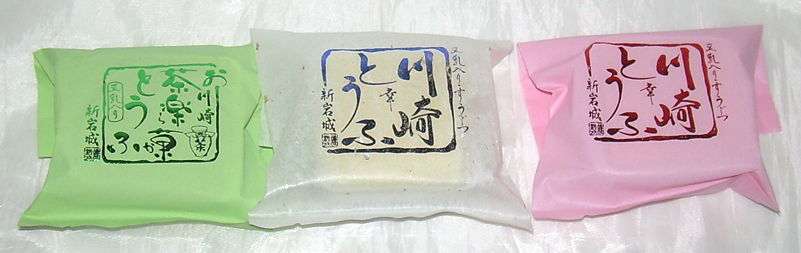
Shin Iwaki Kawasaki "Tofu" Cake


Sometimes the name of a product is meant to convey something about the ingredients, and sometimes it's a play on another type of food. That is, it is meant to resemble that food, but doesn't actually use it as a material. I've made some tofu-based sweets before including a fake cheesecake, and they turned out pretty terrible. I like tofu as a savory component, but I have never taken to it in sweets. I'm pleased to say that these cakes are pure cake. They are just served in a similar style of little plastic container as tofu is sold in. The resemblance to tofu, oh so very fortunately, stops there.

I didn't purchase these cakes. They were a souvenir given to my husband by one of his students who is aware of my blog and kindly gave him one of each type so that I could sample them. The student was in Kawasaki, where this is sold by a shop in Kawasaki station that has been doing business since 1923. The web site says that these are freshly baked every morning, but they are packaged to keep for awhile. They are sealed pretty well and have moisture absorbing packets in them. If you have a chance to pick them up (the shop information is here), they will keep until you can get them home and share them with family and friends.

The cakes are very moist and soft and feel very rich in texture. The filling for each is a thin layer of bean jam. The jam is flavored differently according the cake type so as to compliment it. The first ingredient is eggs, followed by flour. I think the dense, moist texture comes from the heavy use of eggs as well as the moist filling.

There are three flavors available:

Green Tea:


The first bite yields a strong green tea bitterness that mixes well with the lightly sweetened cake and filling. I'm not a green tea fanatic, in fact, it's just "okay" by me, but I really enjoyed this.

Strawberry:


The strawberry flavor of the cake itself is quite subdued, but the bean jam filling is a bit more intense and actually quite realistic. I don't know if it uses real berries, but this in no way is fake or overbearing. Though strawberry isn't my favorite, I still enjoyed the subtle sweetness and delicate flavors of this. 

Sesame:


This was the one that I was most looking forward to sampling and I was not disappointed. The filling in the center tasted like "sesame butter" rather than bean jam. The sense of it being like peanut butter strongly flavored with sesame was rather strong. The flavor was intense, quite sweet and delicious. 

I loved these, though sesame was my clear favorite. If I find myself in Kawasaki, I would definitely pick some up for myself. As souvenir cakes go, they are a great option for foreigners while still retaining their essential nature as a Japanese sweet. If you're searching for something which isn't too overbearing in the sweetness department and is very moist, these will definitely please you.

Tuesday, January 25, 2011

Shogoin (Red Bean) Yatsuhashi


Some foods in Japan are familiar to me mainly through my former work and this is definitely one of them. I hadn't seen yatsuhashi for at least 6 years when my husband brought home this box of traditional Japanese sweets. I don't know if families are buying these for themselves and snacking on them, but this is something I personally associate with obligatory souvenirs that salesmen brought back from business trips as a way of saying, "sorry that you're all stuck in this stuffy office while I go out on sales trips and spend half of the time doing tachiyomi instead of actual work".

The gift box, which doesn't tell you much about what the food looks like and that's why I didn't put it at the top of the post.

Though this traditonal Japanese sweet was made by a company called Shogoin, it almost certainly doesn't matter who makes it if you pick up a box. There is a very low chance that it will be appreciably different as long as it is fresh. In fact, one point about this is that it is actually "raw" rice flour dough which resembles chewy mochi and has to be eaten quickly. The packaging says you've got to eat it within three days and keep it refrigerated.

Note that you can buy various cooked versions of yatsuhashi, but it is markedly different in texture and taste. In fact, I didn't even realize that the cooked version was the same basic material as the raw version as this is like a super soft pastry coated in cinnamon and the cooked version (at the top left of the linked page) is like chewing on a hard cinnamon stick. Research for this post educated me about this fact. This is definitely something which I'd strongly recommend in its raw form over the cooked version despite the limited life span on it.

Yatsuhashi is a food associated with  Kyoto, Japan's former capital and magnet for tourists who prefer to think of Japan as a quaint, quiet place full of people who are politely mincing about in kimono and geta rather than the noisy, modern, and rude place it is (at least if you live in Tokyo). My husband was given this box of sweets by a student who returned from a New Year's trip. Our box included both green tea and basic versions, but I'm only reviewing the basic one.* The wrappers sometimes have other flavors added to them including black sesame seeds or even strawberry, but I'd only encountered the plain cinnamon version before. Various fillings, including peach as on offer by Shogoin at the time of this review, are also possible.

Yeah, it's a crappy picture, but the best of three attempts.

These are an interesting experience from a Western palate's point of view. The smattering of red beans in the center is small enough that it doesn't overcome you with beany flavor but is enough to add something more to the mix. The wrapper is like eating raw pie dough in some ways, but with a little more heft and texture as it is slightly chewy but not the least bit stretchy. The main appeal for me is the sweetness coupled with the cinnamon which is so generous as to be actually hot. Note that, this being a souvenir, there is no nutrition information on the box, but the "Calories in Japanese Food" site provides an estimate of about 66 calories per (about 4"/10 cm) sweet.

This is a curious sweet, but I still enjoyed it. I think it is one of those things which can be an acquired taste for those who were not raised around similar Asian sweets. I love the soft yet chewy texture, and the cinnamon flavors, but I think some people may find it all a bit strange. If you come across this in an Asian grocery or while in Japan, I'd say buy a small amount and give it a try, but I wouldn't gamble on a big box if your tastes run more toward traditional Western sweets and their various derivatives.

*I am only reviewing the basic one because I'm giving away the green tea version. This is not because I expect to dislike it, but rather that there are too many of them for my husband and I to eat in the limited time they should be eaten and I'd rather share them with a grateful person than have some of them go to waste. And while the person I'm giving them to would probably take the open package, I think it's better manners to offer a sealed one.

Friday, December 17, 2010

Excellent Cocoa Daifuku


My husband is a very conservative eater. It's only in the last few years that he's come around to liking traditional Japanese sweets, and even now he doesn't tend to desire them enough to actually buy them. Mainly, he'll just eat them if a student gives them to him as a gift. Because of his conservative nature, I was a little surprised when he suggested that we buy this box of daifuku sweets. Daifuku are made with mochi (pounded rice cake) and usually filled with sweetened beans.


We found this box of "Excellent" cocoa daifuku at a souvenir shop at Meiji Shrine. There are 10 little blobs in the box. Each is about the size of the tip of your thumb. Because this is a bit of a "luxury" sweet, it was slightly expensive at around 1200 yen ($14.34). They're made by a company which I can best translate to "Ander HSK". The company didn't have a web site so I couldn't find any further information.


While these may look like a lot of little cocoa powder covered chocolate truffles, they're very soft and squishy. The outer mochi is so soft that it feels a bit like a membrane surrounding a firm blog of chocolate ganache in the center. They smell like cocoa powder, and it's impossible to take out out of the box without getting said powder all over your fingers. Because they are so limp, you have to pinch them to get them out.

The mochi mainly lends a soft slightly chewy texture. The flavor is of good quality somewhat dark chocolate that is lightly sweet. These are excellent and if you're squeamish about making a foray into traditional Japanese sweets, these are about as accessible as daifuku are going to be for a Western palate.

I wish I could offer information on other outlets for these sweets other than one souvenir shop at Meiji Shrine because that makes it sound like it can only be found if you happen to be a tourist in Japan, but the lack of web presence of the company makes it impossible to make other concrete recommendations. There's a high likelihood that you can find these in department store basements, where vast quantities of premium traditional Japanese treats can be purchased. If you can find these, I can't recommend them highly enough.

Thursday, November 25, 2010

Koganei Imo


I try not to cover too many freshly produced sweets that can only be purchased if you actually live in or visit Tokyo. However, this is an exception because it is the first bean cake in Japan that I actually loved. It is, by far, the most accessible Japanese sweet for Western palates while maintaining a completely Japanese nature. Maybe everyone won't adore it as I do, but there's almost zero chance that a set of fully Westernized taste buds will dislike it.

 The box of 12 as it is given to us.

Koganei Imo means "golden (colored) potato", and while that is what these are called, they are not made with potato. They are simply fashioned to resemble one. The actual cake is finely mashed white beans mixed with sugar and egg yolk then wrapped in a tender crust and liberally rolled in cinnamon. It is the cinnamon that gives these the real edge over any other bean cake I have tried, but they are also incredible because they are hand made and fresh everyday.

The box under the paper wrapper with silk-screened (by hand, very likely) paper. This is classic Japanese gift wrapping with a layer of wrapping under a top layer.

The interior of the cakes is soft and sweet and the aroma of cinnamon wafts at you the minute you start to peel back the paper on in. If you warm one just a bit in the microwave (don't overdo it), they are a slice of cinnamon heaven which carry all of the appeal of a cinnamon bun without the calories or sugary overload. The beans themselves lend only texture and not taste so there's no need to be squeamish about them because they're made with beans. The filling carries mostly the sugar flavor with the richness of the egg yolks.

A whole cake with it's wrapper covered with cinnamon. It's supposed to look like a potato. You can judge what it looks like.

You can buy these in Ningyocho in Tokyo at a shop called Kotobukido. There's a good write up on the shop with address and phone number at Tokyo Food Life and another write-up at Food Sake Tokyo. They are a little expensive, but well worth the cost. My box of 12 cost 1250 yen ($15.15). Each is about 6-7 cm (2.4 -2.7 inches) long and makes for a modest treat. You can buy them individually in paper packets or in souvenir size gift boxes. The shop will serve you hot tea in the winter and cold in the summer when you enter, and you can eat your bean cake there or take it with you.

If you visit Tokyo, I strongly recommend seeking out this shop and sampling this unique and approachable sweet. I go there less often than I'd like, but when I do I buy a dozen, immediately wrap their paper wrappers with plastic wrap and freeze them for long-term enjoyment. They don't suffer for it, and 20-25 seconds in the microwave takes one from frozen log to cinnamony ambrosia.

Tuesday, November 23, 2010

Hida Natural Cheese Softly Bar


One of the things about food in Japan that keeps me interested, yet also ambivalent is the way in which they take a flavor that I associate with one sort of presentation and mix it up with one of a very different presentation. I guess I have an approach-avoidance conflict going on with such foods. I'm repelled, yet also curious.  I must say that I'm glad this is a situation in my life that mainly applies to food, and not other areas of my personal life. If you're going to be strangely repelled, yet curious, you don't want it to be about something which may land you with a social disease.


I should note that I did not buy these (so I can't offer a price), but rather that they were given to my husband by an acquaintance as a gift. You can see by the picture above that the box has a unique accordion file-style way of opening to allow display of the individually wrapped bars inside in a break room or on a coffee table. Clearly, this is one of those things designed as "omiyage" or souvenirs, often picked up by traveling businesspeople and given to coworkers who remain back in the office toiling away.


These "Natrual Cheese Softly Bars" are a curious menage a trois between a savory element (Gouda cheese), a cookie, and a cracker. The bars smell like a pungent slab of cheese, but the texture is dry, but not crumbly. It's soft and easy to bite into but dense. The taste is lightly sweet, fairly cheesy, but not in an intense Gorgonzola way.

The shining star of this is the texture, which is very pleasing because you can tell that there is a lot of fat layered into the flour. The first ingredient is margarine, followed by flour then sugar and cheese. If you took a cheese cracker and tried to change it into a bar cookie or shortbread, this is what it would be. Usually, this sort of sweet and savory mixture comes across as a very funky and unhappy marriage, but it works pretty well in these cookies. That being said, though I found these reasonably enjoyable, I wouldn't seek them out or buy them myself.

Thursday, August 5, 2010

Chichibu Jizou-san Sesame bean cake


I don't travel much in Japan anymore either for pleasure or for business. There are several reasons for this. The big one is that I've been in Japan for a long time and therefore have already spent hours and hours of my life exploring many places. It's rather a shame in some ways because when I used to crack open all of the nooks and crannies of various areas, I never paid heed to the food. I was mainly in it for the second-hand record shopping, looking for rare collectibles to add to my personal booty or to sell to others (and this was before eBay).

Fortunately for me, one of my students travels for business and has been kindly picking up regional sweets for me to try. I'm immensely grateful for her efforts and this lovely bit of manju (traditional Japanese sweets usually made with beans) is courtesy of her. She got it in Chichibu. That's a city which rests in a bowl created by surrounding mountains in what might be considered a suburb of Tokyo called Saitama. In the summer, my student tells me that this topography causes Chichibu to be a sweltering nightmare. She bought these bean cakes in a nondescript 6-pack while killing time and sweating. I'm the lucky recipient of one of them.


This picture was lightened a bit to show texture and composition better.

The picture on the package is a mascot for Chichibu, O-jizuou-san (地蔵さん).  The cartoon pretty much tells you that this is the name of a Buddha representation. I don't know how much these cost, but I don't think they were outrageously expensive or very cheap. If I had to guess, I'd think 6 of them cost between 500-800 yen ($5.77-$9.22). The ingredients list included sugar, sesame seeds, and red beans.

These smell heavenly, like sesame seeds but with a real nutty and rich aroma. The texture is also lovely. It has a moist cake with an almost fudge-like bean filling (minus the sense of fattiness). The beans are very finely ground and form a ganache-like filling. Based on the sheer volume of black sesame seeds, it's no surprise that this is very flavorful. There's a good rich sesame flavor complimented by the mildly sweetened red beans.

The sesame adds a great nutty flavor and the occasional meaty nut-like textural element. The only drawback is that the seeds are whole and you can get them stuck between your teeth. However, this is really a great presentation of classic Japanese sweets elements (red beans and sesame).

My student called this a "grandmother's snack" and she said that she didn't feel that it was really exclusive to Chichibu. She felt that one might be able to find similar cakes in other areas of Japan. I'm sure she's right, but I don't know if they are all going to be as well made as this one was.

Tuesday, May 4, 2010

Nagoya Bouchée (Cheese)


This may seem to be a review leftover from my week of cheese-flavored snacks, but it was simply a coincidence that my husband was given a box of cheese Nagoya Bouchée cakes around the time that I did those reviews. While this was a souvenir box from another city, these types of cakes are available in many, many shops in Tokyo. They may be qualitatively different than these, but they have the same general construction.

I looked up "bouchée" and found out that it means "small pastry casing" in French. I'm not sure if what the Japanese call a bouchée is correct according the French concept or not. I can only say that I didn't find any English-language resources for the meaning of this word that matched the cakes I see in markets, convenience stores, etc., but that could simply be a spelling difference or my less than perfect search skills. They show a variety of confections, but none like the Japanese sandwich cake that resembles a whoopie pie in basic construction.

The manufacturer doesn't have a web site, but I found a page on Nagoya-based souvenir foods which said that this box is 630 yen ($6.77) for 5 cakes. That's quite reasonable as similar individually packaged cakes are between 100-150 yen ($1.07-$1.61). As is almost always the case with souvenirs, there is no nutrition information on the box except a list of ingredients, but the calorie counts for similar cakes are about 200 per cake.


The selling point for this particular souvenir is the use of special regional eggs. The first ingredient is eggs, and 40% of the eggs used to make these cakes are special Nagoya eggs called kouchin eggs (コーチン). These eggs are supposed to have richer, darker, smoother yolks and the shells are cherry-colored. The chickens that lay them are specially bred and weigh more than average chickens with the roosters weighing up to 5 kg. (11 lbs.) and the hens up to 4 kg. (8.8 lbs.). This breed of birds is supposed to be gentle in nature and less mobile due to their large size.


The cakes are about 8 cm. (3.2 in.) in size. There is a proportionally small amount of rich, fatty creamy filling in a very dry cake. Cakes in Japan are often dry because they are made with less sugar and more fat. The ingredients list for this includes eggs (regular eggs are 60% and the kouchin eggs 40%), flour, sugar, vegetable oil, and what translates to "sugar water" in Japan but I believe is essentially like corn syrup (thought likely not based on corn). "Cheese" is far down on the list and there is also the sugar alcohol Sorbitol.

Frankly, I had low expectations of this based on the dryness of the cake, though it did smell "good" in the way that a bakery which makes cakes smells so delicious. The cake was surprisingly tasty.  It has a very nice, "developed" flavor which is ever so slightly reminiscent of a Twinkie's sponge cake. I'm guessing there is a common ingredient that brings this flavor on, but I have no idea what that might be. Though the texture is nothing to get happy about, the taste of the cake (which dominates as the filling is so small proportionally) is that of nicely sweet, good quality yellow cake. It's a cut above a lot of the mass market cakes in Japan.

The filling doesn't have much cheese flavor at all. It's sweet, and seems to be flavored with something, but it's too weak to be distinct. That was fine by me because I didn't want another cheddar-flavored sweet on my hands. Mainly, the filling adds a nice textural contrast and extra sweetness.

I really loved this because the flavor profile was so good. There may actually be something in the claim that the eggs used in these are better qualitatively than most eggs and I frankly am encouraged that the first ingredient is eggs as I think that might make the protein to carbohydrate profile on these better than your average cake. That being said, if you are sensitive to cakes that tend to run on the dry side, I couldn't recommend these for you.