Showing posts with label honey. Show all posts

Wednesday, July 24, 2013

Random Picture #172


Meiji's kinoko and takenoko no sato (mushroom and bamboo shoot) lines of cookie snacks is one of the most venerable in Japan. While I always thought that they were fine as a nice little morsel of cookie with some sort of chocolate, they were never the sort of thing I strongly gravitated toward. There were always bigger fish to fry than the generic combination of buttery biscuit and chocolate. For jaded sorts like me, Meiji has upped their game and released Bergamot Milk Tea and Honey Cafe Latte flavors of these snacks. If I were in Japan and could locate these for the usual price of around 150 yen ($1.50), I'd probably give them a try. Here in the U.S., as you can see, they're more than double that price. Since I don't expect a premium chocolate experience, I was unwilling to pay a premium price for them.

If any of my readers has a bigger wallet than me and popped for these, I'd be curious to hear what you thought of them and if they were worth the scratch.

Thursday, June 27, 2013

Pure Grapefruit Honey and Peach Mango Gummy (product announcement)

Image from Kanro.

One of my friends recently remarked on Facebook that part of the process of making gummi candy involves boiling animal bones. She's a vegetarian, so this was something of concern to her and she wanted to let other friends who may subscribe to her moral code know to avoid such candies. I'm rather torn at this point about whether or not to warn her about marshmallows as well, as they also often contain gelatin derived from animal products.

The rational side of me, which I try to keep firmly in check at all times, would also like to point out that this is actually not food that contributes to the death of animals. No one is killing animals to boil their bones for gelatin products. It's actually finding a use for the parts that are leftover after all of us savage omnivores have consumed the flesh. My guess is that, if we all stopped eating meat, then all gelatin-related products in America would cease to be made from bones and would be made the way they are in Japan, from seaweed. I don't think people would be raising cows to toss their meat in the trash and boil the bones.

The good news is that I can recommend Japanese marshmallows and gummy/gummi candies to her and she can enjoy them without violating her personal ethical code. Since Pure keeps offering up new and interesting flavors, there's no end to the fun you can have sampling their candies. And, they are good gummies. I've tried a lot of them and rarely disliked one. Okay, I really didn't care for the apple and ginger ale one, but the rest were quite nice.


There are actually three new flavors on offer, but I couldn't put them all in the headline. There are the grapefruit and honey and peach mango flavors pictured at the top of the post as well as a yogurt mango flavor shown above this paragraph. It's clear that mango blends are one of the more popular food fads right now. Mango has been in the spotlight for a few years now, and clearly it's popularity has not waned. The yogurt and mango flavor features a split color scheme, supposedly featuring one flavor on each side. It was released in June. The other flavors will be available at the end of the first week of July at convenience stores. 

Wednesday, March 20, 2013

Random Picture #154


For my husband, there were two great problems living in Japan. No, it was not the language or the cultural differences. There were but trivial issues in the face of the things that truly bothered him, the horribly hot and humid summers and the donuts. My husband grew up in an area in which there were numerous places at which fresh donuts were hand-made by people who knew how to craft a fatty sugar bomb. When he went home to visit family, he always went to a local business that made the best crumb donuts in the area and stocked up. They only sold 1-2 per day and he'd get up early and buy them and immediately freeze them. When it was time to pack up and return to Japan, he'd remove his frigid stash and carry it back to Tokyo where we'd refreeze them and he'd enjoy them over a long period of time. Such was his love of a really good donut.

The above are ""new style honey stick donuts". They were the kind of dried out morsel which tasted like over-used stale oil and the most modest of sweetness that my husband hated. Though I do not possess his Homer-Simpsons-like love of donuts nor do I like super sweet things, even I often found these things to be a huge disappointment. While I still miss the angel cream donuts at Mister Donut, even I have to admit that the donuts in America are pretty awesome compared to those in Japan.

Friday, July 20, 2012

Turron de Jijona


The Simpsons once did an episode about Springfield's lemon tree being stolen by some of the residents of Shelbyville. Jebediah Springfiled and his followers planted a lemon tree because it was the sweetest fruit available at the time. This show was about small town rivalry, something which I grew up with and am truly familiar with. When your world is small, you tend to attach significance to stupid things because you're not worldly enough to realize their insignificance. At the end of the episode, the Springfield mob steals back their lemon tree and they all enjoy a glass of lemonade as the Shelbyville denizens have a glass of turnip juice, because that was likely the only thing they had available at the time.

The reason I mention this is that so much of our food culture is about what is available at this time. The Moors, while occupying the Iberian Peninsula, sat around thinking about how they'd like to satisfy their sweet tooths (sweet teeth?). Unfortunately, they'd just conquered an area which was lacking in sesame seeds so getting their chefs to whip up some halva was rather tricky. Since they'd pretty much finished with taking over the Iberian peninsula, they put on their thinking caps and thought about what to do. Fortunately, Marcona almonds were close at hand and they decided to make halva out of it. Voila, turron was born.*

I never saw halva for sale when I was living in Japan, nor did I see turron. In fact, one of the first things I picked up at an American convenience store was a pistachio halva bar because I had been reading about it and wanted to try it. It was sticky, hard, and slightly bitter and I was not a fan. However, when my sister-in-law asked if I wanted anything from Spain when she visited there, I checked out traditional Spanish sweets and came across turron. She brought me back this box.


There are many types of turron and you can find them in various ethnic markets as well as available online. One type is like a nut brittle. This one is like an enormous wet slab of chalky nut butter. When you open the box, there's a sealed packet with lots of what looks like unpleasant meat juices swimming between the clear plastic and shiny plastic. It looks insanely nasty. 

Undoubtedly, turron de jijona is hard to handle because it is slightly soft, tends to break off in soggy clumps, and has a lot of wetness around it. That being said, it's worth the mess. It's a rich, sweet mass of almond butter mixed with honey. Turron de jijona is a form of nougat, so it is made with egg whites, sometimes raw ones, but I'm sure any packaged stuff that you buy is safe. I've had pistachio halva before and this was much, much better both in terms of texture and flavor. The halva I bought (from a convenience store in a package like a candy bar) was bitter and hard, like taffy. This was soft, melt in your mouth fatty, sweet but not too sweet, rich, almond, nougat and honey delight. There really aren't enough positive adjectives for how much I liked this.

In Japan, most of the nut-based sweets were made with peanuts or sesame, because that must be what they have on hand. In Spain, many things contain almonds. Fortunately, neither one of these countries ended up with "a cool glass of turnip juice". They both had lemons and made lemonade in their food cultures.


*I made most of this up. I don't think thinking caps existed back then.

Friday, November 18, 2011

Kkul Tarae (honey skein) Walnut and Chocolate Court Cake

Before I get too far in this review, I should state that this is not Japanese, but Korean. One of my students visited Korea for 5 days of sauna, massage, shopping, and luxury hotel enjoyment. This is a very popular course of action for young Japanese women these days since Korea is a hop, skip and a short swim away, though most take a cheap plane flight. It's well-recommended for vigorous rubdowns that slough the top layer of your disgusting dead skin away and brutally hot spa experiences. So, if you want to sweat and then have strangers scrub down your naked body in every nook and cranny, Korea is the place for you.

It's also the place for you if you want to try some unique treats, and I'm not talking kimchi, which is so common these days (at least in Tokyo) that it's absolutely mundane fare. My student picked this up from a street vendor and offered it to me rather apologetically because it wasn't particularly expensive. This sort of behavior, both gift-giving and then feeling obliged to express regret about the price despite the fact that the thought really does count more than anything, is something I will always associate with Japanese people and a culture which strongly encourages generosity and modesty.

The box provides a bilingual explanation including a story about how this is a "court cake of ripened honey and malt". In the past, it was supposedly presented to the king and guests of sufficient distinction that they deserved a treat that included 16,000 strands of honey. The box goes on to say that the strands suggest prayer for longevity, health, luck and wish-fulfillment. It also says it is good cold or frozen and then enjoyed with tea.

Because I can't read Korean at all, and the web site of the manufacturer is composed largely of graphics which can't be translated by Google's translation facilities, my ability to understand the ingredients or other information about this treat is extremely limited. This makes for a "purer" experience when sampling this food because I have to rely on sensory experiences rather than on what I read, but does limit my ability to provide meaningful information to my readers. I don't even know if the "honey skein" on this is actually honey. It sure doesn't look like it.

The outside of the candy is quite firm, but not brittle. When you bite into it, it yields like soft plastic and as you chew it, it becomes more pliable and chewy. Though the box claims it doesn't stick to the teeth, it does. In the end, it takes on a consistency similar to taffy. The outer "skein" doesn't have much flavor, but lends a delicate sweetness and a lot of texture. Most of the flavor comes from the mix of crushed nuts and seeds that are on the inside. They have a nice, meaty mixture of flavors including some very marginal bitterness with a warm, walnut finish. Though the box says "walnut and chocolate", I couldn't taste any chocolate at all.


This is an unusual treat which is very hard to describe because of the "honey skein" exterior and the combination of flavors inside. It's an interesting experience, but not necessarily a "great" one. However, it definitely is not a bad one either. In Korean drinks and snacks, I have experienced very creative use of nuts and walnuts in particular. I like it, but it's not the sort of thing which is easily accessible to all palates. If you're the type who just wants some sweet which won't challenge your texture and flavor perceptions, this will likely disappoint. However, if you're looking for something a bit more interesting, I'd heartily recommend giving this a try.


Friday, July 8, 2011

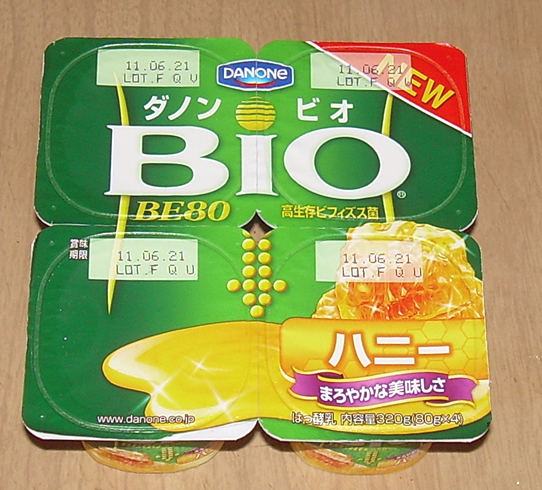
Danone Bio Honey Yogurt


When I was a kid, I hated honey. My mother used to love to slather it on bread or toast, but I was so fussy about texture that I hated the way it tended to sink into the bread and make it mushy inside and leave it kind of crusty on the top. Since I was a kid, I didn't realize this problem could be easily solved by slathering the delicious evil of butter on the bread first. I'm sure my mother didn't mind my staying out of the honey though. It meant all the more for her.

I'm also not a fan of the sometimes strong sweetness associated with honey when it is applied too liberally, so I tend to avoid it in general. In Japan, however, one can always assume anything which is expensive will be applied with a light touch, and I imagined this yogurt wasn't going to be cloying. Incidentally, in Japan there are two types of "honey" on offer. These is the real stuff which is outrageously expensive for tiny amounts and there is "honey syrup", which is big bottles of the stuff for a reasonable price but is actually honey mixed with other types of sugar syrup. If you're shopping and want it for health benefits, it's best to avoid the latter.

Danone is the name of a French company which sells healthy foods and operates in Japan in conjunction with Kirin (best known for its beer). The brand in Japan is focused pretty much on yogurt packaged in very small containers. Four 80-gram (2.8 oz.) cups cost 218 yen ($2.72) at Seiyu supermarket so it doesn't come cheap. The "Bio" line includes live yogurt cultures to improve digestion.

I picked this up partially out of curiosity about the taste, but also because I now pack a lunch twice a week for part-time work and this seemed like a good addition. The portion size allows for about 4 spoonfuls of something sweet and nutritious at the end of lunch and at only 71 calories per serving, it's no worse on the hips than a mini KitKat (and a whole lot better for me).


There is no visible indication that honey is mixed in, but the flavor is definitely there. It's just strong enough not to be lost in the slightly sour yogurt without being overbearing. The place where the yogurt really shines though is the silky, rich texture. This was incredibly smooth and creamy. I have a feeling that, when I go back to the U.S., nothing short of high quality Greek yogurt is going to live up to the incredible texture I sometimes experience in consumer-level Japanese yogurt. Yes, the portions are small, but they really make you want to savor every bite.

I really enjoyed this, and was sorry to consume the last one. That being said, my very positive experience with this makes me more inclined to sample the other flavor varieties that are out there. If you enjoy a bit of honey with your yogurt, this is a definite "don't miss".

Just a gentle reminder that there is a contest running for two weeks to win a few snack and snack-related goodies. If you'd like to enter, the details are in this post.


The contest winner will be announced this weekend. Thanks to all who took part!

Thursday, January 21, 2010

Mister Donut Black Honey Soy Donut


Have you ever wondered why one particular variety of donut (or doughnut) is called "old-fashioned"? No, I hadn't really wondered about it either until I planned to write this post and started to do some research. Since the history of the donut can't be easily tracked. Let's face it, the concept of frying dough is one that could have occurred simultaneously all over the world once dough-making cuisine was common. It could have started with a clumsy pock-marked teen in a Dutch bakery in the 19th century who accidentally flung a bun ball into some oil nearby or it could have been a portly British fish and chip proprietor who ran out of things to fry.

At any rate, I never did track down why one particular variety is called an "old fashioned" donut. I found searching on the keywords to be too frustrating and it turned up too many results so I did what any good blogger would do: I gave up and figured someone smarter and more tenacious than me would give me the answer eventually.


One thing I didn't need to research was the fact that Mister Donut Japan pulled most of their old fashioned donut line some time last year. In particular, they removed their glazed old fashioned which my husband really liked. On January 6, 2010, they brought it back along with some new friends including the tasty number that I'm reviewing today. The old favorites that came back are plain, glazed, and chocolate and the new ones are green tea, green tea with chocolate, coffee, coffee with chocolate, and black honey kinako (soy flour). At present, there's a sale and all of these donuts are 100 yen ($1.09) each. That's about as cheap as they tend to get in Japan.

There's a Mister Donut about 9 minutes from our apartment, so we got super fresh ones. From a basic donut perspective, you really couldn't get a nicer basic bit of fried dough. The outside was a little crispy and the inside tender. The top was a little moist on mine where the black honey glaze had sunk in a bit. Before biting in, I gave it a sniff and it smelled like a regular, fresh donut.

At first, the black honey soy donut was sweet, but not incredibly sweet with a mild molasses and sugar-glazed flavor. The kinako added just a hint of soy. The donut became cumulatively sweeter as I ate it and by the end only felt a bit too sweet for my tastes. I had it with coffee, so I wonder if it might be too much if you just ate it without a beverage. I did note that this was one of the more fattening donuts at 328 calories.

Frankly, I don't know what black honey is, but I'm wondering if the glaze has anything to do with honey. Even the basic glazed donuts (both raised and old-fashioned) are called "honey". I wonder if the use of the word honey is just a naming convention. At any rate, this tasted like a mild "black sugar" (molasses/brown sugar) donut with kinako powder sprinkled on it. The flavor combination is very good, though I could have done with a little less sweetness and a little more kinako. I'd definitely recommend trying this though, and would get it again.

Mister Donut is offering desktop pictures for download here. If you'd like to put a food cue on your computer screen that will cause you to want to eat donuts everyday, you'll want to download them.

Tuesday, September 1, 2009

Tirol Minashigo Hutch Honey Chocolates


As I recently remarked to Ebidebby on her blog, I've been a bit off of the Tirol chocolates as of late. The variety packs in particular have been letting me down (as opposed to the premium candies which are a bit better). Nonetheless, I was intrigued by this 8-pack of honey based chocolates bearing the animated honeybee character, Minashigo Hutch.


I should note that prior to buying this candy, I'd never heard of this character and its big-eyed, cute presence had nothing to do with my buying the candy. The fact of the matter is that it was the inclusion of a honey yogurt flavor that sparked my mojo into money spending mode. It just sounded interesting. For the record, there are 8 candies in the bag at about 37 calories per candy. Half of them are "honey toast" and the other half "honey yogurt". I paid 99 yen for them at a local convenience store, but I've seen them in numerous places for a similar price.


Honey Yogurt: This smells a little lemony and just a bit like honey. Even though I kept these in the refrigerator, the honey part was a bit liquid-like. The yogurt portion is contained in a somewhat creamy, moist marshmallow. The soft exterior chocolate easily gives way and you bite into a nice little pillow with gooey honey. These are very sweet, but the somewhat sour yogurt flavor goes very well with the honey. I loved both the texture and flavor combinations of this.


Honey Toast: I expected this to be another of Tirol's "Bis" (biscuit) types where they stick a bland cookie in the chocolate and surround it with overly sweet candy. In other words, I expected one-note flavor and a big cookie crunch. It turned out to be more interesting. You can't see it when you look at the picture, but there is a little yellow cookie in this. It's become relatively saturated with the honey topping and isn't that crunchy anymore, though it does add some texture. This tasted a lot like a honeycomb. I don't mean the honeycomb candy bar, but rather a real honeycomb if you've ever bitten into one.

Both of these are quite sweet and have pretty authentic honey flavors. It's not the sort of thing you'd be inclined to gobble down a lot of in one sitting, but they are very good. I could easily go for a whole bag of the yogurt ones because of the marshmallow aspect, but the "toast" was good as well.

Wednesday, March 4, 2009

Kokuto Marubolo (Honey Brown Sugar Soft Cookies)


Brown sugar is supposed to be better for you than white sugar. In fact, the company that makes these cookies, Kurobo, devotes a page on its web site to letting you know how rich in minerals like iron, calcium and potassium phosphate, brown sugar is. Kurobo specializes in a variety of snacks which use brown sugar and honey. Kurobo has been making sweets since 1920. My translations claim that the name means "black bow", but I'm a little dubious of that. "Bo" means "stick" in Japanese and various sweets made in bar form are called "bo", so it's possible that it means "black stick" or "black bar". The company's top seller is a fried dough "cake" which looks a bit like dog dootie. I've seen that style of sweet in markets many times, but was never tempted to buy a bag of dachshund pellets. One of these days though, I'll have to cross that bridge.


There are eight cookies in each packet for about 200 yen ($2.23). The primary ingredients are flour, sugar, eggs, brown sugar, honey, "sugar water" (syrup) and vegetable shortening. The package doesn't give specific calorie details, but based on the calories per 100 grams and my rough guess of the weight of one cookie, I'd put them at 50 or so calories per cookie. Each cookie is individually wrapped in a Japanese paper packet, but they are not airtight as you can easily smell the cookies through their paper wrappers. I have a suspicion that these would dry out if not kept in a plastic bag.


The cookies smell like gingerbread, though that is mainly because the dark brown sugar used in them smells like molasses. There aren't any of the spices you expect in gingerbread. When you remove the cookie from the packet, it sticks a bit to the paper. The surface of the cookie isn't sticky, so I'm guessing that this is just accumulated moisture.


When I tore the cookie in half to take a picture of the inside, it was actually quite tough. In fact, it felt more like I was ripping it apart. The texture is very coarse and the cookie is soft, but dry. It's easy to chew, but it's more like bread than a cookie or cake. The flavor is very nice. It tastes of brown sugar and honey and is just right on the sweetness. I really enjoyed the flavor of these, but the texture leaves a lot to be desired. They are so tough for a cookie.

These are like a different version of a black sugar "stick" cookie which I have reviewed before and are readily available from various manufacturers. The difference is that these lack the sugary, semi-crispy exterior that those have. I probably wouldn't buy these again, but I will certainly consume the rest of the bag through time. If I was going to buy something along the lines of this cookie, I'd go for the sugary version over this plain version.

Monday, January 19, 2009

Honey Lemon Hi-Chew


Hi-Chew is one of the most reviewed snack foods among those who talk about such things. Prior to this post, I was a Hi-Chew virgin. Yes, I've been in Japan for 20 years and never felt compelled to sample one of these. In fact, I can't honestly say that I was compelled this time since my husband bought this for us to try.

This Hi-Chew flavor is somewhat special in that it can only be purchased at "New Days" convenience stores in Tokyo, at least that's what the sign at New Days said. They could be trying to express unfounded Hi-Chew Honey Lemon superiority. That being said, I'm not sure why they'd make such a bold claim if it weren't true. New Days is a chain of stores that is only located in Japan Railway (JR) stations.


If like me, you have never had a Hi-Chew before, it's a soft blob of candy which is like non-sticky taffy. It greatly feels like gum that melts in your mouth as you chew it, which is no surprise considering the name includes "chew". It smells vaguely of honey and gum and oddly had little or no lemon scent.

The taste at first is mostly lemon, and a strong flavor at that, followed by the honey. Both flavors become quite present as you chew. It reminds me of a lemony honey cough drop without the medicine aspects. It's good, but it hurt my teeth as I chewed it. It could be just that my teeth were sensitive at the time, but it rather turned me off to eating more of them. Each candy is 18 calories and there are 12 of them in a pack for about a dollar (99 yen).

These are nice, but the honey lemon pairing is a little too etched in my mind as something that goes with cough drops rather than with candy. These are immensely flavorful and the texture is quite nice, but they're not my cup of tea.