Showing posts with label preprepared food. Show all posts

Tuesday, June 21, 2011

Nippon Ham Chilled Bakery Meat Pie


Since I started working part-time, my eating schedule has been forcibly changed two days a week. Usually, I have the luxury of eating dinner at 7:00 or 8:00 pm, but on the two days on which I work, I get home at 10:30 or so after eating lunch around 5:00. I don't want to eat a lot late at night, so I've been pursuing some different options. As a result, my readers will be "enjoying" some different food reviews than before. In fact, chances are that there will be more convenience foods which resemble "real food". Honestly, this is all the better for the continued life of this blog as I really am starting to see fewer and fewer attractive options in the snack aisles. That's not to say there aren't things I haven't sampled, but that variations on a theme get pretty boring after awhile.


This is more pie than "meat", but that's okay with me. I'm not a great fan of meat anyway and chose this for a light meal prospect. The pie is flaky and slightly buttery. It has a light crispiness which is very pleasing and a tender interior. The meat filling is more of a "paste" which has a touch of tomato paste flavor, but nothing really too strong. It reminds me of the sloppy joe mix we used to get in elementary school.

This is actually pretty good as long as you have exceptionally low expectations of the meat filling and reasonable hopes for a nice flaky pie. I enjoyed this quite a lot, much as I enjoyed its companion piece, the cheese pie. I'd pick up either as a filling snack or breakfast if the spirit moved me. Both have better than average bakery qualities for something you pick up in the refrigerator case at Seiyu. At 298 yen ($3.72) for 4 pies, they're cheaper than the local bakery's offerings as well. I kept this around in the fridge for about a week with no degradation in quality, which was a bonus. If you get home late, like a more filling snack, or just want a little breakfast variety, I'd recommend giving this a try.

Thursday, January 6, 2011

Hagoromo (canned) Yakitori


A variety of food review bloggers, including the Onion's AV Club, have reviewed canned hamburgers. The point that this has in common with I'm about to review is that both yakitori and hamburgers are foods that should never be sold in a canned version. If you've had the real thing, you know that it can be a tasty and almost sublime experience that can only be realized in a freshly prepared presentation.

I found this abomination at Lawson 100 and bought it on impulse because I'd never seen canned yakitori on sale anywhere else. Hagoromo is more familiar to me as a maker of crappy canned tuna rather than crappy canned chicken.


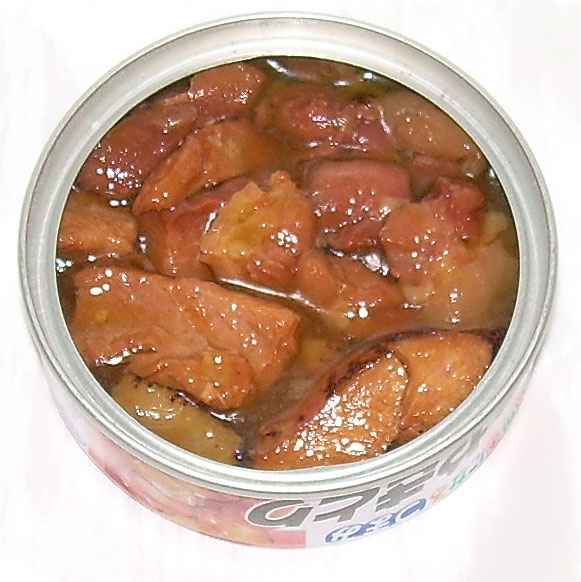
 There are plenty of little bits of chicken skin, and precious little actual chicken. The can is 55 grams and offers 139 calories, but the web side says that that includes everything (sauce, skin, chicken), not just the edible chicken parts. That makes sense because I couldn't imagine such a high calorie count for what little is there. In fact, I'd guess this would be the equivalent of one stick of actual yakitori if you were to get the real deal. I think this stuff is designed mainly as earthquake survival food. You can keep it in your emergency bag for up to 3 years, or you can serve it as a side dish to people that you don't like very much.


Before I popped the top, I expected that this would smell like that usual canned food smell. You know, a sort of eau de dog food? Yeah, it smelled like that and just a bit like chicken. Inside were some chicken tidbits suspended in some sort of gelatinous substance. I figured that it might be more palatable if I warmed it up and allowed the goo to liquefy.

Despite the unappealing look and smell, I wasn't too grossed out by the idea of eating this. I've had bad canned food before, after all. The texture of the chicken was horribly dry and stringy. It needs to be chewed quite a bit unless you prefer to swallow it whole. It has that canned food taste which I always guessed was due to pressure cooking mass amounts of the food as well as whatever preservatives are used. There is also a hint of a smoky, char-cooked flavor and, of course, low quality chicken. The sauce is slightly sweet and salty. It's not bad, but it's far from good.

This was bad, but not in a way that renders it awful. It's just overcooked, processed canned food that fails entirely to be more than one expects, even when one expects very little. If you need something for your earthquake survival kit, this wouldn't be the worst possible choice if you can't find anything else. Otherwise, give it a pass.

Thursday, November 18, 2010

Nippon Ham French Bread Pizza


I rarely buy frozen or chilled pizzas in Japan. In fact, I'm pretty sure that aside from a random Lawson VL "Mix" pizza for 100 yen (like this tuna one, only without the tuna and mayo) every once in a blue moon (however often blue moons make an appearance), every pizza I've bought of this type has been reviewed in this blog. 

I like to think I buy such pizzas when I have forgotten how bad they are in Japan, but the truth is that I occasionally sort of crave a bad pizza. That is, I crave one until I actually have one and then I am full of regret and bad carbohydrates. At the very least, I can always get a review out of these things when I take the occasional pizza plunge.

One "pizza" sealed for your protection.

This particular "chilled" pizza is "Japan's #1 brand" of said type of pizza according to the advertising. I have to wonder if that has more to do with the pricing and portions than the quality. I found this bag of 4 hot-dog-bun-sized "French Bread" pizzas at Seiyu supermarket for a mere 298 yen ($3.69). Any time each serving comes in at less than 100 yen ($1.24) each, it's on the cheap side for Japanese prepared foods. Each serving provides 245 calories and a small mix of cheese and a few scraps of ham and sausage. The ingredients include flour, "natural cheese" (as opposed to the ominpresent processed stuff in Japan), tomato puree, bacon, and very curiously, "apple pulp".

It sort of looks like the bottom of your shoe after you have stepped in something really nasty, doesn't it?

I had the first pizza as I imagine they are intended to be prepared. I unwrapped it from it's tight plastic and placed it directly on the toaster oven grate without a tray. The packaging makes a point of telling you not to use a tray so that you can get cheese all over the toaster oven and have a devil of a time cleaning the mess up later. The instructions recommend you toast it for a spare 3 minutes at 1000W, but that wasn't even long enough to melt the cheese. I think I gave it 7 minutes to get the cheese to the melted state you see in the picture above.

As for the pizza itself, there's a reason I compared its size to a hot dog bun and that's the fact that it tastes a lot like the devil's spawn of said bun and French bread, and this is an offspring which favors the dog's bun side of the family in texture. The bread does not get crispy at all if you heat it from the chilled state to a point where the cheese hasn't turned into a mass of brown bubbles. The results were a little better when I froze the remaining "pizzas" and toasted them longer. The bread had time to get slightly crispy before the frozen cheese got too over-cooked.

The flavor of this was pretty much like cheese on bread with the faintest hint of tomato. It wasn't a bad thing, but it was nothing like a "pizza" or even French bread. I did eat the rest, but mainly because it was there and easy to prepare. I also had a vat of lentil soup I had been trying to eat up over several days and this was a decent accompaniment. I wouldn't recommend this unless you're too lazy to put cheese on your own hot dog bun or piece of bread. You can do better even doing that if you use more flavorful cheese.

Friday, October 29, 2010

S & B Chicken Keema Curry


I grew up poor. I'm not talking about the kind of poor where you couldn't have an iPod and got some cheap knock-off MP3 player at Wal-Mart instead. I'm talking about the kind of poor where you were hunting down bottles that could be returned for a deposit at the end of the month so that you could buy milk. Given that situation, I was very familiar with the type of crappy cheap food that poor parents buy to just have something on the table like store brand macaroni and cheese which could be had for 5 boxes for a dollar on sale. Of course, I'm 46 and I'm guessing that you can't get even crappy mac and cheese for that price anymore.

I mention this not to elicit sympathy for my youthful poverty, but to talk about cheap, crappy food that people buy because it fills the space. One can guess that this S & B Keema Curry falls into that category. Most of the better quality prepared curry prepared food sold in foil bags at market costs between 250-400 yen ($3.03-$4.86). This costs 100 yen ($1.21). I found it at Lawson 100, but you can also find it at Seiyu supermarket for a "discount price" of 98 yen.

S&B is famous in Japan for it's spices and I have a few jars of its product in my refrigerator. I choose their spices mainly because they're in small bottles and cheaper than imported varieties. Most of what they offer is relatively mundane stuff. You wouldn't find something as "exotic" as cardamom in their packaging, for instance, but they're good for work-a-day options like parsley or turmeric.

I chose this keema chicken curry from the plethora of other cheap curry options at the 100 yen shop mainly because when I squeezed the package, it was lumpier than the rest. I figured that this meant there was more "meat" in it. Okay, the truth is that I assumed it had more TVP (textured vegetable protein), but the point was that it had what felt like more substance than the others and the calorie count wasn't too bad at 145 calories. It also has 11.8 grams of protein which isn't too shabby for a 100 yen foil pack of junky food. The main drawback is that it has 2.5 grams of salt when the daily amount recommended for an adult is 3.8 grams of salt.


Given that latter bit of information, I expected it to be salty, and boy howdy, were my expectations fulfilled. This is a mildly hot curry and could use more kick, but has a nice savory undertone and more depth of flavor than many of these cheap preparations. You can't really taste the chicken as an individual ingredient, but you can get a real sense of it in the texture. In terms of the spices, you can really taste the ginger and something which seems like celery salt in flavor (but is not).

I don't have this often, but I do like to have it occasionally when I have a few ounces of leftover chicken and a bit of rice on hand. Adding 2 oz. of bland chicken breast helps cut the saltiness back a bit and the flavors are sufficiently intense that adding unseasoned chicken to it doesn't dilute the intensity to an unacceptable level. I wouldn't recommend this as an "every day" or even a once a week sort of thing because of the high salt content, but as a bit of cheap comforting junk food on occasion, it's pretty good.

Thursday, August 26, 2010

Viva Buono Bacon Pizza


When my friend April Marie mentioned having a personal pizza for under 600 calories, I developed a craving for pizza. She was kind enough to share her information about the pizza she had bought on her blog, but I couldn't find the Nippon Ham pizza that she was eating at my local market. Once one gets a craving though, it's hard to escape it. I picked up a similar looking pizza from Marudai, maker of a good many prepared foods including various meats, yogurt, and, of course pizzas.


My Marudai bacon pizza had one virtue that April Marie's didn't and lacked one that hers had. This pizza was only 505 calories, but she said hers was "delish" and mine certainly was not. The size of the pizza is quite generous at about 8 inches (20 cm.) in diameter. In fact, I could only eat half of it at once.


The page for this pizza claims it has "plenty of shredded bacon", but it doesn't have plenty of anything except sauce and crust. There's also supposed to be wine and clam in the sauce, but I couldn't really detect anything. The sauce was fine though. It has a pretty strong flavor, but the problem is that the sauce is almost all that can be tasted. The cheese is flavorless and after the pizza cools off, it's like a plastic layer on top. The bacon is so sparse as to present a simple ham aftertaste. The crust is soft, but inoffensive.

This pizza wasn't terrible, and I will eat the other half of it. That being said, it wasn't even as good as the 100 yen tuna mayo pizza that I got from Lawson's. I certainly wouldn't buy it again because I like my pizza to have more than a smattering of cheese on it.

Tuesday, August 10, 2010

Ito Ham Tomato Cheese Hamburger Calzone


Today, I came to a realization about food blogging that would never have occurred to me had I not found myself pressed for time and very, very hungry. I came to realize that snack reviewing is a lot easier than any type of food writing which deals with meal-oriented processed food that is reheated and eaten. With snacks, you have all of the time in the world to take a picture, and you usually eat them when you're slightly hungry, but not ravenous. If I'm really in the mood to eat a snack and don't want to take a picture right away, I also have the option of snipping a hole in the back of the bag and easing out a little bit for sampling and taking the pictures later. With prepared food, you don't have this freedom.


I had a lot of work the day that I consumed this particular item and just wanted to dash out, grab something junky, rush home, and chow down before the next round of work came my way. What I didn't want to do was set up a picture of the packaged item, take another picture of it after unwrapping, and then heat it and take another picture of it cut open for detail purposes. All of those food bloggers who deal with this type of food all of the time, I salute you. Your life is much harder than mine.


I chose this "hamburger calzone" (at Family Mart convenience store for 210 yen/$2.33) despite knowing full well it was neither of the things it professed to be. I've lived in Japan long enough to know better. I just hoped it was going to be relatively inoffensive junk food rather than something with funky, peculiar modifications for the Japanese market.

When I opened the package, there was a faint pizza-like smell, albeit one with unfamiliar spices. As it cooked, it actually smelled like a hamburger. The size is 16 cm long (6.2 in.) and 8 cm (3 in.) wide at the widest point. I also knew that this wasn't going to be a meal in itself, though it had almost 276 calories. I ate this with an entire small sliced carrot and about a cup of homemade tomato soup. At the end, I was quite full, though that was almost certainly greatly contributed to by the warm soup. I was hungry enough to eat a small packet of almond sembei about 2 hours later.

The burger portion was thin, but reasonably expansive. It didn't go into every corner, but it covered most of the bread surface. It tasted like elementary school cafeteria food. The "hamburger" tasted like meatloaf and the sauce is a thick, moderately ketchup-like pizza sauce type of thing. I have to give the maker, Ito Ham, credit for not making the sauce too thin or watery (as is often the case) and giving it enough flavor to pack a little punch. There was nothing that resembled cheese in it in texture, taste, or appearance. The outer shell is soft and bread-like and nothing like a proper calzone crust. It is completely inoffensive, though slightly tough around the edges where there is no meat or sauce.

Mainly, this is like a mass-produced meatloaf sandwich. It's better than average for this type of conbini offering mainly because it's comfortingly familiar and has no strange tastes (unlike the wiener-based burritos you often find in the refrigerator cases of convenience stores in Japan). I was on the fence about an indifferent rating and a happy one, but the bottom line is that I could see myself getting this again under similar circumstances despite the fact that it is hardly a thrill to eat. When presented with a mediocre to poor crop of options, sometimes inoffensively familiar and moderately tasty is good enough.

Tuesday, June 15, 2010

Kagome "Rice Menu Set": Chicken Doria and Spicy Tomato Curry

Kagome Chicken Doria (236 calories)

As part of my attempts to review instant or frozen food on occasion, I picked up these shelf stable "heat and eat" meals at Seiyu supermarket on sale for 198 yen ($2.16). There are several of these in a line by Kagome geared toward weight-conscious women. That's why the calorie information is displayed so prominently on the front of the boxes. These boast not only low calorie counts, but some added fiber through the use of a barley and rice mixture. I chose the "chicken doria" because I have a fond experience with that dish from a local restaurant, and the tomato curry because, well, it's curry.


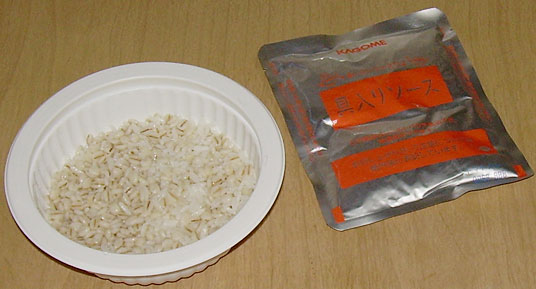
Both of these dishes have a bowl with a bit under a cup of grain in the bottom and foil packets that contain sauces. The Doria has separate mixtures for white sauce and red sauce. In the end, you mix it all together anyway so I don't quite understand the point of the separation. I'm guessing it's for aesthetic reasons. The tomato curry had one large foil pack only.


Going into sampling these, I knew I would try them alone once, and then I would augment them with leftover chicken breast. These sorts of meals are not well-known for their high protein content. I started with the chicken doria which had microscopic bits of tomato, the odd rare crumb of carrot, and tiny little bits of chicken mince. The red sauce with chicken smells like tomato and not much else. the white sauce has a bit of a dog-food/canned food type of smell. It was not encouraging.

This didn't taste like not much of anything. There's some very mild tomato juice flavor and ever so vague hints of some sort of cheese. You have to strain to taste it though. In fact, I'd recommend invoking the power of imagination and hope that you can turn your desire for cheese taste into reality through the power of your mind. I couldn't taste chicken at all. It's also one of those prepared foods that has a lot of sodium, 350 mg., but you still need to add salt to it to taste anything.

The texture was rather gelatinous. You can tell the sauce is mainly made with cornstarch. While the rice is not bad at all and is relatively firm and decent, good pre-made rice is really not hard to come by in Japan.

This was palatable only because I added 90 grams of leftover chicken breast to it and the rice was fine with it. The sauce mainly added some moisture and texture. I was very disappointed in this and probably wouldn't have eaten it all if I hadn't already mixed the chicken in with it and had nothing else to really consume.

The Chicken Doria gets a well-deserved:


Spicy Tomato Curry (235 calories)

After my experience with the Chicken Doria, I had even lower expectations of this. I felt a bit more hopeful after I opened the sauce packet and smelled it. The aroma was about what one would expect of spicy curry and tomato. You can see how little I expect of these things when they end up smelling like they should and I'm pleasantly surprised.

The base component of this was similar to the chicken doria version. The plastic bowl has about three-quarters of a cup of rather dry rice and barley with a foil packet of sauce. After squeezing the sauce onto the rice mixture, I put it in the microwave with the lid on as instructed and the lid blew off about 1 minute and 15 seconds into the process. Curry bubbled up and splattered on the edges of the bowl before I could stop it.


I took it out and gave it a stir and noticed that it was very, very soupy. The rice seemed rather dry at first, but the texture improved after it sat for about 5 minutes. There are small blobs of soft tomato in the sauce, and no other detectable vegetables. I sampled it as is and it is not bad at all. It's nicely spicy in terms of warmth and intensity of tomato flavor. The curry flavors are rather muted, but it's really rather piquant. It's just a bit salty, but not in a too overbearing manner.


After a taste of the curry "as is", I added 85 grams (3 oz.) of leftover chopped, cooked chicken breast and stirred it in. Because there is a lot more sauce than necessary, this worked quite well. There was more than enough sauce to coat the chicken and the combination was very good. I didn't need to add salt to the bland chicken because the sauce is spicy enough to cover.

I actually liked this. If I were inclined to pick up a prepared meal to avoid preparing all of the components, I'd definitely buy this again. For this sort of food, this was pretty good and the low calorie count (235 calories alone, 372 with the added chicken) is appealing. It's not stellar, but it is tasty enough to be worthwhile, especially if you have no time to cook.

Tuesday, June 1, 2010

Meiji Cheese Fondue (Individual size)


My husband and I bought a gigantic 6-lb. bag of mini pretzels from Costco over a month ago and haven't even made a dent in it yet. If you marry our abundant supply of salty-bread-based twists with a desire on my part to find another processed cheese product to review, you'll know my motivation in choosing this single serving fondue as a snack.


I found this at a Lawson's 100 shop (so it cost 100 yen or about a dollar) and was intrigued by the small size and the fact that it says that this is made of "natural cheese" (as opposed to processed cheese). Mind you, this is still processed cheese to me. Anything which is processed such that it melts evenly and contains additives is "processed" in my book.

There are picture-based instructions on the top of the box, which I didn't pay attention to and therefore did not follow. I did look at the top of the little cup and did the important thing, and that was to remove the plastic seal from the top of the cup. That meant I didn't explode the fondue all over the microwave. The part that I didn't do was place the solidified cheese bowl back into the box before putting it into the microwave. I'm guessing this step is to steam the fondue a bit, but I don't think it mattered at all.


This smelled like mild cheese, unsurprisingly. The texture is smooth and it is a good consistency for dipping. You're supposed to microwave it for 40 seconds at 500-600 watts, and that allows you to eat it all before it completely congeals. It did start to solidify to some extent, but it wasn't an issue given that the portion is small and it's easy to finish up before it totally returns to it's original state.

The taste is better than most processed cheese. It resembles Gouda with a hint of Swiss. It's definitely not as intense as some cheeses (like Cheddar), but there is a tiny whisper of aged cheese flavor. It's not great, but it's serviceable and better than some processed cheeses. I do wish it was a bit sharper.

There are 45 grams (1.6 oz.) and 94 calories of fondue in the bowl and that's actually a pretty good portion size. There is enough cheese to dip 12-14 mini pretzels. I had this as an afternoon snack and found it pretty satisfying as a more filling and marginally less "junky" snack. I'm not doing cartwheels over it, but I'd probably buy it again if the mood struck me or I wanted a snack and felt like spending too much so I could dip my pretzels in warm, melted cheese without making an effort on my part.

Friday, April 30, 2010

Variety Friday: Bento Cheats


Bento making is becoming a fad among a certain demographic. If you visit the food porn web site aggregates, such as Foodgawker, you'll invariably find regular entries devoted to lovingly framed shots of bentos made by folks both in Japan and foreign countries. Just a few such blogs are Happy Little Bento, Hapa Bento, and the queen of bento sites, Adventures in Bento Making.

If you read these English language bento blogs or just look at the pictures to admire their artistry, you'll get the sense that the time spent making bentos must be immense. Not only do people have to carefully construct little star-shaped bits of carrot or cut little bits of nori to make happy faces on their rice, but they also have to make all of the food that goes into the bento. I don't regularly read English bento sites, but on the occasions that I do look at them, all of the contents appear to be made by hand.

In Japan, it is far less common for people to make all of the components of a bento themselves. Many of the people who I've discussed the topic with have said that the meat and fish components in particular were purchased in an already completed state at the local deli or supermarket. In particular, few people have the time to make tonkatsu (breaded pork cutlet), croquettes, or meatballs, all of which are popular bento fodder.

The picture at the top of this post is what I'd call a "bento cheat" food. That is, it is prepared food that is marketed and intended to be used as an addition to bento boxes. The little illustration in the upper left corner shows a mother and her two kids smiling at the addition of these meatballs to an artfully arranged bento box.

I bought these meatballs as part of a 3-pack of 65 grams (2.3 oz.) packets for about 200 yen ($2.32) at a tiny local market. There are 113 calories in a serving of 6 small meatballs in what is ostensibly "tomato sauce". You often find this type of meatball or a similar type of burger patty in a plastic pack sold as a bundle of three taped together.

I've had several different types of these throughout my stay in Japan. Most of them are not bad, but not really good either. The meatballs are always heavy on the filler and very soft. They don't taste much like meat as the second ingredient is often onion followed by breadcrumbs or some other cheap carbohydrate. The sauces are always bland and offered in very small quantities. The meatballs pictured at the top here are made by Marudai, which makes quite a few varieties of these types of foods. Though I would never buy these meatballs again, I've had a marginally better experience with a chicken patty version of this sort of thing.

From my utterly ethnocentric and subjective viewpoint, the fact that bentos are lovingly fashioned to look great, but sometimes filled with this sort of, quite frankly, less than mediocre food is a reflection of an emphasis on style over substance. I think it'd be better to spend the time preparing the food that goes into the bento than to waste it making happy faces on your onigiri (rice balls) or cutting your strawberries into tulips. Of course, I toss all of my husband's lunch components into individual Tupperware-style containers and cram the little containers into a big one, so what do I know about bento-making?

Tuesday, April 27, 2010

Ajinomoto Lemon Basil Chicken


One of my readers commented that he would like to see me review more frozen foods or ready-to-eat foods. In response to this, I'm going to try and fit in one of these types of reviews about once a month even though they're not snacks. Since I cook most of the food I eat, this isn't the sort of thing that I take to naturally. That being said, I think it will be interesting to investigate some of these items on an infrequent, though hopefully regular, basis. Trust me when I say that this is in no way an indication that I'm running out of snacks to review. In fact, recently I was struck by the fact that I will never run out of new snacks to try.

I chose this package of frozen nuggets because it was one of the few things which wasn't pasta or rice-based in the small frozen foods case. For the record, the majority of the frozen food in Japan is "doria" or "gratin" (cheese, rice, and some animal-based protein), with an emphasis on shrimp versions. Since shrimp makes me gag, you won't be seeing any reviews of shrimp-based dishes. A lot of the other frozen food bits are fried foods like tempura or other types of fried cutlets which are designed to be put in bento boxes.

I found this at Inageya supermarket for 198 yen ($2.13) for 6 nuggets. The nuggets are a little big. I'd say each is about one and a half times the size of a McDonald's nugget. There are 38 calories per nugget. I'm not a big eater, so three of these accompanied by a little under a cup of rice (and some carrots) was a big enough portion for me for lunch. The ingredients include chicken, soy sauce, mirin (sweet Japanese cooking sake), various meat extracts, basil, parsley, and caramel coloring.

The company that makes these, Ajinomoto, is well-known for its seasonings including MSG, frozen foods, and prepared foods. They make a lot of packaged soups, dressings, and mixes designed to allow for faster food preparation. Early on in my stay in Japan, I tried their "Cook-Do" series for "mabonasu" (a Chinese-style eggplant dish), and wasn't too impressed. Part of their marketing includes the slogan "welcome to tasty Japan." I think that the basic idea is that their foods offer people the taste of Japan through their seasonings.


The nuggets are packaged in little plastic cups that are perforated so that you can break them apart and heat them individually. Though they look a little like something with a fried coating, they're actually little formed bits of white meat chicken with a thin, chicken-skin-like coating. I was ready to pop these in the toaster oven, but the directions on the package explicitly say not to use such a device. I'm guessing that this is because the seasoned skin-like covering would stick like mad to a toaster oven tray and you'd be left with just the processed chicken and no seasoned jacket.

I microwaved three nuggets at 600 W in their individual plastic cups as instructed for 1 minute, and they were still cold so I gave it another minute and that seemed about right. The package instructs you to use an oven with a turntable for even heating, but mine doesn't have one so I just rotated the plates at the half-way point.


The smell coming from them was like funky cooking oil. I'm guessing this was the lemon and basil seasoning. The exterior was quite greasy, as you can see from the shiny exterior in the above picture of the heated chicken balls. The texture was probably the worst part. The chicken is somewhat spongy with a stretchy very thin exterior which is tough to cut through with a fork. In fact, it was difficult to cut them in half and eat the meat proportionally with the rice. I'm guessing that these are meant to be snarfed down whole rather than cut into dainty bits for people like me who prefer not to go all chipmunk-cheeked when I eat.


It doesn't taste like fried chicken, despite looking like it. Mainly, you can taste lemony basil oil with a heavier emphasis on a canned lemon juice taste. It's a little salty, but not over the top. The flavor is not bad at all, but not a great one either. It doesn't taste like much on the chicken front, and the spices could be better. That being said, I think this was at least as good as a fast food nugget. That's not high praise as I think fast food nuggets are generally pretty tasteless and awful.

Though I will finish the package and have the other three nuggets, I wouldn't buy these again. One thing to keep in mind is that I'm a pretty good cook and I set the bar somewhat high on things like this. I can cook chicken very well, and these don't come close to how tasty a well-cooked piece of breast meat comes out. I think people who don't cook might find them more enjoyable than I do. Certainly they're worth a try if you can't cook or have limited options.

Friday, October 16, 2009

Viva Buono Pizza Wiener Rapper


Several days ago, I spent some time listening to a lot of Weird Al Yankovic's somewhat more recent releases. Every time he said the word "wiener", it struck me as funny, especially when he used it as a euphemism for a male body part (because Al's songs are PG-friendly). It could be my inner juvenile asserting itself, but I think it has more to do with how Al sings the word. After all, he's a pretty funny guy.


I'm not sure if it was hearing him say "wiener" in his songs or if this simply looked like the better of a dismal selection (2 choices) of heat and eat burritos at the market, but I picked this up to eat when I was in a bind for something fast. As I've mentioned before, I rarely eat this sort of prepared food because it is bad for you, low quality and expensive in Japan. As I also said before, I would be more than happy to do a Heat and Eat Review style blog of Japanese food if there were enough of it around and it didn't suck so bad.


The forces that drove me to this type of food were copious amounts of badly-scheduled work. Even though I work from home, there simply was insufficient time between lessons and jobs to whip up something homemade and clean up after it. So, I had a choice of anemic, badly-made bagels in 3 flavors (blueberry, caramel, and ham and cheese), refrigerated pizza and pizza bread with almost no cheese or meat on it, and either a ham and cheese or "pizza wiener" Rapper. I chose this because it seemed to have the best protein potential due to the "wiener", but my expectations were very low. For what it's worth, this contained 311 calories and 15.2 grams of fat (8.9 of saturated fat), but I would never expect this kind of food to be healthy.

This smelled mainly like the wiener. Japanese hotdogs are a bit weird and clearly made with different meat or spices than American ones. A lot of people find them inedible because of this. The wiener in this was not nearly as intense with the strange flavors as some I've had (particularly on pizzas). It did have a very tough casing that was hard to bite through and a pretty mushy interior.

Mainly, this tasted like the hotdog. The "pizza" aspect was pretty close to non-existent. It's mildly spicy in a nondescript way, probably from whatever spices are in the wiener and a bit of a tomato flavor mixed in. The cheese had no flavor and added only texture. I was sure that it was processed cheese, though the ingredients said it was "natural cheese". The tortilla is okay, not bad, but a bit gluey and it sticks to your teeth (as does the cheese).

All in all, this wasn't horrible, but it left me with a stomachache for some reason. It filled the empty spot and it did it fast and with minimal mess (save the knife and plate I had to use to cut it for picture-taking). I also have to give the manufacturers credit for not making it look better than it really is with a misleading picture on the label. I wouldn't buy this again, but I can't say it didn't meet my expectations. That's mainly because my expectations were appropriately low.

And note that I know this wasn't a "snack", but I figure that I eat these so infrequently that a review now and then of these things might be interesting. What is more, I definitely want to remember how I feel about these so I won't buy them again. :-p

Tuesday, May 5, 2009

Lawson Value Line Tuna Mayo Pizza


There's an excellent blog called "Heat Eat Review" which features frozen and ready to eat food reviews. I've often thought that such an idea would be interesting for Japanese frozen or prepared meals, but the truth is that there isn't much of such types of food around relative to the U.S. The fact that women tend to cook most of the time and housewives are still pretty common means people tend to get full and balanced meals rather than grab something quick. Also, the types of food that are available in this area tend to be expensive and of very poor quality. It'd require one to eat an entire meal of junk instead of just the snack size things that I review.

As I mentioned in a former review of a prepared ham and cheese bagel, I rarely buy prepared food, frozen or otherwise. The only time I tend to buy it is when I'm not feeling well and feel too tired or sick to cook. The night before I bought the Lawson's Value Line frozen pizza that I only slept about 4 hours, so I was ripe for an easy meal when I hit the local convenience store for milk. I found this pizza, along with a similar one called a "mix pizza" and decided to give it a go.


The pizza cost 100 yen (about a dollar) and is 14 cm (5.5 in.) in size. The entire pizza has 249 calories, which is what puts it into the "snack" range and not a meal. It comes in a plastic shrink-wrapped package inside of it's main plastic package. I guess they feel it needs the extra wrapping for freezer burn protection. The instructions on the package recommend that you cook this in the toaster oven for 5-6 minutes at 1000 watts, but I found that was not long enough for the cheese to melt or the crust to get a bit brown.


After cooking, the pizza smells odd. It has a bit of a tomato smell, but also a strange nondescript fishy smell which I associate with Japanese food. I'm guessing that smell would be the tuna. While the crust is your standard preformed crust, it actually has a little better texture than average. The outsides is slightly crispy and the inside is nicely chewy. The sauce is inoffensive, but not very flavorful. In fact, the main problem is that aside from the crust and the tomato sauce, there's very little flavor at all. The tuna is more of an aftertaste than an actual topping. The cheese is so sparse as to be undetectable as is the corn.


I should note that I had very low expectations of this given that it's very small and cheap, and frozen pizza in Japan is abysmal on the whole. The crust exceeded my expectations, but the toppings were about usual for a Japanese frozen pizza. This makes for a pretty nice "bread" if you manage to cook it just right in the oven. It really isn't much as pizza though. If you'd like a soft, warm pizza-flavored bread to go along with a salad or as a snack at tea time, this wouldn't be a bad choice. I'd say this is fine as long as you're in the mood for that and nothing more.

Tuesday, September 23, 2008

Soft Bagel Ham & Cheese

That nice picture of the bagel with lots of gooey cheese around the edge is a big, fat lie.

Most of the time, I shy away from pre-prepared food. It's always disappointing and not very filling. Sandwiches in Japan are particularly underwhelming because they are almost always made with white bread and high fat, low protein fillings. Once every month or two, I'll feel too overwhelmed to go to the trouble of making something decent from the scraps around the apartment and give in to buying some marginally appetizing food in a plastic package. Of course, I feel guilty later for having done so because the packaging is always wasteful.

In the case of the "soft bagel" ham and cheese sandwiches, the packaging isn't too terribly bad as buying three bagels would net me a plastic bag anyway. Buying ham would add in a styrofoam tray and the cheese would add in another plastic bag. So, my guilt is mitigated a bit knowing the components would bring more waste than the end product in this particular case.

These bagels definitely fall under the "snack" category rather than "meal" because they are on the smallish side though they are a heartier snack than most. There are three bagels in a cardboard tray with a moisture absorbing pack in each bag. The moisture absorber must be good because the expiration date on my package was two weeks after the date on which I purchased it. The ham must be cured within an inch of its life to stay "fresh" for so long.

The 3-pack costs about 370 yen ($3.43 USD) so it's 123 yen ($1.14) per bagel. This makes it a cheaper snack than a box of Pocky or some more lavish candy bars. Each is a relatively modest 227 calories. The instructions tell you that you can microwave it for 50 seconds or toast it, but microwaving bread is always a bad idea, so I decided to toast it.

You only need a smattering of cheese, as long as it's smattered in the right place and can fool the consumer.

Though these are made by Nippon Ham, the quanitity of ham is very skimpy. You get one tiny, thin slice which doesn't even cover the entire small bagel. The cheese distribution is shameful. You get a small sprinkling concentrated around the bagel's center to fool you into thinking it's a reasonably cheesy sandwich when you look at the bagels through the clear plastic part of the packaging.

The filling is utterly anemic and I couldn't taste the ham much at all. It was more like a condiment than a component of the sandwich (and a weak one at that). However, the bagel is really very good. When toasted, it's shiny and a tad crispy on the outside and nicely chewy inside. Considering that buying an average plain bagel in Japan costs almost the same as one of these sandwiches, the value isn't bad as long as you're mainly buying it for the bagel itself. I beefed mine up a bit with some more cheese, spread some mayonnaise and coarsely ground mustard on it and added a side of sliced tomatoes and soup for a small meal. The back of the package recommends you add in some avocado and a salad to make it a "California bagel."

I can see myself buying these again when I'm lazy or too tired to mess around. If I were working in an office and wanted to have something to snack on with more heft, I'd definitely consider buying a package of these  to dissuade me from buying sweets or chips.