Showing posts with label shopping in Japan. Show all posts

Wednesday, March 23, 2011

Random Picture 55


So, it's come to this. The idea that there is bottled water on the market shelves is so novel that I'm posting a picture of it. As of this posting, the situation at Japanese Tokyo markets is starting to improve. Though there are still large gaps in stock, and toilet paper is still a rare and valuable commodity, most food and drink is generally available in some quantities. It probably doesn't hurt that stores have started to restrict the quantity of items that are popular in the post-quake/nuclear-scare panic-buying and  hording. The signs in front of these say that each customer is limited to buying two 2-liter bottles of water and six 500-milliliter bottles. It's my hope that this means people are settling down a bit, and life is returning to normal.

Update: As of this afternoon, it was announced that levels of Iodine-131 in tap water in Tokyo was tested at a level which is unsafe for infants but within the safety margin for adults. This is almost certainly due to the fact that we had our first rainfall since the situation in Fukushima went sour. Radioactive particles in the atmosphere washed into the drinking water supply. The level was 210 Bq/kg  and the limit in Japan is 300 for adults (note that other regulatory entities and countries have higher limits than Japan). I expect this will set off a new round of panic-buying of bottled water and beverages as people will freak out over this news. :-p I was lucky to get this shot between rounds of panic purchasing.

Wednesday, February 23, 2011

Random Picture 51

 Click to see a larger image.

There's a retro candy shop in the Saitama LaLaPort shopping complex that my husband and I visited late last year that carried a huge variety of old-fashioned Japanese candy and some toys. I wanted to go there to see if I could pick up some nifty retro snacks for review. Unfortunately, they were blasting Japanese pop music so ear-splittingly loud that I could not bear to remain in the shop for much time at all. I'm not kidding about how unpleasant it was. My husband left immediately and only took pictures from outside of the shop because it was so unbearable.

The shop had some pretty interesting stuff, but unfortunately I wasn't sufficiently deaf to endure shopping there. I guess they feel that, if you can still hear well enough not to require a hearing aid, then you are too young to remember the contents of this shop and therefore do not need to be in it.

Friday, January 7, 2011

Variety Friday: A Tale of 3 Fukubukuro


Those who have been reading this blog for awhile may recall that "fukubukuro" are bags full of surprise items (in most cases) that are sold in Japan around the New Year. The total value of the items in the bag are supposed to be exceed what you paid for them. The translation of "fukubukuro" is "lucky bag" or "happy bag". In past years, I've purchased these from Mr. Donut and Starbucks.

This year, we weren't sure where we were going to get our fukubukuro, but we decided to investigate some places further afield on January 1 in order to find something new. Unfortunately, we found that it was a dry run through Shinjuku for the most part. Electronics shops (Bic Camera and Yodobashi) were open and loudly selling fukubukuro, but they didn't offer much of appeal. Most of theirs were accessories for digital cameras, video cameras, iPods, and iPads. The contents were surprises but fit a theme.


It turned out that January 3rd was the best day for finding fukubukuro as shops had opened that had been closed, and our local options were pretty good. In fact, they were so good that we ended up with three of them. The first was from Baskin Robbins ice cream. The two young women pictured above were trekking up and down the local shopping street carrying a basket full of them. Each was 1000 yen ($12.20) and quite small. The girls were almost peculiarly delighted when we bought one. I wonder if they were sent out into the cold and told to sell the whole basket or die trying.


We didn't expect actual ice cream, but we did expect coupons to purchase ice cream.As you can see from the picture above (click any picture to see a bigger version), we got a couple of 500-yen coupons so we get back the entire value of the "lucky bag" in ice cream. We also got a snoopy mug, a couple of ice cream magnets, and an ice cream cone cell phone strap. The other items are a list of shops and brochures for Baskin Robbins products. All in all, this is a decent investment in a Fukubukuro provided that you were going to buy some ice cream anyway. The little bag is cloth and can be reused as a tote.


The second bag that we bought was from a supermarket called Peacock. It's part of a chain of shops, but it's not especially common. This one cost 2000 yen ($24.40). If you bought all of these items separately in the shop, undoubtedly they would cost more than 2000 yen.

The items it contained (from left) are: reduced salt soy sauce, roasted seaweed, shrimp snacks, squid- and sweet-sake-flavored rice crackers, Chinese soup mix, green tea, hot pepper and garlic paste (for cooking), tea bags, drip coffee with paper filter system, ground coffee, animal crackers, seaweed rice crackers, and chocolate cookies.

Mainly, the shrimp and squid snacks, and roasted seaweed are not very good for either of us since we're not fans of seafood flavors. The coffee, tea, and cookies are all of use, and I expect we can use the garlic/hot pepper paste, soy sauce, and Chinese soup mixes (though we've never tried them before). I'm going to be giving away the extra items to someone who I know likes them.


The final bag from the snack shop was probably the smallest gamble as it was from Okashi no Machioka snack shop. Even stuff which I might not normally buy would be blogging fodder from this bag. However, a lot of this is stuff I wouldn't buy of my own volition. I guess that either makes it good or bad as it'll push me to try new snacks, or make me sample food I wouldn't really want to eat. All I know is that it's going to take a very, very long time to eat all of this. I'm actually grateful that many of these are very small packages of a half ounce (14 grams, or less). This one also cost 1000 yen ($12.20) and also probably represented the smallest overall value. Certainly all of these items would cost more than 1000 yen if purchased separately, but not that much more. A lot of the items in the front are kid's snacks which would cost between 20-40 yen each.

The contents are (from left):
back "row": Mayonnaise and cheese Pringles, Toppo pretzels filled with chestnut cream, maple pie cookies, Shrimp rice crackers, Toy Story 3 chocolate-covered crunchy snacks
2nd "row": Heart chocolate-covered peanuts, "cheese fondue" Cratz pretzels with almonds, Milky petit (salty milk?) candies
3rd "row": vacuum-packed chestnuts, "fried potato" snack (more like a weird chip), fluffy brown sugar "stick" called "fu-bo-san taro", Chip Chop crispy chocolate snacks with chocolate filling
front "row": cabbage Taro salted snacks, "Big Katsu" fried snack, "new mochi" Taro snack, and "corn Taro".

I've already reviewed some of these things, but most are new to me.

I reviewed the Big Katsu here:
http://japanesesnackreviews.blogspot.com/2010/09/suguru-big-katsu.html

I reviewed the corn taro (as part of a big pack) here:
http://japanesesnackreviews.blogspot.com/2009/12/variety-friday-japanese-christmas-packs.html

And I talked about the cabbage taro and fu-bo san taro here (as part of another big pack):
http://myso-calledjapaneselife.blogspot.com/2007/12/christmas-pack-2.html

In terms of "value", the supermarket bag easily represents the best value overall, but it is still a gamble. For snackers, I'd definitely say grab the Okashi no Machioka bag next year if you can. There's enough in it to make the value worthwhile and unless you've very picky, you'll get your money's worth out of the bag.

Wednesday, December 22, 2010

Random Picture 43


First of all, I'm sorry for the awkwardly censored picture of my husband. Normally, I would just show the product, but this particular picture required the ability to compare sizes so having him stand next to the display allows you to see the relative sizes. My husband is holding a large Wonka bar as a further point of comparison.

Every year around the start of December, shops start to offer up giant kid's snacks that parents can buy for Christmas or New Year's. The items at the top are huge versions of Yaokin's "bo" (stick) snacks which I have reviewed before. They are usually 12 cm. (4.7 in.) long. I can't imagine anyone managing to eat those monster ones, but I think they are really more about the novelty than actually eating them.

Saturday, April 24, 2010

Random Weekend Picture 9


These pictures of store displays may seem pretty bland to you, but it's actually tricky for me to get the pictures as there are signs up telling customers that they are not allowed to take photos in nearly ever store in Japan. That's right, I risk being busted for my art.

The Xylish gum on the left caught my eye because of the use of the word "Oriental" in it. In America, we don't say "Oriental" anymore because it's considered somewhat racist. We are only allowed to say "Asian".

This type of gum packaging irritates me on two levels. First of all, they are quite expensive. On the right, the "Cola" gum is $7.50 (U.S.) for 100 grams (3.5 oz.). The packages aren't even that big. I can't say how many packs of gum you'd need to buy to get an equivalent amount, but I think that these do not represent economies of scale. Some types of gum are only sold in this way in order to encourage people to spend more for a pretty pedestrian bit of food entertainment. Second, the plastic packaging is very wasteful and requires more energy to produce and recycle. Chances are you will never see me review gum sold in this fashion.

Friday, December 25, 2009

Variety Friday: Japanese Christmas Packs

A Christmas goods display at Queen's Isetan market. It includes Christmas boots full of snacks for kids, marshmallows, fondue kits, imported plastic canes full of candy kisses and cookies.

If you're a kid in Japan, you're not likely to be getting very worked up about Christmas. You're far more likely to get excited about the new year's holidays when you get a prolonged vacation from school and can look forward to gift money from all of the relatives. While kids generally get a little something for Christmas, it's nothing like the rain of gifts kids may get in the U.S. or other largely Christian countries.


I have asked students what they were given as children and they have mentioned the style of "stocking" or boot that you see above which is sold for 1050 yen ($11.78). These boots are full of regular snacks like Baby Star Ramen, (plain) popped popcorn, and "bo" (stick) snacks. Yaokin sticks are particularly common.


There are also some big bags of powdered drink mixes and cookies which are offered with Christmas-themed wrapping, but they're also nothing special. The cookies pictured above with a Santa lion motif are just plain and chocolate animal crackers that are around all year being re-purposed.

I have actually purchased and detailed the contents of such Christmas packs before, but not in this blog. I did them several years ago in my former personal blog. I've seen exactly the same packs show up year after year at the local 99 yen shop, so I'm not going to buy a new one and review it again. I will, however, paste the review of one of those packs here for you to read. This was from December 2006, but it is just as valid today:
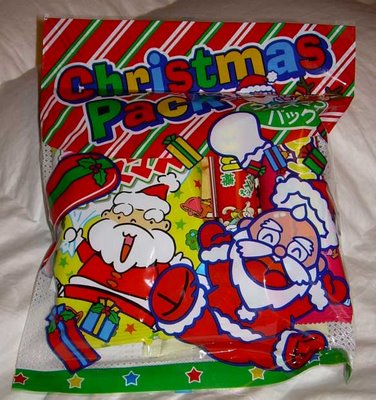
Santa is almost perversely overjoyed.

One thing my husband and I used to do when we first arrived in Japan was buy some random packaged item and find out what was inside. We stopped doing that a long time ago. I rather forgot why. It struck me that it might be interesting to give that a try again. After sampling the contents of the happy package above, I believe the reason we stopped is for the same reason that you touch a hot stove once and then never do it again. Curiosity may not kill the cat but it can sure turn off his taste buds and offer up a belly-ache.

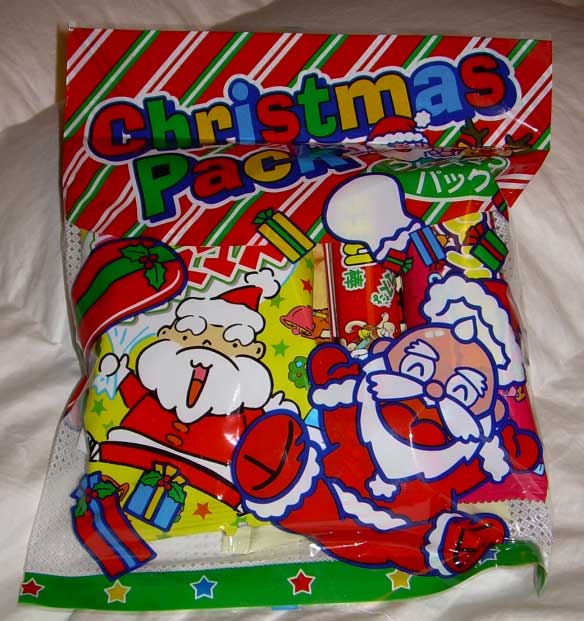
The Christmas Pack pictured above is meant for children and only cost 99 yen at a convenience store. I didn't have great expectations of gourmet contents and I thought that it may be more interesting because it would show what sort of items are supposed to appeal to children. Unsurprisingly, the items in the bag are the kind of things you see in the candy and snack aisles which are geared toward kids in markets.


This bar resembles a cake when you see a smallish picture of it but if you click and see a larger picture, you can see it is far from a cake. It is called "Merry Christmas wheat gluten (fu) snack". I'm sure many children this year will be writing Santa and asking for special treats made of wheat gluten. The package, as best I can read, seems to be saying that it is a nutritionally-balanced snack. Among the main ingredients are brown sugar, sugar, glutinous flour, and all-purpose flour. It smells like a mixture of burnt sugar and bouillon cubes. The description says something about minerals being in it. The outside is incredibly sweet and the inside is a tasteless quasi-puffed corn snack texture. It was perfectly vile when I forced myself to taste it.


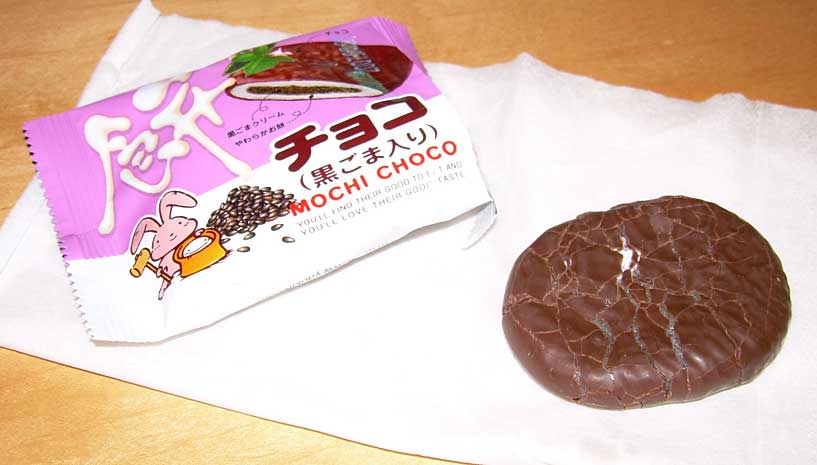
This is a "black sesame mochi choco". I tried to pull this apart so you could see the center but it was too tough to separate. The chocolate just broke up. I did take a small bite of this and it out-did the wheat gluten bar in disgustingness. It was absolutely horrible. I'd try to describe it but I'm trying to allow the brain cells that retain that information to atrophy and die. Among the ingredients for this one are "chocolate" (no ingredients for the chocolate are given), corn syrup, sugar, cornstarch, sesame seed paste, mochi (like rice "taffy", though it's usually called rice "cake"), powdered milk, and soy beans. I liked how the package actually used correct English but confused "they're" and "their" (click the picture to see a larger one to clearly see the slogan). Of course, American young people who have grown up on the internet probably couldn't tell the difference between the two anyway.


This is "morokoshi wa taro" or, essentially, "corn and corm rings". Among the ingredients are corn, taro (a Japanese corm), vegetable oil, and spices. They don't smell like much of anything and taste like an airier, relatively flavorless Chee-to. I'd call these rather inoffensive to mildly pleasant because of the texture.
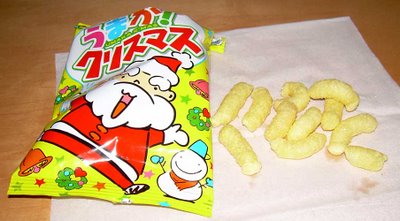

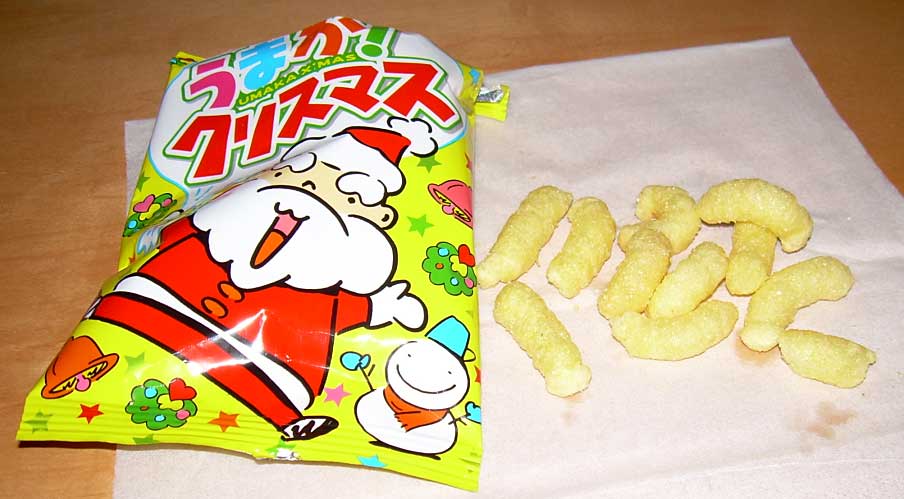
This one is called "Umaka Christmas" which as best I can work out means "sweet Christmas". My research indicated that "umaka" is another way of saying "umai" in a particular dialect but this may be an incorrect translation. Among the ingredients are corn grits, vegetable oil, sugar, pork extract, salt, onion powder, chicken consomme, Japanese rice (uruchi rice) and fructose. This was the only item in the package which I thought was relatively pleasant tasting. The onion powder and consomme were noticeable and the texture was fine.
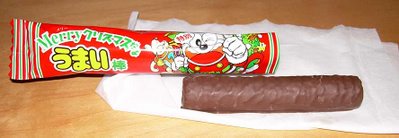

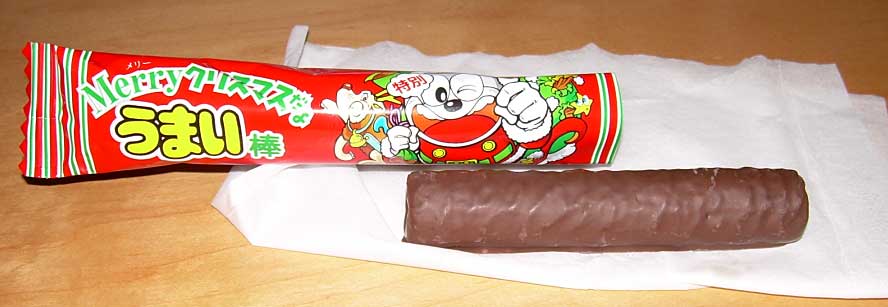
This is "Merry Christmas Umai (Sweet) stick". This actually wasn't bad. The chocolate on the outside tasted okay and the inside was a hollow log which tasted like and had a similar texture to Kix cereal only it was puffier and airier. Among the ingredients are sugar, vegetable oil, corn, powdered milk, chocolate mousse, cocoa, flour, non-fat powdered milk, soybean milk and flavoring.

If nothing else, this exercise pushed my husband and I to do some translating. It also explains why Japan imports so much corn. I think a good portion of it must be processed into these sorts of snacks.

To me, this was a classic example of something you see a fair amount of in Japan. That is, it's something which looks far better on the outside than it actually is on the inside. Maybe kids go nuts for this stuff but I bought this bag over a week ago and the QQ branch I bought it from looked to have just as many in stock as when I purchased mine.

Friday, December 4, 2009

Variety Friday: Machioka Candy Shops

The front of an Okashi no Machioka shop (click any picture to see a larger version).

On many occasions, I've mentioned that I have picked up one product or another at a "discount candy shop". That shop is Okashi no Machioka (おかしのまちおか). "Okashi" is Japanese for "candy" or "sweets", though these shops actually carry a wide variety of snacks including sembei, salted snacks, drinks, and diet-oriented snack foods.

Boxes of stock cluttering already pretty narrow aisles is the norm in many Tokyo stores. It makes navigating these places a chore.

Okashi no Machioka is a chain so their shops are located in various areas of Japan with many located in Tokyo but some in neighboring areas. If you can read Japanese, you can access their web site to find out where their shops are located. All of the stores have the same white on red lettering that you see in the picture at the top of this post and there are often pictures of their little blond-haired mascot, Machiko, pasted or hanging around the shop.

Machiko, the mascot, looks on at a "mild bitter" bag of KitKat minis that are exclusive to Machioka's stores. (image pinched from Okashi no Machioka's web site)

The shop carries a lot of items that aren't readily available in other outlets such as markets or convenience stores, but it also has special Machioka-only items. Recently, for instance, they have collaborated with Nestle Japan to make a KitKat mini which is an exclusive to their shops. This mini is a "mild bitter" flavor which I'll try to review at some point soon.

Products that are normally 100 yen are marked down to 84 yen at Machioka.

There are actually two of these shops located within walking distance of my apartment. Each carry similar, but not exactly the same inventory. Both have boxes of items sitting in the front in copious quantities and carry an interesting array of snacks for a cheaper than usual price. The best thing to hit them up for are items that are about to be or already discontinued, but such bargains are unpredictable.

If you are in Japan and interested in snacks, these shops are worth looking up and visiting if you're in the general area of one anyway. I'm not sure they're worth going out of your way for unless you check the web site and there is an announcement of a Machioka-only item of interest. Though the snacks are cheaper there and the selection different, the price cuts are not that deep. That being said, for someone who does what I do, these shops are a gold mine.

Saturday, November 28, 2009

Things to Come


One long shopping trip and I'm set for review fodder for a very long time. The above picture is a sneak preview of things to come. Just a little extra for Thanksgiving weekend.

I hope all you Americans had a great one, and enjoyed some turkey for me! I can't buy it here in Japan.

Friday, May 29, 2009

Variety Friday: Where the Action Is

I'm sure that many of my readers have spent hours speculating on the glamorous life of a Japanese snack food reviewer. You're wondering what it's really like hunting down salty and sweet treats for review in the land of cosplayers and robotic dogs. Well, thanks to the magic of Google Maps, you can see where I shop and virtually pound the pavement of the same streets that I do.

I frequently refer to a 99 yen shop where I pick up various goodies. Every time I refer to that place, it is this particular store:

The Japanese written on the street on the left says "tomare", which means "stop".

The street to the left goes down an alley into an all residential area. The one on the right is a major street through Tokyo which will eventually lead directly to Shinjuku, a major business and shopping district.

If the shop looks a bit dingy and rundown, then the picture is showing you the absolute truth. This place is no more than 500 square feet in size and located in a building that used to house a Family Mart convenience store. This location, incidentally, is marked in my personal history as the exact spot where I fell off my bike, hurt my back, and set myself up for a lifetime of serious back pain about 16 years ago.

The shop is named "Shop 99" in this picture, but it used to be called QQ. "Kyu" which sounds like "Q" is "9" in Japanese so QQ is a clever way of referring to 99. I guess that the shop's owners though that was too subtle though and change it to the numbers. I go to this shop more often than any other because it's about a 3-minute walk from my apartment and sells useful food items in addition to snacks for relatively cheap prices. In fact, low-fat milk, bread, and eggs are actually cheaper here than regular supermarkets. Snack-wise, it's good for cheap, off-brand goodies and products that either sell regularly, are nearly off the market, or didn't sell well enough to begin with and have been relegated to the bargain bin. It also carries nearly every Tirol assortment that has ever been released.

If you'd like to travel along the virtual street with me, you can follow the path down the street on the right with me. That's where my other two major haunts for snack shopping are located.

The next snack hotspot on my journey as we travel down the same major street is Family Mart:

Family Mart is very rare among the shops in my area because it actually has a parking lot. Very few places have one.

Family Mart is the best place for finding new products that have a short run of it or limited edition products. They tend to carry the latest Tirol Premium chocolates (but not the assortments), new KitKats, and smaller size, esoteric flavors of sembei and salted snack foods. Everything is about 30-50% more expensive than in Shop 99, so I only buy the types of things which I know I won't locate elsewhere in Family Mart.

And, as we journey further down the street (if you want to follow along, Family Mart is here on Google maps), we get to my last regular haunt, Inageya supermarket:


If I mention picking something up at a local market, this is the place. It's good for family packs of sembei, the occasional limited edition cookie products and Pocky as well as bean cakes and other more traditional snacks.

These are by no means my only options. The truth is my husband probably buys about 20% of the items I review at other places like New Days (which is only located in Japan Railway "JR" stations) and various shops near where he works. There is also a discount snack shop near another market that I visit infrequently. However, the lion's share of what I review comes from these three rather dismal, grey, and boring places. I'm betting that ordering your snacks via mail services seems a lot more exciting now by comparison.

Friday, April 3, 2009

Variety Friday: Finding Newly Released Snacks

When I first started doing this blog, I selected my snacks mainly from what was in the local markets. It was easiest just to peruse the snack isle and select something while dealing with my usual food shopping. As I continued to write posts and do research, I noticed that a lot of the newly released items that were turning up on manufacturers' web sites weren't making their way onto the shelves in my local markets. In particular, very few of the plethora of new KitKats were on display, but also a lot of "limited edition" specialty items were absent.

Guess which country this picture was taken in?

The marketing in Japan is fairly specific and all (Tokyo) shops are relatively small. That means that it's difficult to get all of a particular company's product line-up on the shelves at one establishment. Unlike the U.S. where you will see aisles full of every variety of Cheerios ever cooked up by General Mills in one place, you have to find the proper outlet for a particular item in Tokyo. If the market is geared toward older folks, children and housewives, it'll show up in the markets. If it is targeted at young women, business men, or single people, it is most likely to show up in convenience stores.

Most of the novelty flavors of popular brand names are marketed toward the bored people who work in offices and peruse convenience stores at lunch or tea time. Things like Pepsi White are less likely to show up in supermarkets and far more likely to spend their brief time on this earth in the refrigerator cases of 7-11. These flavors cater to boredom and a hunger for novelty rather than a permanent place in the stomachs of consumers. You can take a new find back to the office and share it with coworkers then compare notes on how obnoxious it is.

If you're looking for the new, weird things that are usually covered in the quirky Japan sites and news, the convenience stores, especially places like Family Mart and 7-11 are your best bet. If you're interested in more old-fashioned or daily snacking possibilities, then you're better off hitting the markets.