Showing posts with label melon pan. Show all posts

Friday, July 6, 2012

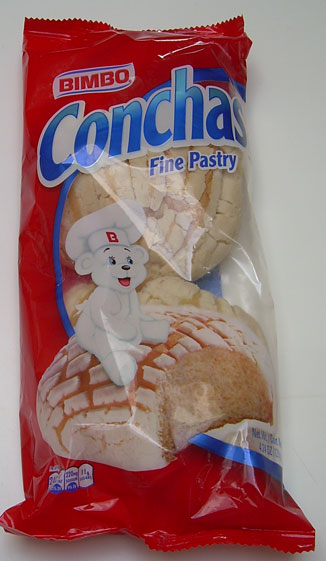
Bimbo Conchas


After living on the shores of America for several months, I must say that I flirted with the notion of changing this blog to "international snack reviews". I pondered that possibility for more than one reason. First of all, I wasn't sure of my ability to consistently access Japanese snacks and I was sure of my ability to get my hands on a plethora of food from other countries (especially Mexico at this point). Also, I want to branch out and try different things, especially after quite a few years of focusing on all things Japanese. However, my heart is still very much with Japan and Japanese snacks so I hope that my readers will tolerate my detours to other types of food on occasion while still accepting this blog as "Japanese Snack Reviews".

All of that being said, it was definitely experiences in Japan that brought me to this particular item. Well, there is that and the fact that the product's name smacks of being a euphemism for a harlot's hooters.  I was at a convenience store on San Juan Island and I saw something called "conchas" being sold there which looked a great deal like Japanese melon pan. Since a lot of Japanese baking culture has been influenced by Portugal (and other European countries), I wondered if melon pan was a riff on conchas. I didn't buy the pink-topped monstrosity I saw there, but I found a less scary version with a funnier name later.

For those who don't know, "melon pan" does not taste like melon, but rather is designed to resemble it. It is a bread-like bun covered with a cookie-like outer layer that is poured over the bread dough. The top is then scored to make it look like the rind of a melon. Conchas, similarly, is a bun with a different sort of dough that is scored to look like a conch shell. I've read several recipes for conchas and they seem to be very much the same except that there is division on the side of the Mexican sweet bread about whether or not the shell should be soft or crispy. Some insist it should be soft and others say crispy. Note that, in Japan, melon pan comes with both soft and crispy tops.


I bought this packaged conchas with the slutty maker name at Target, but the Bimbo brand is available at many different places in California as well as in markets in Spain. My sister-in-law, rather coincidentally, took a picture of Bimbo brand bread in Madrid. It cost $1.38 (111 yen) for two buns. Each bun is 240 calories and a decent size for breakfast or a snack. The second ingredient is egg and the first is flour. The third is high fructose corn syrup so beware those who fear it.

Packaged bread products are never the greatest, especially those that are designed for somewhat long shelf life, but this really wasn't too bad. The coating on top is a little moist and slightly sweet with a nice hint of cinnamon. This may help keep the bread from drying out too much. It has an interesting "doughy" flavor which resembles ever so slightly under-cooked bread. It's an interesting and certainly not unpleasant quality.

Conchas from a Mexican bakery, or melon pan. Po-tay-to, po-tah-to.

In terms of how closely this resembles Japanese melon pan, it's actually a very similar concept with a different execution. Mainly, the flavor and consistency of the topping is different. The underlying bread is almost dead the same. That being said, I went to a Mexican bakery and bought a conchas there and it was dead-on the same as melon pan with a crispy sugar-crusted top. It wasn't exactly the same as a Japanese melon pan, but it was so close as to not be terribly different. I'm sure that conchas is the well from which melon pan sprung.

As for the Bimbo brand Conchas, it's an okay packaged pastry, but hardly the "fine pastry" that it claims to be. If I were looking for a relatively mild sweet to have with coffee and had nothing more attractive, and by that I mean homemade or freshly baked, I would consider it. Chances are, however, that I wouldn't buy this again. It's not that it's really all that bad. It simply isn't all that good and I'm surrounded by more attractive similarly priced options.


Thursday, February 10, 2011

Pasco Stick Melon Choco


I read the results of a study recently which said that putting calorie information on menus didn't have any impact on purchasing decisions. I think that's a big, fat lie. Personally, seeing calorie information actually encourages me to buy certain things. I've taken to inspecting the calorie counts on interesting looking breakfast foods, and anything which is a reasonable portion size and under 100 calories is likely to go into my basket.

These "stick melon choco" (chocolate chip "melon" bread) are 99 calories each, and the perfect size to have two for breakfast or one at tea time. There are 5 in the bag and it only cost 99 yen ($1.22) at Seiyu supermarket. I like melon pan when it's good, because the contrast between the crispy cookie exterior shell and soft, fluffy white-bread-like exterior can be sublime. The main problem is that store-bought melon pan usually is soft, but I was lured into buying this because there was something on the front that said I could make them crispy again by putting them in the toaster oven. I'm dumb like that.

It squishes easily when you cut it.

The flavor is heavily influenced by margarine and white flour. Despite the fact that there are a few chocolate chips and what looks like layers of chocolate, that component is very subdued. The sweetness is also on the light side except when you catch some of the granulated sugar sprinkled on the top on your tongue.

Even wrapped in foil for toaster oven heating, the bottom burned slightly around the edges. Without foil, it turned to a black crispy horror. The packaging should have warned me that I shouldn't put it directly in the oven, but instead just said, "use the toaster oven and it'll be crispy"! Thanks for nothing, Pasco! I charbroiled one in the oven to learn this lesson.

The texture varies widely depending on how it is prepared. Straight out of the bag, it's slightly doughy and a lot like standard white bread. Heated in the toaster oven in foil, the bottom gets a little crispy. Warmed in the microwave, it becomes doughier and quite soft. The flavor of the chocolate came out the best when heated in the microwave, but the texture was best when done in foil in the toaster oven.

There were fine, but I was disappointed that the chocolate aspect wasn't stronger. I liked them well enough, but perhaps not enough to have them again. Chances are that I will opt to sample something else rather than re-visit these. It's not that they're bad in any way, but rather that they're not special enough to become anything resembling a "favorite".

Tuesday, December 16, 2008

Smile Oven Big Melon Pan


Melon pan is one of the most superficially misunderstood pastries in Japan. For starters, people assume it's melon flavored. While it may seem illogical to name an item after a component which is often absent, let's consider some other concoctions in English. Are buffalo wings made from the wings of a buffalo? Are nutty bars made by crazy people? They're not even made with real nuts. Are whoopie pies made from or while making whoopie? No, Japan isn't alone in its inconsistency with naming conventions, though at least occasionally melon pan is flavored with melon.


Most of the time, melon pan is what I can only describe as "nothing" flavored. It's really just a big dollop of bread dough covered with crispy cookie dough then baked. At its best, the inside is fluffy bread and the outside is a lightly sweet crispy cookie shell sprinkled lightly with large crystals of sugar. In short, it is pretty much at its best as this Smile Oven melon pan.


All is not beer and skittles on the Smile Oven melon pan front, however. It smells like margarine and the only real flavor it has aside from margarine (not butter, no, no) is sweetness and flour. This is a pure textural sensation. It's a good one though be careful to get a fresh one if you're diving into melon pan territory. Melon pan that's sat around for awhile softens up and a melon pan without a crispy exterior is essentially sweetened white bread.

The biggest problem with the Smile Oven Big Melon Pan is that big doesn't mean better. You're essentially eating margarine-flavored cookie dough wrapped around the equivalent of 4 slices of good quality fresh and fluffy white bread. While you may consume it thinking that it's not that sugary so it can't be that bad for you, consider that it has a whopping 558 calories. Since this isn't the sort of thing that you can save and eat the next day, it's either a case of having to consume a huge processed carb bomb or throw part of it away.

This is a very nice treat, but I ended up eating the shell and tossing most of the bread away. It is good, but not good enough to be a meal substitute and 558 calories is as much as I eat for dinner. If you're walking around Tokyo and want to fuel up for a lot of footwork, then this might not be a bad thing to eat, but if you're snacking at the computer at work, forget it.

Tuesday, October 14, 2008

Maple Melon Pan


One of the first things you notice when you enter a convenience store in Japan is that there are many different and highly interesting looking baked goods on display. It's a bit like the Hostess displays that you might see in American 7-11's or Sheetz. The main difference is that the Japanese ones are not nearly as sweet and have a much heavier overtone of bread rather than cake. Also, there is rarely a pie of any sort in sight.

After you sample a few of these things, you find that a lot of them are pretty vile and bland white bread-based items. Many of the savory options are little more than hot dog buns with corn, mayonnaise, and small quantities of tuna, eggs, ham, or sausage.

The sweet options sometimes provide a little more promise, but they also tend to be your basic white bread buns or rolls filled with various flavors of whipped cream, jellies or beans. I've got nothing against the fillings, but putting them on a hamburger or hotdog bun is just gross.

Fujipan (the "pan" means bread) makes a variety of bread products in Japan with a heavy emphasis on sandwich bread, "stick" bread, and various snacks. They also market bread snacks based on the Japanese animation character "Anpanman". In various convenience stores, it's not uncommon to run across one or two of their current line of snacks in the baked goods area. At my local shop, two types of Fujipan melon pan were in stock. One was chocolate chip and looked suspiciously like it may actually have been melon- flavored. For the record, a lot of melon pan doesn't taste like melon. It only looks like it.

Since I am not keen on the idea of chocolate flavor mixed with melon, I decided to give the maple flavor a go. A bag with 4 pieces cost 100 yen (about 95 cents USD) so they're fairly cheap. Each piece is more like a soft cookie than a bit of bread. Melon pan is actually made of both bread and a cookie topping. The inside of these cookies is like regular bread dough that has been spread with a maple-flavored fat spread (this is literally what it's called in the ingredients list) and then a cookie dough topping is poured on top of it. It is baked and the bread rises a bit, the filling is largely absorbed into the interior, and the cookie shell is supposed to get a bit hard. The inside is actually hollow and is coated with the residue of the maple fat spread.


The main problem with buying melon pan in these sorts of plastic packages for mass distribution is that the cookie shell gets soft. Half of the pleasure of a melon pan is the crispy shell on top of the bread. You only get that half if you buy your melon pan at an actual bakery. That doesn't mean that the texture of these is not interesting or enjoyable. It just means that it is not an optimal melon pan experience.

When you open the package, the melon pan smells of maple. They are soft, but not spongy. The texture is tender and they get a bit doughy as you chew them. The maple flavor is not overwhelming or overly artificial. I'm pretty satisfied with the flavor balance, but I think many Western folks might like them to be sweeter.

Whether or not you like this is going to hinge heavily on how you feel about the texture. The doughy quality and varied texture of the bread and cookie shell may or may not suit some people. I found these pleasant and think they'd make a nice occasional snack with tea or even a light breakfast with coffee. The only thing to keep in mind is that you don't want to eat too many at once as they are 110 calories apiece and almost certainly contain "bad fats". I'm guessing that the "maple fat spread" is probably made with margarine or some other fat mixture that includes trans fats, though it is impossible to know for sure since there's no explanation on the package.

I might pick these up again some day, but I can't see putting them into any sort of regular rotation. Since they seem to be a seasonal item for autumn, there may not even be a choice in the matter. I think sampling these once or twice a year would be just about right.