Showing posts with label marshmallow. Show all posts

Thursday, April 19, 2018

Yaokin Fluffy Softmallow and Dora-Choco


The next step down the path of reviewing food from my ZenPop box (the "Peach Festa") is paved with things for children. Both of these dagashi (kid's snacks) are made by a company that most people know best for their savory corn snack sticks.  I have to admit that I don't recall every having seen the pastel marshmallow barber's pole that is the "softmallow," but I have a hazy memory of the little tiny dorayaki. Since I left Japan six years ago, I imagine I'm going to continue to have hazy memories.

The softmallow looks like something someone would try to recreate on Instagram or Pinterest, and then someone else would try to recreate it and it could be an epic Pinterest fail. It's adorable enough to be snipped into little pieces and be used as unicorn cow pies as part of a cake decoration.


So, the marshmallow has definitely won the remains of my twelve-year-old self's heart in terms of looks, but what about taste? It is indeed very fresh and soft, but soft like a pillow that gives and then rebounds. The marshmallow is lightly sweet and has no other flavoring added, but it is a nice flavor. I'm pleased to say that most of the Japanese marshmallow's that I had in Japan had a strange aftertaste that is absent in this one. The only difference between this and an American marshmallow is that it's less sweet and just a hair more "rubbery," but not in a way which is off-putting.

The dorayaki has an amazing smell that reminds me of freshly-baked cake. The chocolate filling is so similar in appearance to red bean paste that I forgot it was chocolate until I put it in my mouth. The cake is surprisingly moist for a shelf-stable product and does have a more "cake-like" taste than regular dorayaki which tends to be like a pancake which is a bit dry.

In terms of the filling, it's not super flavorful on the front end (the cake dominates), but hits on the back end when you get a little burst of chocolate that falls somewhere between dark and milk. The filling is nicely fatty and adds to the texture to some extent. This was shockingly good for a kid's snack and reminded me of a less cloying version of a Hostess snack cake.

Softmallow:

Dora-Choco:

Friday, June 9, 2017

Crunky (mini) and Hello Kitty Choco Marshmallow

Last week, I talked about the Dagashi box that I purchased from Oyatsu Cafe and this week I'm going to start reviewing the contents. I'm beginning with the two tiniest items and I have to say it's good that I've already had a lot of experiences with them in the past or I wouldn't have enough of a taste on hand to do a proper review. Yes, I'm winging about how small these were. I've gotten bigger freebies at sample hand-outs at events in the U.S. and attached to tissue packets given away on the streets of Tokyo.


First, there is the itty-bitty, teeny-tiny Crunky that appears to have been designed to be left on the Lotte Hotels pillows en lieu of a mint. The candy inside is literally about the size of an Andes Candy so you can get two tiny bites before it's all gone. On the plus side, I was impressed with how Lotte shrunk the whole thing down and made it look perfectly like its older brother with all detail intact.

I didn't expect to be reviewing this item at all as I was sure that I'd already reviewed the standard issue Crunky bar in the past. However, a search of my archives revealed that I had overlooked this Japanese version of a Nestle's Crunch or Hershey's Krackle bar. I covered a ton of variations, but never the regular bar and though they all have the same crispy bits, all Crunky are not created equal.

To illustrate this, I'll tell you an anecdote from back when I was working at Japanese office, one of my more obnoxious coworkers, a would-be Lothario (or, as they're sometimes called in Japan, a Charisma Man) who looked like Bruce Willis's "Mini Me", asked another of my coworkers, a man who spent all day day-dreaming of his own aikido dojo, to pick him up a Crunky bar at the convenience store on the first floor of the building we were working in. Dojo-boy brought Charisma Man a box of "Crunky Kids". The "Kids" version are like a nugget type of Crunky with a shiny exterior and the shape of a square pellet. Upon receiving his box of Crunky bits, Charisma Man exclained, "Aw, I didn't want the kids!" What he was saying was that no spawn of Crunky is as good as the original.

Incidentally, I'm happy to say Dojo Man is now in charge of his own dojo and doing well in life. I don't know what happened to Charisma Man, but it's possible he's actually functioning as Bruce Willis's Mini Me for all I know. Chances are he is off somewhere battling an STD of some sort though as one of the things he loved to brag about was how he only had intimate relations with "nice clean girls" and therefore didn't need to wear a prophylactic. At any rate, he didn't get his regular Crunky that day, but I got mine (albeit a tiny one).


The main thing that separates a Crunky from it's American crunch bar brethern is that it uses malt puffs inside instead of relatively bland rice puffs. This gives it a greater flavor complexity as the malt brings a nice depth to the mix of somewhat coffee-like, sweet milk chocolate in the bar. The texture really is the thing and the Crunky is nice crunchy with soft chocolate that melts quickly in  your mouth and has a silky, rich mouth feel.

The only difference between this mini version and the standard bar seems to be the size of the puffs. Either the usual puffs have been chopped up a bit to fit the low profile of the bar, or they've got tiny little elves crafting miniature versions of them for this version. Either way, this is tasty and it was quite a(n extremely brief) walk down my taste memory lane.


When I opened the little marshmallow packet and looked at the nicely formed little wad of mallow, I was transported back to my memories of the Japanese version of a treat I love in the U.S. One of the things that rarely worked for me in Japan was the basic marshmallow. They seemed like they were all formulated and injected into molds and were quite rubbery and had a funny taste which I couldn't identify.

Though this little wad had a nice and potent tiny dollop of intense bittersweet chocolate in the middle, it doesn't escape the all-too-common weaknesses of other Japanese marshmallows. It is too firm and chewy and brings to mind a pencil eraser when you compress it between your fingers. It's sweet and has a decent flavor, but the texture is just all wrong.


I think that some people have remarked in the past that Japanese marshmallows are different because they don't use animal-based gelatin and instead use agar agar (from seaweed). That may indeed be the issue, but, if so, I'd rather eat hooves and bones and enjoy a soft, tasty marshmallow. Yes, I am a horrible, horrible person. And, yes, this is a sub-par marshmallow even for a kids' snack. I'd probably rate it a bit better keeping in mind that this is dagashi (kid's snacks), but it's actually not so different from all the other marshmallows I had in Japan. I did have some nice marshmallow snacks in Japan, but only if the marshmallow was a lesser component in the mix. The best thing about this marshmallow was the adorable package it came in.


Source for both products: Oyatsucafe "Dagashi box" (part of a $15/month subscription box)

Friday, March 2, 2012

Montoile Mochi Mochi Kinako Mochi


I've been on a big mochi snack kick as of late. It could be that my affinity for the stretchy, chewy textural delights of pounded rice cake have finally lodged in my brain after years of having them. It could be that I have a death wish and like to take risks with my snacks. After all, the two most dangerous foods in Japan are venomous blowfish (fugu) and mochi, which many people choke to death on over the New Year's holiday. Of course, they eat big honking blobs and I'm nibbling on delightful little packets of it full of sweet fillings.

When I spied this package of mochi treats, I snapped it up in no time because it not only is a mochi snack, but is a collaboration with Tirol. For those who haven't had Tirol's reputation written into their memory cells by my copious numbers of reviews of their products, they make little square chocolates with unique wrappers. Many people collect the wrappers and many more pick up their blocks of limited edition "premium" chocolates for sampling. In my case, I can say that I've probably been as disappointed in their offerings as delighted, but I love trying them. It's a small amount for a small investment, and usually a pretty interesting taste experience regardless of how good I believe it is.

This combines Tirol's kinako mochi chocolate with Montoile's "Mochi Mochi" brand. This is a brand which I had not encountered prior to this, but the company makes a lot of this type of small mochi based treat as a shelf-stable snack. They also collaborate with a wide variety of company's including snack cake makers and Bambi caramels. Besides this kinako variety, they make a coffee and "milk" collaboration with Tirol.


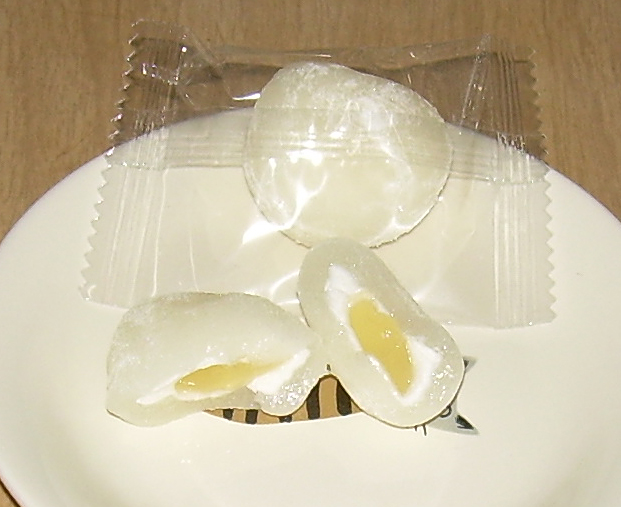
Each little blob of mochi is filled with marshmallow and has a core of kinako chocolate. The size of the entire piece is about the diameter of a quarter with a pea-size chocolate center. Most of the kinako flavor comes from the powder on the outside of the mochi, but a flavor burst comes from the center with the kinako chocolate bit. The mochi and marshmallow mainly add texture, but there is also a little sweetness from the marshmallow.

This is pretty good, but hardly the greatest mochi experience or kinako snack I've ever had. I'm not sure that a shelf-stable mochi snack really gains much from having a bit of Tirol chocolate put in the center. That being said, I liked these a lot because I think the marshmallow filling complements the mochi and kinako well. It isn't as good as a "real" mochi snack like something fresh and filled with bean jam, but it isn't a bad thing to have around for a quick chewy bite.

I found this at Inageya supermarket for about 150 yen($1.86) and you get about 10 pieces for that. Each is about 28 calories. I think this is interesting as a novelty, but I don't think I'd buy it again. Oddly, however, I think that,  had I found this back home, I'd regard it more highly. Right now, I have free and easy access to freshly made mochi at traditional sweets shops. Packaged shelf stable treats like this are far less valuable in the face of fresher options. If you find this in an Asian grocer, I'd certainly recommend it if your options don't include fresher versions. It's not the real deal, but it's pretty good nonetheless.


Monday, August 8, 2011

Sunkus/Circle K White Sour Cream Daifuku


If you live in a linguistically odd environment long enough, you stop seeing strange things as strange. This is a fact that I was reminded of when I mentioned to my friend Shawn (noted wombat-stuffer and center of the known universe... at least as he knows it) that I was about to partake of some "white sour cream daifuku." He said, "is there any other kind of sour cream (other than white)?" He may have delusions of his own grandeur and a predilection for certain marsupials, but he did have a point.

There's something peculiarly interesting about the use of sour cream in daifuku. Since dairy culture isn't something I associate with traditional Japanese cuisine (I hang that on Europeans), mixing it with this type of sweet intrigued me. I found this at Sunkus (which apparently means "thanks" in Japan, though I know why, don't ask me to explain as it's boring), a convenience store I rarely frequent because it's off my beaten path. There are eight somewhat bigger than 100-yen/quarter coin-size blobs of mochi-covered filling in the bag and it costs 160 yen ($2).


They smell somewhat glue-like, but that's the mochi (pounded rice cake) exterior. The blobs are soft and the exterior is slightly chewy. Inside, there is a slightly jelly-like filling surrounded by a thin layer of marshmallow. They are not too sweet, but also not too bland and there is a definite bite of sour cream which resembles yogurt. The flavors have good depth and even the marshmallow comes through as a separate taste experience.

This is a delicious combination of tastes and textures which I will definitely revisit in the future and highly recommend to anyone who enjoys yogurt-like flavors and the texture of mochi. Each is big enough for two satisfying bites and only 42 calories. It's well worth the cost and the caloric density.


Thursday, April 21, 2011

Sweet Box Choco Pie


There used to be a game show in America called "To Tell the Truth" in which three people claimed to be a particular person and the celebrity guests had to guess which one was telling the truth. At the end, they'd say, "will the real (name of person), please stand up." In Japan, one might ask that the real "choco pie" stand up, since there are multiple products with exactly the same name.

I already reviewed the Lawson VL "choco pie" which is an actual pie with a smidge of chocolate goo in it. If you go back to the linked review, you'll see that that choco pie does not resemble this one in any way. This "choco pie" is the more common type in Japan that resembles a moon pie, though this one is not like the most common variety because the filling is marshmallow rather than cream.

I found this for 100 yen ($1.19) at Lawson 100. For a box of 5 pies that are about the diameter of a large chocolate chip cookie, it represents excellent quantity for your yen. The maker, Sweet Box, has disappointed me before when it comes to sweets but pleased me when it comes to sembei. My expectations were therefore quite low. Note that Sweet Box's food is produced in Korea, but their products are widely distributed in Japan for low prices.


The box touts these as "fluffy" marshmallow sandwiches, and I'm not sure if that refers to the cake-like exterior or the marshmallow filling, but I'm pretty sure that it doesn't really accurately describe either. The sandwich parts are like a cake version of a graham cracker. It's soft, but slightly dense. The texture is satisfying and the flavor subtle but still quite nice. The marshmallow compliments the modest graham flavor well, but is also on the mild side. Likewise, the chocolate coating is so thin and mild as to be more of an aftertaste than a strong flavor component.

I liked these pies quite a lot, and at only 124 calories each, they are a very conservative treat. That being said, they win me largely by texture (which is a bigger draw to me than taste or smell) and the allure of the graham-cracker-like flavor of the cake/cookie. For those who want a stronger mix of flavors, these will likely disappoint because the chocolate and marshmallow represent so modestly on the tongue. Frankly speaking, these seem to be designed for the palates of children, who don't like intense flavors as much as adults.

I am giving these a "happy" rating because I personally liked them despite their subtle flavors. However, I wouldn't recommend them to anyone who had to get them from an importer or who has a more refined sense of taste. If you're the sort of person who is buying dark chocolates or artisan marshmallows with specks of real vanilla bean in them, this is going to monumentally let you down. If you're the kind of person who is happy slapping a few crackers together and cramming a marshmallow with a slab of consumer chocolate between them and then microwaving it for a minute, then this might be good for you to have around for nights when you feel your sweet tooth aching.

Monday, March 28, 2011

Samba Kisses Better


Samba Kisses Better has to be one of the worst names I've ever come across for a product. It's too long, not the least bit descriptive, and frankly sounds dumb. I have to wonder if the name  makes more sense in Denmark, the home of GEI Corporation and maker of this treat.  

Samba Kisses Better are currently being marketed rather aggressively in Japan. They aren't widely available in basic markets or convenience stores, but they are being sold at stands outside of major stations, in department stores, and at select shops. I have found them at National Azabu Supermarket in Hiroo, Village Vanguard in Koenji and at Okashi no Marche discount snack shop. They have a FaceBook page which details exactly where you can find them in Japan. Though the company originated in Denmark, they currently have a main office in Yokohama and are clearly situating themselves to be a bigger player in the Japanese confection market.

I've known about Samba Kisses Better for quite awhile, and have bought them at least 4 times as of writing this post. I never considered reviewing them because I didn't think they seemed "Japanese" enough, but the truth is that this product is not available worldwide and is being sold here more and more. If you live in Japan, you may have seen it on offer for between 350-400 yen ($4.33) per 6-pack, and not known what you were missing.


The exterior of a Samba Kisses Better is a wafer thin shell of moderately dark and every so slightly bittersweet chocolate surrounding a sweet, cloud-like filling of whipped egg whites and sugar. The interior is like the fluffiest, lightest, tastiest marshmallow you can imagine perched on a super thin wafer base. The slightly crispy shell of the chocolate makes a delightful contrast to the almost whipped cream-like interior, though it can be messy to eat as the high dome means you may get the cream on your nose when trying to bite into it. The base, incidentally, is not a hard wafer and really doesn't do much other that provide structure to keep this from collapsing when you eat it. That's okay because the chocolate and foamy filling do all of the heavy lifting on both the taste and texture front. Note that there is no nutritional information on the package, but I tracked down a page on the web (not GEI Corporation's) which claimed that these have 77 calories each. That sounds about right for the size and sweetness.

This is absolutely a hit with me because I love marshmallow and meringue and this is like the most glorious love child of those two elements ever. I can't imagine that anyone could make this style treat any better than this. If you like chocolate-covered marshmallows, then this is the caviar version of it and I strongly recommend tracking some down.

Monday, February 28, 2011

Kasugai Chocolate Marshmallow Hard Candy


There are a lot of ways to add variety to a small pool of mundane elements. One way is to start pairing traditionally savory elements with sweet ones. This is how the notion of chocolate-covered bacon was given birth into a braver, fatter world. Another is to play with textures and to put together two things which wouldn't usually be paired. Kasugai has taken that route with these chocolate hard candies.

Up until now, all of my marshmallow experiences were of the variety which included regular chocolate (like the sort you eat in a candy bar) covering, sugar crystals or some sort of quasi-congealed coating (doesn't that sound yummy?). The main idea was that whatever was paired with the puffy marshmallow was capable of yielding when bit into. This allows you to appreciate the soft marshmallow with a variable texture or flavor without shattering your teeth.

I found this intriguing candy at Seiyu supermarket for about 160 yen ($1.92) for a bag of 15 pieces, each the size of a typical piece of hard candy. Each candy is 18 calories of tooth decay potential. The first ingredient is syrup, followed by sugar, and vegetable oil. The marshmallows are made with gelatin, and they don't have that funky Japanese marshmallow flavor or texture that many foreign folks find off-putting.


The peculiar thing about this candy is that the shell is a typical hard candy that is designed to be sucked on rather than bit into. Inside is a soft vanilla-flavored marshmallow. I guess this is a bit like a variation on a Tootsie Pop, though you can't really lick this to get to the center. Instead, you have to suck on the flavorful coating until it either gets thin enough to bite into. I guess there won't be any strange animated commercials with owls who steal your candy for this product.


The chocolate candy on the outside has a rich cocoa flavor and is quite tasty. Once you get to the marshmallow inside, you are treated to a good dose of vanilla and an interesting mix of crispy candy shards with the pillow of marshmallow. It's a very good flavor combination, but there is something about the way in which the entire experience works which just feels "off". I think the main reason for this is that the marshmallow, unlike the chewy center of a Tootsie Pop, starts to disintegrate and collapse so rapidly. That doesn't make this in any way a bad thing. It's just unusual.

While I enjoyed these, I'm not sure I'd get them again. I love marshmallow, but there isn't enough of it here to give a true experience with it. It's more of a hard candy experience than a gooey marshmallow one. I guess the bottom line is that if I want a chocolate hard candy, I'd have the Senjaku Diet Cocoa candy, and if I want a marshmallow, I'll have the real deal which is four times the size of the little tidbit in this candy. This is not enough of one or the other for a repeat buy, but it certainly is tasty enough to finish the bag.

Tuesday, November 16, 2010

Crane's Village Marshmallow Eggs


If you don't pay attention to what you're buying in Japan, you can often end up buying the wrong thing. When my husband and I came across this package of egg-style treats for the mere price of 228 yen ($2.53) for 6 of them, we assumed we'd found a variation on the kamome no tamago (seagull's eggs bean cakes) that we both love.


Kamome no tamago bean cakes look a lot like these in terms of packaging. They come in the same type of plastic tray and are similarly wrapped in a nice bit of paper with Japanese writing. The main difference is that 6 of those cost about 550 yen ($6.12) and are slightly bigger than these. If these turned out to be as good as kamome no tamago, they'd be a much lower-priced treat. It would seem that "crane's eggs" are cheaper than "seagull's eggs".

As it turned out, these were a variation on something else. They are very similar to the Fuwa Fuwa marshmallow cakes. Yes, instead of cakes with beans, we were getting marshmallows with beans. Oh the humanity! Still, the Fuwa cakes are about 50 yen (46 cents) each and these were 38 yen (42 yen) each. I don't know if I would have bought them had I realized I was getting another marshmallow egg candy since I've already sampled so many of the Fuwa cakes, but this was a happy mistake as they ended up being well worth it.


Like the basic Fuwa Fuwa marshmallows, these are filled with sweetened yellow bean jam. As soon as you open the bag, you can get the scent of fresh, sweet marshmallow. The marshmallows themselves are very high quality and nice soft pillows, but have a certain taste which I associate with Japanese-made marshmallows. It's difficult to put into words, but it is like perfume and a mild chemical flavor. It's slightly off-putting when you're not used to it (sort of like the flavor of Japanese milk), but it's not an issue when you're accustomed to it. The beans themselves are relatively bland, as is often the case with white beans, but still lend a nice bit of flavor and a good textural contrast.

The main difference between these and the Fuwa cakes is that these are noticeably sweeter. They are on the borderline of being too sweet for my tastes, but they are a great coffee or tea time accompaniment. They also have fewer calories at 61 per egg, but this is likely because they're slightly smaller.

I would definitely buy these again. They're good value, a great size, and a wonderful treat, particularly if you love marshmallows and fine textures. My only caveat to those considering buying them is that they may be too sweet for some. If you have them, make sure you drink something to cleanse your palate between bites, though they're only about two bites each.

Monday, October 18, 2010

Meiji Creamy Marshmallow Chocolate


I'll be honest. These days the chocolate sections of most stores leave me a bit cold. A lot of it is a reissue of things I've already reviewed in slightly different or the same packaging. Japan is big on seasonal and "limited edition" stuff, but I'm starting to see that what goes away almost always comes back. For example, the caramel purin KitKat in Halloween packaging has made a return visit this year as the season of the jack-o-lantern is coming upon us. It's still tasty, but it's less interesting as a repeat. I'm really only interested in something new.

Fortunately, Meiji offered something which would be common back home, but is relatively uncommon in Japan. Marshmallows and chocolate are not usually combined in Japan, though marshmallows are incorporated into a variety of other snacks. There aren't enough for me to indulge in a "week of marshmallow snacks", but I wish there were. I love marshmallow anything and the combination of chocolate with it in particular.


This large bar, 42 grams or 1.5 oz., can be had in almost any shop in Japan for about 100 yen ($1.20). I can't even remember where I bought mine, but I think it was a drug store in my neighborhood. One thing about any product made by Meiji is that the distribution is pretty wide and the products quite accessible. They're probably bribing store managers and stock boys nation-wide to ensure that this situation continues.

The ingredients list is relatively simple. It's chocolate, marshmallow including gelatin, cocoa butter, and powdered milk. I don't know if the gelatin is Japanese-style and made from seaweed or Western and made from hooves, but I'm guessing the former. The bar doesn't smell like much of anything, which is odd because chocolate usually smells like chocolate. The taste is sweet, milky, mild chocolate with a little hint of marshmallow. The marshmallow bits, while quite visible, are not all that intense. Mainly they add a textural element. The bar has a firm outside with a softer interior. Inside, it is actually creamy and the marshmallows are soft and slightly sticky. The entire bar has 229 calories  or 23 calories per square.

This has a nice, mild flavor with a little too small an amount of marshmallow for my tastes. It is pleasant nonetheless. I think that compared to most Japanese chocolate offerings, this is notable because it lacks the bittersweet notes you often experience and lacks sour or bitter aftertaste that comes along with it. While I was a little disappointed at the less than prominent use of marshmallow, I'd still buy this again.

Thursday, July 22, 2010

Kubota Pudding Mochi


Mochi, or pounded rice cake, is a fairly common component in many traditional-style Japanese treats. It doesn't tend to show up that often in the more "glamorous" snacks that are familiar to English-language speakers. Nestlé Japan has made KitKats with "mochi puffs" (that taste like mothballs), but has never made a real "mochi" KitKat. When mochi gets used in chocolates, such as Tirol's mochi sweets, it tends to really just be a bit of a gummy blob and not actual mochi. I believe this is because the texture is delicate and it can go hard, tough, or moldy easily.

Real mochi has a very fine textural element that you can't easily incorporate into things like mass produce chocolates. It's soft, slightly chewy, and delicate when used as a shell to wrap some other filling. It's a bit like a fine dough. You can see why many Japanese people prefer wagashi, traditional sweets made with a variety of indigenous ingredients including mochi, over other types of sweets because the ingredients are used in a way which maximizes their appeal rather than bastardizes them for mass production.

Since I can buy wagashi at many places in Tokyo, I have less of an impetus to buy mass-produced mochi sweets. Frankly, the same applies to Japanese people so the market shelves are not overflowing with a wide variety of them. I've only reviewed two sweets (Yukimi daifuku, yuzu mochi) which used traditional-style mochi. I found this latest entry at Seiyu supermarket for 198 yen ($2.24). There are 10 pieces in the bag and each is about 44 calories for a blob which is about 3.5 cm (1.4 in.) in diameter (that's an average since they're not circular).

These are made by a company called Kubota, which is yet another one of those small snack food makers which squeezes an occasional product onto market shelves and of which I have never heard. Annoyingly, they don't have a web site. I'm guessing their target customer is at an age at which this new-fangled "computer" stuff might seem to only be accomplished with the aid of ghosts or demons in the metal box.


The ingredients for these include barley sugar, sugar, mochi powder, gelatin, eggs, and carotene (for coloring, no doubt). The fact that the list starts with two kinds of sugar should clue you in that these are pretty sweet. When you open a packet, you don't smell anything as mochi is really just rice so it has little smell. After you cut it open, you can smell the rich, eggy pudding inside. If you've had flan or custard, you know what it smells like. I expected this to mainly be a nice textural experience. This is not only because of the soft, chewy mochi, but also the marshmallow lining around the little soft pools of custard pudding.

It was, indeed, a very nice mixture of textures, but it also tasted very good. The pudding itself was more flavorful than expected and the sweetness made up for the bland mochi. You can also actually taste the soft marshmallow. In fact, this is impressive because every component can be detected on the tongue. Everything was soft and seemed very fresh. My feeling about these after sampling one was that these would make a great souvenir for folks back home because the flavor is familiar and palatable to all but the pickiest types, and they remain uniquely Japanese because of the mochi.

The only caveat I can offer to someone before buying this is that they are rather sweet and won't suit those who are sensitive to such things. That being said, these are truly lovely to have as a little treat with a cup of tea. The fact that they are packaged in such a way as to remain fresh over a longer period of time allows you to have a wagashi-like experience without worries about them going hard or stale rapidly. You can keep a bag around for awhile and sample at will. Note that I bought these on July 12 and they're good until September 28, 2010.

Friday, July 16, 2010

Angel Pie (Mini)


Angel pies are something that I've seen around Japan for a long time. In fact, I think I may have purchased a box of them a very long time ago. The full size pies are about 6.5 cm or 2.5 inches in diameter. The mini ones are about 3.5 cm or 1.4 inches. The big ones are usually sold in boxes of 6 in supermarkets. I picked up this tiny one at an AM/PM convenience store for 30 yen. It was a premium price for such a small morsel, but I wouldn't be reviewing it now if I had had to buy a whole box of the big ones as my lack of a strong impression upon initial purchase years ago probably indicated I was less than overwhelmed. Also, at 40 calories, it's an indulgence that I can make without much guilt.


The Angel Pie is one of Morinaga's "biscuit line" of products. It was introduced in 1961 and is one of their better known cookie-style products. If you'd like to see a history of the pies and their packaging, you can have a peak at Morninaga's site's history of the product. You can also pick yourself up a desktop picture of a bare-assed angel munching one of the pies if you're into quasi-kiddie porn illustrations. I think this was named "Angel Pie" because of Morinaga's logo (which is an angel) as well as the notions of cloud-like marshmallow filling.


The angel pie is a fake chocolate coating over a super soft graham-cracker-style cake and a soft marshmallow filling. The softness of the pie when chewing is emphasized as a positive attribute in Morinaga's blurb on these. It doesn't smell like much at all. There's a faint whiff of cheap chocolate. The first sense you have when you bite into it is of the graham cracker-style cake. It's a weak flavor, but it's the most prominent of all of the weak flavors. You are hit, for mere seconds, by a mild chocolate flavor and finally with an odd aftertaste which I believe is supposed to be the taste of the marshmallow filling.

This was a very "blah" experience. It wasn't bad at all, but it just wasn't very good. The funky marshmallow flavoring is off-putting, but the truth is that all Japanese-made marshmallows have a strange aftertaste, so it's par for the course. The main problem is that the textures don't have enough variation and the flavors are all too weak. It's inoffensive, but I wouldn't buy it again or even eat one if I was offered one for free unless I was very, very hungry because I wouldn't feel it was worth the cost in calories.

Monday, October 26, 2009

Fuwa Fuwa Lemon Cream Marshmallow Cake


One thing Japan is renowned for is the freshness of its food and the fussiness of its populace when it comes to buying the freshest food. The Japanese, on the whole, are willing to pay more for higher quality food. The main problem with paying more for something which is fresh is that you lose value if you sit on that food for a long time. Such was the case with this marshmallow which I'm sure was as good quality as the first one of these that I reviewed when I bought it, but had gone a bit stale after about a month in the refrigerator.

Given how favorably inclined toward the anko Fuwa Fuwa marshmallow cake, I was looking forward to sampling another variety, despite my delay in getting to it. My husband found these at New Days convenience store for about 50 yen (50 cents). To be fair, I should preface this review by saying that I'm not a huge lemon fan, though I like it well enough. I tend to favor lemon in cakes and cookies though rather than candy. In candy, lemon often reminds me of cough drops unless the the flavor is greatly diluted.


The fact that this marshmallow is filled with a type of lemon sauce was slightly surprising. The package does say "cream", not sauce. The marshmallow itself is lightly lemon-flavored, but the filling in the center is really intense. The sweetness level is quite appropriate, but the lemon is strong.

We had two of these and my husband was keener on it than I, though I have to say that he had a cold and the flavor may have been muted for him. I thought this was good for what it was, but the lemon was too much for me. It really did remind me of medicine and I think I even imagined a honey flavor attached to it (like a lemon honey cough drop). If you enjoy really strong lemon sweets and hard candies in particular, this might really float your boat. Otherwise, it'll probably be too much for you, too.

Thursday, September 10, 2009

Fuwa Fuwa Marshmallow Cake


This is actually the third or fourth one of these marshmallow treats that I've purchased. Every time I get one, I eat it before I can get around to reviewing it and taking pictures. The only reason this review is going out is that I bought two and the second one was earmarked for my husband.

These are called "cakes" but they're really just incredibly soft high-quality marshmallows with a filling. I've only ever seen them for sale in big name convenience stores like 7-11 and Family Mart. One is about the size of an egg and costs 53 yen (about 55 cents). There are a plethora of varieties of these out there, but it's hard to find them. In my Internet searches, I've seen strawberry and jam, and my husband has found lemon and caramel (which will be reviewed later). I've never seen them personally, but you can also buy boxes of 10 for 500 yen.


This particular version, which I've always assumed was the basic variety that the company started with, is filled with white bean jam. The taste is very hard to describe, but the beans don't have as strong a flavor as red bean jam (anko). There's a sense of vanilla and butter in these, but mainly they are a sweet, textural delight. The marshmallow is soft, but not chewy in the way that American ones can be. And it's not rubbery in the way that Japanese ones can be. These are unusual because they are made with gelatin instead of agar agar (a derivative of seaweed which is often used instead of gelatin in Japan). The bean filling adds a slightly grainy texture as well as flavor.

I couldn't find a manufacturer's web page for these (and there's no nutrition information on the package so I can't give calorie information), but searches turned up a ton of blog reviews and favorable mentions. Some people were unhappy about the price because it costs almost half of the price of an entire bag of regular marshmallows. I think the quality though makes it well worth it. This is like a gourmet marshmallow and I definitely recommend sampling it if you see one in a box by the check-out counter in a convenience store.

Tuesday, September 16, 2008

"Oishi" (Delicious) Black Sugar "Marshmallow" Sticks


When you first arrive in Japan, there is a cornucopia of food items which look pretty strange. Some of them you will be brave enough to sample and others look just too strange to even consider. The snack item pictured above looks like something you might find floating in a toilet. The funny thing is that this is one of the better looking varieties of this particular snack.

The "translation" of this particular food is pretty weak. These aren't marshmallows, but, like sushi, there isn't a good word to describe this treat simply and easily. There are many varieties of these in Japan and they all are coated on the outside with brown sugar, or, as the Japanese call it, "black sugar". Some varieties are a little hard on the outside and firm on the inside and others are very soft on the inside and a little soft on the outside. The cheapest varieties are white on the inside. I'm guessing that they have less flavor and that's why they're cheaper. I have read that these are a specialty of Kyushu and it's possible that the more pedestrian varieties are knock-offs rather than the real deal.


My hunch regarding the reason these are (at least sometimes) translated as 'marshmallow' is that they are a bit spongy like a marshmallow and they are quite sweet. The process by which they are made is likely very different as the ingredients are different and these are more like a super airy coarse cake inside than a marshmallow though there is a certain textural resemblance when you bite into one. These are, essentially, a type of baked good. The information I found on them states that their origin in Japan is unclear, but that the speculation is that they are a sweet inspired by the West rather than something absolutely indigenous to Japan.

If you love brown sugar or molasses, these are an incredible treat. They are sugary and light. The firm texture on the outside makes an excellent contrast to the airy interior. They smell like molasses, but don't have an oppressively sweet smell. They aren't chewy and are a bit like eating a super soft, spongy biscotti. Though they feel quite hard if you press on one through the bag, they are actually very easy to bite into.

The main ingredient is flour followed by various types of sugar (brown (black) sugar, sugar, and grape sugar), eggs and a leavening agent. These are not nutritious, but they are also not high in calories. Each little bite (about 1.25 inches) is about 20 calories and you'd be hard-pressed to eat too many at one time given how sweet they are. They are very satisfying when you have a craving for something sweet and I can see how they'd pair well with coffee or tea.

This particular variety is a little more expensive than the types that are geared toward kids or families. This bag has 3 packages of about 16 bites (80 grams or 2.8 oz.) for 350 yen ($3.24 USD). It's worth every yen of it. I'm certain to buy these again. This variety is made by Nagashima (ナガシマ) and they are 'carefully' "handmade" in Kagoshima and have been making them for 70 years with flour and brown sugar made in Kyushu, Japan. I searched a bit on the Internet to see if I could find any on-line sellers who might be selling them in the U.S. and not only could I not find an agent that sold them abroad, but I couldn't locate them at Amazon Japan. You can get them direct from some of the manufacturers if you can deal with Japanese web sites, but the easiest way is to visit Japan or have a friend here pick you up some. I'd highly recommend giving them a try despite their suspect appearance.