Showing posts with label grape. Show all posts

Friday, November 16, 2012

Ramune candy and kid's gum (round stuff)


This post is a review of three items that are unified in two ways. All of them are round and I got them all as part of the Sakura Box monthly candy box. Note for my readers, November is KitKat month and they're offering 5 unique KitKat flavors. I mention that not because they sent me free candy (though they did), but because I know many people are especially interested in Japanese KitKats.

This is part of the selection I received in the October candy box and these are the types of small things that are very common in the kid's snacks section in Japanese markets. I am familiar with all of these things, and I once had the little boxes of gum with fruit illustrations on them, but it was so long ago that my aging brain lost the memory. Well, it's either my age or the fact that one isn't exactly stowing away such memories as if they were precious and not to be forgotten. It is, after all, only bubble gum.

Marukawa Fusen gum (upper right in the picture) is one that I saw around for pretty much the duration of my 23 years in Japan. It was often sold in multi-packs that included all available flavors, but also as individual packs of one flavor. I also often saw enormous tubs of it as prizes in UFO Catcher machines. I'm not sure who would want such a huge amount of these little pellet-shaped bits of gum, but I guess someone out there really loves it, especially little kids.

 See? It is all round stuff!

The orange tastes a lot like Bayer's orange baby aspirin in the U.S., except with a bit more tartness and sweetness. The grape is your typical grape gum flavor. The melon is probably the weirdest one because it tastes strongly of quite sweet cantaloupe in the initial burst of flavor. In fact, it's rather too strong and my taste buds rebelled at first.

Fortunately, or unfortunately, all flavors of this gum have a very short half life on the flavor front. Within 5 minutes, pretty much all of the flavor is gone and you're left with some pleasantly soft and pliable bubble gum and a generic sweetness. Incidentally, I chewed all 4 little gum balls (each is about the size of a large pea) at once. I can't imagine that anyone would chew one at a time. As bubble gum goes, this is fine. It's nothing spectacular, but if you were a kid and wanted to stuff your maw full of a big wet blob of it and blow a bubble that would explode all over your face, this would do the trick.

The "tsuppai (sour) lemon" gum, which contains three larger gum balls but the wrapper said it was only 2 servings, is made by a company called "Meiji Gum". I should note that both Marukawa and Mei specialize in gum, which seems like an odd choice, but I guess it's what a lot of companies do in America as well. You just never think about someone saying to himself (it's usually a "him"), I think I'll start a chewing gum company. In the case of Marukawa, that was said in 1888, apparently. That's some forward thinking.

As promised, this is sour lemon gum. In fact, it was a bit too intense for me and I had to spit it out after a short chew. That doesn't mean it's bad. It just means I'm a sourness wuss, or that it didn't go over too great after chewing the sweet tiny little gum balls.

I give both types of gum an indifferent rating because they are pretty much just kid's gum in approachable flavors. The main benefit of them is that they have a good texture and carry an intense candy-like burst of flavor at the start. The main drawback is that the flavor doesn't last long and that once it drains away, you're left with sweetness (or sourness) and not much more.


 Finally, I tried the ramune candy which comes in the plastic blue-green soda bottle in the upper left of the picture at the top of this review. It is made by confectionery powerhouse, Morinaga. If you don't realize it, they're the folks that are delivering HiChew to the world. These are pressed powder candies like SweeTarts, but they are looser and softer than those American sweets. If you bite down on them, they quickly dissolve into a soft blobby bit in your mouth. If you let them dissolve on your tongue, they yield slowly and release the flavor of bubble gum. They're sweet, but not overbearingly so and have a fresh flavor which is hard to pin down.

I actually like powdered candies like this more than the average adult. I'm not sure that I'd keep a stash around the house, but when I happen to buy one or are given one, I enjoy them more than I might expect and that was certainly so with this ramune candy. 


Tuesday, December 28, 2010

Lotte Frutio Gum


I've written before that I'm not a big consumer of gum, but that has since changed. I'm not sure why, but now I find myself subscribing to "Chewing Magazine" and wanting to walk around my neighborhood like a well-mannered cow working its cud. This image can be further enhanced by the fact that chewing sugar-free gum (especially that made with Xylitol) has some unfortunate side effects that may contribute to global warming. I realize that may provide an insanely sexy image for some of my male readers, but I hope the fact that I'm 46 will keep your hormones in check.

You'll note that at the top of the plastic canister with this gum, it says "Plus X". That isn't some secret ingredient. It's the flatulence-inducing Xylitol which is supposed to be good for teeth. We may all be going around leaving smelly vapor trails, but we won't have any cavities!

You can buy Frutio gum pretty much anywhere in Japan, though these larger plastic versions are usually only at supermarkets and snack shops. In convenience stores, you can generally get packs of individual flavors. I won't buy these plastic micro-buckets unless they're deeply discounted to about 399 yen ($4.76) or less. I got this one at Okashi no Machioka snack shop for that price, but I see these at markets for around 600 yen ($7.16) quite often.

There are three flavors and a pad of Post-it notepaper in the canister. The paper is to put your chewed gum in so that it won't stick to someone's shoe or the side of your trash can. The flavors are juicy lemon, juicy grape and juicy apple. Each has a nice candy shell surrounding its gum interior and all are so small that you'll likely need two pieces to feel you've got enough to work with.

The apple is the  most artificial tasting of the bunch, as is so commonly the case with green apple flavors. It's not bad, but definitely my least favorite. The lemon is the nicest with a good strong tang and somewhat authentic lemon flavor. The grape is pretty standard fake grape, but I liked it. The flavor lasted about 10 minutes tops on each of these, but that still puts them a cut above a lot of the gum in Japan.

The thing which makes me like Frutio (and I've bought it at least 3 times already) is that it isn't a mix of "mint" and fruit which is so often the case in Japan. The flavors are pure (fake) fruit rather than something which resembles toothpaste spread on a slice of fruit. Clearly, I'll buy this again, but only if it is on sale.

Wednesday, June 30, 2010

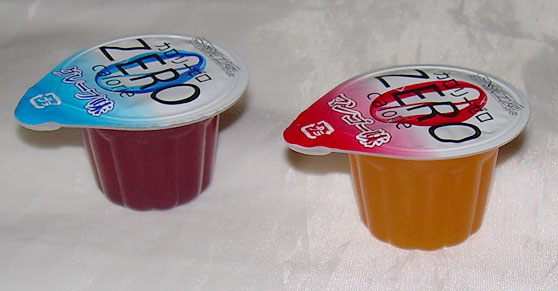
Slim & Slim Mango and Grape "Jelly"


When I first came to Japan, diet foods were pretty much nonexistent. There were pleasantly chubby Japanese girls, but they were seen as "healthy", not "fat". In the past decade and a half, diet foods and focusing on weight loss has grown exponentially. You see more products with "Zero" on them every year.

Part of me is sad about this because I think that it reflects diet obsession, which is never a good thing. Part of me is glad because I am a willing consumer of such foods. Of course, I have an excuse, I arrived in this country "pre-corrupted" by Western obsessions with dieting. Sometimes I think that the more we focus on our eating, the fatter we get, and I worry that the Japanese may eventually fall victim to the same problems as Westerners as their culture learns to promote fear of weight gain to sell products which eventually end up causing weight gain and food obsession.

Sociological issues aside, and I'm sorry to get so serious, but sometimes things take on a life of their own, I decided to finally dive in and try one of the plethora of zero calorie "jellies" (actually, it's what we call "gelatin" in the U.S.). I've seen big, single-serving size tubs of them in convenience stores and snack shops for quite some time and had passed on them. When these two varieties of smaller size jellies showed up for 89 yen (97 cents) per bag at Okashi no Machioka, I decided to dive in.


Note that I have tried regular (that is to say, sugar-filled) Japanese single serving gelatin tubs before. I wasn't a fan of them because they seemed toothachingly sweet. I can compare these sugar-free versions directly to that version. The first ingredient is Erythritol on both flavors and their respective fruit purees are the second. I don't understand how each can be zero calories and contain fruit puree, but there it is. The mango version is colored with carotene and paprika.

The mango has a pleasantly fruity smell and a nice mango flavor. It's not too strong, but it is rather sweet. It mainly lacks the citrus tones that you get with a real mango, but the flavor isn't bad at all. The grape smells like a grape lollipop and pretty much tastes like one. I think both of these would have a bit more punch with some citric acid or the equivalent.

I tried these both refrigerated and at room temperature and they're more pleasant when cold. The texture is pretty much what you'd expect for gelatin, though this is less firm and rather soft set compared to American gelatin like that you make with Jell-O mixes. Both also have a bit of liquid which tastes like juice around the outside.

These are pleasant tasting and not painfully sweet (which is better than the sugar-based jellies I tried before). They're even a little bit of a refreshing mouthful (each tub is 22 grams/.77 oz.) in hot weather when you have them cold. The thing that did surprise me though is that they tended to suppress appetite. Perhaps the gelatin is designed to achieve this effect, or it was just psychology, but I really did find that eating two of them (I tended to eat one of each flavor each time) killed my hunger for awhile.

I'd recommend buying these and putting one in your refrigerator if you're on a diet or have a tendency to eat more than you'd like. I think the mango is better than the grape, but both are fine. These aren't healthy at all since they have a chemical cocktail (Acesulfame K, Sucralose), but they seemed to serve me well when hunger struck and I either couldn't eat or didn't want to.

Friday, June 25, 2010

Kamu Kamu Hi-Chew


Taking picture of food isn't exactly an exciting endeavor, but taking pictures of Hi-Chew's lumps of goo is even more boring than usual. This blob of "kamu kamu" stuff looked like a small piece of fatty ham.

Kamu kamu is the Japanized version of camu camu, a bush that bears red fruit and grows in the area of the Amazon river. This is the second in the "world fruit" series of Hi-Chew. Previously, I reviewed the American cherry version. Morinaga's information on Hi-Chew lets us know that the fruit for their candy is from Peru.


Though Wikipedia identifies this as a "berry", the picture on the candy's label shows what looks like grapes. This does smell a bit like grape and tastes like the most intense grapes you have ever eaten. In my opinion, these are like a cross between a grape and a cherry with the sour notes of cherry and the sweetness of grapes.

At 19 calories per candy, these are a pretty nice little sugar-based pick-me-up. They're also cheap since you get 12 candies per pack at an average cost of 100 yen ($1.10). If I were a greater fan of Hi-Chew in general, I'd almost certainly give this a "very happy" rating. These are the tastiest Hi-Chew I've had to date according to my taste buds.

Thursday, April 15, 2010

Lipton Grape Tea Zero


I think that I'm starting to have a stimulus-response reaction to anything in Japan with a big zero on it. Like the Pavlov's dog that drools when it hears a bell, I whip out my wallet when I see something with a zero. Though diet foods are more common than they used to be in Japan, something which is zero calories is still uncommon. I'm particularly drawn to drinks, as one can see by my track record thus far with reviewing beverages.


This is the third zero-calorie flavored tea that I've come across. Previously, I've tried orange and peach teas, and I think the shine is starting to wear off of the novelty of these drinks. While I feel this is no worse than the other two teas, I didn't feel that it was as enjoyable. The tea smells strange in that it doesn't smell especially like grape or tea but some sort of chemical concoction in between. It tastes a lot like someone stirred in a powdered packet of grape Kool-aid drink mix with some ice tea. It's really not bad at all. It's refreshing and mild, but it just isn't all that interesting an experience.

If you're a fan of powdered fruit drink mixes, you may like this more than I did. I finished the carton with no sense of discontent and with mild enjoyment, but I wouldn't buy it again.

Wednesday, October 7, 2009

Calpis Soda Grape Zero


Let's get the big laugh out of the way first. When you say "Calpis", it sounds like "cow piss". The makers of Calpis either didn't know or didn't care about that when they made the name. The "cal" is for Calcium and the (rather unfortunate) "pis" is from Sanskrit and supposedly means "supreme taste" and is used because it is part of Buddist culture (and Japanese culture has elements of Buddism). Note that in English-speaking countries, this is called "Calpico".


Despite having been here for 20 years, I've never been tempted to buy Calpis. I chuckled about it a few times when I first got here, and promptly lost interest. The drink is supposed to be yogurt-like and feature milky flavors. It's called a "lactic acid" beverage. The color of this beverage certainly would bear that out as it is very cloudy and appears to be mixed with something milky.

This attracted me to it because it is zero calorie, though the first ingredient is, oddly "grape sugar". I'm guessing that it is not absolutely zero, but one of those deals where it is essentially zero per 100 ml. The other ingredients include the usual cocktail of artificial sweeteners.

This smells like grape soda, and on first sip, tastes like it. It has two strange aftertastes. The first is likely the lactic acid/milk element and the second is the artificial sweetener. I don't know what it is about Japanese low calorie sodas, but with the exception of Diet Coke, they all seem to have a heavy chemical flavor. This one is better than some on that front, but the weird bitterness and somewhat metallic taste that chases every sip spoils what might have been a promising beverage. So, while I drank the rest of the bottle, I wouldn't buy it again.

Wednesday, September 16, 2009

Akagi Grape Ice Pops


Part of the design on the front of this box depicts a grape that has been partially peeled. I'm not sure what image peeled grapes conjure up in the minds of most people, but, for me, it brings to mind decadent Roman officials. You can see them at their bacchanalia asking slaves to peel their grapes just before doing unsavory things to the backsides of their poor servants.

If the people at Akagi had thought of that, I'm guessing this box design could have been a lot more interesting. Who doesn't want to consume something and feel like they're taking part in a bacchanal? The fact that these are something to be slurped and sucked on only helps with the (okay, rather disturbing) imagery.


In a previous review, I sampled Akagi's similarly constructed mikan pops to great satisfaction. These are similar in construction in that they have bits of fruit embedded in a fruit juice base. You can see shadowy bits of white grape (because they've peeled the skin, you see) in the bar above. Each bar is the same size as the mikan version as well at 63 ml. (2.1 oz.) though the calorie count is slightly higher at 55.

Once freed from its clear plastic prison, you have a nice adult popsicle with good grape flavor and bits of fruit. I found the texture of the grapes less obtrusive than the bits of mikan. I'm guessing that this is because mikan, as a citrus fruit, is a bit stringy whereas grapes are just blobs. Grapes also simply freeze better. These bars are a little sweeter than the mikan ones, but still not over the top sweet.

I'll definitely buy these again, and if you want to keep something on hand for sore throats, these are really good. Of course, they're also really great if you love grape popsicles and just want to have one.

Wednesday, July 15, 2009

Nico Nico Niccori Jelly


These Japanese "jelly" candies are really just gelatin in disguise. This is something which I sort of forgot when I bought this bag of "jellies", but was quickly reminded of when I sampled them. These are essentially prepared, all weather (as in they require no refrigeration), individually wrapped tubs of gelatin made from kelp instead of animal parts. I must say, looking at it that way either makes these much more attractive (hurray! no animal died in the making of these gelatin treats) or less attractive (yuck! eating seaweed derivatives).

I don't know many people who make their own gelatin desserts in Japan. There are boxes of gelatin as well as plain gelatin available in shops, but the variety and quantity is very limited. Most people buy these individually packaged versions. I guess that the joy of slowly moldering Jell-O in the fridge and it's fake fruity jiggliness hasn't caught on here.

back row: orange, melon, pineapple front row: grape, strawberry

You can get about one-cup-size tubs or ones with tiny amounts of gelatin like the ones I sampled. If I had to guess at the volume in one of the containers in the package I bought, I'd say it's about a tablespoon. The bag I bought lured me in because it was incredibly cheap. It contains 27 itty bitty tubs of gelatin for only about a dollar (98 yen). There are five flavors, grape, orange, melon, strawberry, and pineapple.

The first ingredient in these is grape sugar and puree, fruit sugar and puree from the various fruits represented by the flavors, and kale. The fact that there are a lot of sugars in them is a clue of what is to come. These are very, very sweet. In fact, they're far sweeter than any Jell-O I've ever made from a mix or gelatin I've had back home.

An unmolded orange jelly, with a small deformation from pushing it out of its tub.

When I opened the bag, it smelled like lollipops. Even though the tubs look airtight, they clearly are not or the bag itself wouldn't smell so fruity. Eating these requires you to tear back the top and then push the bottom to "pop" the gelatin out. The size, shape, and mechanics make it clear that you're meant to pop them directly into your mouth. No utensils, no mess, no fuss, but a lot of trash for a tiny bit of gelatin.

I was going to review each flavor individually, but the truth is that I can sum up the flavor of each of them in the same manner: super sweet and intense. The fruit flavors are real, but concentrated. It's a lot like eating a spoonful of cheap, off-brand jelly (yeah, the type you spread on toast) on the flavor front and slightly soft gelatin on the texture front.

It wouldn't be bad to toss these in the refrigerator (Nanao Seika recommends you eat them cold) and have one on a hot day as a quick, sweet pick-me-up, but I really am not a fan of the super sweetness or the concentration of the flavor. Frankly, I think these might be marketed more towards children rather than adults. More expensive and larger size versions of these types of gelatin desserts tend to have bits of fruit in them, which adults might favor. I gave away the rest of the bag and I don't plan on buying them again.

Friday, December 26, 2008

Plus X Grape Mint Gum


In Japanese business, there's a concept called "plus alpha". This means that an additional service is added on to whatever the usual package of services is offered. I'll note for those who have not lived in Japan that "plus alpha" is said in English, not in the Japanese equivalent of those English words. So, most Japanese people know what "plus" means even if it is written in English.

This grape mint gum says "plus X" which makes it sound as if something extra has been added. Lotte's web site says that the branding using "plus X" is specifically targeted at young people as a way of making gum made with Xylitol (a sweetener which helps strengthen tooth enamel) seem "fun" and "cool". I guess they feel that the whole idea of gum that is good for your teeth is too square for the likes of Japanese young people so it's hipper to make it vague by saying "plus X". Of course, I'm not sure how "fun" you can make tiny pieces of gum.


Lotte also mentions that the price of this gum is set at 100 yen (about $1), though I'm not sure why that should be so special. A lot of individual packs of gum are in the same price range, though there are some pretty expensive big plastic canisters of gum for around 500-800 yen (about $5-$8). Each pack has 14 pieces and if you chew the whole thing, it's only 37 calories. The pieces are rather sloppily wrapped in textured foil which is too big for the size of the gum. Perhaps Lotte is recycling packaging from more generously proportioned gum or they like the look of a product swaddled in foil.


The gum is similar to Chiclets in the U.S. though they are perhaps a little bigger. The pieces have a candy coating and don't have any scent at all. When you bite into it, you're hit by a faint grape flavor then by a very odd mixture of mint and grape. The mint is stronger than the grape, though they do tend to mix into a bit of a funky combination for a short time until the flavor peters out. The grape dies off entirely after about a minute and you're left with an almost bitter mint flavor. The flavor doesn't last all that long and the piece size is so small that even a conservative gum chewer might need 3 pieces to satisfy herself.

I'm not a serious gum chewer, but if I were, I wouldn't buy this again. It's not only that grape and mint do not make a great pairing, but also that the flavor doesn't last long and the gum isn't especially a great chew. I can't understand why fruit gum in Japan seems to be often paired with mint since that's not a particularly tasty combination. It could be that gum is mainly used to freshen breath and mint is seen as necessary for doing the trick. At any rate, I wouldn't recommend this.

Sunday, November 2, 2008

KitKat Muscat of Alexandria

The box tells you that two fingers contain 114 calories.

This particular KitKat has been in my refrigerator for about a month waiting for me to work up the desire to sample it. It's not that I think it's going to be bad necessarily, but rather that you don't just develop an sudden desire to eat a grape-flavored candy bar. Let's face it, grape is a flavor that belongs in juice, hard candy, chews, gum, and even possibly cakes, but it doesn't feel right in chocolate. Muscat, by the way, is a recurring favorite in Japan. It's not as popular or used as often as chestnut or green tea, but it disappears and resurfaces with regularity.


I was in a particularly adventurous mood after lunch today and decided to finally take the plunge. The bars are white chocolate tinted a pale lime green with a white cream filling. They smell vaguely of grape juice and pretty much taste like it as well.They're sweet, but not overbearingly so. Mainly, it's just a weird combination of texture and taste when you experience grape flavor in a wafer.

The grape taste isn't artificial, but it's a bit too strong to seem natural. The ingredients state that "muscat sugar powder" is used to flavor the white chocolate. Even though muscat are green grapes, these remind me of the large, round, tough-skinned (semi-expensive) purple grapes with you can get in Japanese markets. I'm guessing that dehydrated grape powder can intensify the flavor and make this more like grape juice concentrate in flavor than real grapes.

I have to give Nestlé credit for not trying to mix actual chocolate with grapes because that could have been a very bad combination. This is an interesting bar, but not the sort of thing one might want to consume regularly. It's more of a conversation piece than a satisfying snack, but it's good in an unusual way. Buy a box, split the 4 fingers with some friends and talk about your impressions. You're most certainly not going to hate it. You just might not love it.

This is also reviewed at Snack Love.