Showing posts with label peanut. Show all posts

Friday, February 14, 2014

Chocoworld Choco*O*Star


After reviewing snacks regularly since 2009, you'd think I'd approach purchases with an informed eye. There is one thing which I don't do, and I really should, and that is look at the ingredients list before I buy. When I saw this at an Asian market, I looked at the name only and expected this was full of, well, chocolate. It was only after I got home and opened up the package that I looked to the ingredients list to understand what I had before me.

What I had was a bunch of little individually wrapped packages of very crumbly brown stuff. It smelled like chocolate, but the appearance was quite peculiar. The ingredients list reads: sugar, peanuts, milk powder, cocoa powder, vanilla flavoring. You'll notice that there isn't anything in there that suggests much in the way of fat. This was very cheap for the side - a little over half a pound/240 grams for $1.49. I think it reflects well the notion that sugar is cheap, but cocoa butter is not.


This is quite sweet, as would be expected from something which lists sugar first. The peanuts and cocoa do a bit to offset the sugary nature of it, so it is not cloying. However, the purity of the sugar on my teeth made them ache a bit. The picture above shows the candy after opening. I didn't break it. It fell apart in this fashion. The texture made me think about astronaut food like dehydrated ice cream and how you have to provide the moisture to allow the components to dissolve on your tongue and then you can experience the flavors. This has a fairly serviceable peanut and chocolate combination. It's mellow and sweet and pleasant, but not decadent and overwhelmingly flavorful.

This was not a bad experience in the least. It was, for lack of a better word, "weird". When you see the words "milk chocolate" on a package, you expect something with a very different texture and a lot more richness. You don't expect something which is like a cake of dried and powdery things, but that is pretty close to what this is.

The truth is that I'm glad that I bought this for the experience of something I'm not familiar with. It didn't cost me much, and there is a certain unique enjoyment in allowing the flavor to unfold by letting it rest on my tongue. It forced me to find a new way to enjoy it. On the other hand, I do tend to enjoy the way I have chocolate just fine already and the way in which the sugar in it made my teeth ache means that I won't be having it again. If this has piqued your interest despite my less than glowing review, you can buy it online for a marginally higher price than I paid.


Friday, January 3, 2014

Lil' Dutch Maid Dutch Wafer Rolls


I have blogged about "American" things in Japan that were not in any way American. Most of the time, these were what the Japanese believed was American-style, but was actually a distorted version that was modified to suit the tastes of the Japanese market.

This often applied to coffee, which Japanese folks think is super weak if it's "American", but also to things like pizza. The American-style pizza varied from place to place, but it could be anything from frankfurter to French fry toppings on your pie. One thing that it never was was heaping piles of cured meat with great lashings of cheese. That would have actually been closer to what you'd find in the average American pizza place, but it also would have been unpalatable to the Japanese.

At the local big lots, I believe I found some very unDutch Dutch wafers. They lured me in with the illustration on the box which brought to mind Kinder sweets like the Bueno or the Happy Hippos. These are chocolate-hazelnut cream filled wafer treats which I can occasionally find in shops in my area, but generally at a premium price. I figured that these might be a knock-off version of the Bueno, and I was willing to take a chance on them for a mere dollar for a box of four.

To be honest, I had no idea what made these Dutch in any way. Ferrero SPA, which produces the Kinder line, is Italian, so the oncept was seemingly taken not from a Dutch company. I did a little investigating and found that the Dutch part literally applies to the wafers themselves and not the way in which they are rolled, filled or coated. I should have been thinking "stroopwafels" or waffle cones, not Happy Hippos.

I didn't attend to where there were made, but when I got home, I learned that these "Dutch Wafer rolls" are made in Mexico. Uh-oh. No matter. Just because they aren't actually European does not mean that they can't be good. I tried to remain optimistic, but when I broke one in half for a picture of the inside, more than a little pessimism creeped in. It was much more "wafer" than I was lead to believe and far less creamy filling.


Unlike the lovely illustration showing a full great filling with lashings of Nutella-like filling, When you bite into it, the first hit is full-on cheap milk-chocolate-covered peanuts. The wafer adds nothing to the flavor profile at all, but does add a crispy texture. The filling creates a very slight sense of richness and a deepening of the chocoalte flavor, but whatever hazelnut aspects are in it are totally overwhelmed by the peanuts in the coating.

In no way would I say this isn't enjoyable as long as you like milk-chocolate-coated peanuts. In fact, I rather liked this, but it was far from what I expected based on the illustration and my, perhaps, unrealistic expectation that I was getting a cheaper version of a Bueno. Each piece is individually wrapped in a plastic-foil packet, is about 4" x 1" (10.2 cm x 2.5 cm) in size, and is only 110 calories. As an accessible, somewhat moderate bit of candy, it's not bad at all. It's not high quality, but it is more than serviceable if your tastes don't run consistently toward the high end. At the Big Lots price of a box of four for a dollar (about 100 yen), I'd pick this up again. I wouldn't buy it all of the time, but I could imagine a revisit or two in the future.


Monday, November 4, 2013

Bourbon Kinako Chocolate


Have you ever thought about what you owe to the existence of fire? Oh, I'm not talking about such pedestrian things as keeping your naked ass warm, generating energy for your gadgets so you can be a techno-zombie, or making sure that every burger you eat isn't tartare. I'm talking about something bigger and more important - the contribution it makes to the taste of the food you eat.

Since most of us are naked apes who enslave machines to do our dirty work (and occasionally people, but this isn't a political blog so let's not go there), we don't think very hard about how our food gets to be what it is. Roasting, which involves, you know, fire, is part of what makes some of the best things in life good. I'm not even talking about the type of "roasting" that involves cooking food, I'm speaking of the type which makes the things used in cooking palatable. In particular, coffee, nuts, and chocolate all come into their own through roasting. Soy bean flour is another one of those things which blossoms into something special through the magic of fire.

One of the reasons that I like kinako so much is that the roasting brings out a nutty flavor. It is reminiscent of peanuts, but has its own special qualities. I'm guessing that it tastes like peanuts in large part because the roasting cultivates similar qualities in soy bean and legumes, but I'm no expert on this. All I know is that kinako is good. When I found these for about $2.00 at Niyiya market, I snapped them up.

Bourbon is best known for making tubes of tiny packaged cookies. Some are pretty good and some are quite boring. They do have other products as well, but they aren't as ubiquitous or well-known (except for the Alfort line of cookies with chocolate). I'm certain this particular product is a temporary one which will vanish when the cherry blossoms arrive in spring, if not sooner. Kinako is a winter flavor for reasons unknown to me, but I'm guessing it has to do with the harvesting season for soy beans in the distant past.


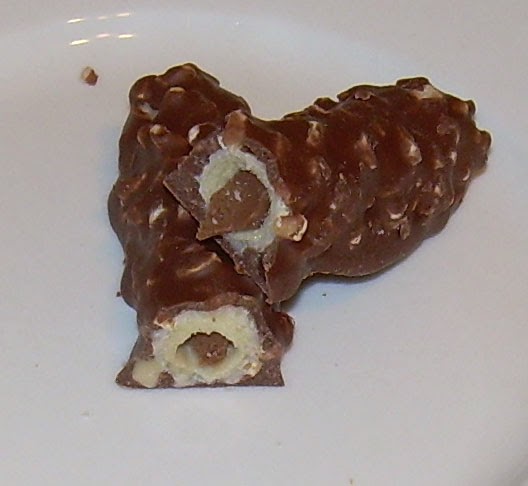
These are little nuggets of kinako bliss on multiple levels. First, you are hit with the nutty joys of the toasted soybean flour on the outside with the slightest bit of creamy white chocolatey flavor and texture. Next, you get the airy, crispy wafer shell and finally you are rewarded at the end with a roasted peanut. Each element unfolds both as an individual flavor (the peanut mainly as an aftertaste) and as a melange of flavors. For a tiny little thing, this packs a load of depth both in taste and texture.

Clearly, I loved these. Each package is supposed to be one serving of 190 calories, but I think I can stretch that over two or three portions given that there are 34 little nuggets in the bag (yes, I counted). They're too good to pop in your mouth by the handful and chomp down on rapidly. I recommend savoring each individual bite for it's flavor depth and mixture of textures, preferably with a drink to cleanse the palate between nibbles. If you like kinako, you will love these. If you've never had it, these are a very good introduction to a flavor that is known and loved by many Japanese people and that I wish were common in America.


Monday, June 10, 2013

Yuki & Love Japanese Style Peanut Mochi


Have you ever wondered which part of an Oreo cookie makes the cookie better? Is it the slightly bitter, not terribly sweet and crispy outer cookie or the creamy, sweet death-mush in the center. If eating habits are any indication, that is, our tendency to mush together two cookies divorced of one half of their outer cookie sandwich, then the filling is the star of the show. That being said, in Japan, they used to sell only the outer cookie sans the sugary goo. Tastes are relative, after all.

When thinking about mochi treats, one can ask the same question, though I'm figuring those that are not aficionados of Japanese traditional sweets would say, "neither". Those who are connoisseurs would likely say, "both." As someone who just buys snacks for a living, I'm definitely saying the proof is in the rice cake (mochi) and that a substandard mochi experience will make or break the experience. 


The peanut filling of this is lightly sweet, dense, and pretty fatty. The texture is rich, but it's a little kludgy, like "natural" peanut butter before it has been stirred (though not quite that bad). The mochi is where things fall apart. It's actually nicely balanced in terms of taste and lends a sweetness from the rice cake having been infused with a bit of sugar and a nuttiness due to the powder on the exterior. The place where it all goes wrong is the mochi's texture.

The first time I tried a "Yuki & Love" Japanese style mochi, I loved it. It was soft and tasty with a delicate taro (like a potato, only, not) filling. I was so excited that I was dying to try another flavor and scooped up boxes of other varieties when I found them on sale. The second time was a more so-so experience, but that was largely due to the weirdness of the brown sugar flavor in that one. This time, the mochi was just crummy. It was too thick and rubbery, like chewy on the eraser on the end of a number 2 pencil. I don't know if this was old or if they just did a bad job on this particular one, but it really ruined the experience. Despite being quite good with the flavor (and being an enormous fan of all things peanut butter), I didn't finish the box. I kept going back and trying them, even microwaving them to soften the thick exterior, but it didn't help. I ended up throwing out half of the box because they just weren't worth the 130 calories per rubbery lump.

I hope this was a "bad batch", but I'm unlikely to try this variety again. I'm not giving up on the brand and will try another, but if it doesn't get better after the next sampling, I'll be saying goodbye to "Yuki & Love", or at least their Japanese style mochi offerings.


Monday, October 1, 2012

Tirol Summer Assortment


I'm fully cognizant of the fact that it is no longer summer, and that this bag showing sun, seagulls, and palm trees is incongruous with the cool breezes, dying leaves, and chilly air of autumn. Actually, with climate change, I'm not sure that we actually experience fall in that fashion anymore, but for the sake of argument, I will admit that I'm reviewing this seasonal variety pack rather late in the game. To be fair, I bought it recently at Nijiya market in San Jose, CA (it could not be had at the Mountain View branch) and this selection only recently vanished from Tirol's web site. I can't recall what I paid for it, but I think it was somewhere in the $3 (234 yen) range.

This was the sort of thing that I would not buy when I was living in Japan because it includes a very common flavor (nuts crunch), a reissue (mango) with one flavor of interest to me (coconut). Under those circumstances, I would not pop for a bag on non-premium Tirol chocolates. For those who don't know or remember, the Tirol brand is offered in two different sizes. One is a smaller square sold in 9 packs and the other is a larger (about 1 inch/2.54 cm.) size which is sold individually. The premium candies larger size means they are generally more sophisticated in construction with multiple layers of fillings. The non-premium ones, such as these, tend to be simpler as it's hard to layer in much in such a tiny presentation. In general, the variety packs lack the flavor depth and potential of the premium candies. 

The strange thing is though that I thought I'd already sampled two out of three of these chocolates, but reviewing my backlog, I see that I had never tried any of them. I guess that's all for the better then. 

One has to wonder why peanuts wear bow ties around the world. Is this level of formality a genetic inclination?

Nuts Crunch:
I should note that I balk at writing "nuts" crunch instead of "nut crunch". The Japanese generally don't accept or follow the conventions in English in which you do not use a plural when a noun modifies another noun. That's why they say "peanuts butter" instead of "peanut butter". However, the words are written on the package in such a way that I can hardly deny them, so don't come around telling me that I've adapted crappy English as a result of my time in Japan. My English may be crappy, but it's all on my shoddy editing skills, not absorbing Japanese-English. 

Now that we've got that straight, let me say that this is a very tasty peanut and chocolate combination. It is crunchy, but I think the reason it tastes better than some others is that the peanuts were fried prior to having their fragments embedded in milk chocolate. There's a rich roasted quality to the nuts which makes the flavor profile better even with an extremely small portion in the candy. Incidentally, I intentionally photographed this chocolate upside-down so that the uneven distribution is easy to see. I loved this, and if I could buy a big bag of these alone, I certainly would.


Mango:
This smelled nicely fruity with a slightly perfume-like edge. The outer white chocolate is very, very sweet and quite soft. The jelly inside is also soft and has a zesty edge to it which helps cut through the sweet outer coating to some extent. The flavor is like a really rich mango puree mixed with a bit of powdered sugar. As a small bite, it's really enjoyable, but I think that one small candy would definitely be the limit. Any more than that at once and it's just going to overwhelm one with sweetness.

Coconut:
The coconut scent on this is quite intoxicating and I was encouraged by the fact that it had a dark chocolate coating. I can't think of any reason why dark chocolate should pair better, but it's possible that years of seeing "Mounds" bars made me believe this was the proper presentation. Unlike the aforementioned bar, the coconut filling in this is not too sweet and the bittersweet chocolate cuts through what sweetness there is for two complimentary flavors. That being said, I ate this in two bites and it seemed rather intensely bittersweet by the end of the second bite. I liked this, but I wouldn't go out of my way to eat a lot of them.

I like the Tirol concept of mixing flavors in small portions and the fact that the flavors are often pronounced with balanced sweetness. I don't like the fact that the chocolate is often quite soft and that was the case with these. I prefer chocolate with a greater snap to it. That being said, as small bites of chocolate to satisfy a craving, I don't think one can go wrong with these. The flavors are strong without being overbearing and you really do feel that one chocolate is "enough."


Friday, March 9, 2012

Variety Friday: Yokohama Chinatown Food and Snacks

Click any picture to see a larger version. This is one of several gates to enter the Chinatown area.

Since deciding to leave Japan, my husband and I have been revisiting and visiting various places with the knowledge that this will be our last chance to do so, at least for quite some time. One of the places we went to a very long time ago was Yokohama's Chinatown and neither of us remembered what it was like. When we got there, we learned that it certainly wasn't what we expected.

The main draw of this particular Chinatown is supposed to be the food. The area is rather small and populated with ostentatiously decorated restaurant facades, snack and sweets stores, and stands and shops selling very tacky items. It's like a Chinese tourist trap conveniently set up in Japan so that Japanese tourists don't have to go all the way to China to get their dose of unrealistic Chinese cuisine and souvenirs. None of this really bothered me at all. I'm all for the occasional immersion in kitsch and I don't take life that seriously. It's important to take things at the level they are offered for what they are instead of what you think they might be or should be.

Chestnuts and shrimp chips, a winning combination. The shrimp chips looked very much like pork rinds. 

That being said, I did have one expectation of Chinatown in Yokohama and that was that the food would be different and "better" than Chinese restaurants in Tokyo. The main idea is that it's supposed to be a bit more authentic than Japanized versions in my neck of the woods. What I found was well beneath expectations. The main disappointment was that there was so much repetition of the same food and even the same vendors. Every street had several people pushing samples of roasted chestnuts on people quite aggressively and even the sample-crazy Japanese (usually, they descend on them like starving wolves) were turning them down right and left. Steamed buns filled with pork and meat filling were also on every corner. The only difference between them and those in Tokyo was that they were enormous and more expensive. In terms of the restaurants, it wasn't that every place tended to offer the same range of dishes, though that was very much the case, but that the same chain of restaurants were repeated throughout the limited Chinatown area. It was literally the same food in many places, not just a varied presentation on mabo-dofu or cashew chicken. 

Garlic ribs and shumai.

My husband and I ran across no fewer than 4 and quite possibly more "tabehodai" ("all you can eat") restaurants with the same pricing structure and signage. People stood on the streets trying to press fliers for such establishments into our hands and touted that you could stuff yourself silly for 1980 yen (a little under $25). These weren't buffets (or what is called "viking" in Japan), but places at which you paid your money and then ordered what you wanted. I had limited experience with this sort of thing at a buffet in Shinjuku which was part buffet and part "ask us for the stuff you want". It was a huge pain in the ass trying to track down and ask for things which were not in the buffet as waiters and waitresses in such places aren't exactly making themselves as available as possible to customers. I've also heard (after our trip) that the food quality at such places is not particularly good, so it's probably best that we passed.

Fried rice, cashew chicken and unidentified soup.

We walked along the side streets and lesser trafficked areas searching for places off the main drag which might offer less common food options. In the main areas, there were mainly the same dishes we see everywhere in Tokyo. We settled for a place which had a rib dish my husband hadn't seen at every other Chinese joint between Shinjuku and Yokohama. I bought the "safe" option, a cashew chicken set off of the lunch menu for 1480 yen ($18.20), and he got the adventurous ones, garlic ribs from the a la carte menu for 1800 yen ($22.13). The set came with fried rice (cha-han), a soup I'd never had before which seemed to be beef-broth based and was full of little stringy things (not egg, trust me) and mushrooms, one lone shumai (dumpling), and annin dofu (almond pudding). His ribs came with nothing, but usually there is too much food for both of us when we order a set.

The cashew chicken was fine, but fairly par for the course. The fried rice was better than average, but the portion was amazingly tiny. Usually, we're given enough rice that it exceeds what both of us need. This time, I'm pretty sure a Japanese child would have found the scant amount lacking. I'm not a big eater of carbohydrates with a meal and it takes a very stingy portion to disappoint me, but this place managed. The soup was tasty enough, but too fatty and a bit viscous, so it had a strange texture. I didn't have the shumai, but my husband said it was perfectly average and the annin dofu was bitter and unpleasant. The whole meal was less than impressive except for the garlic ribs, which were deep fried and freshly made. It didn't help that the service was quite poor. They served one dish at a time, including the cashew chicken sans rice, with long gaps between subsequent dishes and ignored our water glasses. I've been told by Japanese folks that bad service is par for the course in Chinatown, but I can only say that my experience would lend credence to that assertion but is insufficient to prove it. One of the things I'm pretty sure of is that in all but the most expensive places, most of the food at the Chinese places in Chinatown are not fresh or handmade. I'm pretty sure all of my set food was reheated. All in all, the whole restaurant scene disappointed us.

Coconut and egg tarts. They tasted like disappointment.

We weren't in it only for the restaurant meal though. I also wanted to try Chinese sweets. Once again, there was a huge amount of repetition with the same types and flavors of mooncakes, fried dough, steam cakes, and cookies on offer. There was a lot of coconut-based food and we found a place selling a coconut tart paired with a custard one and bought it. They were supposedly freshly made, but the shells were obviously factory made and filled. Though this wasn't something we saw for sale everywhere and was sold at a shop that didn't sell mass-made food, the tarts were very disappointing. The filling was lackluster and too sweet in the pudding one and the shells were tough. The coconut filling was dry and flat in taste.

Peanut Cake (more like a cookie) and Peanut Cake Slice (a peanut brittle). 

We also found a dingy little store that was selling what appeared to be an unusual range of snacks and picked up some "peanut cake" packaged snacks. One was a sort of brittle and the other was more like a flaky cookie. The brittle was fine except that it had an odd taste to it, as if some strange spice were in the mix (reminiscent of Chinese Five Spice). While not bad, that aftertaste diminished the experience. I think it also could have used more salt. The other  "peanut cake" was a block divided into three segments that tasted like as super rich peanut butter cookie mixed with peanut butter fudge. It was a true winner and well worth the 170 yen ($2.09) we paid for it. 

Obviously, I couldn't leave without buying a mooncake since it is such a well-known Chinese snack food and there were so many varieties around. I also had about a dozen shops from which to buy them and settled on a pumpkin one from a relatively nice-looking shop. A very small cake, about half the size of my palm, was 200 yen ($2.46). Note that I could not locate any shops which sold actual fresh mooncakes. They all seemed to be selling ones that were wrapped in plastic and had an oxygen absorber packet in them. This was a disappointment, but I have had plenty of preserved Japanese bean cakes which were awesomely delicious. 


Unfortunately, my mooncake experience was not to be so positive. I took it home and photographed it for review. The smell was a bit light on the pumpkin, though the center was very orange. The pumpkin flavor was there, though it was lightly sweet such that the flavor wasn't enhanced much and diluted enough with fat and other ingredients that it wasn't carrying through any pure pumpkin taste. The main issue was that it had a weird taste that I associate with canned food (like Vienna sausages) and a smell that I associate with opening up a can of dog food. I can only guess that this was due to the outer cake or some preservative. 

Going to Yokohma's Chinatown is an interesting experience from the viewpoint of seeing an area with a unique dynamic. However, I wouldn't recommend going there for the food and am surprised at positive reviews of it. Most Japanese people who I've spoken with about it (before relating my experience) have answered the question of "is the food good" with what I call the "mouth says yes and the eyes say no" answer. When pressed, they say it is decidedly so-so. I think that's pretty reasonable assessment of the food experience, but the whole area has a lot to offer for it's over-the-top look and sales pitches, proximity to other sightseeing attractions (like the waterfront and foreigner cemetery), and relative walkability. 

Friday, February 3, 2012

Sonton Peanut Soft


This review marks a personal first for me; it is the first time I've gone into a store to buy something and found myself crying in the snack aisle. No, there hasn't been a marked increase in the price of chocolate (yet) nor did they take away some much-loved snack. If you read my other blog first, you may already know why. I stood in front of the shelf with rows of sleeved Bourbon petit snacks and saw the kinako wafers (which are heavenly) and thought about the fact that my days of being able to casually peruse and purchase such snacks are now greatly numbered. That's right, gentle readers, I'm leaving Japan.

A deeper explanation is on my 1000 Things blog, but the bottom line is that my husband and I are going on March 29 and don't anticipate returning. Of course, "never say never" is a very good motto, but our plans are not to return. For my other blog, this doesn't mean much as memories are as good as being here in constructing those posts. For this blog, the future is quite a bit more difficult to predict as I peer into my Japan-related crystal ball. I'd like to continue sampling and writing about Japanese snacks, but I have no way of knowing at this time what the availability of such things will be upon my return. This is, in large part, because I'm not even sure where I'll be living beyond the state I ultimately plan to be in (California).

Chances are that I will be making some connections to importers once I am settled. Immediately after I return, my address will not be known since where I reside depends on things I can't be certain of yet (like what university my husband enters). At the very least, I should be able to answer questions about how to get snacks outside of Japan more effectively once I am in a position of having to do so myself. At the very worst, well, I guess I won't be able to carry on with this blog at all, but I'm going to try and think positive. I hope to carry on and hope that, if there is a hiatus while I pull my new life together, that my readers will be patient with me. In the meantime, here's the actual review:


Awhile back, I negatively reviewed something called "Peanut Cream" by Sonton. I wanted to give one of the Peanut Soft versions sold in many Japanese markets a try, but I wanted to try a different brand as one of the commenters mentioned that Sonton was the worst. Unfortunately, my local market only stocked this brand in peanut flavor so I paid my 268 yen ($3.52) and decided to take my chances. 

These tubs of softly whipped cream come in a variety of flavors and right next to this one was a peanut/kinako combo that I nearly bought instead of the straight up peanut variety. I decided that I'd rather go for something that my husband might be willing to eat as well because I've got two months left in Japan and 190 grams (6.7 oz.) of this is a bit much for one person to polish off in a short time, especially when each tablespoon is packing 95 calories. That makes it slightly more energy dense than peanut butter and the ingredients make it a lot less healthy. The primary components of this "peanut soft" are peanut butter, sugar, and shortening. This is junk food pure and simple.


As for how it tastes... Well, it's heaven on a spoon. It's sweet, soft, light, and has a nice peanut flavor. It's like peanut butter that is actually "buttery". The fatty texture on the tongue is most gratifying and the sweetness just a nudge away from cloying. The good part about it is that you don't have to use a lot to be satisfied. The bad part is that it's so good that you may want to be gluttonous about it. This is a treat to be enjoyed in moderation, rather like Nutella in terms of how controlled you are about eating it, not so much in terms of flavor.

Sometimes you can buy bread in bakeries in Japan that are spread with peanut cream and this is what they are spread with. I've had such bread given to me before and it is wickedly awesome. I don't buy it myself usually, but now I know that I can "make it" any time if I have a tub of this around. If you see it and want to indulge and throw caution about nutrition to the wind, I can't recommend this highly enough. 


Monday, February 14, 2011

Fujiya Heart Peanuts


Back when I was working in an office, my boss used to buy packets of 100 yen ($1.20) "peanuts choco". For foreign folks who want to indulge in something which is "safe", chocolate-covered nuts of any sort are the bee's knees. In fact, there are some incredibly good chocolate covered almonds that I was addicted to when I was working. Unsurprisingly, I was fatter when I worked in an office.

I haven't reviewed any chocolate covered nuts because they're hard to mess up. This bag of heart-shaped peanut chocolates from Fujiya is being reviewed because it came with one of my three fukubukuro. I'm betting my readers are getting tired of hearing that. Yeah, well get used to it. I'm not even halfway done with what I got.

There are 15 little medallions in the bag, each individually wrapped and with the words "have a heart" imprinted on them and providing you with 45 calories. Though these look like they're a Valentine's release, they're always available.  For reasons I'm not sure of, Fujiya felt it was important to say that these were manufactured at their Hiratsuka plant. That means nothing to my readers who don't live in Japan, and problem means little to those who do. I only know it as this place which is really far from my apartment that my husband and I once ventured to to look at a second-hand record shop. We were looking for rare records. I don't remember smelling peanuts or chocolate when I was there, but maybe they hermetically sealed the emissions in efficient Japanese fashion.


There really isn't much to say a about these. They smell like peanuts and chocolate. The nuts are very lightly roasted and plentiful, and the milk chocolate is fairly smooth and lacks the bad aftertaste that some Japanese chocolate has. They're good, but they're pricier (more or less 200 yen/$2.40 per bag) than the bags of peanuts choco my boss used to buy. The main difference is that the chocolate on these is smoother and has a finer texture and have bigger peanuts. Also, the packages of peanuts choco are not wrapped individually, but just tossed into a plastic tray so they buffet one another and lack the pristine appearance and gloss of this Fujiya offering. The Fujiya ones also are fortified with Vitamin E so that you can feel good about eating them. At least that's the only reason I can think of to include it.

These are good, but they're not outstanding compared to other similar offerings. If I were in the mood for chocolate-covered peanuts, I'd buy the cheaper hundred-yen shop versions of "peanuts choco". They have less packaging, are cheaper and taste pretty much the same. I'm giving them a happy rating because they taste good, but I wouldn't buy them again for the aforementioned reasons.

Thursday, December 9, 2010

Sonton Peanut Cream


The review of this particular product is offered as a public service. Before I purchased this, I already knew what I was buying and I knew that I would sample it, review it, and never ever eat the rest. The reason this service is necessary is to warn any number of countless unsuspecting foreigners from making the mistake so many of us have made before. That is, they see a carton of peanut cream and figure that this is the Japanese version of "peanut butter." There should be big red warning signs in front of "peanut cream" that flash "NOT PEANUT BUTTER!"


So, that being said, I am pleased to introduce you to a product that puts the lie to the assertion that Americans love everything sweeter than the Japanese do. This is little more than peanut frosting in a bizarre glossy, semi-translucent presentation. The texture isn't creamy, but rather sort of like eerily suspended gelatin which is cold and rather like what you'd expect thick brown mucous (sorry) to be like.

The ingredients list may reveal what is going on with the texture. The first thing it mentions is "peanuts paste" followed in parentheses by "flour paste". The first ingredient is sugar water (probably the equivalent of high fructose corn syrup but made with grapes instead of corn), followed by flour, then peanut butter. This is pretty much peanut butter mixed with a fructose-based syrup and flour. As an ardent fan of peanut butter, I believe they have tampered with perfection to create this abomination.

The texture is really unfortunate because the truth is that this has a fantastic peanut smell and a good peanut flavor. In fact, this could be given a favorable rating if it were not so incredibly cloyingly sweet. You know those over-used dumb jokes about eating something so full of sugar that it gives you diabetes after one bite? This stuff brings those jokes to mind and makes me think, nay, fear, that there may be some truth behind them.

Ultimately, whether or not you're going to like this is a matter of personal taste and experience. Most people who grew up with peanut butter (especially natural types) are going to find this pretty hard to tolerate and anyone who is sensitive to super sweet foods is going to gag on it. This is best applied sparingly to something quite bland. I had it on a bit of a saltine, and it wasn't bad at all, but I'd just as soon have real peanut butter without all of the sugar and textural strangeness.

If you're inclined to buy this, you can find it at most supermarkets for about 180 yen ($2.14). One of the reasons that foreigners may gravitate toward it when they don't know any better is that real peanut butter is generally only available as an expensive import. Small (about 1 cup) jars of Skippy sell for 400-500 yen ($4.76-$5.94), so if you see what looks like a domestic brand for less than half the price, you may be inclined to sample it and be in for a big disappointment. 

Incidentally, the maker of this peanut cream, Sonton, offers a variety of other spreads including a chocolate one and some "whip" versions of peanut butter, black sesame and chocolate as well as jams. The whip versions are in clear containers and are mixed with fat. I've had those on rare occasions before and they are actually not so bad because, while they are sweet, they are lighter and have a pleasant texture. If you want to go for a sweet peanut or chocolate spread, I'd recommend the whips over these flour and sugar water types.

Friday, February 26, 2010

Taiko Sembei


When Japanese people explain sembei, they sometimes call it a cracker and at other times a cookie. It turns out that sembei is one of those words like "biscuit" in English. That is, it can apply to more than one type of food. Taiko sembei is not a rice cracker, but a dense cookie.


The reason these are called "taiko" (Japanese drum) sembei is that two cookies are wrapped together in a little shrink-wrapped package. The cookies are meant to resemble the two ends of a drum. I bought a big package with 10 double packets in it for about 200 yen ($2.22). That means that each generously sized cookie is only 10 yen (11 cents) each. That makes these much cheaper than Japanese-made Western-style cookies.

These are made by a company named Nanao Seika. The company started doing business in 1957 by making "crackers" (these cookies are called crackers on their web site). Their main products continue to be hard cookies and crackers, but they also make doughnuts and fruit gelatin snacks (called "jelly" in Japan, but they are essentially what we call gelatin or "Jell-O".) Their line of products is limited, and as far as I know they have no "signature" products which are commonly exported, though I'd be surprised if their peanut sembei or these taiko sembei didn't make their way into Asian supermarkets in other countries.


These cookies are dense, dry and brittle. There are three or four roasted and unsalted peanuts in the center of each cookie. The cookie itself is lightly sweet and tastes of toasted flour, margarine, and mild sweetness. They are incredibly crunchy and have a flavor which is just a bit shy of being burnt.

The only thing which I'm not necessarily happy about is that they're a little dense in calories for a cookie which isn't very sweet. The calorie information states that there are 475 calories for 100 grams, but they don't give the weight of the entire bag. My unreliable kitchen scale places 6 cookies at 100 grams. That makes each cookie about 70-80 calories, and I'm always going to eat two because of the packaging style and the fact that they will most certainly be no good if they are stale.

I really like these, but texture often factors more strongly into my enjoyment of things than taste. These are not very sweet and they lack the flaky nature of most butter cookies. They remind me of what might happen if you flattened some yellow cake batter into as dense a disc as possible and then cooked it to the "dark" toast setting. I'd definitely buy these again, though not incredibly often, but I can't guarantee that others would find them as appealing as I do.

Wednesday, December 23, 2009

Kameida Seika Almond Fried Sembei


Have you ever eaten something for the first time and you could swear that you've eaten something very much like it before, but you can't work out what it is? Well, that's how I felt when I ate this sembei. It wasn't that I have eaten sembei like it before, but I believe I've had some sort of snack food which is roughly similar to it. The annoying thing is that I can't remember what it was. It's going to keep bugging me until I remember.


I'd been eyeballing this bag of almond sembei for quite some time. The calorie counts for each 25 gram bag (.88 oz.) bag put me off a bit. It is 133 calories for a pretty small-looking portion. That being said, when I dumped the contents out for picture taking, it didn't seem quite as bad as I thought it would be (entire contents of one bag pictured below). Any time nuts are a large component of some food, there is a boost in fat. In the case of these, there are 7.1 grams of fat per serving (and 3.1 grams of protein).


This sembei mix actually contains both almonds and peanuts. The peanuts are whole and coated in some sort of crispy shell which is strangely sweet. They resemble honey-roasted nuts without the honey flavor. Note that I believe they are sweetened with maltitol as well as sugar (both are ingredients). The sembei pieces are the thing that reminds me of something else. The closest food I can liken them to are sesame sticks with a nuttiness from almonds instead of sesame. They're super crispy, as are the nuts, and don't have that usual rice cracker taste or smell. In fact, when you sniff the mix, you smell peanuts.

These were good, but the peanut part is far too sweet and the almond component overwhelmed by the peanut flavor. It's not a bad mix at all, and I will easily finish the remaining 5 packets of the 6 in the entire bag. Frankly speaking, I prefer saltier nut flavors rather than sweet. These were also slightly expensive at the supermarket I picked them up in at 260 yen ($2.93) and I can't see going for them again. Someone with different tastes than me might really like them. They're definitely well-made, fresh, and offer depth of flavor, but just not my cup of tea.

Thursday, December 3, 2009

Daiiti Seika Goma (Sesame) Crunch Candy


One of my labels for posts is the category "grandma's snacks". This is the sort of old-fashioned stuff that I believe is marketed toward the older generation and reviewing such items is always a pain in the ass. The main reason for this is that it requires harder research to find the company that made the product, and often a much harder time reading the names of the companies. You can read Japanese characters in different ways such that even Japanese people read names incorrectly. For instance, I have a student name "Satomi" but her name can be read as "Rimi". In fact, when she was referred to me, the referral agency tole me her name was "Rimi" (and they're Japanese). You know that a language is confusing when even its native speakers can't read the names correctly.

With a little help from my husband (who is pretty good at kanji), I learned that this is made by a company named Daichi Seika, though they romanize the characters as Daiiti on their web site. They make a variety of nut brittle types of candies, but mainly focus on peanuts and sesame seeds. Their product line is limited and not incredibly glamorous, as is often the case with grandma's snacks types of treats.


I picked up this bag of very tiny sesame seed bars (5 cm x 2 cm x .5 cm/2 in. x .8 in. x .2 in.) at a local discount snack shop. It was about 120 yen ($1.34) and there are 24 individually wrapped pieces in the bag. Each candy is 22 calories if my math is correct. The first ingredient is sesame seeds and the second is granulated sugar followed by maltose and peanuts. This covers pretty much all of the flavor in these minuscule bits of sesame brittle.

The first taste is of the sesame and familiar sugary flavor. The sugar aspect is just like what I grew up with eating cheap nut brittle. That is, it has no toffee elements to it because there seems to be no butter. That doesn't mean it's bad at all. On the contrary, the sesame seed flavor is so perfect and rich that I think it's better that the sweetness be very simple. There are also tiny bits of peanut in the little slabs which come out when you come across one. Strangely, these smell just like peanuts despite the small amount of them in the bars.

I would absolutely buy these again. They are well-made, fresh, and have a great taste. I also think they'd make a pretty good souvenir for fussier eaters back home, particularly those who want something a little off the beaten path (sesame brittle instead of peanut). The only issue I have with these is that they are extremely hard to limit your intake of. They really are that good and the tiny size can deceive you into thinking eating a lot at once is OK, but those calories start to add up fast.

Tuesday, May 19, 2009

Cheese Potato Otsumame Arare


I was drawn to this snack by the picture of the baked potatoes covered in gooey cheese. While I wasn't entirely fooled into thinking that a bunch of little pellets flavored with whey and cheese powders was going to fill my mouth with the flavor of cheesy baked potato, I figured I'd see how close this came. Incidentally, this is another one of those snacks which is designed specifically to be consumed with alcoholic beverages (otsumame). There is an endless parade of them in Japan.


"Arare" means "hail" in Japanese. It's used in reference to food to indicate that something is being produced in little pellet-like pieces. I guess this is supposed to make them easier to eat when you're too drunk to bite off bits of a potato chip without having it crumble into your lap, or your beer glass. Japanese snack manufacturers are so considerate.


The bag is full of small pouches of what are essentially sembei (rice cracker) pellets and peanuts. Each pouch is 12 grams (.4 oz.) and contains a very small portion of peanuts and tiny cracker bits. The amount pictured above is the entire content of one little triangular packet. This portion contains 63 calories, which seems like a lot for such a tiny amount. The peanuts are average in size and comparing them to the sembei gives you a good idea of how small the pellets are. The entire bag cost about 170 yen, or about $1.60 or so in U.S. dollars.

Despite the fact that potatoes are on the cover, glutinous rice is the first ingredient, followed by peanuts. "Potato powder" and smoke flavoring are added in addition to cheese powder, yeast extract, and other seasonings. The smokey flavor is what hits you the most when you bite into these. It's somewhat surprising that they don't smell like much of anything given how intense the smoke flavor is. After the first nibble, the smoke flavor gives way to more of a cheesy bite. The peanuts are blanched so they aren't too intense. It's a nice mix. The texture is pleasantly crunchy.

I liked these, but I'm a bit dissatisfied with the wastefulness that comes along with putting nine tiny plastic packages in the bag. I'm all for portion control, but this is such a small amount that I have the sense that they are more for handing out at parties than for personal snacking. I imagine most people would want just a little more than what is in one package. I'd consider buying these again if I were in the right mood or if I wanted to exercise extremely judicious control of my eating.

Tuesday, March 10, 2009

Kaki No Tane ("Persimmon Seeds" Sembei) with Peanuts


This is another one of those snacks that I have seen for years in Japan and never bothered to buy. A big reason for this is that most of the time kaki no tane (kaki = persimmon, no = of, tane = seed) is sold in fairly large quantities. I'm sure there are small packs around, but I just never went out of my way to find them. This is the sort of snack that people buy for their families to nosh on, perhaps while watching television.

There are many companies that produce these. Mine just happened to be made by a company with no on-line profile named Sweet Box, Inc. (株式会社スイートボックス). I found this at the 99 yen shop and figured that this was a relatively small bag and cheap so it was past time to try this well-known and oft-enjoyed savory snack. These are frequently eaten with beer or other alcoholic beverages and are part of the category of snacks to be eaten with alcohol called otsumami.


The bag is 150 grams and contains 6 packets. Each packet is 120 calories. There are generous amounts of peanuts in each bag and that's what you smell when you open a packet. The sembei doesn't really carry much of a scent.


The little slivers of sembei are slick and shiny. They taste like plain sembei, but carry some heat. The heat isn't present on the first bite, but comes cumulatively and as an aftertaste. The peanuts are blanched so they just carry a nice peanut flavor with no heavy roasted or burnt flavors. The sembei is quite crispy and the entire mix isn't salted. The ingredients include peanuts, rice, starch, soy sauce, sugar, dried bonito extract, hydrolyzed protein, salt, sea tangle extract, seasoning, sorbitol, paprika color, caramel color, and spices extract. I'm guessing their savory nature comes from the soy sauce mainly, but also whatever spices are in the final extract.

These are very good, even for someone who isn't mad about sembei like me. I love the mix of the peanuts with the crispy and very mildly hot little pieces of sembei. Even though this was a very cheap brand made by a no name company, it seems very well-made and fresh tasting. This is a snack I'll definitely pick up again some time, particularly at 16 yen per serving.