Showing posts with label curry. Show all posts

Tuesday, September 3, 2013

Glico Disaster Supply Marketing

Image courtesy of Glico.

Glico knows how to survive a disaster. If there's an earthquake, typhoon, or nuclear disaster, all you need to sustain you is several cans of their snacks and curry. In order to make sure that they stay intact, they offer them in vacuum packages and tins. This protects them from air and water and, according to Glico, makes them easier to carry.

As part of this promotion, they're emphasizing that their packets of shelf stable curry are tasty and have a good texture even if they aren't heated. They also mention that their candies will provide quick energy if you're on the run from falling objects and can't get food. The Glico biscuits are easy to eat for the whole family from children to grannies.

Personally, I'm a bit suspicious about the nutrition you'll get from candy, cookies, and curry packets. They assume, I guess, that you're going to also have shelf-stable rice packets or that you'll pour your curry on your cookies or something. At any rate, with the earthquake situation in Japan, it's a good idea to keep food supplies on hand, but I'm not sure this is the mix you're going to want to invest in. 

Tuesday, July 30, 2013

Family Mart Bububu Curry (product information)


People love to show rarely eaten and even more rarely offered food monstrosities in the U.S. and say, "this is why Americans are fat!" They hold up these foods as if they were commonplace in the Western diet. Similarly, we often see weird Japanese food that is quite uncommon offered as an indication that those wacky Japanese are so strange from the rest of the world.

I say this because I want to be sure that my offering this picture and information is not misconstrued as saying this food is common in Japan in any way, but it is, nonetheless, being marketed by convenience store "Family Mart". The item pictured above is a curry which features bacon, sausage and lunch meat. As a serving suggestion, crushed potato chips are placed on top of it. The information on the left tells you that the chips are not included, but this curry dish is only 530 yen ($5.30), so you can probably afford to buy a bag of chips for 100 yen ($1.00) and perform a do-it-yourself garnish.

I had to search a little hard to find out how many calories are in this. Without the chips, it's 1400 calories, so this is really good if you plan on skipping dinner or have to run a marathon. 

Friday, June 28, 2013

Yaokin Ebi Mayo and Chicken Curry Umai Bo

You can probably tell that the one on the left is the chicken curry since there's a picture of a chicken on the package, but I'm going to tell you anyway because I'm pedantic like that.

Today's items come to you (and me) courtesy of Skoshbox. These were part of the monthly goodie box that they sent me a free sample of and reviewed last week. 

When I was a kid, growing up in a run-down rural area of Western Pennsylvania, my parents used to "go out" in the only manner in which someone could in the area in which we lived. The only type of social experience that one could have there was at one of several little watering holes. There weren't any restaurants in the town, at least not at that time. You could go out and eat frozen, deep-fried food out of a plastic basket lined with paper and have a beer, you could stay home, or you could drive about a half hour to an hour away and look for something marginally better. 

My sister and I were too young to go out with our parents, and I imagine it would have been a colossal bore if we had; no kid wants to sit around a dark, dank, smoky room while a bunch of men and a handful of women get either quietly or noisily drunk. The highlight of my parents going out was that they'd often placate us for sitting at home with a babysitter who we hated (and we hated all of them) by bringing back tiny bags of Wise potato chips. I remember being happy when my mother would hand over 1 oz. bags of barbecue chips, and annoyed when she'd pony up plain ones.

For me, Wise brand potato chips are indelibly linked to my childhood. It's not only because they were something that I only ate as a kid, but also that they are associated with the region I grew up in. You can't get them in California. I'm guessing that, similarly, Japanese kids might connect their youth with Yaokin's umai bo. It's a salty snack "stick" which is made of puffed corn, comes in a variety of flavors and costs about 10-20 yen a stick, depending on whether you buy them individually or as part of multi-packs.

The fact that these are designed for kids is clear based on the colorful cartoon designs on the outside as well as the fact that no calorie or nutrition data is included. Kids, after all, do not have to worry about calories, right? That doesn't mean they aren't good for adults, though. It's not like there aren't people of all ages out there who are still eating Cap'n Crunch. 

Sorry for the blue cast. My photo taking situation is a bit odd at present.

The ebi mayo (shrimp mayonnaise) stick was the one I started with because I am not a fan of shrimp and I wanted to get the one I was least likely to enjoy out of the way first. I gave it a sniff, twice, and my suspicion that this was going to be very "fishy", or perhaps more accurately, "seafoody" was confirmed. I was encouraged, however, by the large amount of red powder on the outside. I associate that with "hot" and "spicy", but, on second thought, I figured that it is also a color that may be associated with, well, shrimp.

Though this smelled incredibly strongly of shrimp, the actual flavor was more balanced than I expected. The mayonnaise aspect was much more present than the shrimp. It had a nice savory undertone and was ever so slightly sweet as well as salty. Even though I hate shrimp, I really didn't have a problem with this. While I wouldn't seek it out, I wouldn't turn my nose up at it either.

The chicken curry was something I was actually looking forward to as I love both flavors. Just as was the case with the shrimp mayo version, the animal product portion of this was muted next to the other flavoring. Curry is definitely the dominant flavor. In fact, this tasted very much like Japanese curry roux. That is not to be confused in any way with Indian curry, but it is a nice flavor. This has curry flavor on top with a savory undertone and a little sweetness. 

The "umai bo" series of snacks is not meant for adults, but is marketed toward children. To that end, these are not snacks with serious flavor depth or intense or strong flavors. They are still very, very tasty and have a nice, almost fresh, corn flavor with good crunch. I like how airy these types of snacks are. They're giving you texture and the illusion of volume, but are not especially filling. 

I like these, even the shrimp one, and I hate shrimp. This is the sort of thing which I will always associate with life in Japan and a childhood there which I didn't actually experience. They're light, tasty, crispy, and portion-controlled. They're pure junk, of course, but a little junk now and then is unlikely to send anyone to an early grave.


Wednesday, February 13, 2013

Random Picture #149


The Japanese are great at fusion, and I don't mean just cooking. They can take disparate elements and mix them up to create something uniquely Japanese. This might explain the propensity to create things like wasabi KitKats. Of course, a better explanation might be insanity, or taste buds that are completely confused. You have to tip your hat to them though for being so open to merging their culture with the cultures of others.

This bag of Disney rice crackers fuses three, and arguably four, cultural elements. The curry comes from India. Mickey Mouse is pure Americana, and the rice crackers are Chinese and/or Japanese. Three great tastes that taste great together. Who wouldn't want to have a cartoon rodent smiling at them with his tongue sticking out as they enjoy a salted snack food?

Monday, September 12, 2011

Kitami City White Curry Soup

Sorry that I don't have a picture of the soup dissolved in a cup. It's just a white, semi-translucent fluid. It doesn't resemble any disgusting bodily fluids or anything. Nope.

Kitami City is in Hokkaido and this is a souvenir package of instant consomme soup. You might ask yourself if I have been to Hokkaido lately. The answer would be "no". You might ask yourself if one of my students has gone there and kindly given me this soup. The answer would be "no". You might ask yourself if I pawed through the trash of someone who recently went to Hokkaido and discovered a discarded bit of food. The answer would be "no" as I'm not quite that far gone yet.

Like many special regional souvenirs, this is sold in Tokyo. I was taking a break-time walk at work and walked around the Shinjuku Southern Terrace area (famous for its Christmas lights and Krispy Kreme). It seems that it's a mini-Mecca of places that stock regional souvenirs. One was for Miyazaki prefecture and another for Hokkaido. I went into the latter and perused their stock. I was familiar with a lot of things already from a bit over a decade of office work and being the recipient of obligatory souvenir treats from traveling salesmen. The "corn choco" was always a crowd pleaser. I wasn't going to buy anything because it's all pretty expensive and sold in portions meant to allow your whole office to partake. However, the soup looked like it'd make a good companion to the sandwich I'd brought for lunch and I debated buying the instant gobo (burdock) soup or this white curry. The choice I made is obvious. I do wonder why white curry is in any way representative of Kitami City. It may have something to do with their winter festival because, you know, snow... white...white... curry. Yeah, it's a pretty tenuous link.

The company that makes this, "Greens Kitami", makes several different packets of dehydrated consomme soup. Their own web site link was dead or redirected, but they appeared on an aggregate site and it appears their specialty is onions. Since most soup has onions, this makes sense, though you don't really see any in this powdered mix.

This was an expensive  bit of soup at 315 yen ($4.07) for 10 packets of consomme powder. Each sleeve makes 150 ml. or three-quarters of a cup of soup. That's not much for your money, but at least each serving is only 15 calories. I had to guess how much water to use the first time since I was at work and there were no measuring cups. I believe I made it too strong, but that was still good.

The smell is very good. It is not exactly the same as conventional curry. In fact, it lacks that telltale scent of cumin or generic curry powder. The first ingredient is pork extract followed by a lot of other extracts, which is to be expected from consomme. The flavor is definitely that of curry, but it is less "heavy" and overbearing. It's not very hot, but has enough of a kick to make it interesting. In fact, this has a deep savory edge and is quite delicious. It's definitely a cut above your usual powdered soup mix.

I liked this soup very, very much. In fact, it's safe to say that I'd consume it regularly if it weren't so expensive and available in a rather limited fashion. The bottom line, however, is that this would have to be the food equivalent of cocaine for me to buy such small portions for 32 yen each on a regular basis. However, I would buy it again as a special treat, and can definitely recommend trying it if you come across it in your travels.


Friday, October 29, 2010

S & B Chicken Keema Curry


I grew up poor. I'm not talking about the kind of poor where you couldn't have an iPod and got some cheap knock-off MP3 player at Wal-Mart instead. I'm talking about the kind of poor where you were hunting down bottles that could be returned for a deposit at the end of the month so that you could buy milk. Given that situation, I was very familiar with the type of crappy cheap food that poor parents buy to just have something on the table like store brand macaroni and cheese which could be had for 5 boxes for a dollar on sale. Of course, I'm 46 and I'm guessing that you can't get even crappy mac and cheese for that price anymore.

I mention this not to elicit sympathy for my youthful poverty, but to talk about cheap, crappy food that people buy because it fills the space. One can guess that this S & B Keema Curry falls into that category. Most of the better quality prepared curry prepared food sold in foil bags at market costs between 250-400 yen ($3.03-$4.86). This costs 100 yen ($1.21). I found it at Lawson 100, but you can also find it at Seiyu supermarket for a "discount price" of 98 yen.

S&B is famous in Japan for it's spices and I have a few jars of its product in my refrigerator. I choose their spices mainly because they're in small bottles and cheaper than imported varieties. Most of what they offer is relatively mundane stuff. You wouldn't find something as "exotic" as cardamom in their packaging, for instance, but they're good for work-a-day options like parsley or turmeric.

I chose this keema chicken curry from the plethora of other cheap curry options at the 100 yen shop mainly because when I squeezed the package, it was lumpier than the rest. I figured that this meant there was more "meat" in it. Okay, the truth is that I assumed it had more TVP (textured vegetable protein), but the point was that it had what felt like more substance than the others and the calorie count wasn't too bad at 145 calories. It also has 11.8 grams of protein which isn't too shabby for a 100 yen foil pack of junky food. The main drawback is that it has 2.5 grams of salt when the daily amount recommended for an adult is 3.8 grams of salt.


Given that latter bit of information, I expected it to be salty, and boy howdy, were my expectations fulfilled. This is a mildly hot curry and could use more kick, but has a nice savory undertone and more depth of flavor than many of these cheap preparations. You can't really taste the chicken as an individual ingredient, but you can get a real sense of it in the texture. In terms of the spices, you can really taste the ginger and something which seems like celery salt in flavor (but is not).

I don't have this often, but I do like to have it occasionally when I have a few ounces of leftover chicken and a bit of rice on hand. Adding 2 oz. of bland chicken breast helps cut the saltiness back a bit and the flavors are sufficiently intense that adding unseasoned chicken to it doesn't dilute the intensity to an unacceptable level. I wouldn't recommend this as an "every day" or even a once a week sort of thing because of the high salt content, but as a bit of cheap comforting junk food on occasion, it's pretty good.

Thursday, August 12, 2010

Bakauke Tomato Curry Sembei


Much to my surprise, tomato is coming on as one of the summer's hottest flavors. Tomato gelatin is on offer in convenience stores, for instance. I'm not sure who decided it would be the fruit du jour in the summer of 2010,  but I think they made a good choice. I love tomato. When I was a kid, I used to eat them as a hand fruit. Yes, I was a strange kid. I wonder if tomato may be touted as the flavor for summer because it contains lycopene and that is supposed to help your skin handle UV rays. Of course, I'm probably giving the food manufacturers too much credit.

Given my love of tomato, I snapped up this bag of Bakauke (Befco) tomato curry sembei when I saw it for a mere 139 yen ($1.58) at Okashi no Machioka. The bag has 15 medium-size crackers at 34.4 calories each. These are the sort of super crispy, deep fried sembei which are meant to help a person drink more alcohol by putting more fat in the stomach (and on it, most likely). Frankly, I don't favor this variety in general because the frying oil is often a bit overbearing in the flavor profile, but you never know until you try.

The front of the bag tells us that there are 29 spices in these. A list of all of the spices is not given in the ingredients. I'm sure it's a trade secret or something, but tomato powder, chicken extract, wheat germ, Sucralose, and sugar are included.


The crackers are pebbly and crisp. They do smell like frying oil and baked rice with the barest hint of some sort of spicy smell. The first taste didn't reveal much of anything except the usual oil and sembei flavor. The second hinted more strongly at tomato with a whisper of curry. I was really disappointed that these were so bland when there is such promise in a stronger flavor from both tomato and curry.

I think this is the sort of thing where eating a lot at once might intensify your ability to perceive the flavors, but two crackers at once is my general limit. I was really disappointed that these were only a little better than plain sembei. That doesn't make them bad at all. They're still crispy and salty and good quality crackers. They just aren't very flavorful for something which promises 29 spices. I enjoyed finishing the bag, but I wouldn't buy another.

Wednesday, July 7, 2010

Sanko Seika Japanese-style Curry Sembei


I'm coming up on two years of this sort of Japanese snack food reviewing and you'd think there would be some lessons I would have learned about having food lying around all of the time, especially in the 5-month long "summer" in Tokyo. If you don't finish up a salted snack food rapidly, it's going to go stale in the heat whether it is completely sealed up or not.

I left two of the six packets of sembei in the bag for about a month before I got around to them and they started to go stale despite being well-sealed both in their individual packets and a Ziploc bag to boot. Stupid heat! The fact that they sat around for about a month is an indication that these were not something I was crazy about or that I was really lazy about getting around to reviewing. In this case, it was mainly the latter as I've found far too many salty snack treats this past month and couldn't eat them all up.

If you look at the picture on the front of the bag, you'll see that it is not Indian-style curry but rather Japanese. Japanese curry is more like a spicy stew than actual curry. It's heavy on the beef or pork gravy and usually lacks some classic Indian spices (like cardamom) and includes some Japanese components (like soy sauce, though not always). Among the ingredients for this are apple juice, black pepper, soy sauce, pork and chicken extract, and chicken oil.


There are two parts to the sembei, a flat curry flavored cracker and a small ball which is shrimp flavored. If you eat them separately, the shrimp balls are quite sweet and the curry crackers rather savory. I recommend eating them both together for the best effect. They smelled nicely spicy, and carried a lot of the flavor of curry powder with some good cumulative black pepper heat. They have a lot of good savory flavors in them, but somehow seemed a bit flat in flavor regardless. I think part of the problem is that the peppery nature and curry powder flavors saturate your tongue too rapidly and mask any other tastes (like garlic).

These were good, and I think fans of rather mundane curry (as opposed to authentic Indian curry) would probably enjoy them. I liked them fine, but I wasn't over the moon about them (as their approaching staleness testified to). I found them at Okashi no Machioka snack shop for about 160 yen, and I certainly don't regret sampling them, but I would have been happier with about half as many packets as come in the pack (six, at 86 calories per pack). These have a nice sweet/spicy thing going on, but they just didn't blow me away.

Tuesday, June 22, 2010

Meiji Very Hot Curry "Karl"

In Japan, you don't have to settle for a "hot Carl". You can get a "red hot Carl".

One of these days, I need to have a contest in which I post a food item and ask readers to enter their ideas about the ingredients in that item based on the sometime esoteric inclusions I've mentioned in former posts. It's easy to guess that something like curry, chicken, and onion flavors are in a baked corn snack like this one, but what are the chances of guessing that it includes "pineapple powder"? Ah, Meiji, you tricky devils!

"Karl", or as we might say in English, "curl", is a popular brand of salted snack from Meiji. In various flavors, sizes,  and packages, these can be found in most convenience stores and markets. When I was working, I often saw them sold in foil lined paper cups like Calbee's Jaga Rico. They were first introduced in 1968 in a cheese flavor and a curry version first came out in 1969. There's an interesting scrolling photo history of all of the flavors, designs, and packages since the product's inception here.

There are instructions on the back of the bag telling you how to tear it down the seam if you're offering these at a party.

When I saw this bag of corn snacks perched outside of Okashi no Machioka in a box labeled "69 yen" (75 cents), I jumped at the chance to try it. Not only was it marked down in price, but it was also new to may area and it has flames all over the bag. Little encourages me more than the chance of something red hot. It doesn't hurt that the entire 48 gram (1.7 oz.) bag weighs in at 246 calories. That's a bit on the low side for a salted snack food of this sort in Japan considering their penchant for high fat counts. The size is such that I felt quite full after eating just half of it.


When I first opened the bag, I caught a whiff of what I could colorfully refer to as "corrupted curry". There are definitely curry elements, but there's more. The curls themselves are puffy and satisfyingly crispy. They have a nice depth of flavor from all of the seasonings that are layered onto them, which include various seafood powders, pork, and soy sauce in addition to the aforementioned ingredients.

Sometimes the heat that is advertised on Japanese snacks is sub par, but these are gratifyingly hot. They also have a cumulative fiery effect that makes your tongue get a better burn as you eat more of them. They may not satisfy the most ardent hot pepper lovers, but they pleased me.

I enjoyed these and would definitely buy them again if I wanted something hot and salty to snack on. I was really happy with the flavor depth as that is something that some corn-based snacks are lacking in my experience. If you want something hot and spicy to have with a soda or alcoholic beverage, I'd recommend giving these a go. You won't be disappointed, and they aren't as fattening as such foods can get.

If you'd like to download some items that have the mascot's theme (the frog and farmer), you can find some message cards, a coloring page for kids, and some tickets here.

Tuesday, June 15, 2010

Kagome "Rice Menu Set": Chicken Doria and Spicy Tomato Curry

Kagome Chicken Doria (236 calories)

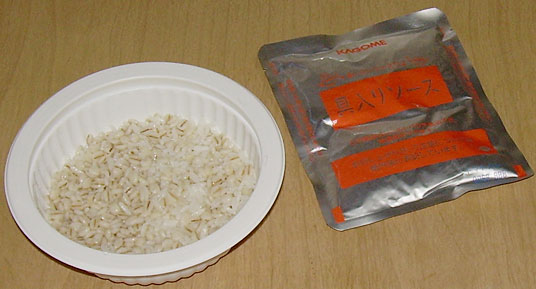
As part of my attempts to review instant or frozen food on occasion, I picked up these shelf stable "heat and eat" meals at Seiyu supermarket on sale for 198 yen ($2.16). There are several of these in a line by Kagome geared toward weight-conscious women. That's why the calorie information is displayed so prominently on the front of the boxes. These boast not only low calorie counts, but some added fiber through the use of a barley and rice mixture. I chose the "chicken doria" because I have a fond experience with that dish from a local restaurant, and the tomato curry because, well, it's curry.


Both of these dishes have a bowl with a bit under a cup of grain in the bottom and foil packets that contain sauces. The Doria has separate mixtures for white sauce and red sauce. In the end, you mix it all together anyway so I don't quite understand the point of the separation. I'm guessing it's for aesthetic reasons. The tomato curry had one large foil pack only.


Going into sampling these, I knew I would try them alone once, and then I would augment them with leftover chicken breast. These sorts of meals are not well-known for their high protein content. I started with the chicken doria which had microscopic bits of tomato, the odd rare crumb of carrot, and tiny little bits of chicken mince. The red sauce with chicken smells like tomato and not much else. the white sauce has a bit of a dog-food/canned food type of smell. It was not encouraging.

This didn't taste like not much of anything. There's some very mild tomato juice flavor and ever so vague hints of some sort of cheese. You have to strain to taste it though. In fact, I'd recommend invoking the power of imagination and hope that you can turn your desire for cheese taste into reality through the power of your mind. I couldn't taste chicken at all. It's also one of those prepared foods that has a lot of sodium, 350 mg., but you still need to add salt to it to taste anything.

The texture was rather gelatinous. You can tell the sauce is mainly made with cornstarch. While the rice is not bad at all and is relatively firm and decent, good pre-made rice is really not hard to come by in Japan.

This was palatable only because I added 90 grams of leftover chicken breast to it and the rice was fine with it. The sauce mainly added some moisture and texture. I was very disappointed in this and probably wouldn't have eaten it all if I hadn't already mixed the chicken in with it and had nothing else to really consume.

The Chicken Doria gets a well-deserved:


Spicy Tomato Curry (235 calories)

After my experience with the Chicken Doria, I had even lower expectations of this. I felt a bit more hopeful after I opened the sauce packet and smelled it. The aroma was about what one would expect of spicy curry and tomato. You can see how little I expect of these things when they end up smelling like they should and I'm pleasantly surprised.

The base component of this was similar to the chicken doria version. The plastic bowl has about three-quarters of a cup of rather dry rice and barley with a foil packet of sauce. After squeezing the sauce onto the rice mixture, I put it in the microwave with the lid on as instructed and the lid blew off about 1 minute and 15 seconds into the process. Curry bubbled up and splattered on the edges of the bowl before I could stop it.


I took it out and gave it a stir and noticed that it was very, very soupy. The rice seemed rather dry at first, but the texture improved after it sat for about 5 minutes. There are small blobs of soft tomato in the sauce, and no other detectable vegetables. I sampled it as is and it is not bad at all. It's nicely spicy in terms of warmth and intensity of tomato flavor. The curry flavors are rather muted, but it's really rather piquant. It's just a bit salty, but not in a too overbearing manner.


After a taste of the curry "as is", I added 85 grams (3 oz.) of leftover chopped, cooked chicken breast and stirred it in. Because there is a lot more sauce than necessary, this worked quite well. There was more than enough sauce to coat the chicken and the combination was very good. I didn't need to add salt to the bland chicken because the sauce is spicy enough to cover.

I actually liked this. If I were inclined to pick up a prepared meal to avoid preparing all of the components, I'd definitely buy this again. For this sort of food, this was pretty good and the low calorie count (235 calories alone, 372 with the added chicken) is appealing. It's not stellar, but it is tasty enough to be worthwhile, especially if you have no time to cook.

Tuesday, March 30, 2010

Bakauke 40-piece Sembei Assortment


In Japan, variety packs are called "asooto" (アソート) which is the Japanized version of "assortment". This Bakauke pack of 40 sembei in 5 flavors has been in my line of sight for some time. I resisted it because of the hassle associated with reviewing such packs (more pictures, more writing, same number of posts), but also because I think it'll take me a very long time to eat all of this myself and my husband doesn't eat sembei.

In the end though, the price and the fact that I could sample a lot of flavors that I've been considering purchasing individually made me take the plunge. I found this at a discount snack shop for 269 yen ($3.12). I'd also seen it for a somewhat higher price at Peacock supermarket, but it's not the sort of thing that tends to show up in just any old market. I think this would be a good thing to have on hand if you tend to have a lot of visitors to your home or have a family and can eat it quicker than the likes of me can consume 40 sembei.

Like all bakauke sembei, these come in a banana shape. The package doesn't offer nutrition information for each flavor, but I'd guess that they are similar to the other flavors I've reviewed and are about 20-35 calories each per cracker. My guess is the black sesame one is higher in calories than the other varieties.

Spicy Soy Sauce:


The strange thing about this soy sauce cracker is that it neither looks nor smells like the typical "shoyu" variety. It's not covered with a semi-sticky veneer of soy sauce. This does small very faintly of soy, but also vinegar. In fact, the predominant taste is a mild vinegar one, not a soy sauce flavor. This reminded me more of a very subdued version of the "Happy Turn 200%" sembei. That's not a bad thing at all, but I think this could have been a bit more intense in flavor. Nonetheless, this was perfectly enjoyable despite its lack of strong spice.

Black Sesame and Soy Sauce:


For some reason, this cracker is wrapped individually while the others come two to a pack. This is the most "fried" one and is bumpy and super crunchy. It smells lightly of sesame and of soy sauce. The exterior is very shiny and quite appealing to look at. These have a mixture of sweet and savory flavors including honey. All of the components come together well to present a multi-layered taste experience with all of the flavors complimenting each other well. I really enjoyed this.

Seaweed and Soy Sauce:


This was the flavor that I had the lowest expectations for because I'm not a huge fan of nori (seaweed). It's not that I can't eat it or find it gross. I can certainly consume it, but if I have a choice, I'd prefer not to have it included in foods that I eat. That being said, this is the sembei for those like me who are indifferent toward nori. The base soy flavor is deep, savory, and complex. The amount of small flakes of nori are enough to make the flavor present, but not overwhelming. The only bad point about this one is that the outside is a bit sticky so you need to eat it with the wrapper on or be prepared to wash your hands after touching it.

Spicy Curry:


This smells lightly of Japanese curry roux blocks, which is to say that the scent is somewhat different from actual curry powder and miles away from real Indian curry. The flavor is mild at first, but builds up a bit on your tongue by the end of a second cracker. There is no heat whatsoever in these and they're mildly salty. I get the sense that these were designed for people who have what is called a "cat's tongue" in Japanese. That is, they are sensitive to foods that are hot in a spicy way. While certainly a nice enough and completely enjoyable cracker, I have more of a "dragon's tongue" (I made that up, it's not Japanese) and would have liked some heat.

Cheese:


I'm going to be a bit lazy on this one and tell you that this is exactly the same as the Bakauke cheese sembei that I reviewed previously. There is no difference between what you get in the bag devoted to "5 cheese" sembei. This is a good thing because I gave those a "happy" rating and thought they were like a higher quality Cheeto cheese flavor.

This was a great value and full of high quality, flavorful, fresh, and crispy rice crackers. If you like sembei, or are going to buy some to send home to people who enjoy it, this is one of the best choices you can make. Despite my initial reservations about buying so much at once, I wouldn't hesitate to buy this assortment again, particularly if I wanted to serve some to guests or keep a stash on hand for late-night T.V. viewing accompaniment.

Tuesday, September 15, 2009

Kameda Seika Curry Sembei "Joy Pack"


How many failures does it take before one should give up on a good version of something coming along? Well, my previous experience with curry sembei was not great. The taste was good, but the texture ruined it. This time, I came across a variety from a company that has not let me down on the sembei front, Kameda Seika. I found this for about 140 yen (about $1.40) at a Family Mart convenience store and figured I'd go to the Japanese-Indian well in the hopes of drawing some sweet water this time. Besides, this is a "joy pack", so I was counting on truth in advertising.


There are 74 grams (2.6 oz.) of crackers in the bag. If you snarf down the whole thing, it's 370 calories. The crackers smell just like curry powder. Each cracker is about the size of a large potato chip. You can put a whole one in your mouth (or at least I can, and my mouth is pretty small). The flavor is a decent curry flavor, but much weaker than the cheaper Sanshin curry that I sampled previously. It was just a little hot toward the end, but definitely not for lovers of a really good burn. And, I love a good burn.

The crackers are fresh and crispy. They're "soft" sembei which means they're puffier inside and not brittle, but the flavor is somehow wrong. There's too much of a Japanese mixture in it. This could be something about the way the rice crackers are baked, or it could be the soy flavors that are added to it. I'm not sure, but I just wasn't thrilled with these. Don't get me wrong, they were fine and I'll easily finish the bag, but they just weren't good enough to justify having them again.

I'm pretty much giving up on curry sembei after these two tries. It's not that I don't think they can be done right, but just that I figure if Kameda Seika can't get it right, no one can.

Thursday, April 30, 2009

Sanshin Curry Sembei


Something about this packet of curry sembei rubbed me the wrong way when I saw it elegantly displayed in a cardboard box at the local 99 yen shop. I like curry, but the package put me off. I think that the cartoon of a turban-wearing man might be a part of it. It could be the fact that the graphic is a bit cheap-looking with the over-sized head and the tiny body. It could also be the bizarre disconnect between the relatively lifeless expression on the face and the "thumbs up" gesture, or it could simply be it all carries strong hints of politically incorrect packaging.


At any rate, my desire to give curry sembei a sampling overcame my apprehension. I do love curry and this bag claims 18 spices have been used to season these rice crackers. The packet is actually quite small at 45 grams (1.6oz.) so I won't be wasting much if they end up being a bust. The entire bag contains 204 calories and half a bag seems about right for snacking.

When I opened the bag, the very strong and familiar scent of curry powder wafted up to my nostrils. This was quite welcome as I prefer a strong flavoring over a weak one and these did not disappoint on that front. The flavor is rich, potent, and slightly hot at the finish. If I were judging these on the flavor alone, I'd be pretty satisfied.

Unfortunately, texture plays a huge role in things like sembei and these failed rather badly on that front. Sembei ought to be crisp and fresh, but these seemed like they had drawn a little damp. They are still a bit crispy, but also rather spongy. I don't know if this is an issue with how they are made or if they have absorbed moisture from the seasonings coating them as time has gone by. The expiration date on my bag was May 24, 2009 which is relatively soon by snack dating standards. The maker of these sembei, Sanshin, is a relatively small manufacturer that has been in business since 1972 and makes a small variety of crackers and chips. You'd think they'd have a method down for keeping them crispy, so I'm attributing the dampness to age and possibly just the curry flavoring in particular rather than the company's lackluster production methods on the whole.

I loved the intense curry flavor on these, and I will slowly finish the bag. However, I don't think I'd buy them again because of the texture issues and I can't recommend anyone else pick them up.