Wednesday, May 30, 2012

Random Picture #115


I don't know what cultural influences make me believe this sounds like a euphemism for a carnal act, but it isn't helped by these words on the bag:


Yes, I have a dirty mind. Shikuwasa, incidentally, is an Okinawan lime. However, if you'd like to think of it as another name for a carnal act, you can feel free to do so and join my demented club.

Tuesday, May 29, 2012

Pepsi Salty Watermelon (Product Announcement)

Image pinched from Pepsi's Japanese web site.

This is just a quick and brief post to say that the weird Pepsi flavor that everyone (no one?) has been waiting for is going to be "salty watermelon". This isn't a bad flavor choice actually, as watermelon and summer are inextricably linked and the Japanese do salt their melons. If you have sub-par watermelon which isn't sweet enough salting it a little will make it taste better. The same goes for apples. However, don't salt your fruit like you do your fries or you'll be filled with regret.

This flavor will be released on July 24, 2012 and will be in a 490 ml. bottle. This continues Pepsi's new trend of slicing 10 ml. from their drink bottles. Pepsi says that the graphic design featuring a big melon in front of the ocean is meant to bring to mind "the joy of summer". Given that Japan is going to endure another year of "setsuden" (energy conservation) as their energy woes from the nuclear problem in Fukushima continue, they'll need to extract all the fun they can while they cook in air conditioners set to 28 degrees C./82 degrees F.

Monday, May 28, 2012

Tokyo Sumida River Bean Cake


One of the things you get from being outside of a culture and looking in is a perspective on how things seem to be. You get an overview which is not possible when looking from the inside out. Of course, there is also that other perspective, the one people have from being outside and never being inside or only have been so for a short time. That's the one that you get quite often about Japan and Japanese food. People think that perusing the imports at the local store or checking out the catalog at J-Box or other importers gives them a pretty good idea of how Japanese people must snack. The truth is that I think they prefer snacks like the topic of this post (bean cakes) and rice crackers (sembei) to most of the types of things foreign folks fixate on. I think they care far less about the latest weird Pepsi or KitKat than about a wad of bean jam encased in bread or cake and find our fascination with such things peculiar. They know those things don't taste good and are little more than novelties, mere blips in the flavor continuum meant to gather attention with a flash and die away. 

Of course, my blog indicates that the interest level of foreigners in these types of snacks is pretty low. In a Venn diagram of Japanese snacks, there is not so much overlap between what piques Japanese interest in food and what gets my blog hits from those who have the patience to read my prattle. Trust me though when I say that you'll make any Japanese person happier with something from this type of snack than a box of chocolates unless they recognize the name as having a high price tag. Even then, they may not necessarily enjoy eating it as much, but they will definitely appreciate that you spent a wad of bills just to get something with the word "Godiva" emblazoned on it. As an aside, I've had the best luck giving Japanese people See's candy. They tend to like it a bit better because it's not as sweet as other American chocolates. My husband has been known to buy nearly 30 boxes of various sizes to give as gifts to students during visits back home. He had a lot of students, and they often gave him gifts and that was his way of returning the favor. 

Getting back to the subject at hand, my husband and I first encountered these bean cakes at a traditional sweets shop in Kichijoji, home of one of the more popular areas for cherry blossom viewing (Inokashira Park) and a very popular place for middle-aged shoppers. If you go to the Wikipedia page, keep in mind that the picture there is misleading. I didn't even see it look like that during Christmas when lights are often put up. At any rate, we bought this based on being given a sample by the shop attendants so we knew what we were getting. The interior is a slightly powdery, yet still moist, clump of very finely strained white beans sweetened with sugar and margarine. It doesn't have a strong taste, but mainly lends texture as it nearly melts on the tongue and offers sweetness. The outside is a slightly chewy, but also slightly crispy shell which is dusted with cinnamon. The combination of textures and flavors is sublime. 

These reminded us a bit of one of our other heavy favorites in the Japanese bean cake arena, Koganei Imo. The difference is that the cinnamon flavor is more pronounced in these and the interior is a little drier because these are shelf stable and mass produced. They are also greatly more accessible as they are sold at a variety of shops and you can only get Koganei Imo from one generational shop that hand prepares them in Ningyocho. There's a list of the shops that carry these bean cakes here, though if you can't read Japanese at all, you'll have to apply Google's translation to read the names. The shop chain that carries these is called "Chidoriya" and they have shops in department stores and various Japanese-style "malls". 

Before leaving Japan, my husband and I wanted to buy a big box of these to take with us. We returned to Kichijoji two days before leaving only to find that that branch of Chidoriya had disappeared. We decided to track some down in Kita-Senju and picked up a dozen to take back. The expiration date on the box was short, but the truth is that we still have them and are still eating them. They don't seem to lose all that much even though we've had them for about two months now. As you might guess, with something we enjoy this much, we're rationing them and trying to make them last by refrigerating them.

If you go to Japan for a tourist stint or live there, I would strongly recommend tracking these down. At the very least, you can get a sample taste before you buy to see if you like them as much as we do. And if you go and carry some back to the states, bring a box for me, too. I'm pretty sure ours won't hold out a whole lot longer. ;-)


Friday, May 25, 2012

Celestial Seasonings Authentic Green Tea


Several years ago, I had a conversation with one of my friends in California in which he told me that he preferred to drink green tea rather than other sorts of beverages. Though he has since moved on to the more manly choice of coffee (though he still puts milk in it like a little girl), he was happy at that point in time when I said I wanted to send him a teapot and some authentic green tea from Japan. While he liked the tea pot, he was puzzled by the bag of what appeared to be grass clippings that I sent him. The green tea that I experienced in Japan was nothing like what he was quaffing in America.

One of the ways in which the green tea he drank was different was that it wasn't really, truly green. This was a fact that he didn't relay to me until I'd sent him a bag of green tea leaves that was, well, very green. That's not to say that all of the green tea that is sold in America is not green, but just the variety he was having. However, when something sells its green tea as "authentic", I expect it to be like what I had in Japan. In the case of Celestial Seasonings Authentic Green Tea (with white tea for smooth taste)", that was not quite the case.

I guess part of the issue is that I'm not sure what makes anything "authentic". In my fevered imagination, I believe it means that it is like the original and in my bias toward Japan being the center of all things green tea, I thought that meant it should be like Japanese traditional tea. That is, it should be green and have a more than faint taste like chlorophyll. It turns out that, like many things in Japan (like "Japanese cheesecake", "Japanese bread", etc.), the origin of green tea and the truly authentic version is hardly like the Japanese one at all. Green tea originated in China and this may actually be more authentic than the green tea I had in Japan because it is akin to Chinese green tea.

I don't brew or serve my tea out of drinking glasses, but I don't have on of those cool-looking clear Captain Picard tea cups with the metal bands. ThinkGeek sells them, but I don't have one because I'm still a homeless person and have no place for cups.

When I brewed up a cup of this, I was surprised to see that it is closer to gold and that a bit of oil floats on top of it. The oils are more akin to what you sometimes see when brewing coffee. It also does not smell very grassy and it tastes a a bit like a blend of oolong tea and what I drank as green tea in Japan. It has a deeper, earthier taste rather than a profoundly grassy one. The truth is that, not being an ardent fan of Japanese green tea, I rather liked this better than what I had previously conceived of as "authentic" green tea. I liked it a lot more, and it has a cool dragon graphic on the front of the box as an added bonus.

You can get Celestial Seasonings teas at nearly any supermarket in the United States. I could actually buy them at markets in Tokyo as well, though the variety of flavors was limited and I never saw this green tea for sale there. I guess it would be just as confusing for the Japanese to buy this and see how it differed from their version of green tea as it was for me. If you can't find it anywhere else and want to try it, you can find it at Amazon. It's mellow and well-balanced and requires no sweetener or milk to make it enjoyable, though I'm guessing you could probably find bags of bulk oolong and green tea and mix up you own blend and it which would be similar and cheaper than this. However, I think they'd also taste a bit harsher and have a less spiffy graphic on the box. 


Wednesday, May 23, 2012

Random Picture #114


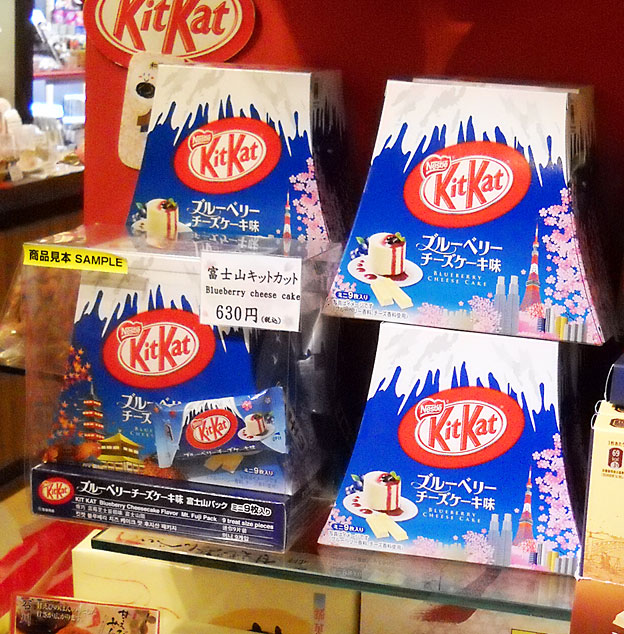
I'm pretty sure that I saw blueberry cheesecake KitKats were available in Japan in at least 4 different packages. I bought them as single stick bars quite some time ago and saw them as a regular bar with 4 fingers at one point. I also saw them in a conventional regional KitKat box. Just as I was leaving, I saw them on offer in these Mt. Fuji style boxes. The boxes are rather cute and very appealing from the viewpoint of being a souvenir from japan, but I wasn't too keen on the blueberry cheesecake KitKats when I tried them before and can't imagine these would be appreciably different. Still, I may have gone for them on "my way out the door" (leaving Japan).