Friday, February 28, 2014

Sumo Citrus Oranges (Dekopon)


I consider myself extremely fortunate in some regards as a blogger who used to live in Japan and now does not. One of the big ones is my unimaginable access to Japanese food from my current location. If I lived in my home town, well, let's just say there'd be nothing to write about or I'd have to rack up extremely hefty mail order bills by getting things from agencies that sell exported Japanese snacks.

Though I knew shelf stable items would always be possible, I didn't think fresh fruit and vegetables would. I was thrilled when I found "kabocha" (Japanese pumpkin) at local markets. In fact, I was shocked at just how often I could find it. After a few rounds of cooking with it, and noting that it was grown in Mexico, the excitement vanished. The kabocha that I tend to have access to tastes like a cross between a squash and a cantaloupe. There is something of a strange aftertaste to it. Clearly, a kabocha by any other name does not taste as sweet.

The lesson I learned was that it may walk like a Japanese duck, talk like a Japanese duck, but it doesn't taste like a Japanese duck... not that I have ever eaten a Japanese duck. My experience with the kabocha showed me that produce can be marketed as being like what I loved, but not actually taste like it. With that thought in mind, I approached the "Sumo Citrus" entity that is often marketed as "Japanese mandarins". What they are, ostensibly, is dekopon, a type of Japanese orange which is available in the winter and is sweeter and more flavorful than your average orange.


Finding Sumo Citrus is not easy. They have a limited number of stores carrying their produce. If you are going to try and track some down, I'd recommend calling the stores listed on their web site to make sure they have them first. And, I'm going to tip my hand and say that you are going to want to find them if you like oranges a little because they are fantastic. They are every bit as good if not better than the dekopon I bought in Japan.

The only down side to these oranges is that they aren't cheap. Whole Foods, which is where I got mine, is selling them for $3.99 a pound. One orange will cost you about $2. Though that is a pretty large orange, it is a splurge. At the very least, it is a healthy one.

Finding them at Whole Foods was more of a chore than I expected. We went in through one of the entrances and walked the length of the front of the store to the produce section. After casing the entire produce area, we had to ask someone where they were and they were in a display outside and in front of the other entrance. As we approached the display, a woman was picking one up and saying that they were really good, but expensive. We told her that we'd had them in Japan and that they were very, very good.

As my husband talked to her about our past experience, I picked out the ugliest, most pock-marked-looking and old-looking ones. My husband asked me why I was taking those ones and I told him that the worst looking ones were the sweetest. In Japan, it's common to pick them then allow them to age a bit so their natural sugars develop. So, if you decide to have these, don't go for the pretty ones. The ugliest one from our bag was nearly as sweet as candy.

These are seasonal and available in a limited area. I wish more growers were providing them, but Sumo Citrus is the only one I know and there is a risk that they won't produce many (or at all) next year due to the drought in California. Get some while you can, if you can. They're really worth it.


Thursday, February 27, 2014

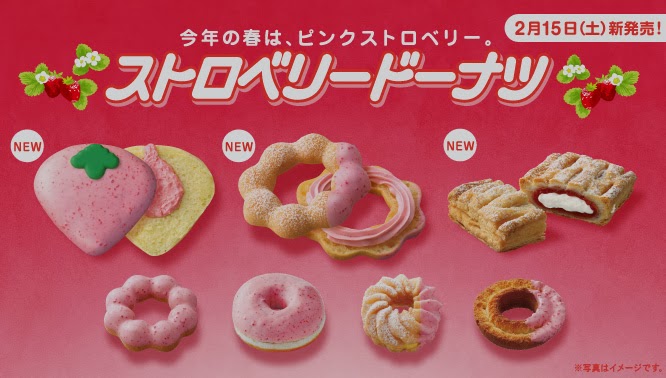
Mister Donut Strawberry Assortment and prize sponges (product information/promotion)

Images from Mister Donut Japan.

For spring, Mister Donut is releasing a host of strawberry-flavored donut options. Three of them are new (which you can tell by the little circles that say "new" in them). From left, top row: strawberry milk donut, strawberry milk pon de ring (a chewy donut made using rice flower), and strawberry whipped cream pie (made with strawberry jam). The prices range from 126 yen/$1.23 (the yeast-raised strawberry donut second from the left in the bottom row) to 168 yen/$1.64 (the strawberry milk donut). For the most part, they are variations on two single themes - one is a strawberry coating made with white chocolate and whipped cream either on its own or mixed with strawberry. The French crueller (second from right, bottom row) is filled with custard.


Those who live in Japan already know that Mister Donut has a point card system in which you get a stamp in a little booklet when you buy donuts. After collecting a certain number of points, you can get certain promotional items. Of interest at present is a Duskin sponge with the pon de lion or French crueller mascot on it. When I was in Japan, I often saw a variety of such rewards like little bags, bento boxes, and, most frequently, various dishes (cups, plates, bowls), but this is the first time I've seen dish sponges. You need 50 points to get these and, as a point of comparison, you can also get a free donut for 50 points or a free drink for 100 points. I think it says something about the Misdo customer base that they would offer cleaning products as a prize. It lets you know that they are overwhelmingly female.

Wednesday, February 26, 2014

Random Picture #203


David Letterman used to do a line repeatedly in which he'd say, "does this look infected to you?" While looking at these cakes, I'm thinking they look a little infected to me, or possibly "infested". Those little black things are beans, not bugs or spots of mold. The cakes are "mushi" or steam cakes. They're actually a sponge cake that isn't especially sweet, but tend to be fairly fatty. They're usually quite fluffy and, though the texture is light, some of them are rather weighty. In fact, as I've mentioned in other posts, misunderstanding how caloric these babies can be helped add some weight to me in my early years in Japan. 

These are quite popular and I think they are one of the older sweets. My guess is they were borrowed cuisine from China. I've mentioned before that Japan got its baking culture largely from Europe. These steam cakes are not made in an oven, but usually on the stove top. That would explain their long history and the nostalgic popularity of them. If you'd like to try your hand at making your own (sans bizarre-looking beans), there's a recipe here.

Tuesday, February 25, 2014

KFC's Colonel Pokota (game)


This isn't about a particular food or item from KFC Japan, but rather about a promotional item. I think there are a lot of absolutely adorable mascots in Japan. In fact, I think they have more cute cartoon mascots per capita than any country in the world (likely any civilization in the universe - there's no chance an alien culture has more). That being said, this thing is a creepy hybird of Colonel Saunders and a bunny. When I look at it, it's hard not to think of some sort of unnatural coupling that produced a result that is horribly wrong. It actually reminds me a bit of the ugly Nova usagi (which I always called the "beak bunny" because of its weird yellow nose) that was extremely popular. I guess rabbits are something that artist struggle to anthropomorphize.

At any rate, the point of this post is not to talk about the abomination, but the fact that it is used in a game that KFC is making available for free to promote its greasy poultry products. I have not downloaded the game, but their web site says you can "summon" this monstrosity by tapping on something called "friend's power". I don't know what happens once it arrives in your game, but you might want to have a can of pepper spray on hand.

Those who want to give it a go can get it from Apple's app store or Google Play. If you can't understand Japanese, you can enable automatic translation of the pages in your browser (at least you can in Chrome) and bumble your way through in broken English.

Monday, February 24, 2014

Eiwa Blueberry Marshmallows


I once read a little blurb in an article about a woman who had a conversation with her grandmother about food in her childhood. She said that her grandmother loved sugar cane. She said that she had a stalk of it that she kept under her pillow and would savor over time when she was a child. Her granny spoke of it as if it were the most magical and sublime food experience that she ever had. The granddaughter was so impressed by what her grandmother said about how good sugar cane was that she obtained some to try. When she got it, she found that it tasted like sugar. It wasn't the most fantastic food experience ever. It just tasted like sugar.

I remembered this story because I think about old-fashioned vs. modern sweets sometimes. I think that things like marshmallows are not as popular because they entered our food culture at a point in time when the types of sweets that we now have access to either did not exist at all (because of a lack of diverse ingredients on hand) or were not mass produced due to cost issues. How can the lowly, simple marshmallow compete with the fatty, sugary, salty, greasy complexity of a peanut butter cup?

I'm an enormous fan of all things marshmallow, but the truth is that, even I don't crave them all of the time. Since returning to the U.S., I've had more marshmallows because there is a plethora of varieties compared to Japan. I'm not only talking about the short-lived joys of a fresh, sugar-coated Peep (once they're stale, then the rainbow has gone away), but also the unique flavor offerings that come out seasonally like gingerbread or pumpkin spice marshmallows. From my childhood, incidentally, my favorite candy was Mallow Cups and I only recently came across and sampled the joys of Vallomilk. Both are pleasures I've revisited on a few occasions since coming home.

In Japan, I didn't really care for the texture and the funky aftertaste of Japanese marshmallows, so I tended to just avoid them, but I decided that it was time to give them a better chance. I was convinced both by the flavor combination of blueberry and marshmallow and the price. I found these on sale for under a dollar (100 yen) at one of the Japanese markets in our area (Marukai, I believe).


A whiff inside the bag when opened reveals the scent of fake blueberry. The marshmallows are small and soft. They are a little chewier than an American marshmallow, but less sticky. If you try to pull them apart with your fingers, they're tougher than what I'm used to.

The marshmallows themselves are overwhelmed by the blueberry jam flavoring. I don't think they're incredibly sweet on their own, but the jam inside is quite concentrated both in terms of flavor potency and added sweetness. I'd prefer a bit more mashmallow in the mix to try and offeset the nearly cloying nature of the blueberry filling.

The ingredients list starts with "corn syrup" followed by "sugar" so the sweetness is not surprising. Other ingredients include dextrose, water, gelatin, corn starch, sorbitol, concentrated blueberry juice, pectin, and citric acid. The coloring comes from beet root. As I've mentioned on my other blog, the Japanese rarely, at least in my experience, use artificial colors.

Because these are so sweet, it's no surprise that the manufacturer recommends as a serving suggestion that you pour plain yogurt over them and wait 4-5 hours. I tried this "recipe" twice. The first time, I waited about 4 hours, but it just seemed like blobs of chewy marshmallow covered with a yogurt topping. I had hoped that the moisture of the yogurt would break down the marshmallows a bit and create a different texture. I found that leaving them overnight accomplished this and it was actually quite good. It still tasted like there was candy in my yogurt but the textural blend was more enjoyable.

Frankly, I'm a bit on the fence about these. I liked them fine, but I can't see craving them or wanting to have them again. My criteria for an "indifferent" rating is that I don't mind having them, but am very unlikely to buy the same thing once more. I could see sampling another flavor, but I think one small bag of blueberry was enough.